

A Sad Family Situation (2 Samuel 14:25-33)

David and Absalom, by Marc Chagall, 1956

In all Israel there was not a man so highly praised for his handsome appearance as Absalom. From the top of his head to the sole of his foot there was no blemish in him. Whenever he cut the hair of his head—he used to cut his hair once a year because it became too heavy for him—he would weigh it, and its weight was two hundred shekels by the royal standard.

Three sons and a daughter were born to Absalom. His daughter’s name was Tamar, and she became a beautiful woman.

Absalom lived two years in Jerusalem without seeing the king’s face. Then Absalom sent for Joab in order to send him to the king, but Joab refused to come to him. So he sent a second time, but he refused to come. Then he said to his servants, “Look, Joab’s field is next to mine, and he has barley there. Go and set it on fire.” So Absalom’s servants set the field on fire.

Then Joab did go to Absalom’s house, and he said to him, “Why have your servants set my field on fire?”

Absalom said to Joab, “Look, I sent word to you and said, ‘Come here so I can send you to the king to ask, “Why have I come from Geshur? It would be better for me if I were still there!”’ Now then, I want to see the king’s face, and if I am guilty of anything, let him put me to death.”

So Joab went to the king and told him this. Then the king summoned Absalom, and he came in and bowed down with his face to the ground before the king. And the king kissed Absalom. (New International Version)

Parents are people, and so, they don’t always make sense. David was both a king and a parent. And those two roles often got mixed and complicated for him.

David’s son Abasalom had killed another son, Amnon, who had sexually assaulted a daughter, Tamar, Abasalom’s sister. Yes, it sounds a lot like a Bible soap opera.

Joab, David’s military general (and cousin) convinces the king to bring Absalom back to Jerusalem, having fled Jerusalem after killing Amnon. And David did so. Yet, he gave an order that Absalom was not to come into his presence, even though David longed for his son.

It was a case of the nonsensical – the parental approach of yearning for an adult child, while at the same time, shunning and shaming them. Indeed, these were incongruent actions on the part of David.

When Tamar was assaulted, David found out and was very angry; yet he neither dealt with Tamar by giving her support and compassion, nor dealt with Amnon in meting out justice.

As for Absalom, David’s feelings for him did not translate into action. It appears the story wants us to see the wide gap between King David’s emotions and actions.

Perhaps the emphasis on Absalom’s sheer beauty is designed to emphasize the incongruence of David – this handsome man is put at arm’s length by his father. Furthermore, this behavior would eventually put David’s royal position in jeopardy.

When guilt and shame are not confronted, it leads to a downward spiral into continued levels of degradation.

The assault of Tamar led to the murder of Amnon, which led to the inactions of David. Everyone ended up responding to someone else’s guilt by adding their own guilt to it. In this scenario, everyone loses something, and there is a lot of unnecessary grief.

Abasalom returned to his hometown of Jerusalem. But everything had changed. He was simply existing. Honestly, Absalom needed something, anything, instead of living day after day in a house without any love or acceptance. Absalom was in that awkward place of wanting either mercy or judgment, acceptance or punishment, because to live in limbo was shrinking him to nothing.

For those who know the story of David and Absalom, you understand where all of this family dysfunction is leading; and it will not end well.

It could be that Jesus had this story in the back of his head when he told the parable of the prodigal son (Luke 15). Perhaps Christ wanted us to see what could happen when a father chooses to respond with actions of grace, acceptance, and undeserved kindness. Even though the son had done something awful and was full of guilt, when he finally made his way home, the father ran to him, embraced him, and accepted him with a blowout party.

We can only wonder what would have happened had David stepped into the situations of his children’s lives when they were going awry. Methinks that had David done so, with his characteristic wisdom and mercy, there would have been a very different outcome in his family.

One way of viewing this story is that the incongruence of King David toward Absalom, with his combination of longing and rejection, was a stubborn passive-aggressive refusal to give his son the grace and love which God had given to him. In light of the story’s eventual end, this view makes a lot of sense.

Yet, this doesn’t have to be the same for you or me in our family relationships today. We can choose to love, instead of inflexibly holding on to a denial of love. One can do all the mental gymnastics of justifying that denial by believing you’re teaching the kid a lesson, or giving them what they deserve, but it’s really, at it’s core, choosing not to love with the love provided by God.

Réconciliation d’Absalom et de David, by Gabriel de Saint-Aubin, 1752

Absalom eventually entered David’s throne room and received a kiss. But it was simply too little, too late. And that’s why, at some point after this, Absalom decided to replace his emotionally and actively distant father as king.

If guilt, shame, evil, and sin go unchecked for too long, it makes for a terrible mess of people’s lives; and usually results in either verbal violence, physical violence, or both.

But it doesn’t have to be that way….

For being quick to see the sins of others, and slow to repent of our own, forgive us, Lord.

For clinging to remembered hurts, and brushing off gestures of kindness, forgive us, Lord.

For the divisions among us that damage our mission to the world, forgive us, Lord.

For the work we have not done because we refused to do it together, forgive us, Lord.

For these and all our sins, O God, we weep in sorrow and ask for your forgiveness, through Jesus Christ our Lord. Amen.

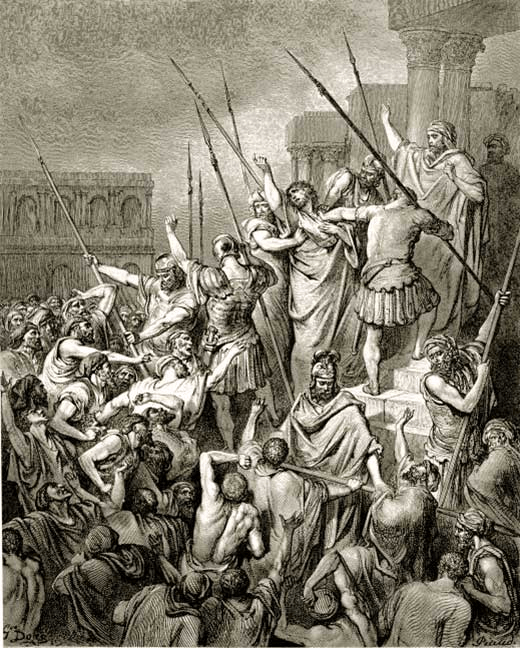
Yet Another Conflict (Acts 21:27-39)

Apostle Paul in Jerusalem, by Gustave Doré, 1878

When the seven days were nearly over, some Jews from the province of Asia saw Paul at the temple. They stirred up the whole crowd and seized him, shouting, “Fellow Israelites, help us! This is the man who teaches everyone everywhere against our people and our law and this place. And besides, he has brought Greeks into the temple and defiled this holy place.” (They had previously seen Trophimus the Ephesian in the city with Paul and assumed that Paul had brought him into the temple.)

The whole city was aroused, and the people came running from all directions. Seizing Paul, they dragged him from the temple, and immediately the gates were shut. While they were trying to kill him, news reached the commander of the Roman troops that the whole city of Jerusalem was in an uproar. He at once took some officers and soldiers and ran down to the crowd. When the rioters saw the commander and his soldiers, they stopped beating Paul.

The commander came up and arrested him and ordered him to be bound with two chains. Then he asked who he was and what he had done. Some in the crowd shouted one thing and some another, and since the commander could not get at the truth because of the uproar, he ordered that Paul be taken into the barracks. When Paul reached the steps, the violence of the mob was so great he had to be carried by the soldiers. The crowd that followed kept shouting, “Get rid of him!”

As the soldiers were about to take Paul into the barracks, he asked the commander, “May I say something to you?”

“Do you speak Greek?” he replied. “Aren’t you the Egyptian who started a revolt and led four thousand terrorists out into the wilderness some time ago?”

Paul answered, “I am a Jew, from Tarsus in Cilicia, a citizen of no ordinary city. Please let me speak to the people.” (New International Version)

The Apostle Paul arrived in Jerusalem, after a sojourn in Greece and the province of Asia. He had been gathering a collection for the believers in need. In his journey, Paul received messages, warnings, and even prophecy that he would be arrested if he went to Jerusalem.

Since the prophecy did not tell Paul to stay away, he kept going, ready not only to be arrested but to also die for his faith, if need be. (Acts 21:10-14)

Iron handcuffs (chains) from the Roman Empire, Archaeological Museum in Durrës, Albania

The first week of being Jerusalem entailed the status quo for Paul: He dealt with yet another church conflict between Jews and Gentiles. Then, the prophecy began to unfold and become reality.

Jews from Asia, who had seen Paul in the Temple and recognized him as a Christian agitator, immediately jumped to the conclusion that Paul was up to no good. It appeared to them that Paul had taken a Gentile into the Temple, thus defiling it, which in fact, he had not.

But when you have a grudge against someone, and an axe to grind, you begin making mental correlations and causations that aren’t really there.

So, the Jews from Asia got the crowd all stirred up by judging Paul as a person who teaches everyone everywhere against the people, the law, and the Temple. In other words, they accused Paul of being anti-Semitic and fomenting violence against the Jews.

Ironically, however, that is just what the Asian Jews did themselves. Without just evidence, they evoked the crowd’s emotions enough to drag Paul from the Temple. And they weren’t inviting him to tea. It seems they had every intention of doing him in, and not by throwing sugar cubes at him.

The only thing that stopped a death that day was the Roman authority getting in between Paul and the crowd. As per the prophecy, Paul was arrested and bound with chains.

The crowd had turned so riotous that the Roman commander could not ascertain Paul’s identity. The mob became violent, so Paul was whisked away by the Roman soldiers. As he left, the shouts of “Away with him!” could be heard throughout the city.

Jesus had a similar experience, but went to his death without any opportunity for a defense speech before an angry crowd.

Paul requested, however, to address the mob. And the Roman commander was aghast to learn that Paul spoke Greek – supposing that he was just another annoying religious nut on the street corner who got up into everyone’s grill a bit too much.

Yet, the commander quickly discovered that he was dealing with a citizen of the Empire who was no kooky preacher. Here we see a turn of events and a flip-flop between two groups of people.

It’s the Roman army who upheld proper justice and protected the interests of the individual; whereas the Jewish crowd became vigilante, ironically violating their own law by trying to put an innocent person to death without justification.

In a twist of history, the Roman arrest of Paul was his deliverance from a Jewish mob. Go figure.

Today’s story opens for me a set of questions that are both genuine, as well as a bit rhetorical:

  • How often do we – as both individuals and churches – accuse others of being unfaithful and/or unbiblical, when it is we ourselves who are going rogue from Holy Scripture?
  • In what ways do we handle false charges, judgmentalism, and unjustified criticism from others who misunderstand and/or misinterpret us?
  • What do we do (and not do) whenever there are differences within the church, family, community, workplace, or nation?
  • Does our manner of approaching conflict include the verbal violence of gossip and slander and/or actual physical violence through passive-aggressive behavior?
  • Am I looking too closely and/or critically under the hood of your soul? What will you do with me, let alone Jesus?

If you can receive this, I recommend taking some time and space today for answering those questions honestly through writing them in a journal and/or talking about them with a trusted friend.

May God have mercy upon our human institutions, societies, and relationships. To God be the glory. Amen.

This Is No Time for Bitterness (2 Samuel 3:31-38)

David at the tomb of Abner, by Unknown Artist, 1850

Then David said to Joab and all the people with him, “Tear your clothes and put on sackcloth and walk in mourning in front of Abner.” King David himself walked behind the bier. They buried Abner in Hebron, and the king wept aloud at Abner’s tomb. All the people wept also.

The king sang this lament for Abner:

“Should Abner have died as the lawless die?
    Your hands were not bound,
    your feet were not fettered.
You fell as one falls before the wicked.”

And all the people wept over him again.

Then they all came and urged David to eat something while it was still day; but David took an oath, saying, “May God deal with me, be it ever so severely, if I taste bread or anything else before the sun sets!”

All the people took note and were pleased; indeed, everything the king did pleased them. So on that day all the people there and all Israel knew that the king had no part in the murder of Abner son of Ner.

Then the king said to his men, “Do you not realize that a commander and a great man has fallen in Israel this day? (New International Version)

To put it succinctly, Abner was a rascal. He was smart and savvy, as well as self-centered and treacherous. Abner was the general of Israel’s armies. In his shrewdness, Abner knew that King David of Judah would eventually win out.

So, he set things up to sell-out his position with Ish-Bosheth, the king of Israel, and bring all of Israel and Judah together as one people. Then, he would be the general in a united kingdom under David.

However, Abner had burned some bridges in his day, and created some enemies. Joab was one of them, David’s general. What’s more, Joab was loyal to King David and did not have intentions like those of Abner. All of this (and more) stirred within Joab, as Abner and David talked through a transition plan.

Joab was a bitter man. He and his brother Abishai did not like their king consorting with Abner. Abner had killed their brother Asahel in the battle at Gibeon. Bitterness turned Joab into a myopic person who could only see his own perspective. So he and his brother murdered Abner without David’s knowledge. Abner was a stinker in a lot of ways. But he didn’t go around murdering people, and he himself didn’t deserve to be murdered.

When David found out, he chose not to channel his anger into another murder. Instead, he wisely focused on grieving the loss of Abner and demonstrating to all Israel and Judah what sort of king he really was.

“Many people suffer because of the false supposition on which they have based their lives. That supposition is that there should be no fear or loneliness, no confusion or doubt. But these sufferings can only be dealt with creatively when they are understood as wounds integral to our human condition.” Henri Nouwen

Far too many people allow their spiritual and emotional wounds to fester – eventually poisoning their own character. With the illness of bitterness, someone is always bound to get hurt.

We all have to contend with adverse situations and hard circumstances. Our doubts, wonderings, hurts, and suffering may be legitimate, yet if addressed in an illegitimate way, those things become emotional wounds that seek to wound others.

Make every effort to live in peace with everyone and to be holy; without holiness no one will see the Lord. See to it that no one falls short of the grace of God and that no bitter root grows up to cause trouble and defile many. (Hebrews 12:14-15, NIV)

David had no picnic for a life. Saul had tried to repeatedly kill him, hunting David down like an animal. After Saul was killed in battle, there were all sorts of shenanigans going on with people like Abner and Joab. This was no idyllic setting for David to set up a kingdom.

And yet, David made it work by not succumbing to the bitterness which was so easy for others. King David did something different. He seemed to understand that his own woundedness, sufferings, and doubt was the place for personal and spiritual growth – a way of connecting with God.

The hurts which David acquired in his life never became a source of shame to him. Instead, those things became a source of healing – which made him a wounded healer who was able to rule Israel and Judah with mercy, wisdom, and justice.

For us, the same thing can happen. All of the stuff we’ve been through, from people who intended harm for us, doesn’t have to end with being poisoned by bitterness. Our actual woundedness can become the place where we bless the world.

Indeed, ‘tis our weaknesses which give us our true strength.

Bitterness, on the other hand, may fuel some anger and give us a false sense of strength; but it’s only really a matter of time until we implode. And before that happens, the bitter person will likely take down others with the inevitable spit of poison which is vomited up from the pit of their serpentine belly.

We are, like David, to take a different path in dealing with the troubles brought upon us by others:

And do not grieve the Holy Spirit of God, with whom you were sealed for the day of redemption. Get rid of all bitterness, rage and anger, brawling and slander, along with every form of malice. Be kind and compassionate to one another, forgiving each other, just as in Christ God forgave you. (Ephesians 4:30-32, NIV)

The road to a better life is full of twists and turns, and fraught with severe potholes and downed trees. But the road to a bitter life is quite easy, straight and paved perfectly smooth with asphalt. The problem is that it is a one way highway to the cemetery.

The clock is ticking, and it’s no time for bitterness. Which road will you take?

Blessed God and Father of our Lord Jesus Christ, please don’t let our appropriate anger morph into destructive revenge. Don’t let our raw hurts become a festering and putrid abscess of the soul, which is bent on getting even—repaying harm for harm, evil for evil, and death for death.

Holy Spirit, our Companion and Counselor, don’t let our hearts become gardens for the roots of resentment, growing into bushes of bitterness. Give us, instead, the desire to forgive others. May redemption and restoration have their way in us, through Christ our Lord. Amen. 

Dealing with Another’s Evil Intentions (1 Samuel 19:18-24)

David and Saul, by He Qi

When David had fled and made his escape, he went to Samuel at Ramah and told him all that Saul had done to him. Then he and Samuel went to Naioth and stayed there. 

Word came to Saul: “David is in Naioth at Ramah;” so he sent men to capture him. But when they saw a group of prophets prophesying, with Samuel standing there as their leader, the Spirit of God came on Saul’s men, and they also prophesied. 

Saul was told about it, and he sent more men, and they prophesied too. Saul sent men a third time, and they also prophesied. Finally, he himself left for Ramah and went to the great cistern at Seku. And he asked, “Where are Samuel and David?”

“Over in Naioth at Ramah,” they said.

So Saul went to Naioth at Ramah. But the Spirit of God came even on him, and he walked along prophesying until he came to Naioth. He stripped off his garments, and he too prophesied in Samuel’s presence. He lay naked all that day and all that night. This is why people say, “Is Saul also among the prophets?” (New International Version)

King Saul was in the middle of a personal downward spiral of evil. And David was his target. Even though David served Israel and the king with distinction and bravery, his success aroused the jealousy of Saul.

It came to the point that David needed to flee for his life because Saul saw him as a threat and was out to kill him. Instead of trying to go it alone, feeling angry and defeated, David went to the one person he knew was wise, discerning, and could help: Samuel, the priest and prophet of Israel.

David was not looking to kill Saul, as Saul was trying to kill him. He just needed someone to talk to, some empathy and solid help in this very unwanted and awful situation.

As we move through the biblical narratives which tell of Saul and David, we will observe that God is with David and helps him through his travails; but God is not with Saul, who is continually haunted with a bad spirit whenever he descends into the dark path of jealousy, anger, even murder.

It is only human to wonder why people of faith, with good and genuine hearts, must contend with such self-absorbed narcissistic people like Saul. We can only answer it in part: the presence of evil in the world; the place of trials and tribulations in the believer’s life, etc. For the most part, it is a mystery for which we shall not have answers, this side of heaven.

But what we do know is that God is concerned for the godly, for those who seek to do right, have pure hearts, and think of the common good of all the people. And the Lord can deal with evil, while protecting the good, in quite unexpected ways.

We expect prophets to prophesy. We don’t expect anyone else to necessarily do so. Yet, in this story, we see God sending the spirit of prophetic speech not just upon the prophets and the good folk, but upon those who have ill intentions toward the godly ones.

Yes, the Lord sent a spirit upon people who were trying to kill David, and then even upon Saul himself; not to illumine, but to prevent. The power of prophecy in this instance was not a sign of being chosen by God, but a clear sign from God of rejection.

In stripping off his clothes and laying naked in prophetic utterance, Saul was being humbled, abased, and mortified. Decades later, King David would do so willingly as a repentant person. But here, King Saul does so unwillingly, as an unrepentant person who needs to let himself be among the penitent persons. But, alas, Saul did not do so, and was continually moved by other forces other than the Lord.

For the believer who is in the throes of a gaslighting boss, or a narcissistic leader, or a self-centered relative, today’s story is an encouragement: God’s will on this earth shall prevail; and the Lord will take care of those who desire to live a just, right, and good life.

Conflict and trouble must not necessarily result in one’s devastation and discouragement.

Whenever we find ourselves in the crosshairs of an evil person, we do not need to add to the madness with harsh and divisive words.

Instead, we can be sober-minded and good-hearted by handling the adverse situation with gentle words and a wise spirit. We can face the trouble, without wishing it away, by going to a wise person for counsel and help, if need be.

The mark of a truly good person is not whether they have conflict in their life, or not, but by how they handle the trouble when it comes. And as for the troublemakers and chaotic people themselves, the Lord knows how to deal with them.

You may be in an unwanted situation, dealing with a difficult person. Please don’t let that person steal your personal integrity and happiness from you. The one thing you can always control – that nobody can ever take away from you – is your own attitude and ability to respond.

“Everything can be taken from a man but one thing: the last of the human freedoms—to choose one’s attitude in any given set of circumstances, to choose one’s own way.”

Viktor Frankl, Man’s Search for Meaning

You and I really can deal with this. If the hurt was unintentional, then forgive and let it go. If the hurt was intentional, we need not be judge, jury, and/or executioner. That’s God’s job, not ours. Rather, we can choose to forgive and not hold onto bitterness; talk with a wise person to receive wise counsel, and not spread anger and slander; and determine to be joyful and godly, not sullen and irritable.

O Lord God almighty, listen to the prayer of the righteous! Direct the way of your servants in safety under your gracious divine protection, so that through all of the changes of our earthly pilgrimage, we may be guarded by your mighty help and power. Amen.