1 Samuel 15:10-31 – Rationalizing Disobedience

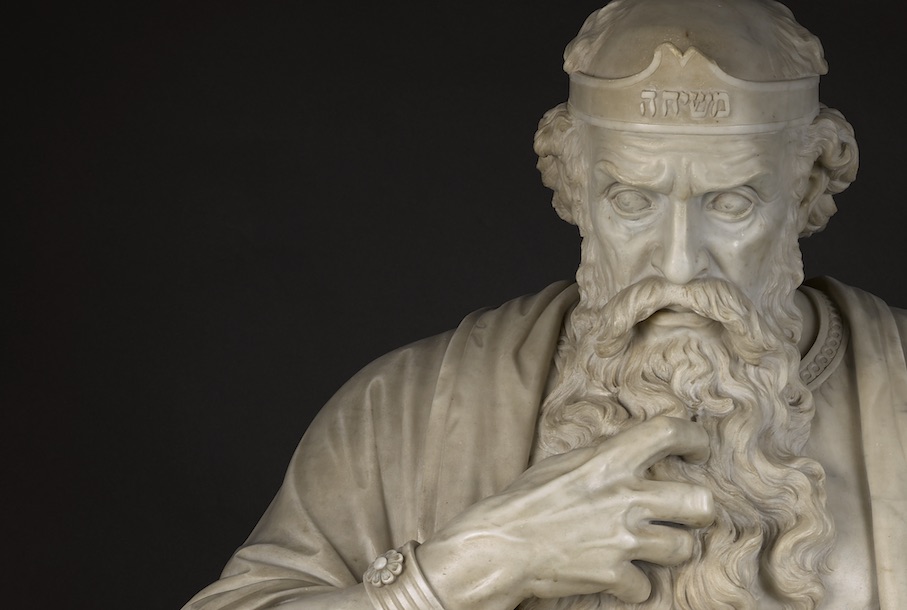
King Saul by William Wetmore Story (1819-1895) at the North Carolina Museum of Art

Then the word of the Lord came to Samuel: “I regret that I have made Saul king, because he has turned away from me and has not carried out my instructions.” Samuel was angry, and he cried out to the Lord all that night.

Early in the morning Samuel got up and went to meet Saul, but he was told, “Saul has gone to Carmel. There he has set up a monument in his own honor and has turned and gone on down to Gilgal.”

When Samuel reached him, Saul said, “The Lord bless you! I have carried out the Lord’s instructions.”

But Samuel said, “What then is this bleating of sheep in my ears? What is this lowing of cattle that I hear?”

Saul answered, “The soldiers brought them from the Amalekites; they spared the best of the sheep and cattle to sacrifice to the Lord your God, but we totally destroyed the rest. “Enough!” Samuel said to Saul. “Let me tell you what the Lord said to me last night.”

“Tell me,” Saul replied.

Samuel said, “Although you were once small in your own eyes, did you not become the head of the tribes of Israel? The Lord anointed you king over Israel. And he sent you on a mission, saying, ‘Go and completely destroy those wicked people, the Amalekites; wage war against them until you have wiped them out.’ Why did you not obey the Lord? Why did you pounce on the plunder and do evil in the eyes of the Lord?”

“But I did obey the Lord,” Saul said. “I went on the mission the Lord assigned me. I destroyed the Amalekites and brought back Agag their king. The soldiers took sheep and cattle from the plunder, the best of what was devoted to God, to sacrifice them to the Lord your God at Gilgal.”

But Samuel replied:

“Does the Lord delight in burnt offerings and sacrifices
    as much as in obeying the Lord?
To obey is better than sacrifice,
    and to heed is better than the fat of rams.
For rebellion is like the sin of divination,
    and arrogance like the evil of idolatry.
Because you have rejected the word of the Lord,
    he has rejected you as king.”

Then Saul said to Samuel, “I have sinned. I violated the Lord’s command and your instructions. I was afraid of the men and so I gave in to them. Now I beg you, forgive my sin and come back with me, so that I may worship the Lord.”

But Samuel said to him, “I will not go back with you. You have rejected the word of the Lord, and the Lord has rejected you as king over Israel!”

As Samuel turned to leave, Saul caught hold of the hem of his robe, and it tore. Samuel said to him, “The Lord has torn the kingdom of Israel from you today and has given it to one of your neighbors—to one better than you. He who is the Glory of Israel does not lie or change his mind; for he is not a human being, that he should change his mind.”

Saul replied, “I have sinned. But please honor me before the elders of my people and before Israel; come back with me, so that I may worship the Lord your God.” So, Samuel went back with Saul, and Saul worshiped the Lord. (NIV)

“You cannot compensate by sacrifice what you lose through disobedience.”

edwin louis cole

God had given Saul explicit instructions on how to handle a group of people called the Amalekites (the first nation to attack the Jewish people after the Exodus from Egypt, and viewed as the archetypal enemy of the Jews). Saul obeyed only some of the instructions, but not all of them. King Saul rationalized his behavior as worship. But God would have none of it. The Lord rejected Saul as king. God wants no monkey business when it comes to obedience.

Whenever I come across biblical characters like Saul, I find myself trying to distance from them. Yet, oftentimes, when I take the time to sit a bit with the Scriptures, I realize I can have some of the same propensities as their behavior. In today’s Old Testament lesson, I am like Saul whenever:

  • I say I will do something and then get busy and not do it. I sometimes rationalize my lack of follow through by explaining what good things I was doing with my time instead.
  • I justify a purchase of something I do not really need but want with the excuse that I put a lot of money in the offering plate for God.
  • I slander another person, even though it is forbidden by God, with the knucklehead notion that I am protecting and helping others from that person’s evil ways.
  • I keep quiet in the face of a bad situation when I should be speaking up. I dismiss the lack of engagement and involvement with needing to save my energy for people who want it….

I could have kept going with this little exercise, but I got too convicted to keep thinking about it anymore. So, before we get too uppity about saying we are not like Saul and would never be like him, perhaps we ought to sit with the story for a while, being mindful and aware of any unacknowledged disobedience.

Rationalization is the way of sinners.  Repentance is the path of saints.  Which road will you choose today?

Holy God, you expect obedience to clear instructions.  I am sorry for all those times I found creative ways to circumvent your teaching.  Help me not to avoid your good commands, but to own them with vigor and vitality through Jesus Christ my Lord in the power of your Holy Spirit.  Amen.

Matthew 25:14-30 – The Parable of the Talents

Welcome, friends. Although we are socially distanced, let us be spiritually connected through our worldwide communion with all the saints. Click the video below and, by God’s grace, we will be linked with the blessing of Christ…

The following is an animated take on Christ’s parable of the talents…

Jesus’ Parable of the Talents. Completed 2012 from http://www.max7.org.

And consider this song as we consider our own gifts…

We All Have Gifts to Share by Susan Kay Wyatts

May each of you use whatever gift you have received to serve others, as faithful stewards of God’s grace in its various forms.

The Parable of the Talents

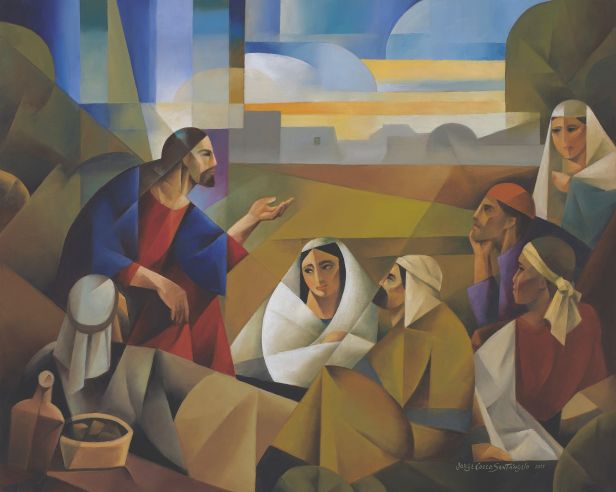
The Parables of Jesus by Argentine artist Jorge Cocco Santiago, 2018

What would you do with a million dollars?…  Maybe you would pay off some debts, finish some work on your house, or quit your job and take a vacation. Perhaps you might invest a good portion of it. However, your investment is only as good as your level of trust.   

When I worked at a senior citizen healthcare facility, there was a resident with an apartment in independent living, but he still owned his house. During one conversation, the old man admitted to me that over the past sixty years he owned his house, he had secretly bored holes in every door jamb of the house and had stuffed away $100,000 dollars in cash!  This dear resident had personally experienced the run on banks which began the Great Depression in 1929. He had zero trust for investment banking. 

A “talent” in Christ’s day was a monetary denomination.  A talent was worth 6,000 denarii, and one denarius was worth a day’s wage.  So, in Christ’s parable of the talents, Jesus was talking about millions of dollars (in today’s money) with the master who gave his servants five talents, two talents, and one talent. (Matthew 25:14-30) 

As Jesus was telling his parable, one of his chief points was to communicate that God is gracious and generous.  The three servants responded their master’s generosity according to their view of him.  Two of the servants regarded the master as gracious and generous, and so, freely took their talents and confidently invested them to create even more money.   

The two faithful servants took risks and acted with the idea that they were secure in their relationship with their master.  However, the third servant’s perception of his master was different.  This servant discerned his master as stern, serious, and angry, so therefore, he did nothing with his talent – he was afraid. 

The man was fearful because his view of the master was off.  If we consider God as primarily an angry Being, then we will almost certainly not use the gifts he has given us, for fear of messing up and experiencing his wrath.   

However, the truth is, God is gracious and generous.  The Lord has mercifully gifted everyone and expects us to use those gifts and not hide them away in a door jamb!  God wants us to actively display grace and generosity – which will require addressing our fears. If we want to hear the Lord Jesus say, “Well done, good and faithful servant,” then taking initiative is necessary. 

Fear is perhaps the greatest block in preventing God’s people from being productive Christians in serving the church and the world.  Beneath our fears are powerful feelings of inferiority, inadequacy, and an inner conviction that we are not enough. Oftentimes, a low view of self can come from a low view of God. 

Fear paralyzes our potential to serve God’s kingdom.   

Being continually afraid, drains our energy and lessens whatever impact we could have for God in the world, diminishing our resolve to act and leaving us ineffective in service. 

Fear destroys our dreams and godly desires.   

We are meant to enjoy the gracious and generous God, and in our enjoyment of the Lord, godly dreams will be placed within us that God is pleased to fulfill: 

Take delight in the Lord, and he will give you the desires of your heart. (Psalm 37:4, NLT) 

Our enjoyment of God gives us the security and confidence to act upon godly desires and produces a generous harvest of righteousness and peace. We then can share the bounty with others, as a way of giving back to God.   

Yet, if fear gets thrown into the mix, it dilutes and destroys everything.  Fear paralyzes us, and we do nothing, like the third servant in the parable.  What is more, fear can force us into hiding, just like the servant hid and buried his talent.   

In the Old Testament book of Numbers, the Israelites were immobilized by fear.  God had a grand vision and a big dream for the people to enter the Promised Land.  But ten of the twelve spies who came back after checking out the land were paralyzed by fear.  “The land has giants, and we are like grasshoppers!” they nervously said.   

Caleb and Joshua, however, had a different view of taking the land because they had a different view of God.  They didn’t see giants – they saw a gracious and generous God who could easily take care of whoever might be in the land, and they wanted to act on the faith they had in a mighty and merciful God.  The God of the other spies wasn’t big enough to handle the giants.  Their low view of themselves as grasshoppers betrayed their low view of God. (Numbers 13:26-33) 

We might wrap a lot of our fears in morbidly sanctified self-belittling.  That is, we might feel good about feeling bad and wrap ourselves with a blanket of secret shame. As a result, those self-deprecating feelings stop us from exploring God’s dream and vision for us.   

We could use some bold God-sized dreams!  We can speak and act in the world with confidence because we serve a God who sees giants as gnats. 

Some of the greatest fears that hold back people from exploring their faith is: 

  • Fear of criticism – being afraid of what others may think or say.   
  • Fear of taking a risk – being afraid of going outside the comfort zone of how something has always been done.  
  • Fear of ourselves – being afraid to explore our vast inner world with its guilt, shame, insecurity, and mixed motives. 

Fear snatches away God’s dreams for us.  If you once had a dream and you think that dream is dead because of your sins and bad habits, you are misguided.  Dreams evaporate because of fear, by being duped into believing that we are not enough, and never will be. So, we end up doing nothing. 

Fear ruins our relationship with God and others. 

Living a spiritual life, meanwhile always looking over our shoulder to see if God is going to sneak up on us and rap our knuckles with a ruler, is no way to live.  I think the hardest people to get along with are those who have a low view themselves.  Because they do not like themselves, they do not like others. They continually wonder if God is upset with them about something.  The man in the parable blamed God for his own lack of investment.  Yet, blame shifting is really our own fear and insecurity seeping through onto others – it helps no one, especially ourselves.   

God wants us to bloom with the talents given us.  God wants us to shine and succeed. God is on our side, has our backs, and wants us to live a good life. 

Fear sabotages our service. 

“I can’t!” is the cry of the person locked in fear.  I cannot stand up in front of people, meet strangers, sing, serve like that other person can or love like Jesus did.  I cannot because I am afraid, and I only have one talent!   

Perhaps you have observed that God typically uses tongue-tied people, worriers, and those with a sordid past – and not superstars – as servants commissioned with a set of talents. The less a person has, the more God shows up and shows off with generous power and gracious ability through that person. 

Nothing sabotages serving more than being afraid, worried, and believing we have so little. Give God a chance!  Step out.  Take a risk.  Act on that dream. 

Conclusion 

Once in a small village in India, a farmer brought to the open-air market a whole covey of quail, with a string tied around a foot of each bird.  The other end of the string was tied to a ring on a central stick.  The quail were all walking in a circle because of the strings on their feet.  As the day went on no one seemed interested in buying the farmer’s quail.   

Finally, an old man came and bought every one of the quail.  After he bought the quail, the old man told the farmer to cut the strings and set all the quail free.  So, the farmer did.  But none of the quail flew away.  They kept marching around in a circle as if they were still tied to the string.  Finally, the farmer had to shoo them away to get them to move, and even then, the quail landed somewhere else and just started marching in a circle again. 

God has freed and forgiven us.  Yet, we can so easily remain tethered to imaginary strings and march around in vicious circles of fear, afraid to venture into the unexplored world God has for us, to spread our wings and be free. 

God loves you.  God has wonderful plans for you.  God created you with your unique personality, gave you unparalleled experiences, and gifted you with uncommon abilities. God wants you to tap into that passion and dream placed down deep in your heart to serve the world.   

What would you do with a million dollars?  You already have it.  Now, go and invest it.