

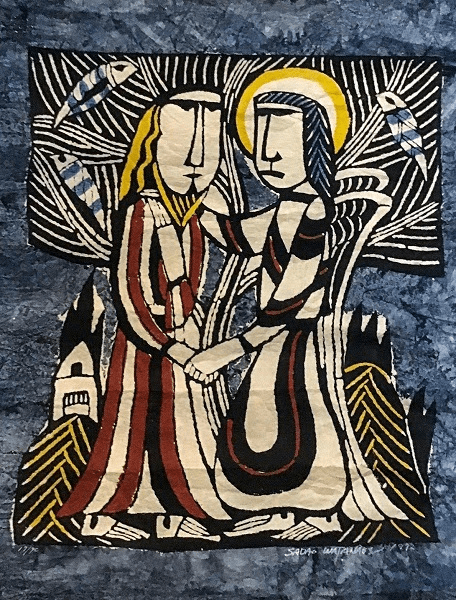
There was a man from Zorah named Manoah. Manoah was from the family of Dan. His wife was not able to have children. The Messenger of the Lord appeared to her and said, “You’ve never been able to have a child, but now you will become pregnant and have a son. Now you must be careful. Don’t drink any wine or liquor or eat any unclean food. You’re going to become pregnant and have a son. You must never cut his hair because the boy will be a Nazirite dedicated to God from birth. He will begin to rescue Israel from the power of the Philistines.”
The woman went to tell her husband. She said, “A man of God came to me. He had a very frightening appearance like the Messenger of God. So I didn’t ask him where he came from, and he didn’t tell me his name. He told me, ‘You’re going to become pregnant and have a son. So don’t drink any wine or liquor or eat any unclean food because the boy will be a Nazirite dedicated to God from the time he is born until he dies.’ ”
Then Manoah pleaded with the Lord, “Please, Lord, let the man of God you sent come back to us. Let him teach us what we must do for the boy who will be born.”
God did what Manoah asked. The Messenger of God came back to his wife while she was sitting out in the fields. But her husband Manoah was not with her. The woman ran quickly to tell her husband. She said, “The man who came to me the other day has just appeared to me again.”
Manoah immediately followed his wife. When he came to the man, he asked him, “Are you the man who spoke to my wife?”
“Yes,” he answered.
Then Manoah asked, “When your words come true, how should the boy live and what should he do?”
The Messenger of the Lord answered Manoah, “Your wife must be careful to do everything I told her to do. She must not eat anything that comes from the grapevines, drink any wine or liquor, or eat any unclean food. She must be careful to do everything I commanded.”
Manoah said to the Messenger of the Lord, “Please stay while we prepare a young goat for you to eat.”
But the Messenger of the Lord responded, “If I stay here, I will not eat any of your food. But if you make a burnt offering, sacrifice it to the Lord.” (Manoah did not realize that it was the Messenger of the Lord.)
Then Manoah asked the Messenger of the Lord, “What is your name? When your words come true, we will honor you.”
The Messenger of the Lord asked him, “Why do you ask for my name? It’s a name that works miracles.”
So Manoah took a young goat and a grain offering and sacrificed them to the Lord on a rock he used as an altar. While Manoah and his wife watched, the Lord did something miraculous. As the flame went up toward heaven from the altar, the Messenger of the Lord went up in the flame. When Manoah and his wife saw this, they immediately bowed down with their faces touching the ground.
The Messenger of the Lord didn’t appear again to Manoah and his wife. Then Manoah knew that this had been the Messenger of the Lord. So Manoah said to his wife, “We will certainly die because we have seen God.”
But Manoah’s wife replied, “If the Lord wanted to kill us, he would not have accepted our burnt offering and grain offering. He would not have let us see or hear all these things just now.”
So the woman had a son and named him Samson. The boy grew up, and the Lord blessed him. (God’s Word Translation)

In the anticipation of Christ’s birth, we are reminded today that there have been extraordinary births in history – a sign that the delivery of a baby will lead to a deliverance of the people.
The ancient Israelites were yet again in one of their downward spirals into apostasy. As a result, their arch-nemesis, the Philistines, had domination over them. The tribe of Dan – from which Samson was born into – was geographically situated in such a way that they would have borne the brunt of Philistine oppression.
In the case of miraculous births in Holy Scripture, an angel comes to announce the coming child. These sorts of situations always have an infertile woman who was not planning on becoming a mother. And in many cultures, including Israel, a son born to a woman who was childless for a long time is recognized as a particularly special gift from God.
There are typically, therefore, high expectations that such a special child is destined for great things in this life. Indeed, Samson would become an extraordinary person by initiating the deliverance of Israel from the Philistines.
Samson, according to the angel, was not only to make sure he never eats any unclean food, but also was to be set apart from his very conception as a Nazirite – one who has the special rules of abstinence from alcohol, cutting the hair, and touching corpses. (Numbers 6:1-8)
From the very beginning of Samson’s existence in the womb of his mother, the Spirit of God was with him and began empowering him for his destiny of deliverance.
Since we know the rest of the story, as contained in the Bible, we understand that the way the deliverance of Israel came was not by any sort of conventional means. It was a rather circuitous and complicated set of circumstances and decisions which brought about Israel’s freedom from oppression.
In a similar way, the deliverance which Jesus secured – not only for Israel, but according to Christianity, for all nations – came about through unexpected and tragic circumstances. This is why many Christians will state that Jesus was born to die – because his death, like Samson’s, brought about a great saving event that vastly outdid anything done during life.
Perhaps you existentially know something in this season about such bittersweet circumstances and events. It could be that you are experiencing a situation that is both very sad and quite joyous at the same time.
So, may you, especially, in this time of year, find satisfaction in your grief, and contentment in your lament. May the angel’s announcement stir in your soul the peace that passes all understanding. May the Lord be with you, my friend.
Soli Deo Gloria


 Rev. Tim Ehrhardt