
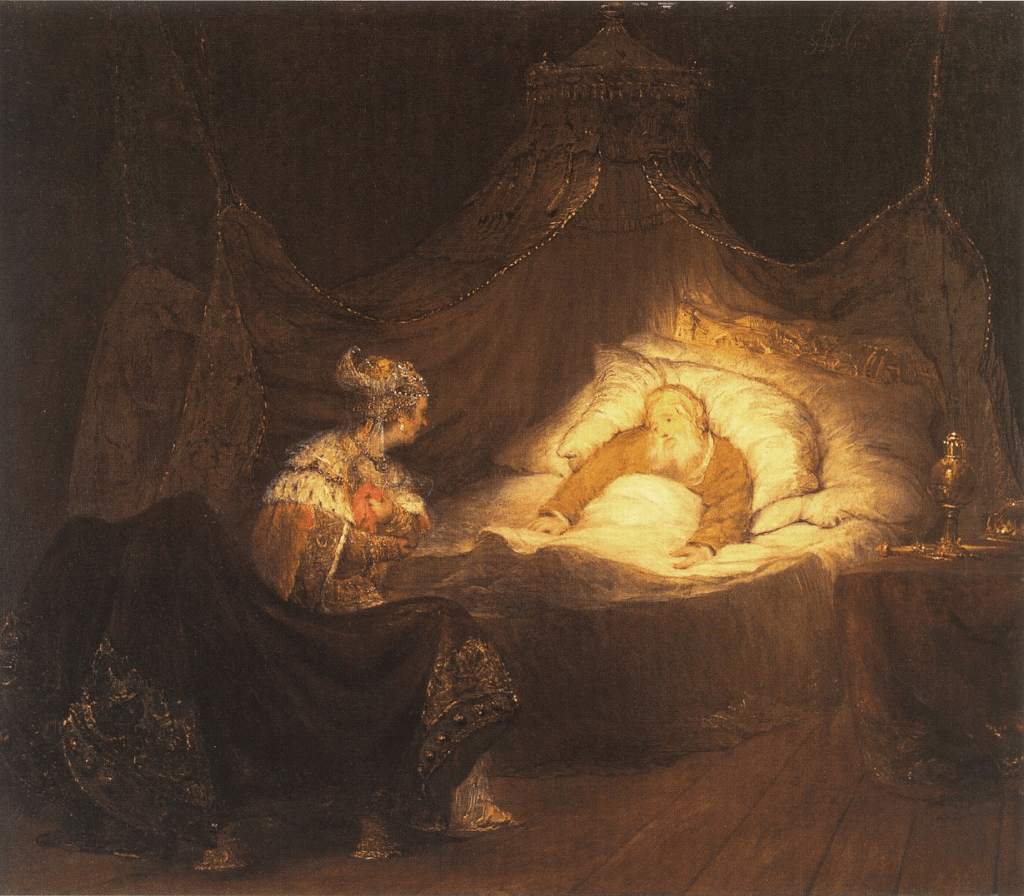
Dealing with Injustice (1 Kings 1:28-48)

Bathsheba appeals to David, by Arent de Gelder, c.1685

Then King David said, “Call in Bathsheba.” So she came into the king’s presence and stood before him.

The king then took an oath: “As surely as the Lord lives, who has delivered me out of every trouble, I will surely carry out this very day what I swore to you by the Lord, the God of Israel: Solomon your son shall be king after me, and he will sit on my throne in my place.”

Then Bathsheba bowed down with her face to the ground, prostrating herself before the king, and said, “May my lord King David live forever!”

King David said, “Call in Zadok the priest, Nathan the prophet and Benaiah son of Jehoiada.” When they came before the king, he said to them: “Take your lord’s servants with you and have Solomon my son mount my own mule and take him down to Gihon. There have Zadok the priest and Nathan the prophet anoint him king over Israel. Blow the trumpet and shout, ‘Long live King Solomon!’ Then you are to go up with him, and he is to come and sit on my throne and reign in my place. I have appointed him ruler over Israel and Judah.”

Benaiah son of Jehoiada answered the king, “Amen! May the Lord, the God of my lord the king, so declare it. As the Lord was with my lord the king, so may he be with Solomon to make his throne even greater than the throne of my lord King David!”

So Zadok the priest, Nathan the prophet, Benaiah son of Jehoiada, the Kerethites and the Pelethites went down and had Solomon mount King David’s mule, and they escorted him to Gihon. Zadok the priest took the horn of oil from the sacred tent and anointed Solomon. Then they sounded the trumpet and all the people shouted, “Long live King Solomon!” And all the people went up after him, playing pipes and rejoicing greatly, so that the ground shook with the sound.

Adonijah and all the guests who were with him heard it as they were finishing their feast. On hearing the sound of the trumpet, Joab asked, “What’s the meaning of all the noise in the city?”

Even as he was speaking, Jonathan son of Abiathar the priest arrived. Adonijah said, “Come in. A worthy man like you must be bringing good news.”

“Not at all!” Jonathan answered. “Our lord King David has made Solomon king. The king has sent with him Zadok the priest, Nathan the prophet, Benaiah son of Jehoiada, the Kerethites and the Pelethites, and they have put him on the king’s mule, and Zadok the priest and Nathan the prophet have anointed him king at Gihon. From there they have gone up cheering, and the city resounds with it. That’s the noise you hear. Moreover, Solomon has taken his seat on the royal throne. Also, the royal officials have come to congratulate our lord King David, saying, ‘May your God make Solomon’s name more famous than yours and his throne greater than yours!’ And the king bowed in worship on his bed and said, ‘Praise be to the Lord, the God of Israel, who has allowed my eyes to see a successor on my throne today.’” (New International Version)

Solomon at the deathbed of King David, by Giulio Romano (1499-1546)

One of King David’s sons, Adonijah, was a stinker. He tried to pull a fast one on his aging father, in order to try and take the throne. But some of the people caught wind of what was afoot.

Even Nathan the prophet got involved and gave some sage instructions to Bathsheba, Solomon’s mother, so that the king’s wishes could come to fruition – namely, that Solomon would succeed David.

As a result, despite King David’s struggles toward the end of life, he had enough wherewithal to attempt some decisive leadership. He confirmed Solomon as his royal successor.

Despite Adonijah’s attempt to take advantage of his father’s failing capacity and execute a coup d’état, the king immediately took action by anointing and enthroning Solomon without any delay.

The installation of Solomon as king was accomplished so quickly that it caught the conniving Adonijah and his cohorts off guard. King David may have lost several steps in his old age, but he was still someone to be reckoned with. That underestimation would cost the connivers dearly.

To be honest, I don’t like Adonijah. And that’s what the storyteller wants us to feel. We are meant to read the narrative and walk away saying to ourselves that we don’t want to be like Adonijah; we don’t want injustice to have the day; instead, we want King David’s wishes honored, and to see a just and right Ruler ensconced as king.

The Lord is a just God. And since we are people created in God’s image and likeness, we have an inherent sense of justice down deep inside us. So, it drives people nuts whenever there are things happening which are not right nor good.

Everyone faces injustice, and things that are not right, in this life. The trick is to deal with it, without becoming unjust ourselves. It’s not an easy thing to do. It’s tough. So, how do we maintain being just while handling injustice?

The feeling of helplessness is rather uncomfortable, even painful. It doesn’t feel good to think that your efforts at doing right and being just don’t accomplish much of anything, and are only a drop in the bucket of what’s needed. It also doesn’t feel right whenever we see others going through injustice, and we have little to no way in helping the situation.

The first step in dealing with the world’s injustice is to acknowledge it. Don’t purposely ignore it, avoid it, or pretend that it isn’t there. Everything in life must be acknowledged before anything can be done about it – whether it’s dealing with an event, or your own emotions.

So, it is imperative that your care for yourself. And it’s the most important thing in being of service and help to others. Attend to the whole self – body, mind, emotions, and spirit – because it is necessary in order to move through unjust circumstances with health, confidence, and sobriety.

When facing injustice and dealing with it, no matter whether it concerns yourself or another, it’s good to keep in mind that our brains tend to gravitate toward the negative, to the detriment of seeing good and positive things.

Therefore, we must work at keeping our “compassion quotient” high, and not let our compassion turn to fatigue, then burn-out.

It seems that King David continually worked on maintaining a robust spirit and healthy self, so that, even when he was old, his compassionate and wise instincts kicked in – the ones he had spent a lifetime developing.

In contrast, Adonijah appears to have nurtured a self-centered and bitter spirit. He did not attend well to his spiritual and emotional health. His mind turned to the dark thoughts of intrigue and rebellion. Arrogance clouded his right mind. This would not end well for him.

Dealing with injustice is never easy. And it very much requires us to be healthy and just ourselves, so that when we are faced with issues of justice, we can deal with them in a good and right manner.

Almighty God, you have given all peoples one common origin.
It is your will that they be gathered together
as one family in yourself.
Fill the hearts of humanity with the fire of your love
and with the desire to ensure justice for all.
By sharing the good things you give us,
may we secure an equality for all
our brothers and sisters throughout the world.
May there be an end to division, strife and war.
May there be a dawning of a truly human society
built on love and peace. Amen.

Facing Death (1 Kings 1:1-30)

Mural of King David, in the Wilshire Boulevard Temple, Los Angeles

King David was now a very old man, and although his servants covered him with blankets, he could not keep warm. So his officials said to him, “Your Majesty, let us find a young woman to stay with you and take care of you. She will lie close to you and keep you warm.” 

A search was made all over Israel for a beautiful young woman, and in Shunem they found such a woman named Abishag, and brought her to the king. She was very beautiful, and waited on the king and took care of him, but he did not have intercourse with her.

Now that Absalom was dead, Adonijah, the son of David and Haggith, was the oldest surviving son. He was a very handsome man. David had never reprimanded him about anything, and he was ambitious to be king.

He provided for himself chariots, horses, and an escort of fifty men. He talked with Joab (whose mother was Zeruiah) and with Abiathar the priest, and they agreed to support his cause. But Zadok the priest, Benaiah son of Jehoiada, Nathan the prophet, Shimei, Rei, and David’s bodyguards were not on Adonijah’s side.

One day Adonijah offered a sacrifice of sheep, bulls, and fattened calves at Snake Rock, near the spring of Enrogel. He invited the other sons of King David and the king’s officials who were from Judah to come to this sacrificial feast, but he did not invite his half-brother Solomon or Nathan the prophet or Benaiah or the king’s bodyguards.

Then Nathan went to Bathsheba, Solomon’s mother, and asked her, “Haven’t you heard that Haggith’s son Adonijah has made himself king? And King David doesn’t know anything about it! If you want to save your life and the life of your son Solomon, I would advise you to go at once to King David and ask him, ‘Your Majesty, didn’t you solemnly promise me that my son Solomon would succeed you as king? How is it, then, that Adonijah has become king?’” And Nathan added, “Then, while you are still talking with King David, I will come in and confirm your story.”

So Bathsheba went to see the king in his bedroom. He was very old, and Abishag, the young woman from Shunem, was taking care of him. Bathsheba bowed low before the king, and he asked, “What do you want?”

She answered, “Your Majesty, you made me a solemn promise in the name of the Lord your God that my son Solomon would be king after you. But Adonijah has already become king, and you don’t know anything about it. He has offered a sacrifice of many bulls, sheep, and fattened calves, and he invited your sons, and Abiathar the priest, and Joab the commander of your army to the feast, but he did not invite your son Solomon. Your Majesty, all the people of Israel are looking to you to tell them who is to succeed you as king. If you don’t, as soon as you are dead, my son Solomon and I will be treated as traitors.”

She was still speaking, when Nathan arrived at the palace. The king was told that the prophet was there, and Nathan went in and bowed low before the king. Then he said, “Your Majesty, have you announced that Adonijah would succeed you as king? This very day he has gone and offered a sacrifice of many bulls, sheep, and fattened calves. He invited all your sons, Joab the commander of your army, and Abiathar the priest, and right now they are feasting with him and shouting, ‘Long live King Adonijah!’ But he did not invite me, sir, or Zadok the priest or Benaiah or Solomon. Did Your Majesty approve all this and not even tell your officials who is to succeed you as king?”

King David said, “Ask Bathsheba to come back in”—and she came and stood before him. Then he said to her, “I promise you by the living Lord, who has rescued me from all my troubles, that today I will keep the promise I made to you in the name of the Lord, the God of Israel, that your son Solomon would succeed me as king.” (Good News Translation)

King David, by Sefira Lightstone

Death isn’t exactly a popular subject. You might think, since all of us will eventually experience it personally, and most of us have seen it up close through dying loved ones, we would talk it up as something to face and deal with squarely. And yet, we don’t.

Ideally, death ought to teach us how to live, how to face our limitations, and how to accept hardship and the inevitable.

If we will let today’s Old Testament lesson speak to us concerning the subject of death, we can observe four differing responses to the impending death of King David…

King David’s servants: death as a problem to solve

The servants of David treated his downward health as a problem to be solved. They essentially sidestepped the issue of death. Perhaps they believed it to be too negative a subject, or were simply too uncomfortable with the prospect of losing their king.

King David’s servants remembered well the vigorous David who took on enemies and problems. They wanted him to act like a king, so they looked for the miracle cure of a virgin who would be some sort of fix for David.

In the ancient world, a king’s vitality was always linked to his sexual vigor. The servants thought if they could arouse David, he would be back to his old kingly self. In other words, the servants were trying to avoid death. And, of course, it didn’t work.

King David’s son Adonijah: death as an opportunity to seize

Whereas the servants were scheming a way to get the old David back in the saddle, Adonijah was impatient to see his father David in the grave. He sought to use death for his own advantage.

Adonijah wanted his dad, the king, out of the way, so that he could pursue his own kingship. So, he simply proclaimed himself king, hoping to hasten David’s death.

The guy was looking for an opportunity; and, I might add, Adonijah ended up losing his own life for it. He never understood the true dynamics of life and death – that life is complicated, death should be honored, and not used for personal gain.

King David’s wife Bathsheba: death as a difficulty to navigate

Honestly, I have a lot of compassion for Bathsheba, because she got a raw deal earlier in her life with David. Bathsheba was married to Uriah, and was used by David, ending up in her husband’s death.

But then King David took her in and made Bathsheba one of his many wives. After their first child together died, they had Solomon. And this was the person Bathsheba really cared about. She wanted to make sure her son Solomon became king.

Reading today’s narrative, you may wonder why King David needed a virgin – where was his wife? Bathsheba showed up to see David, not because she wanted to keep him warm and comfort him, but because she was concerned for her son.

For Bathsheba, David became a means to an end – someone who could help her negotiate a difficult situation. She sought to navigate the complicated politics around death.

King David’s caregiver Abishag: death as a reality to witness

Throughout the story, we have no recorded words from Abishag. Everyone else had plenty to say. In contrast to all of the other people, Abishag was simply a witness to David’s deteriorating health, and eventual death.

She seems to me like a hospice worker, who exists to ease the person’s pain at end of life. In this, we can perhaps learn more from Abishag than from anyone else – to be present, listen, and serve.

Unfortunately, death brings out the worst in some people. But if we will face death, and not view it as a problem to be solved, an opportunity to be seized, or a difficulty to be negotiated, I believe we will find the grace of God when we become sacred witnesses to death.

Jesus faced death. He did not try and avoid death; was not impatient to get death over with; and did not stoically endure death as a difficulty. Christ’s death is life – bringing meaning to both life and death.

Into your hands, O merciful Savior, we commend all your servants staring death in the face today. We humbly ask that you acknowledge these sheep of your own fold, these lambs of your own flock, and these sinners of your own redeeming. Receive them into the arms of your mercy, into the blessed rest of everlasting peace, and into the glorious company of the saints in light. Amen.