Persecuted (Acts 8:1b-8)

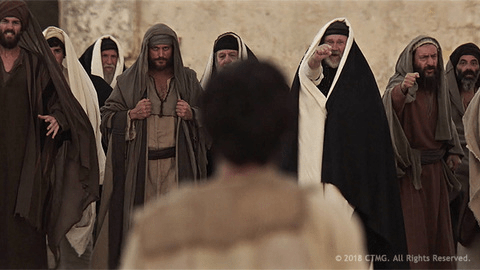
A scene from the movie, “Paul, Apostle of Christ,” in which Saul sought to wipe out Christians beginning with the stoning of Stephen

On that day a great persecution broke out against the church in Jerusalem, and all except the apostles were scattered throughout Judea and Samaria. Godly men buried Stephen and mourned deeply for him. But Saul began to destroy the church. Going from house to house, he dragged off both men and women and put them in prison.

Those who had been scattered preached the word wherever they went. Philip went down to a city in Samaria and proclaimed the Messiah there. When the crowds heard Philip and saw the signs he performed, they all paid close attention to what he said. For with shrieks, impure spirits came out of many, and many who were paralyzed or lame were healed. So there was great joy in that city. (New International Version)

Just because Christians experience the blessing of God through new life in Christ, does not mean that the rest of this earthly life will be bunnies and unicorns without any hardship.

Sometimes we forget that rabbits and horses produce manure, and we’ll have to muck out the barn. And even more than that, blessings from God are not limited to an abundance of earthly resources; blessing also comes through suffering. Jesus said:

“Great blessings belong to those who suffer persecution for doing what is right. God’s kingdom belongs to them.

“People will insult you and hurt you. They will lie and say all kinds of evil things about you because you follow me. But when they do that, know that great blessings belong to you. 

“Be happy about it. Be very glad because you have a great reward waiting for you in heaven. People did these same bad things to the prophets who lived before you.” (Matthew 5:10-12, ERV)

Saul was an up and coming Jewish Pharisee. He was intelligent, driven, and pious. Saul had the pedigree, passion, and position to go a long way and make a big splash in Judaism. And he was more than ready to do whatever it took to stamp out a heretical and dangerous sect of Jesus followers – even to the point of giving approval to the stoning of the Christian Stephen; and leading a persecution against believers like him.

Jesus not only promised abundant and eternal life to his followers, but he also promised that the cost of Christian discipleship would be persecution. Believers in Jesus Christ can expect to suffer in this life for their faithful commitment. Yet, because Christ overcame the world, we too, can accept, cope, and transcend any persecution and trouble we face in our embrace of faith. Jesus said:

“The world will make you suffer. But be brave! I have defeated the world!” (John 16:33b, GNT)

Even though the unity the believers enjoyed together in Jerusalem was disrupted and destroyed by the leadership of Saul, God bent the adverse situation toward blessing. Christians were flung all over the known world. In their going, they obeyed the words of their Lord Jesus to proclaim the message they so wholeheartedly embraced.

When Jesus came near, he spoke to them. He said, “All authority in heaven and on earth has been given to me. So wherever you go, make disciples of all nations: Baptize them in the name of the Father, and of the Son, and of the Holy Spirit. Teach them to do everything I have commanded you.

“And remember that I am always with you until the end of time.” (Matthew 28:18-20, GW)

The ancient prophesies were becoming realized. Grace, mercy, and peace were overcoming bitterness, judgment, and enmity toward one another. Even though persecution was happening, there was now a very different response to it, which will lead to a new outcome. In the last days…

The Lord will mediate between nations
    and will settle international disputes.
They will hammer their swords into plowshares
    and their spears into pruning hooks.
Nation will no longer fight against nation,
    nor train for war anymore. (Isaiah 2:4, NLT)

Suffering can be tolerated, even embraced, whenever we are aware that it can lead us to peace and joy – both personally and communally. Instead of evil taking root amongst a people, good seeds can be planted in the heart of humanity. And when those seeds are watered and nurtured, they grow to become a blessing for the world.

Finally, Jesus said, “What is God’s kingdom like? What story can I use to explain it? It is like what happens when a mustard seed is planted in the ground. It is the smallest seed in all the world. But once it is planted, it grows larger than any garden plant. It even puts out branches that are big enough for birds to nest in its shade.” (Mark 4:30-32, CEV)

Spiritual growth is built into Christianity. The faith formation and development of both individual believers and churches is important. Without it, Christians devolve into cliques of special interest groups.

But with it, Christianity becomes a blessing to the world, that is, if believers focus on producing and harvesting the spiritual fruit of love, joy, peace, patience, kindness, generosity, faithfulness, gentleness, and self-control. (Galatians 5:22-23)

Whenever and wherever believers and followers of Jesus are spiritually growing in their faith, they become like exorcists who organically purge unhealthy institutional systems of their moral corruption, selfishness, idolatry, hate, in-fighting, obsessions, bitterness, rage, competitive oppositions, conflict, and polarizing group rivalries. (Galatians 5:19-21)

Christianity is meant to bring joy and healing of both body and soul. If it doesn’t do this, then it has become just another unjust and unhealthy organization that is in need of purging its impurities; and embracing its mandate to uphold the common good of all persons through proclamation of good news and committed to a lifestyle of loving one another as Christ has loved us.

For people pay attention to that which is right, just, and good – because righteousness, justice, and goodness are in everyone’s spiritual DNA.

Almighty and gracious God of all:
Remember Christ, your Son, who is peace itself,
and who has washed away our hatred with his blood.
Because you love all men and women everywhere,
look with mercy on all who are engaged in battles of the flesh and the spirit.
Banish the violence and evil within all combatants of both body and soul
so that one day, we may all deserve to be called your sons and your daughters.
Grant this through Christ our Lord, in the enablement of the Spirit. Amen.

Challenging the Status Quo (Acts 4:1-4)

While Peter and John were speaking to the people, the priests, the captain of the temple guard, and the Sadducees confronted them. They were incensed that the apostles were teaching the people and announcing that the resurrection of the dead was happening because of Jesus. They seized Peter and John and put them in prison until the next day. (It was already evening.) Many who heard the word became believers, and their number grew to about five thousand. (Common English Bible)

I’ll be honest. I like upsetting the status quo. It drives me nuts when a system or group of people get so used to doing things a certain way that there is no room for anything different. Peter and John did exactly that – they went off the beaten path. According to the religious authorities, they were creating trouble, causing a stink, disturbing the peace, and making waves.

At the heart of the disturbance was the authorities’ deep concern of potential social disorder. After all, the Roman Empire with all its great strength was firmly ensconced in Judea. It was already hard enough for Jews to maintain their customs and religious practices. Now, these rabblerouser disciples of Jesus come along with their unorthodox teaching, and threaten the very social fabric of Jewish life. No! Get them out of here!

So, off to jail Peter and John went. That’s how the politics of fear typically works. Being afraid of change leads to removing the object of fear. Stuff the apostles in the gulag. Shut and lock the door. Maybe if they are out of sight they will be out of mind to the people.

But the rulers were too late. A lot of people heard the message of Christ’s resurrection. The number of believers in Jesus swelled into the thousands. Well, now, everyone’s really in a pickle! That is, except the church. Each time the Christians got squelched and silenced, more of them showed up. Oh, my, goodness. The ruling council saw they were multiplying like roaches!

It didn’t help the authorities that these religious bugs continued to interpret their own whippings and jailtime as a positive thing – enjoying the solidarity of suffering with their Lord. Ugh. What’s a decent Sadducee to do with that kind of thinking and behavior?

Apostles Peter and John heal the sick, by Pieter Aertsen (1508-1575)

Turns out nothing can stop resurrection. It cannot be chained, bound, or imprisoned. Once life gets into the hearts of people, there’s no getting it out. The message takes over and consumes the whole person. Then it spreads to another, like an infectious disease.

Before you know it, the entire social order is off kilter. What a bunch of weirdos. Following a dead guy who they say isn’t dead. Walked right out of the grave, they say. Sheesh. Pull yourselves together. So many unhinged delusional people believing in resurrection!

It’s easy for some Christians to be hard on non-Christians, just as it was easy for the ancient Jewish rulers to be hard on others leaving their fold. Sometimes we followers of Jesus forget whence we have come. We can get so upset and worked up in fear.

It could be that our underwear is too tight. More likely, we take the prideful stance of believing that our own status quo is best for everyone. So, there’s no listening, paying attention, or teachable spirits.

Peter, John, and the other apostles just went about proclaiming good news with joy. And the gospel spread. Jesus became known first to thousands, then tens of thousands, hundreds of thousands, and millions. Today, according to the Pew Research Center, there are over 2.5 billion Christians in the world. That’s a lot of people.

Christianity has had two thousand years to create their own status quo, some of it good, some of it not so much.

Yet, at the heart of it all, is the resurrection of Jesus Christ from death. It’s a message that still speaks to billions. And it’s a message Christians need to come back to, whenever they are fearful of others challenging their hegemony.

All the hopes and expectations of Christians everywhere are realized not in maintaining some Constantinian sort of Christendom, but in the resurrection of Jesus Christ the dead. The former does a lot of handwringing over social and cultural issues. The latter has a lot of joy, celebration, and renewal which works itself out in both personal and systemic redemption.

Because the good news of Easter can hardly be contained in a single day’s celebration, it’s message of new life in Christ is like a bright sun of inexhaustible grace to people everywhere – still warming the earth all these centuries later.

The Apostle Peter went on to pen a letter to struggling Christians facing hard circumstances in a world not yet dominated by Christianity, reminding them of the heart of Christian faith:

Praise be to the God and Father of our Lord Jesus Christ! In his great mercy he has given us new birth into a living hope through the resurrection of Jesus Christ from the dead, and into an inheritance that can never perish, spoil or fade. This inheritance is kept in heaven for you, who through faith are shielded by God’s power until the coming of the salvation that is ready to be revealed in the last time. 

In all this you greatly rejoice, though now for a little while you may have had to suffer grief in all kinds of trials. These have come so that the proven genuineness of your faith—of greater worth than gold, which perishes even though refined by fire—may result in praise, glory and honor when Jesus Christ is revealed. 

Though you have not seen him, you love him; and even though you do not see him now, you believe in him and are filled with an inexpressible and glorious joy, for you are receiving the result of your faith, the salvation of your souls. (1 Peter 1:3-9, NIV)

Don’t get stuck in the status quo to the point you cannot see anything outside yourself.

May we come back repeatedly to Christianity’s message so that our faith is strengthened, the church is edified, and the world is blessed. Amen.

Spiritual Sight and Power (Acts 3:1-10)

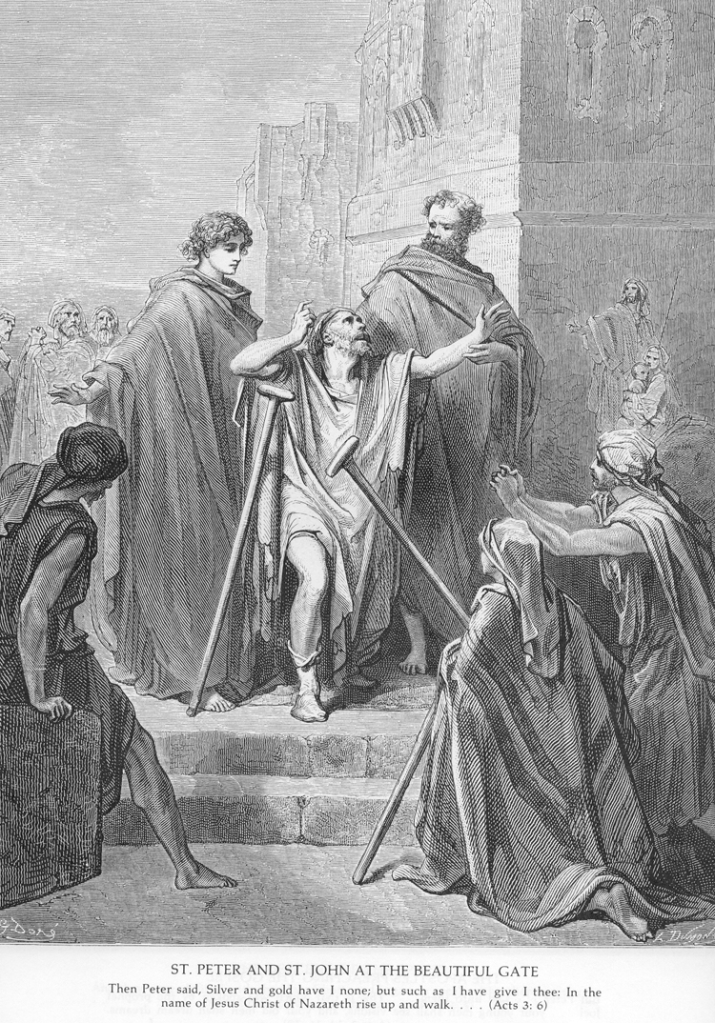
Peter and John heal the crippled man, by Gustave Doré (1832-1883)

Peter and John were going to the temple courtyard for the three o’clock prayer. At the same time, a man who had been lame from birth was being carried by some men. Every day these men would put the lame man at a gate in the temple courtyard. The gate was called Beautiful Gate. There he would beg for handouts from people going into the courtyard. When the man saw that Peter and John were about to go into the courtyard, he asked them for a handout.

Peter and John stared at him. “Look at us!” Peter said. So the man watched them closely. He expected to receive something from them. However, Peter said to him, “I don’t have any money, but I’ll give you what I do have. Through the power of Jesus Christ from Nazareth, walk!” Peter took hold of the man’s right hand and began to help him up. Immediately, the man’s feet and ankles became strong. Springing to his feet, he stood up and started to walk. He went with Peter and John into the temple courtyard. The man was walking, jumping, and praising God.

All the people saw him walking and praising God. They knew that he was the man who used to sit and beg at the temple’s Beautiful Gate. The people were amazed and stunned to see what had happened to him. (God’s Word Translation)

Peter and John at the gate of the temple, by Rembrandt

Money isn’t everything; and neither is having a lot of talent or giftedness. Yet, we often live our lives as if we cannot do much because of our lack of personal abilities and financial resources. But we can. All we need to do is give something that we all have to give.

Peter and John were disciples of Jesus. Though Jesus has ascended to heaven and the gift of the Spirit has come, they still maintained a daily rhythm of prayer three times a day at the temple.

As the two of them were about to attend afternoon prayer, they encountered a man at the gate. We are told that this particular guy was crippled. He came every day to the temple in order to beg. What is interesting to me is that this surely was not the first time Peter and John encountered the guy who begged at the gate.

Did they just ignore him? Was he one of many? Whatever the reason, they never put their eyes to him before. But on this occasion they did. In fact, they fixed their gaze on him and really took the time to stop and look at him.

I remember when my late brother-in-law had a complete turn around of his life to Jesus. At the time, he walked to work every day in the city. And every day there was a beggar on the corner. Most every day he had ignored him. One day he even spit on him.

The day after his great awakening to the Lord, he was walking to work and saw the beggar. But this time he really saw him. And when he looked into the man’s eyes, he had pity upon him. My brother-in-law – who took his lunch with him each day – surrendered it to the beggar. Eventually, he began a practice of bringing enough food for two, sitting down with the man, and talking with him as they ate together.

Perhaps for the first time, these disciples of Jesus, Peter and John, see the man who was there every day at the temple. They have not a thing with them. No money. No lunch. But they had something better: the power of grace and love.

In our contemporary Western society, we prefer things to be efficient and simple. Giving money, preferably online and dispassionately, is ideal for us. This way, we can give without any strings attached while feeling good about ourselves.

Yet, my brother-in-law and Peter and John decided to give the gift of connection. And that meeting of the eyes was the conduit for spiritual power to flow from one person to another. Doing what they saw Jesus do, the disciples gave the man who could not walk his legs back.

As a result, the guy was no longer lame nor a beggar. He became a fellow witness of God’s mercy and power. He went right up into the temple with Peter and John – walking and jumping and praising God.

It is not really money that gets things done. And it’s not our ingenuity or intelligence that really makes things happens. Throughout the book of Acts, demonstrations of God’s mighty power in the name of Jesus Christ is paramount. And those with alternative sources of power are shown to be powerless when it comes to life transformation.

In all of human history, including today, people like power; and power attracts wealth, as well as wealth attracting power. But the power of Christ’s resurrection is completely disconnected from worldly wealth. And it is never used for personal gain or popularity. And what’s more, this sort of power is available to every Christian – and not just a special class of super-Christians or clergy persons.

If we trace apostolic work in the New Testament, we shall find that the people with such spiritual power received it not because of extraordinary faith or exceptional virtue; instead, the Spirit grants us the ability to make a difference in this world by granting us the gift of sight – to truly see another as the precious image bearer of God that they are.

There are people right in front of us every day that we might not see. If we are wondering how to tap into the spiritual power of resurrection, we have no further to look than observing and gazing upon the folks within our eyesight, so that we can see them in new and redemptive ways.

Holy Lord, you gave us something more powerful and more valuable than riches; you have given us healing and hope. Please bring that healing and hope into our world and show us evidence of your presence in our lives. Amen.

Accept Your Shadow Side (Acts 7:30-40)

“Forty years later, in the desert near Mount Sinai, an angel appeared to Moses in the flame of a burning bush. When Moses saw it, he was amazed at the sight. As he went to take a closer look, the voice of the Lord called out to him, ‘I am the God of your ancestors—the God of Abraham, Isaac, and Jacob.’ Moses shook with terror and did not dare to look.

“Then the Lord said to him, ‘Take off your sandals, for you are standing on holy ground. I have certainly seen the oppression of my people in Egypt. I have heard their groans and have come down to rescue them. Now go, for I am sending you back to Egypt.’

“So God sent back the same man his people had previously rejected when they demanded, ‘Who made you a ruler and judge over us?’ Through the angel who appeared to him in the burning bush, God sent Moses to be their ruler and savior. And by means of many wonders and miraculous signs, he led them out of Egypt, through the Red Sea, and through the wilderness for forty years.

“Moses himself told the people of Israel, ‘God will raise up for you a Prophet like me from among your own people.’Moses was with our ancestors, the assembly of God’s people in the wilderness, when the angel spoke to him at Mount Sinai. And there Moses received life-giving words to pass on to us.

“But our ancestors refused to listen to Moses. They rejected him and wanted to return to Egypt. They told Aaron, ‘Make us some gods who can lead us, for we don’t know what has become of this Moses, who brought us out of Egypt.’ (New Living Translation)

We humans are a confusing paradox of sinner and saint. We are majestic people, created in the image and likeness of a good God. We are also profoundly fallen, touched by sin in every area of our lives. Our hearts exist with both light and darkness, having the capacity for both incredible altruism as well as inexplicable evil.

So then, it will do no good to retreat into binary definitions of people as being either good or bad. No, we shine and shadow at the same time. What really gets us into a terrible mess is when we ignore or deny our shadow selves. We then demonize the other while claiming purity for ourselves.

This is precisely what occurred when Stephen stood and spoke to a group of his fellow Jews. They stubbornly refused to acknowledge their shadow side. And it resulted in Stephen’s stoning and death. Whereas Stephen lifted and brought to light the unseemly aspects of their collective heritage, the people wanted nothing to do with it.

The Martyrdom of Stephen

In our present day, responses that do not want to acknowledge the shadow side include statements such as, “Quit being so negative. We focus on the positive. Expel this recalcitrant troublemaker once and for all!”

Oy. Acceptance cuts two ways. We must accept both our blessings and our curses. The acceptance of reality will not occur apart from a solid self-acceptance of who we are and how we are feeling in any given situation. On the practical level, it works something like the following story…

Several years ago, I went on a leadership retreat in the Canadian wilderness. We were so far out in the sticks that we needed special first aid training before leaving because if someone got severely injured it would be hours before any medical attention could be received. There was no cell phone service, no towns, no anything except mile after square mile of wilderness. 

One day, I was canoeing with a group of leaders, far out into the Canadian wilderness where there were no towns or people anywhere near us. It was very windy on this day in late May – which meant the water was still ice cold in Canada. One of the canoes capsized. We had to act quickly and deliberately – which was no small feat in a stiff wind. More than fifteen minutes would result in hypothermia for the two people in the water.

I did not like being in that situation. In fact, I didn’t much like the Canadian wilderness. Too many black flies and giant mosquitoes for me. My shadow side was coming out. But here I was, and I had to accept the reality I was in. One of the lessons I learned in that moment was that acceptance can sit alongside other reactions and emotions.

For example, a person can be outraged by an injustice, as Stephen was, and accept that it is a reality. Acceptance does not mean complacency or giving up. We can accept something while at the same time trying to make it better.

I also needed to accept what was happening inside of me. I was cold and worried. Trying to push those feelings away would have only added to the stress of the situation. If I failed to accept what was true about myself, I would be less able to deal with the situation, and so, would compromise my ability to help two people at risk.

I needed to accept the entire circumstance, including myself. Accepting what is inside gave me more influence over the situation, not less. Self-acceptance became the key to acceptance of unwanted conditions, and more importantly, acceptance of one another as human beings.

In that moment of rescuing two people (which ultimately proved successful) I became aware of a part of myself – the part that gets afraid and irritated – and chose not to stuff it or deny its existence.

I became the guy who talked to the panicked people in the water and kept them as calm as possible so that the others could get them out. I was able to do my part to help fearful people because I acknowledged and accepted my own fear.

Unlike my situation, however, Stephen’s experience ended in martyrdom. Just because we respond rightly, is no guarantee that everything will work out for our benefit. Rather, we say and do the things we must say and do, while leaving the results to a sovereign Lord.

It is our responsibility to work on ourselves, not others. And acceptance is the path to get there, all of it – including the shadow side – and not just part of it.

Jesus, let your mighty calmness lift me above my fears and frustrations. By your deep patience, give me tranquility and stillness of soul in you. Make me in this, and in all things, more and more like you. Amen.