Acts 1:1-11 – Ascension of the Lord

In the first book, Theophilus, I wrote about all that Jesus did and taught from the beginning until the day when he was taken up to heaven, after giving instructions through the Holy Spirit to the apostles whom he had chosen. After his suffering he presented himself alive to them by many convincing proofs, appearing to them during forty days and speaking about the kingdom of God. While staying with them, he ordered them not to leave Jerusalem, but to wait there for the promise of the Father. “This,” he said, “is what you have heard from me; for John baptized with water, but you will be baptized with the Holy Spirit not many days from now.”

So, when they had come together, they asked him, “Lord, is this the time when you will restore the kingdom to Israel?” He replied, “It is not for you to know the times or periods that the Father has set by his own authority. But you will receive power when the Holy Spirit has come upon you; and you will be my witnesses in Jerusalem, in all Judea and Samaria, and to the ends of the earth.” When he had said this, as they were watching, he was lifted-up, and a cloud took him out of their sight. While he was going and they were gazing up toward heaven, suddenly two men in white robes stood by them. They said, “Men of Galilee, why do you stand looking up toward heaven? This Jesus, who has been taken up from you into heaven, will come in the same way as you saw him go into heaven.” (New Revised Standard Version)

“When you went to bed last night Jesus was at work subduing his enemies. While you slept he was continuing to rule over the world. He was still at it when you woke up this morning and even now as you read this. That is the outrageous claim of the ascension.”

Tim Chester

Jesus was taken up to heaven in what Christians celebrate as the “Ascension of the Lord.”  It is hugely important for followers of Jesus. The ascension means that Christ is now presently sitting at God’s right hand offering continual prayers on our behalf to the Father. We have an advocate, a champion who has gone before us and secured deliverance from sin, death, and hell. This is no small thing. On top of it all, Christ’s ascension means that Jesus is the universal ruler; he commands a kingdom which will never end. Yes, the ascension of the Lord is a big deal.

So, why does a day set aside on the Christian Calendar celebrating the Lord’s mighty and redemptive ascension over all creation garner scant attention from many churches? Maybe the church has A.D.D. (Ascension Deficit Disorder). Perhaps our clue to the inability to focus on such a grand event is the disciples’ response when Jesus ascended.

The picture St. Luke paints for us in the account of our Lord’s ascension is a group of guys looking up into the sky slack-jawed and shoulders hunched. It took a couple of angels to come along and ask them what in the world they were doing just standing there. Now is not the time to stand and gawk at the clouds, the angels insisted. Jesus will come back when he comes back. You aren’t going to know when. So, now is the time to get busy with what Jesus just told you to do two minutes ago: Tell everyone about me.

“At His Ascension our Lord entered Heaven, and He keeps the door open for humanity to enter.”

Oswald Chambers

Christ’s ascension to heaven is a deeply theological event. It’s freighted with major implications for our prayer lives. And it means Christ is the King to whom we must obey. Jesus is coming again. In the meantime, there’s to be no cloud-gawking. Instead, there is to be a well-developed and well-cultivated connection with Jesus which proclaims the good news that Christ died, rose from death, and ascended to heaven for mine and your forgiveness of sins and a new clean slate on life.

Developing extensive prophecy charts and trying to peer into the future about how the end of history will shake-out is, frankly, not the job we are called to do. Believers in Jesus aren’t supposed to stand and gawk at the clouds waiting for the Lord’s return, as if we are in some earthly holding tank until heaven. 

Rather, we are to bear witness about the person and work of Jesus. The Ascension of the Lord means we are God’s people blessed with deliverance from the realm of sin, and the hope of Christ’s coming again. The Church everywhere recognizes together the rule and reign of the Lord Jesus.

“The miracle of Christ’s ascension to heaven is not in the lifting off from earth to another realm. It is in the reality that though being far away, the Lord is actually near.”

Mit Tdrahrhe

The world as we know it shall eventually come to an end. Until that time, Christians since the time of the ascension have been proclaiming Christ crucified, died, risen, ascended, and coming again. This is a day of joy and celebration for us. Jesus is our ascended and glorified king! The fate of the earth is with the benevolent and mighty Ruler of all. Jesus is Lord, and no other human leader is. Thank you, Jesus.

The great Reformed Confession, the Heidelberg Catechism, question and answer 49, states:

Q: How does Christ’s ascension to heaven benefit us?

A: First, he is our advocate

            in heaven

            in the presence of his Father.

Second, we have our own flesh in heaven

            as a sure pledge that Christ our head

            will also take us, his members,

            up to himself.

Third, he sends his Spirit to us on earth

            as a corresponding pledge.

            By the Spirit’s power

                        we seek not earthly things

                        but the things above, where Christ is,

                                    sitting at God’s right hand.

Amen.

Acts 10:34-43 – Alive with a New Vision

Then Peter began to speak: “I now realize how true it is that God does not show favoritism but accepts from every nation the one who fears him and does what is right. You know the message God sent to the people of Israel, announcing the good news of peace through Jesus Christ, who is Lord of all. You know what has happened throughout the province of Judea, beginning in Galilee after the baptism that John preached—how God anointed Jesus of Nazareth with the Holy Spirit and power, and how he went around doing good and healing all who were under the power of the devil, because God was with him.

“We are witnesses of everything he did in the country of the Jews and in Jerusalem. They killed him by hanging him on a cross, but God raised him from the dead on the third day and caused him to be seen. He was not seen by all the people, but by witnesses whom God had already chosen—by us who ate and drank with him after he rose from the dead. He commanded us to preach to the people and to testify that he is the one whom God appointed as judge of the living and the dead. All the prophets testify about him that everyone who believes in him receives forgiveness of sins through his name.” (New International Version)

Peter’s Vision

The Apostle Peter, a Jew, was told by God to go to the house of Cornelius, a Gentile. God had given Peter a vision of unclean animals, saying, “Get up, Peter. Kill and eat.”  While Peter was wondering about how to make sense of this, men came to retrieve Peter and take him to the house of Cornelius the Centurion.

The death and resurrection of Christ is universal in its scope. It effects every person on planet earth. God shows no favoritism. The cross of Christ is for all kinds of people from every nation, race, and ethnic group. Peter invites us to have a perspective on the cross which delivers us from all wrongdoing and misguided living. The Apostle encourages us to interpret the resurrection of Jesus as a new lease on life to millions of people. Peter’s message is to view the life and death of Jesus and see it as our redemption.

My Vision

For the first seventeen years of my life, I grew up in a nice family, a nice church, and attending a nice school. I heard the facts of Jesus, and the story of Jesus. I heard and understood that Jesus lived on this earth; lived a holy life; was a loving and good teacher; that evil persons had him arrested, tortured, and killed on a cross; that after three days he rose from death; and, that he now lives with the Father in heaven. I simply took all these Christian facts for granted. And yet, I never looked at those facts from my own perspective.

I did not see that as a teenager I was metaphorically speeding down a gravel road about to hit a t-intersection and face spiritual death. I did not interpret those events of Jesus from the angle that it was all done for me.  After all, there are all kinds of needy and lost people in the world, and I was living in Christian America. It’s all good for me, right? 

But it wasn’t all good. My heart was dark and unable to see the good news that Jesus did it all for me. Then, not too unlike what God did for Peter in seeing the world a new way, I saw that Jesus died for me. It totally changed my life.

“For we know that since Christ was raised from the dead, he cannot die again; death no longer has mastery over him. The death he died, he died to sin once for all; but the life he lives, he lives to God. In the same way, count yourselves dead to sin but alive to God in Christ Jesus.”

Romans 6:9-11, NIV

Suddenly, I saw life around me as if it were a new world. I began seeing and experiencing God’s love. I started to see the beauty and grace of God everywhere. I began to experience peace. These are the very things the gospel does for us – changes us from the inside-out.

When Peter preached his message to the household of Cornelius, they both were changed. Peter gained a brand new perspective on Gentiles and on God’s grace. And Cornelius began to interpret Jesus in a way that brought hope and life. 

A Cosmic Vision

In forty years of proclaiming the message of God’s peace through Christ to others, I have seen that the gospel is for everyone – poor and rich, the paranoid schizophrenic and the well-adjusted, addicts and non-addicts, those without much education and the highly educated, mean people and nice people.

One of the interesting things about the book of Acts is that it ends quite abruptly. We have all these wonderful stories about the good news of Jesus changing people’s lives, and then, in the middle of one of those stories with the Apostle Paul, the book of Acts just ends with chapter 28. The wise way of interpreting the abrupt ending is to see that God is still writing a story. The Lord is still active in the world, helping people to see Jesus in new and life-giving ways.

Today the right and proper way to interpret the story of Christ is that he is alive!  Because he lives, we live, if we direct our faith squarely toward Jesus. There is forgiveness through the cross. Since Jesus is alive, we are alive. Alive to the grace of God that has taken care of the guilt and shame issue once for all through the cross. Alive to the possibilities of what God wants to do in and through us. Alive to the people around us who need Jesus. Alive to one another. Alive in Jesus. 

God Almighty, thank you that Easter is for all people, that your love and salvation are for all who confess with voices and heart that the tomb is empty because Jesus is risen so that we might know forgiveness, and be reborn through Christ, your Son, our Lord, who with you and the Holy Spirit reign as one God, now and forever. Amen.

Acts 4:1-4 – The Message of Resurrection

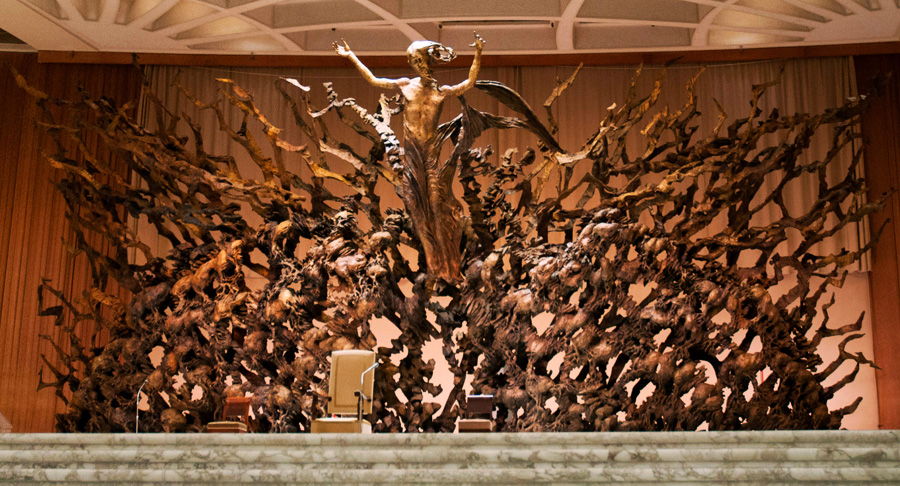
La Resurrezione by Italian sculptor Pericle Fazzini (1913-1987)

The priests and the captain of the temple guard and the Sadducees came up to Peter and John while they were speaking to the people.They were greatly disturbed because the apostles were teaching the people, proclaiming in Jesus the resurrection of the dead. They seized Peter and John and, because it was evening, they put them in jail until the next day. But many who heard the message believed; so, the number of men who believed grew to about five thousand. (NIV)

There’s nothing quite like upsetting the status quo. And that’s exactly what the apostles Peter and John were doing. Creating trouble, causing a stink, disturbing the peace, and making waves. At least, that’s how the ruling authorities saw the upstart Christians’ activity.

At the heart of the disturbance was the authorities’ deep concern of potential social disorder. After all, the Roman Empire with all its great strength was firmly ensconced in Judea. It was already hard enough trying to maintain Jewish customs and religious practices. Now, these rabblerousers come along with their unorthodox teaching and threaten the very social fabric of Jewish life. No! Get them out of here!

So, off to jail Peter and John went. That’s how the politics of fear typically works. Being afraid of change leads to removing the object of fear. Stuff the apostles in the gulag. Shut and lock the door. Maybe if they are out of sight they will be out of mind to the people.

The rulers were too late. So many people heard the message of Christ’s resurrection that the number of believers in Jesus swelled into the thousands. Well, now, everyone’s really in a pickle! Except the church. Each time the Christians get squelched and silenced, more of them show up. Oh, my, goodness. They’re multiplying like roaches!

It doesn’t help the ruling authorities that these religious bugs continue to interpret their own whippings and jailtime as a positive thing – enjoying the solidarity of suffering with their Lord. Ugh. What’s a decent Sadducee to do?

Turns out nothing can stop resurrection. It cannot be chained, bound, or imprisoned. Once life gets into the hearts of people, there’s no getting it out. The message just takes over and consumes the whole person. Then it spreads to another, like some infectious disease.

Before you know it, the entire social order is off kilter. What a bunch of weirdos. Following a dead guy who they say isn’t dead. Walked right out of the grave, they say. Sheesh. Pull yourselves together. So many unhinged delusional people believing in resurrection!

“Here’s to the crazy ones. The misfits. The rebels. The troublemakers. The round pegs in the square holes. The ones who see things differently. They’re not fond of rules. And they have no respect for the status quo. You can quote them, disagree with them, glorify or vilify them. About the only thing you can’t do is ignore them. Because they change things. They push the human race forward. And while some may see them as the crazy ones, we see genius. Because the people who are crazy enough to think they can change the world, are the ones who do.”

Rob Siltanen

It’s easy for some Christians to be hard on non-Christians, just as it was easy for the ancient Jewish rulers to be hard on others leaving their fold. Sometimes we followers of Jesus forget whence we have come. We can get so upset and worked up in fear. Could be our underwear is too tight. More likely, we take the prideful stance of believing our status quo is best for everyone. So, there’s no listening, paying attention, or teachable spirits.

Peter, John, and the other apostles just went about proclaiming good news with joy. And the gospel spread. Jesus became known first to thousands, then tens of thousands, hundreds of thousands, and millions. Today, according to the Pew Research Center, there are 2.5 billion Christians in the world. That’s a lot of people. Christianity has had two thousand years to create their own status quo, some of it good, some of it not so much.

Yet, at the heart of it all, is the resurrection of Jesus Christ from death. It’s a message that still speaks to billions. And it’s a message Christians need to come back to whenever they are fearful of others challenging their hegemony.

All the hopes and expectations of Christians everywhere are realized not in maintaining some Constantinian sort of Christendom but in the resurrection of Jesus Christ the dead. The former does a lot of handwringing over social and cultural issues. The latter has a lot of joy, celebration, and renewal which works itself out in both personal and systemic redemption.

Because the good news of Easter can hardly be contained in a single day’s celebration, it’s message of new life in Christ is like a bright sun of inexhaustible grace to people everywhere – still warming the earth all these centuries later.

The Apostle Peter went on to pen a letter to struggling Christians facing hard circumstances in a world not yet dominated by Christianity, reminding them of the heart of Christian faith:

Praise be to the God and Father of our Lord Jesus Christ! In his great mercy he has given us new birth into a living hope through the resurrection of Jesus Christ from the dead, and into an inheritance that can never perish, spoil or fade. This inheritance is kept in heaven for you, who through faith are shielded by God’s power until the coming of the salvation that is ready to be revealed in the last time. In all this you greatly rejoice, though now for a little while you may have had to suffer grief in all kinds of trials. These have come so that the proven genuineness of your faith—of greater worth than gold, which perishes even though refined by fire—may result in praise, glory and honor when Jesus Christ is revealed. Though you have not seen him, you love him; and even though you do not see him now, you believe in him and are filled with an inexpressible and glorious joy, for you are receiving the result of your faith, the salvation of your souls.

1 Peter 1:3-9, NIV

May we come back repeatedly to Christianity’s message so that our faith is strengthened, the church is edified, and the world is blessed. Amen.

Acts 4:23-31 – Why Not Us?

Hear My Plea by Rochelle Blumenfeld

The apostles Peter and John were arrested for preaching the good news about Jesus. After warning and threatening them to stop doing this, the ruling council of the Jews released them. This was the apostles’ response….

On their release, Peter and John went back to their own people and reported all that the chief priests and the elders had said to them. When they heard this, they raised their voices together in prayer to God. “Sovereign Lord,” they said, “you made the heavens and the earth and the sea, and everything in them. You spoke by the Holy Spirit through the mouth of your servant, our father David:

“‘Why do the nations rage
    and the peoples plot in vain?
The kings of the earth rise up
    and the rulers band together
against the Lord
    and against his anointed one.’

Indeed, Herod and Pontius Pilate met together with the Gentiles and the people of Israel in this city to conspire against your holy servant Jesus, whom you anointed. They did what your power and will had decided beforehand should happen. Now, Lord, consider their threats and enable your servants to speak your word with great boldness. Stretch out your hand to heal and perform signs and wonders through the name of your holy servant Jesus.”

After they prayed, the place where they were meeting was shaken. And they were all filled with the Holy Spirit and spoke the word of God boldly. (NIV)

The early believers in Jesus turned to God in a time of persecution. They found comfort in how God had worked in the past. The ancient church claimed the strength to carry on with speaking about Christ in their everyday lives. When they heard about threats against the apostles, the believers did not get angry or upset about how terrible things were. Instead:

The church decided to concentrate on corporate prayer together.

God is going to do what God is going to do. No government, nation, institution, group of people, or individual person can thwart God’s agenda for the church and world. God is sovereign over everything. We are not. Our place is to participate in God’s agenda through the ministry of prayer and speaking the word of God.

God acted in the past, on behalf of those first believers who came to Jesus and worshiped him with all their hearts. God is still transforming lives. It happened in ancient Jerusalem, throughout the history of the church, and in places today around the world. It can also happen with us.

Prayer is like breathing – inhaling more of God and exhaling less of me. Prayer takes the form of first remembering what God did in the past. Then, we pray specifically for our current situation which connects to the larger purposes of what God is doing. All the while we anticipate God will hear and act, just as has been done throughout history.

Remembrance is an important dimension to biblical prayer. Memory is necessary because we have a tendency toward forgetfulness. The older we get the more we tend to forget (probably because we have so much to remember!). So, continually rehearsing what God has done keeps us grounded in Scripture and tethered to what God can do now.

Remembering God’s saving actions and finding our own personal stories in the grand story of redemption helps us to pray in biblical ways.

The prayer of the early believers was a rehearsal of God’s mighty reputation, from creation to King David, to the redemptive events of Jesus. They reminded God of when, in the past, there was divine intervention. The church collectively quoted Psalm 2 about the Messiah. That psalm declares how the nations of the earth plot in vain because the Lord is the One who shall prevail over every hard circumstance. 

God bends each malevolent action toward the redemption and transformation of humanity. God will work out benevolent plans and purposes, even using people who have no acknowledgment of God. God is not surprised by our troubles and our tough situations.

God is never frustrated by people acting badly, because divine providence and guidance is in control, even if we cannot always perceive it or see it in the moment.

Remembering and rehearsing what God has done in the past helps us realize that, during any trouble, God is in control and will accomplish good plans on this earth. The prayer of the believers in Acts made the connection between what God has done and what they needed.

Photo by Pixabay on Pexels.com

Interestingly, the believers did not pray for relief from oppression or for God to judge their persecutors. Instead, they prayed for boldness to speak the word of God in the middle of their trouble. They rightly discerned that they needed to pray for courage to speak about Jesus. So, the church prayed for God to act in power, for God’s Word to go forth, and for Christ’s Name to be glorified.

God’s response to the prayer was immediate. The place where the church was praying shook. God did exactly what they asked for – filling them up with the Spirit, so that they spoke boldly about Jesus. Just as God empowered people for service in the past, so it was done in the present. What’s more, God will empower us with the same courage.

It is completely normal to simultaneously yearn for bravery while being afraid of getting a prayer for boldness answered. This is more than trying to overcome feelings of awkwardness or shyness. For the early believers, a very real and immediate danger to speaking up about Jesus was present.

It seems to me we need more people who know how to ask good questions and have the patience and attention to listen well and respond thoughtfully. It does no good to simply dispense answers to questions people aren’t asking. Speaking about Jesus does not mean making spiritual cold calls on strangers. And it certainly doesn’t involve being obnoxious or acting like a spiritual pester pup.

Discussing Jesus mostly means speaking casually, one-on-one, with a friend, co-worker, neighbor, or family member you already know. Too often we might try to fly under the radar and avoid people because we think talking about Jesus is going to be too hard, or out of our league.

Confidence and courage are not telling people what they ought to believe. It is rather like sharing a precious gift with someone. It begins in relationships with people we care about and extends to a relationship with God. It is about discovering God together, and not arm-twisting others to personal ethics or churchgoing.

Yet, it may still all sound too scary. So, maybe we start with this: “Tell me what’s going on.” Then listen. After listening, say, “I’ll pray for you.”  The next time you encounter the person, ask how that situation went.  Express that you’ll pray again. Keep doing it and watch what God will do through you.

When we pray for boldness, and courageously make ourselves available to God, then we are living sacrifices. This is our spiritual act of worship. (Romans 12:1-2) Who knows? Why not here? Why not now? Why not us? After praying, we might find our meeting places shaken, lives transformed, and everyone filled with God’s Holy Spirit.

God almighty, as you sent the Son, send us into the world with your compelling love. Help us by means of your Spirit, to share your good news of love, forgiveness, justice, peace, compassion, and care. Revive your Church, o Christ. Gracious God, work everywhere reconciling, loving, and healing your people and your creation. Open our eyes to your mission in the world. Send us to serve with Christ, taking risks to give life and hope to all people and all your creation. Amen.