When God made his promise to Abraham, since there was no one greater for him to swear by, he swore by himself, saying, “I will surely bless you and give you many descendants.” And so, after waiting patiently, Abraham received what was promised.
People swear by someone greater than themselves, and the oath confirms what is said and puts an end to all argument.Because God wanted to make the unchanging nature of his purpose very clear to the heirs of what was promised, he confirmed it with an oath. God did this so that, by two unchangeable things in which it is impossible for God to lie, we who have fled to take hold of the hope set before us may be greatly encouraged. We have this hope as an anchor for the soul, firm and secure. It enters the inner sanctuary behind the curtain, where our forerunner, Jesus, has entered on our behalf. He has become a high priest forever, in the order of Melchizedek. (New International Version)
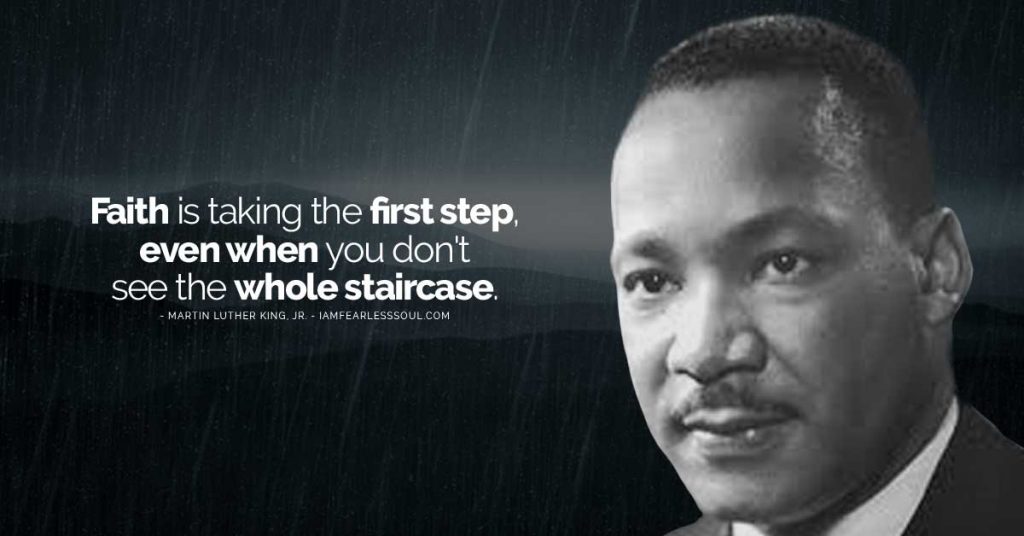
“We must accept finite disappointment, but never lose infinite hope.”
Martin Luther King, Jr.
Humanity needs hope. We all require a confident expectation that things will be different or better. Hope is what our ancestors in faith had in abundance.
How did Abraham receive what was promised by God?
Abraham received what was promised because of hope. He believed God’s promise of having a place to belong. His faith caused him to make a major move from the city where he had always lived. What’s more, Abraham understood that the promises of God don’t end in this life. He looked forward to being a permanent resident in the eternal city.
By faith Abraham obeyed when he was called to go out to a place that he was going to receive as an inheritance. He went out without knowing where he was going. By faith he lived in the land he had been promised as a stranger. He lived in tents along with Isaac and Jacob, who were coheirs of the same promise. He was looking forward to a city that has foundations, whose architect and builder is God. (Hebrews 11:8-10, CEB)
Why did God swear an oath to Abraham?
The Lord wanted to reinforce Abraham’s faith and encourage him. God desired to convincingly show that divine promises are sure.
The Lord spoke to Abram in a vision and said to him, “Do not be afraid, Abram, for I will protect you, and your reward will be great.” But Abram replied, “O Sovereign Lord, what good are all your blessings when I don’t even have a son?…. You have given me no descendants of my own, so one of my servants will be my heir.”
Then the Lord said to him, “No, your servant will not be your heir, for you will have a son of your own who will be your heir.” Then the Lord took Abram outside and said to him, “Look up into the sky and count the stars if you can. That’s how many descendants you will have!” And Abram believed the Lord, and the Lord counted him as righteous because of his faith. (Genesis 15:1-6, NLT)
What are the “two unchangeable things?”
The promise and the oath. God promised to Abraham:
“I will make you into a great nation, and I will bless you; I will make your name great, and you will be a blessing. I will bless those who bless you, and whoever curses you I will curse; and all peoples on earth will be blessed through you.”(Genesis 12:2-3, NIV)
God confirmed the promise with an oath:
“I swear by myself, declares the Lord, that because you have done this and have not withheld your son, your only son, I will surely bless you and make your descendants as numerous as the stars in the sky and as the sand on the seashore. Your descendants will take possession of the cities of their enemies, and through your offspring all nations on earth will be blessed, because you have obeyed me.” (Genesis 22:16-18, NIV)
Is there a way to be motivated and encouraged in the Christian life?
Yes. Hope in God’s promises and the confidence that our efforts to live for Christ are being seen and they are not in vain. We need one another. So, it is important to maintain significant relationships with other believers so that we will not lose our spiritual vitality and become discouraged. The author of Hebrews also stated:
We should keep on encouraging each other to be thoughtful and to do helpful things. Some people have gotten out of the habit of meeting for worship, but we must not do that. We should keep on encouraging each other, especially since you know that the day of the Lord’s coming is getting closer. (Hebrews 10:24-25, CEV)
Faith and patience, fueled by an unshakable hope, has always been the way believers have lived their lives. For the Christian, we have a promised inheritance, focused on the person and work of Christ. All of God’s good promises are fulfilled in Jesus.
God of hope, in these times of change, unite us and encourage us with your promise and oath. Help us overcome our fears and enable us to build a future in which all may prosper and share, through Jesus Christ our Lord. Amen.
Isn’t it obvious that God-talk without God-acts is outrageous nonsense?
I can already hear one of you agreeing by saying, “Sounds good. You take care of the faith department; I’ll handle the works department.”
Not so fast. You can no more show me your works apart from your faith than I can show you my faith apart from my works. Faith and works, works and faith, fit together hand in glove.
Do I hear you professing to believe in the one and only God, but then observe you complacently sitting back as if you had done something wonderful? That’s just great. Demons do that, but what good does it do them? Use your heads! Do you suppose for a minute that you can cut faith and works in two and not end up with a corpse on your hands?
Wasn’t our ancestor Abraham “made right with God by works” when he placed his son Isaac on the sacrificial altar? Isn’t it obvious that faith and works are yoked partners, that faith expresses itself in works? That the works are “works of faith”? The full meaning of “believe” in the Scripture sentence, “Abraham believed God and was set right with God,” includes his action. It’s that weave of believing and acting that got Abraham named “God’s friend.” Is it not evident that a person is made right with God not by a barren faith but by faith fruitful in works?
The same with Rahab, the Jericho harlot. Wasn’t her action in hiding God’s spies and helping them escape—that seamless unity of believing and doing—what counted with God? The very moment you separate body and spirit, you end up with a corpse. Separate faith and works and you get the same thing: a corpse. (The Message)
True faith is shown as the genuine article by how it acts and responds in real life situations.
Christians are saved for a purpose. Christian faith is much more than mere intellectual knowledge of Jesus Christ. We are to take our knowledge of Christ’s redemptive events and put it into daily practice.
There were folks in today’s New Testament lesson who were justifying a lack of action with statements such as, “I’m not wired that way,” “That’s not my gift,” “We pay our pastor to do the ministry,” “This church is not meeting my needs,” “Let the next generation deal with change.”
Anyone in the habit of complaining without doing anything to be part of the solution needs to get an active faith. Every believer in Jesus Christ is called to ministry. All Christians are gifted by God for service. And God expects us to use those gifts to build up the Body of Christ. The church suffers when we do not all participate with the abilities God has provided.
Faith apart from action is impossible. It’s like saying I can bench press 400lbs. just because I read about it in a muscle magazine; or, that I can produce corn just because I saw a farmer in a field.
There are no atheistic demons. The glimpses of Satan we get in the Bible lead me to think he likely has the entire Bible memorized and knows it quite well. Knowledge, however, by itself, is useless.
The Great Blondin, walking a tightrope across Niagara Falls, 1859
In the nineteenth century, a famous tightrope walker from France, Charles Blondin, once strung a cable across Niagara Falls from the American side all the way to the Canadian side. Thousands of people watched him do his theatrics across the falls. He walked back and forth, people applauding wildly. Then to further wow the crowds, he put a blindfold on and went back and forth. He also rode a bicycle back and forth, and then pushed a wheelbarrow back and forth.
As the story goes, while pushing the wheelbarrow back and forth, he called out to the crowd on one end, inquiring whether or not they thought he could successfully push the wheelbarrow across with a human being riding in the wheelbarrow. The crowd went berserk: “Sure you can. You’re remarkable. We believe in your abilities. You are the greatest.” On and on they went, to which Blondin responded, “Then someone volunteer. You come right up here, single file, form a line, and get in the wheelbarrow to prove your trust in my ability.” A deafening silence overtook the crowd. There were no takers.
Intellectual belief is one thing. It is quite another thing to place complete trust in Jesus Christ. Knowledge without an active commitment is about as helpful as a backseat driver.
Faith is a big word in Scripture and life. It encompasses the totality of how we come to Jesus Christ and how we live for him. So, when talking about faith, it is important to distinguish between saving faith and sanctifying faith.
If we are fuzzy on our understanding and application of these two spiritual realities of salvation and sanctification, we will sleepwalk through life as zombies living in two different worlds of the living and the dead.
“Salvation” is a term used a lot in the church. In Christianity, it means to be delivered from sin, death, and hell. Through the death and resurrection of Jesus, a person is “saved” by knowing about the work of Christ on the cross and trusting this has taken care of the sin issue once for all.
Through repentance and faith in Jesus, there is salvation. A person cannot earn it, accomplish it, or buy it. Salvation is a gift that comes by faith in the person and work of Jesus. It is a one-time event of trust.
“Sanctification,” on the other hand, begins when we become believers in Jesus. The word means “to become holy,” or, “to be set apart for God.” Sanctification is not a singular event; it is a lifelong process. Whereas saving faith is a gift given to us without effort, sanctification requires much effort. We work, struggle, and expend lots of energy to live the Christian life.
“Grace is not opposed to effort; it is opposed to earning. Earning is an attitude. Effort is an action. Grace, you know, does not just have to do with forgiveness of sins alone.”
Dallas Willard
When a student receives a college scholarship, it is a one-time event, granted to the student. She now possesses it and is able to attend school without trying to earn the money to pay for it. Yet, the scholarship was given for a reason – so that the student can now focus entirely on their studies and/or sport. The work is just beginning. More blood, sweat, and tears will take place living into that scholarship than the student could ever imagine. It won’t be easy. It will consume the student’s waking hours for the next four years.
When the Apostle James talks about faith, he is primarily referring to sanctifying faith, to believers who already professed saving faith in Jesus. They were granted a full-ride scholarship in the kingdom of God. Now the work begins. And, just as a student will surely become discouraged at points throughout their education, wondering if they ought to drop out, so the Christian will face tremendous adversity and challenge in living the Christian life. There is a lot of spiritual training and studies to do so that faith will be strengthened for a lifetime of service.
Abraham was saved from an empty way of life and given a gift of grace to move to a better country. Abraham did nothing to earn this favor. God just chose him, period. Abraham sojourned as a pilgrim throughout the land God gave him, which mirrored his spiritual sojourning and learning to be a follower of God.
Abraham’s faith was demonstrated by what he did. The way genuine faith develops and grows is in the fiery trial of adversity and hardship.
Christianity is not a matter of continual upward triumph; it is a downright hard work of faith development as we learn to be followers of Christ. Spiritual maturity happens through sanctifying faith by means of difficult life circumstances.
Rahab, a completely different person than Abraham, was a prostitute who lived in the red light district of Jericho. Abraham is a recognized giant of faith. Rahab is an almost overlooked example of faith. All of us likely fall somewhere in between these two people – graced and called by God to live into our sanctifying faith through continual spiritual exercise.
Rahab’s faith and actions worked together. She honestly believed the city of Jericho would experience God’s judgment, and, so, she housed the visiting Israelite spies.
Maybe we need to expand our understanding of faith to include people we might typically exclude.
No one is outside the realm of faith. So, let’s not be quick to judge those with dubious lives and backgrounds, as well as the poor and needy. If we do not know their stories, or why and how they ended up in this station in life, we may make unwarranted assumptions, and turn our backs on the needy.
We must not sanitize Rahab as someone other than who she was – and because of her faith she ended up being an ancestor of Jesus himself.
Needy people are not dumb, clueless, helpless, or ignorant; they are resourceful and resilient. They need Jesus, too. Yes, people make choices, often bad ones. Yet, nobody says to themselves, “When I grow up I want to be a prostitute or maybe a porn star and live in a red light district with a pimp who abuses me and gets high on heroin.”
People too often back into behaviors due to a lack of positive relational connections and just trying to survive whatever crisis is going on in their lives. The church can be a social connection for them to become grounded in something other than their past experience.
God grants faith scholarships to the rich and the poor, from every race, ethnicity, and background imaginable across the entire earth.
From the standpoint of faith, Abraham and Rahab are on the same level. Neither of them did anything to receive God’s grace. And God does not grit his teeth to show favor – the Lord genuinely loves us – and sincerely loves and likes all kinds of people.
Saving faith means life is just beginning. True salvation produces good works. Both Abraham and Rahab, along with all God’s people throughout the ages, exhibit sanctifying faith by persevering through hardship and allowing God to grow their faith.
Therefore, submit to hardship. Find solace in God and Scripture. Pray and worship like you mean it. Lean into community. Keep your eyes of faith open to what the Lord is doing around you.
Faith works. So, embrace it. Enjoy it. Live into it and with it always.
By faith Abraham, when God tested him, offered Isaac as a sacrifice. He who had embraced the promises was about to sacrifice his one and only son, even though God had said to him, “It is through Isaac that your offspring will be reckoned.” Abraham reasoned that God could even raise the dead, and so in a manner of speaking he did receive Isaac back from death.
By faith Isaac blessed Jacob and Esau in regard to their future.
By faith Jacob, when he was dying, blessed each of Joseph’s sons, and worshiped as he leaned on the top of his staff.
By faith Joseph, when his end was near, spoke about the exodus of the Israelites from Egypt and gave instructions concerning the burial of his bones. (New International Version)
Life requires faith.
To keep going, to endure and persevere, demands sustained faith over the course of a lifetime.
Faith is confidence in what we hope for and assurance about what we do not see. (Hebrews 11:1)
The biblical character, Abraham, let faith shape his actions. He obeyed God’s call on his life and left his home country to go somewhere he knew nothing about. And he did it with no GPS and no AAA tour books.
Even thought Abraham had a good life in his home city of Ur, he left, believing there was something better ahead.
After reaching the land which God led them to, Abraham, age 100 and his wife, Sarah, age 90, became parents. It happened because of faith. The two of them believed God’s promise of a child, even though it was biologically impossible.
Abraham kept his faith over the long haul of his life. He did it by looking ahead to the eternal city. Because Abraham had looked ahead on this earth and stepped out in faith, he was able to clearly discern that all his faith eggs were not in the earthly basket.
Against all odds, Abraham was convinced God was good for his promises and knew what he was doing.
Trust in the Lord with all your heart, And lean not on your own understanding; In all your ways acknowledge Him, And He shall direct your paths.
Proverbs 3:5-6, NKJV
Isaac was the miracle child, the promised son born to Abraham and Sarah in their old age. One day, God came along and gave Abraham a very strange command: Take your son, the child of the promise, and go to the mountain and sacrifice him there. (Genesis 22:1-19)
“Huh? What the @#$&*!!” we might say. But it only seems perplexing and weird to us. Abraham listened and obeyed. He simply went about the business of saddling up the donkey, chopping some wood for the sacrifice, and took his only son with him on the journey to the mountain – with no questions or talk back to God.
While you and I might try and figure out if we really heard God or not, Abraham had a history of faith with God. He knew God’s voice as well as he knew his own. Abraham was well down the road of relationship with the God he served.
Today’s New Testament lesson gives us an insight into Abraham’s thought process, a line of thinking consistent with a person who has a regular habit of talking with God. Abraham was willing to follow through with sacrificing his beloved son because he was sure that God could raise people to life. Abraham believed death would not have the last word.
Abraham did not try and figure out God’s mind. He didn’t get into a debate with God about the contradiction of ethics he was being asked to do. He just obeyed. Abraham reasoned that it didn’t matter if Isaac were killed because God could raise him from death. This, of course, is not what happened. It was all a test of faith. Abraham knew beyond a shadow of a doubt that God is the Lord who provides.
You and I rarely know why we are facing the unwanted circumstances we are enduring. We don’t always know what in the world God is thinking. Yet, like Abraham, if we have a spiritual history of walking with God and hearing the Lord’s voice, we don’t hesitate to respond. We are convinced God will provide.
Obedience for the follower of Christ is not a burden but a privilege, even when we are being tested beyond our seeming emotional ability to do it.
Grant, O God, that we may never lose our way through self-will, and so end up in the far countries of the soul. May we never abandon the struggle, but endure to the end, and so be saved. May we never drop out of the race but press forward to the goal of our high calling. May we never choose the cheap and temporary path but let go of all but you. May we never take the easy way and never forget that sweat is the price of all things, and that without the cross, there cannot be the crown.
So, keep us and strengthen us by your grace so that no disobedience, weakness, or failure may stop us from entering into the blessedness which awaits those who are faithful in all the changes and chances of life, through Jesus Christ our Lord. Amen
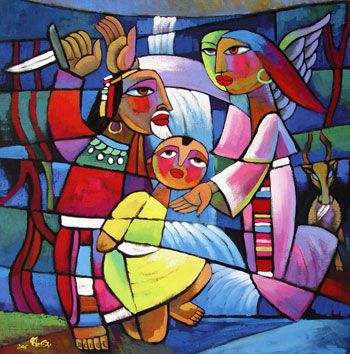
The Lord said, “Go get Isaac, your only son, the one you dearly love! Take him to the land of Moriah, and I will show you a mountain where you must sacrifice him to me on the fires of an altar.” So, Abraham got up early the next morning and chopped wood for the fire. He put a saddle on his donkey and left with Isaac and two servants for the place where God had told him to go.
Three days later Abraham looked off in the distance and saw the place. He told his servants, “Stay here with the donkey, while my son and I go over there to worship. We will come back.”
Abraham put the wood on Isaac’s shoulder, but he carried the hot coals and the knife. As the two of them walked along, Isaac said, “Father, we have the coals and the wood, but where is the lamb for the sacrifice?”
“My son,” Abraham answered, “God will provide the lamb.”
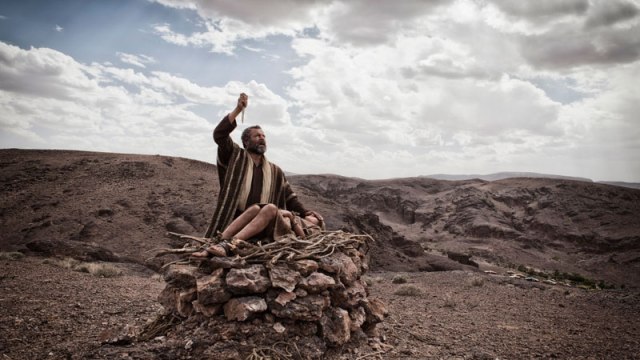
The two of them walked on, and when they reached the place that God had told him about, Abraham built an altar and placed the wood on it. Next, he tied up his son and put him on the wood. He then took the knife and got ready to kill his son. But the Lord’s angel shouted from heaven, “Abraham! Abraham!”
“Here I am!” he answered.
“Don’t hurt the boy or harm him in any way!” the angel said. “Now I know that you truly obey God, because you were willing to offer him your only son.”
Abraham looked up and saw a ram caught by its horns in the bushes. So, he took the ram and sacrificed it in place of his son.
Abraham named that place “The Lord Will Provide.” And even now people say, “On the mountain of the Lord it will be provided.”
The Lord’s angel called out from heaven a second time:
You were willing to offer the Lord your only son, and so he makes you this solemn promise, “I will bless you and give you such a large family, that someday your descendants will be more numerous than the stars in the sky or the grains of sand along the beach. They will defeat their enemies and take over the cities where their enemies live. You have obeyed me, and so you and your descendants will be a blessing to all nations on earth.”
Abraham and Isaac went back to the servants who had come with him, and they returned to Abraham’s home in Beersheba. (CEV)
The biblical character of Abraham is synonymous with faith. And for good reason. God had told Abraham he would have a son with his wife Sarah. This would not be unusual except for the fact the couple were well advanced in age, and Sarah was incapable of having children. Infertility is not just a modern problem; it has always existed. Yet, despite the overwhelming odds, Abraham believed God. Years later and with a mix of patience and impatience from the would-be parents, the promise from God was realized. Abraham and Sarah had a son, Isaac.
“Child of the promise.” That was Isaac’s moniker – which makes the command coming from God so incredibly perplexing: Take your son, the child of the promise, and go to the mountain and sacrifice him there. Huh? What the…! But it only seems strange and super-weird to us. We get no reaction from Abraham, no questioning, no talk back. He simply went about the business of saddling up the donkey, chopping some wood for the sacrifice, and took his only son with him on the journey to the mountain.
We might wonder what was going through Abraham’s mind through all of this. While you and I might try and figure out if we really heard God or not, Abraham had a history of talking with God. He knew God’s voice as well as he knew his own. Abraham was well down the road of relationship with the God he served. We get an insight from the author of Hebrews into Abraham’s thought process, a line of thinking consistent with a person who has a regular habit of talking with God:
“Abraham had been promised that Isaac, his only son, would continue his family. But when Abraham was tested, he had faith and was willing to sacrifice Isaac, because he was sure that God could raise people to life. This was just like getting Isaac back from death.” (Hebrews 11:17-18, CEV)
Abraham did not try and figure out God’s mind. He didn’t get into a debate with God about the contradiction of ethics he was being asked to do. He just obeyed. Abraham reasoned that it didn’t matter if Isaac were killed because God could raise him from death. This, of course, is not what happened. It was all a test of faith. Abraham knew beyond a shadow of a doubt that God is the Lord who provides.
You and I rarely know why we are facing the unwanted and unasked for circumstances we are enduring. We don’t always know what in the world God is thinking. Yet, like Abraham, if we have a spiritual history of walking with God and hearing the Lord’s voice, we don’t hesitate to respond. We are convinced God will provide. Obedience for the follower of Christ is not a burden but a privilege, even when we are being tested beyond our seeming emotional ability to do it.
Sovereign Lord, your ways are sometimes strange and confusing. Yet, I know that everything you do is always right, just, and good. It is to your gracious and merciful character that I know you will provide. My allegiance is to you, in the Name of Jesus Christ, through the power of the Holy Spirit. Amen.