Lessons From a Genealogy (Ruth 4:18-22)

Now these are the descendants of Perez: Perez became the father of Hezron, Hezron of Ram, Ram of Amminadab, Amminadab of Nahshon, Nahshon of Salmon, Salmon of Boaz, Boaz of Obed, Obed of Jesse, and Jesse of David. (New Revised Standard Version)

No, I didn’t make a mistake about what the verses are for today from the Revised Common Lectionary. Yes, the Old Testament lesson is a brief genealogy. And yes, there is something to learn from this.

The Bible contains a lot of genealogies. Although they may be boring, with names we have difficulty pronouncing, every genealogy serves the same purpose that it does for your own family history.

Genealogies remind us of our connection with past generations. And this interconnectedness has influenced us in profound ways. You and I are the result of what history has produced. We are who we are, to a significant degree, because of the people who came before us.

By listing someone’s descendants in writing, it indicates an ongoing developing story which has happened, and continues to develop up to the present time, and even into the future.

One aspect about biblical genealogies that must be noted: Ancient compilers of genealogical lists did not often include every single person in the genealogy. They typically listed the more significant persons, and left out persons who barely dented history.

That’s because the biblical writer’s purpose in giving a genealogy was not necessarily to be exact and precise about each individual past actor. Rather, the writer usually has a moral and/or theological reason for providing the list.

For the writer of the Book of Ruth, the reason for this genealogy was to establish the bloodline and pedigree of King David. Perez was a son of the patriarch Judah (and Tamar). Boaz was a descendant of Judah. Boaz married Ruth, and they had a son, Obed, who was the grandfather of David.

I hope that you see the grace in every biblical genealogy. Including in our genealogy for today, we have two women, Tamar and Ruth. Both of them were unlikely candidates for producing a king. And even more unlikely to be included in greatest Christian genealogy of them all, the lineage of Jesus (Matthew 1:1-17)

The Gospel writer Matthew included in his genealogical list a note about Boaz. He was the son of Rahab. Yes, the same Rahab who was the prostitute in Jericho, and became a faithful woman included in God’s covenant community. (Matthew 1:5-6)

Ruth was a “heathen” woman from Moab, a nation which historically was hostile to Judah. Yet, through her own pious actions, Ruth became a worthy member of Judah, and listed as a great mother of the Jewish people.

The brief genealogy we have here is a part of an historical continuity in God’s covenant community. From Abraham to Judah to David to Jesus, and to the Christian Church, this both literal and spiritual heritage is brought about through a daughter-in-law of Naomi the Jew, Ruth.

None of us are truly alone. We are all connected as people. And Christians are spiritually linked to the covenant as God’s people, by faith.

Just as Abraham “believed God, and it was reckoned to him as righteousness,” so, you see, those who believe are the descendants of Abraham. And the scripture, foreseeing that God would reckon as righteous the gentiles by faith, declared the gospel beforehand to Abraham, saying, “All the gentiles shall be blessed in you.” For this reason, those who believe are blessed with Abraham who believed. (Galatians 3:6-9, NRSV)

This connection to the past, prevents us from having an over-individualistic faith in God and relationship to the Lord. We belong to the historical and worldwide communion of saints. We, both personally and communally, belong to God.

For the writer of the Book of Ruth, history is important. Genealogy is significant. God’s covenant matters. The Church’s life is bound up in the person of Christ, in King Jesus, Son of David, Son of Boaz and Ruth, Son of Abraham.

Not only do we belong to God, but we also belong to one another. We belong to ordinary people who showed extraordinary faith.

And it is through ordinary people that God works out divine purposes on this earth for the common good of all people.

We have many grandparents in the faith. We are linked to them by faith. There is a mystical spiritual connection that we enjoy with them. And that connection is shared with others of the faith, as well.

For by the grace given to me I say to everyone among you not to think of yourself more highly than you ought to think but to think with sober judgment, each according to the measure of faith that God has assigned. For as in one body we have many members and not all the members have the same function, so we, who are many, are one body in Christ, and individually we are members one of another. (Romans 12:3-5, NRSV)

Blessed Christ, you do not call us servants, but friends—companions on this mission to see love, peace, and hope made known. You do not leave us to fend for ourselves, but invite us into community with you and others. Draw us closer to you and one another, and help us to become companions and confidants in our collective journey of faith and perseverance. Amen.

Jesus Is Better (Hebrews 7:1-10)

Abraham meets Melchizedek, 13th century mosaic, Basilica di San Marco, Venice, Italy

This Melchizedek was king of Salem and priest of God Most High. He met Abraham returning from the defeat of the kings and blessed him, and Abraham gave him a tenth of everything. First, the name Melchizedek means “king of righteousness;” then also, “king of Salem” means “king of peace.” Without father or mother, without genealogy, without beginning of days or end of life, resembling the Son of God, he remains a priest forever.

Just think how great he was: Even the patriarch Abraham gave him a tenth of the plunder! Now the law requires the descendants of Levi who become priests to collect a tenth from the people—that is, from their fellow Israelites—even though they also are descended from Abraham. This man, however, did not trace his descent from Levi, yet he collected a tenth from Abraham and blessed him who had the promises. And without doubt the lesser is blessed by the greater. In the one case, the tenth is collected by people who die; but in the other case, by him who is declared to be living. One might even say that Levi, who collects the tenth, paid the tenth through Abraham, because when Melchizedek met Abraham, Levi was still in the body of his ancestor. (New International Version)

We all become discouraged at various times in our lives; it’s part of being human. Chronic discouragement, however, can turn into a resignation to one’s apparent fate. It can cause us to give up.

That is where the Jewish Christians were, both spiritually and emotionally, in the New Testament Book of Hebrews. As Jews, they were living in a pagan Gentile world which did not appreciate their religious and cultural differences. As Christians, they lived with isolation from their Jewish families who did not understand their faith commitment to Christ and the Church.

It’s one thing to become discouraged. It’s another thing altogether to never have your situation change. Day after day, the Jewish Christians faced hardship, even persecution. So, over time, their faith and resolve to serve Jesus began weakening. They were in danger of reneging on their cherished beliefs and way of life.

This is why the author of Hebrews stepped in to address the situation. He wanted to encourage the struggling believers to not give up, to persevere in their faith. In order to do that, the Christians would need to fix their eyes on Jesus.

Instead of returning to Judaism, the Jewish Christians were encouraged to see how Jesus is superior to every important person in history, and better than the legal and sacrificial systems that they came from.

In chapter 7 of Hebrews, the author is continuing an argument that Jesus is better than the high priest Aaron (Hebrews 4:14-10:18). Part of that argument was to highlight the significance of an ancient king, Melchizedek, who was both a king and a priest of the Most High God.

The line of reasoning goes like this:

  • Melchizedek was a king and a priest in the time of Abraham.
  • Abraham acknowledged Melchizedek as such, and recognized his greatness and authority.
  • Therefore, Melchizedek is superior to the founder and patriarch of Jewish faith, Abraham.
  • Jesus is both a king and a priest, like Melchizedek.
  • Aaron is a priest, not a king.
  • Jesus is superior to Aaron; Aaron’s ministry was temporary, and Christ’s reign is permanent.

Specifically, regarding the lesson today, the argument is this:

  • Descendants of Levi were priests in Israel.
  • Levi was the ancestor of Aaron, the original Levitical high priest.
  • Abraham was the great grandfather of Levi.
  • Abraham was patriarch, and therefore, greater than Levi.
  • Melchizedek is greater than Abraham.

And so, the author of Hebrews was making this argument:

Jesus is a priest and king, like Melchizedek. Therefore, Jesus is superior to Abraham, Levi, Aaron, and all of the Levitical priests.

The Book of Hebrews insists that Jesus is greater than all other Jewish persons in history; and is superior to the old Levitical sacrificial system. Every Levitical priest lived and died. Jesus lived and died and rose from death. Therefore, Christ’s priesthood is still in existence. It is permanent.

From the New Testament perspective, Christ’s death and resurrection has replaced the Levitical priesthood as a new and better system of order. It’s new and better because, whereas the Levitical priests offered sacrifices day after day, Christ offered himself, once for all. The Cross of Christ was the sacrifice to end all sacrifices.

This spiritual reality, presented to the Jewish Christians in the ancient world, was meant to encourage them to hold fast in their commitment to Jesus.

We now have the privilege of coming to God without any spiritual hurdles to jump or obstacles to overcome, because Jesus made it possible.

God is available to us at all times, without having to offer a sacrifice in order to enter God’s presence, because the curtain of the temple has been torn in two.

Christ Jesus has finished the sacrificial work, and made it possible for every believer to come to God by faith alone.

So, don’t give up. Be encouraged with Jesus, the Savior and Sovereign of the universe, the Sustainer and Helper in a time of need, and the great King and High Priest who lives even now to intercede for us.

Hebrews is a somewhat long book in the New Testament of the Bible, encompassing thirteen chapters in all. It’s contents may sometimes seem dense and/or confusing. Yet, if you read through it, in one sitting, I believe you will come away encouraged and motivated to persevere and keep going.

Be patient, my friend. The situations which are now discouraging you will not last. And there is a King and High Priest who will last forever, and who has your back through all of the icky sticky circumstances of your life.

Fix your eyes on Jesus, the author and perfector of our faith.

Accept, O Lord, our thanks and praise for all that you have done for us. We thank you for the splendor of the whole creation, for the beauty of this world, for the wonder of life, and for the mystery of love.

Above all, we thank you for your Son Jesus Christ; for the truth of his Word and the example of his life; for his steadfast obedience, by which he overcame temptation; for his dying, through which he overcame death; and for his rising to life again, in which we are raised to the life of your kingdom.

Grant us the gift of your Spirit; that we may know you and make you known; and through your Spirit, at all times and in all places, may give thanks to you in all things. Amen.

True Faith (Hebrews 11:1-3, 13-19)

Now faith is confidence in what we hope for and assurance about what we do not see. This is what the ancients were commended for.

By faith we understand that the universe was formed at God’s command, so that what is seen was not made out of what was visible….

All these people were still living by faith when they died. They did not receive the things promised; they only saw them and welcomed them from a distance, admitting that they were foreigners and strangers on earth. People who say such things show that they are looking for a country of their own. If they had been thinking of the country they had left, they would have had opportunity to return. Instead, they were longing for a better country—a heavenly one. Therefore God is not ashamed to be called their God, for he has prepared a city for them.

By faith Abraham, when God tested him, offered Isaac as a sacrifice. He who had embraced the promises was about to sacrifice his one and only son, even though God had said to him, “It is through Isaac that your offspring will be reckoned.” Abraham reasoned that God could even raise the dead, and so in a manner of speaking he did receive Isaac back from death. (New International Version)

Faith is important. It’s part of us. We are all people of faith – maybe not sharing the same faith – but it is faith, none-the-less.

Belief transcends time. Faith is rooted in the past, experienced in the present, and future-oriented. In Christianity, faith is historically moored to the redemptive events of Christ’s incarnation, life, death, resurrection, and ascension.

This historic faith has continuing ramifications into the present time. And it is a faith which believes Christ is coming again to judge the living and the dead.

People of faith allow their belief in what is coming to shape how they live now in daily life.

The biblical character of Abraham is synonymous with faith. And for good reason. God had told Abraham he would have a son with his wife Sarah. This would not be unusual except for the fact the couple were well advanced in age, and Sarah was incapable of having children.

Yet, despite the overwhelming odds, Abraham believed God. Years later and with a mix of patience and impatience from the would-be parents, the promise from God was realized. Abraham and Sarah had a son, Isaac.

But true faith never comes without anguish…

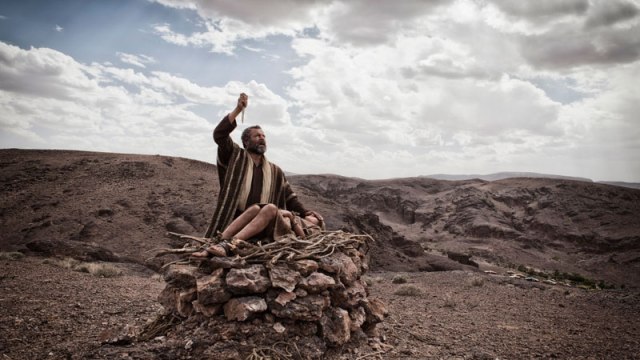
Isaac was known as the child of the promise. So that’s why this command of God was so perplexing: Take your son, this child of the promise, and go to the mountain and sacrifice him there. (Genesis 22:2)

Huh? What the #&%!  But it only seems strange and super-weird to us. There was no reaction from Abraham, no questioning, no talk back. He simply went about the business of saddling up the donkey, chopping some wood for the sacrifice, and took his only son with him on the journey to the mountain. (Genesis 22:3-5)

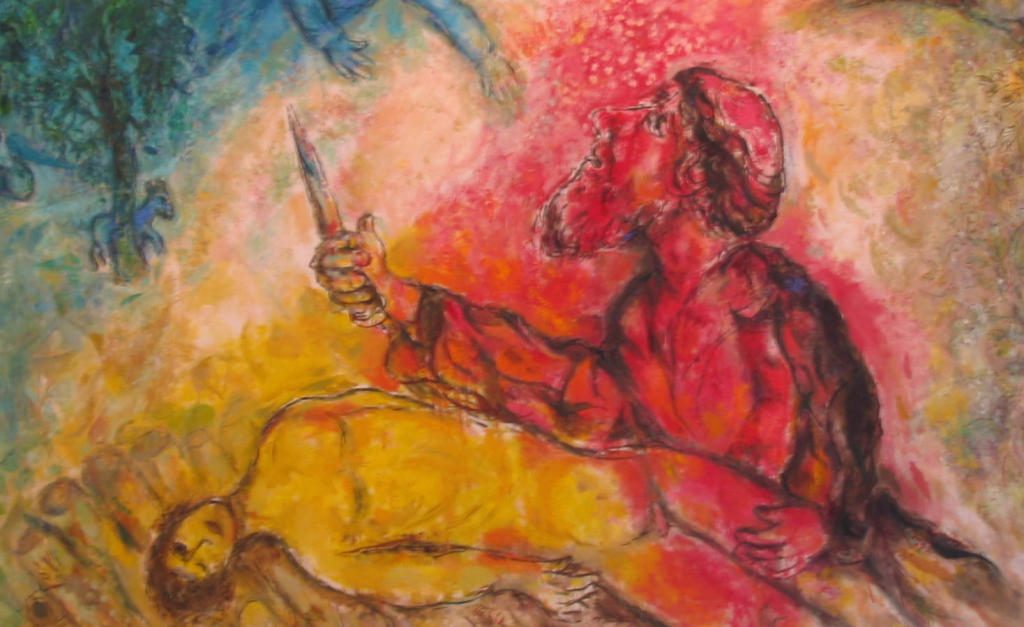
The Sacrifice of Isaac, by Marc Chagall, 1966

We might wonder what was going through Abraham’s mind through all of this. While you and I might try and figure out if we really heard God or not, Abraham had a history of talking with God. He knew God’s voice as well as he knew his own.

Abraham was well down the road of relationship with the God he served. We gain the insight from the author of Hebrews into Abraham’s thought process, a line of thinking consistent with a person who has a regular habit of talking with God.

The promise was given to Abraham that it would be Isaac who receives the family blessing. So, when Abraham’s faith underwent a maximum test, he was willing to sacrifice Isaac. He reasoned and believed that God could raise people to life. Abraham simply thought he would get Isaac back from death.

Abraham did not try and figure out God’s mind. He didn’t get into a debate with God about the contradiction of ethics he was being asked to do. He just obeyed. Abraham knew that it didn’t matter if Isaac were killed because God would raise him from death.

This, of course, is not what happened. It was all a test of faith. Abraham knew beyond a shadow of a doubt that God is the Lord who provides. (Genesis 22:9-14)

You and I, along with all the faithful believers who have gone before us, rarely know why we are facing the unwanted and unasked for circumstances we are enduring. We don’t always know what in the world God is thinking.

Yet, like Abraham, if we have a spiritual history of walking with God and hearing the Lord’s voice, we don’t hesitate to respond. We are convinced God will provide. Obedience for the follower of Christ is not a burden but a privilege, even when we are being tested beyond our seeming emotional ability to do it.

True biblical faith is neither an existential leap into darkness, nor a simple recognition of certain facts. Rather, Christian faith is a reliance upon and commitment to the promises of God that results in taking a risk. 

Sovereign Lord, your ways are sometimes strange and confusing. Yet, I know that everything you do is always right, just, and good. It is to your gracious and merciful character that I know you will provide. My allegiance is to you, in the Name of Jesus Christ, through the power of the Holy Spirit. Amen.

Recall the Faithfulness of God (Psalm 105:1-11, 37-45)

The Delivery of Israel out of Egypt, by Francis Danby, 1825

O give thanks to the Lord; call on his name;
    make known his deeds among the peoples.
Sing to him, sing praises to him;
    tell of all his wonderful works.
Glory in his holy name;
    let the hearts of those who seek the Lord rejoice.
Seek the Lord and his strength;
    seek his presence continually.
Remember the wonderful works he has done,
    his miracles and the judgments he has uttered,
O offspring of his servant Abraham,
    children of Jacob, his chosen ones.

He is the Lord our God;
    his judgments are in all the earth.
He is mindful of his covenant forever,
    of the word that he commanded for a thousand generations,
the covenant that he made with Abraham,
    his sworn promise to Isaac,
which he confirmed to Jacob as a statute,
    to Israel as an everlasting covenant,
saying, “To you I will give the land of Canaan
    as your portion for an inheritance….

Then he brought Israel out with silver and gold,
    and there was no one among their tribes who stumbled.
Egypt was glad when they departed,
    for dread of them had fallen upon it.
He spread a cloud for a covering
    and fire to give light by night.
They asked, and he brought quails
    and gave them food from heaven in abundance.
He opened the rock, and water gushed out;
    it flowed through the desert like a river.
For he remembered his holy promise
    and Abraham, his servant.

So he brought his people out with joy,
    his chosen ones with singing.
He gave them the lands of the nations,
    and they took possession of the wealth of the peoples,
that they might keep his statutes
    and observe his laws.
Praise the Lord! (New Revised Standard Version)

Some stories are worth repeating over and over again. For example, on the birthday of each of my children (and now grandchildren) I recount and remember their birth story; on Christmas, I read the first chapter of Luke’s Gospel to the family in order to recall and remember the birth of Jesus.

Psalm 105 is a remembering and retelling of the ancient Israelites’ exodus event, their deliverance from Egyptian slavery. That event permeates much of the Old Testament, and rightly so. God’s faithfulness, grace, and steadfast love dominates the psalm, namely because the Lord’s majesty, power, and sovereignty was overwhelmingly evident through the deliverance from Egypt.

And so, it is appropriate for the psalmist to express gratitude and praise to God in remembering that deliverance. It only makes sense, in such a retelling, that we are encouraged to continually seek the Lord. Seeking the Lord is a common biblical admonition, and is linked to memories of what God has done in the past.

Glory in his holy name;
    let the hearts of those who seek the Lord rejoice.
Seek the Lord and his strength;
    seek his presence continually.
Remember the wonderful works he has done,
    his miracles and the judgments he uttered. (1 Chronicles 16:10-12, NRSV)

God graciously works in history by choosing a people and making a covenant with them. The Lord is faithful to that arrangement by giving them everything they need to maintain obedience on their end of the covenant. For God doesn’t merely call persons who are already equipped and ready for high level spiritual service. Rather, the Lord equips those who are called.

Abraham was called by God, not because he had some sort of superior spirituality or inclination toward the divine, but only because God chose him, period. And once he was called, Abraham doggedly and faithfully sought the Lord.

God brought the Israelites out of Egypt because of the covenant made to Abraham. The Lord promised him and his descendants a people and a land. It may have seemed that becoming enslaved in Egypt would negate the promise. But not so. The exodus happened.

Being freed from slavery, the people could seek the Lord and pursue knowing God without any hindrance or obstacle. From that point on, the people were expected to utilize their memory of God’s saving actions to seek God with all their heart, soul, and mind.

The entire aim of recounting God’s covenant and the exodus event is to remind the people to observe God’s commands. Since a powerfully good God has acted in history, then we are to keep the faith by embracing the powerfully good words of God and following them with the utmost commitment.

Remembering that we belong to God, enables us to keep on seeking the Lord throughout all of life, for the rest of our lives. The consistent retelling of deliverance stories can strengthen our faith and equip us for what is ahead.

When times are tough, it is good and helpful to recall the divine deliverance that has already happened. Our memory can then serve us well, by renewing our minds and energizing us to persevere in the spiritual life.

O Lord our God, we pray that your Spirit would guide and inspire our life and worship, our contemplation and our action. Open our mouths to sing and speak your praise, our ears to hear your Word, our eyes to see to you at work among us, and our hearts to receive your divine love. Help us to remember your goodness, seek your face continually, and serve you always. Amen.