A Sad Family Situation (2 Samuel 14:25-33)

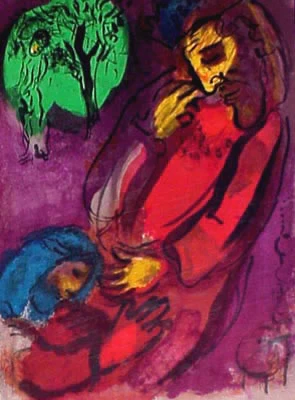
David and Absalom, by Marc Chagall, 1956

In all Israel there was not a man so highly praised for his handsome appearance as Absalom. From the top of his head to the sole of his foot there was no blemish in him. Whenever he cut the hair of his head—he used to cut his hair once a year because it became too heavy for him—he would weigh it, and its weight was two hundred shekels by the royal standard.

Three sons and a daughter were born to Absalom. His daughter’s name was Tamar, and she became a beautiful woman.

Absalom lived two years in Jerusalem without seeing the king’s face. Then Absalom sent for Joab in order to send him to the king, but Joab refused to come to him. So he sent a second time, but he refused to come. Then he said to his servants, “Look, Joab’s field is next to mine, and he has barley there. Go and set it on fire.” So Absalom’s servants set the field on fire.

Then Joab did go to Absalom’s house, and he said to him, “Why have your servants set my field on fire?”

Absalom said to Joab, “Look, I sent word to you and said, ‘Come here so I can send you to the king to ask, “Why have I come from Geshur? It would be better for me if I were still there!”’ Now then, I want to see the king’s face, and if I am guilty of anything, let him put me to death.”

So Joab went to the king and told him this. Then the king summoned Absalom, and he came in and bowed down with his face to the ground before the king. And the king kissed Absalom. (New International Version)

Parents are people, and so, they don’t always make sense. David was both a king and a parent. And those two roles often got mixed and complicated for him.

David’s son Abasalom had killed another son, Amnon, who had sexually assaulted a daughter, Tamar, Abasalom’s sister. Yes, it sounds a lot like a Bible soap opera.

Joab, David’s military general (and cousin) convinces the king to bring Absalom back to Jerusalem, having fled Jerusalem after killing Amnon. And David did so. Yet, he gave an order that Absalom was not to come into his presence, even though David longed for his son.

It was a case of the nonsensical – the parental approach of yearning for an adult child, while at the same time, shunning and shaming them. Indeed, these were incongruent actions on the part of David.

When Tamar was assaulted, David found out and was very angry; yet he neither dealt with Tamar by giving her support and compassion, nor dealt with Amnon in meting out justice.

As for Absalom, David’s feelings for him did not translate into action. It appears the story wants us to see the wide gap between King David’s emotions and actions.

Perhaps the emphasis on Absalom’s sheer beauty is designed to emphasize the incongruence of David – this handsome man is put at arm’s length by his father. Furthermore, this behavior would eventually put David’s royal position in jeopardy.

When guilt and shame are not confronted, it leads to a downward spiral into continued levels of degradation.

The assault of Tamar led to the murder of Amnon, which led to the inactions of David. Everyone ended up responding to someone else’s guilt by adding their own guilt to it. In this scenario, everyone loses something, and there is a lot of unnecessary grief.

Abasalom returned to his hometown of Jerusalem. But everything had changed. He was simply existing. Honestly, Absalom needed something, anything, instead of living day after day in a house without any love or acceptance. Absalom was in that awkward place of wanting either mercy or judgment, acceptance or punishment, because to live in limbo was shrinking him to nothing.

For those who know the story of David and Absalom, you understand where all of this family dysfunction is leading; and it will not end well.

It could be that Jesus had this story in the back of his head when he told the parable of the prodigal son (Luke 15). Perhaps Christ wanted us to see what could happen when a father chooses to respond with actions of grace, acceptance, and undeserved kindness. Even though the son had done something awful and was full of guilt, when he finally made his way home, the father ran to him, embraced him, and accepted him with a blowout party.

We can only wonder what would have happened had David stepped into the situations of his children’s lives when they were going awry. Methinks that had David done so, with his characteristic wisdom and mercy, there would have been a very different outcome in his family.

One way of viewing this story is that the incongruence of King David toward Absalom, with his combination of longing and rejection, was a stubborn passive-aggressive refusal to give his son the grace and love which God had given to him. In light of the story’s eventual end, this view makes a lot of sense.

Yet, this doesn’t have to be the same for you or me in our family relationships today. We can choose to love, instead of inflexibly holding on to a denial of love. One can do all the mental gymnastics of justifying that denial by believing you’re teaching the kid a lesson, or giving them what they deserve, but it’s really, at it’s core, choosing not to love with the love provided by God.

Réconciliation d’Absalom et de David, by Gabriel de Saint-Aubin, 1752

Absalom eventually entered David’s throne room and received a kiss. But it was simply too little, too late. And that’s why, at some point after this, Absalom decided to replace his emotionally and actively distant father as king.

If guilt, shame, evil, and sin go unchecked for too long, it makes for a terrible mess of people’s lives; and usually results in either verbal violence, physical violence, or both.

But it doesn’t have to be that way….

For being quick to see the sins of others, and slow to repent of our own, forgive us, Lord.

For clinging to remembered hurts, and brushing off gestures of kindness, forgive us, Lord.

For the divisions among us that damage our mission to the world, forgive us, Lord.

For the work we have not done because we refused to do it together, forgive us, Lord.

For these and all our sins, O God, we weep in sorrow and ask for your forgiveness, through Jesus Christ our Lord. Amen.

Family Drama (2 Samuel 13:37-14:24)

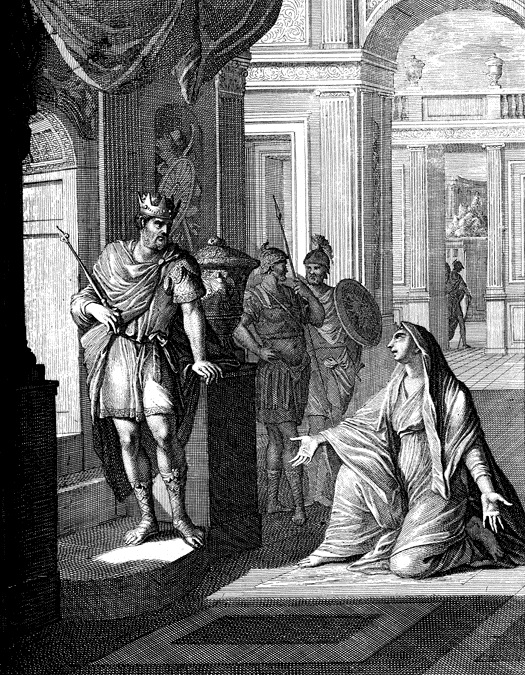
The woman of Tekoa before King David, by Caspar Luiken, 1700

Absalom fled and went to Talmai son of Ammihud, the king of Geshur. But King David mourned many days for his son.

After Absalom fled and went to Geshur, he stayed there three years. And King David longed to go to Absalom, for he was consoled concerning Amnon’s death.

Joab son of Zeruiah knew that the king’s heart longed for Absalom. So Joab sent someone to Tekoa and had a wise woman brought from there. He said to her, “Pretend you are in mourning. Dress in mourning clothes, and don’t use any cosmetic lotions. Act like a woman who has spent many days grieving for the dead. Then go to the king and speak these words to him.” And Joab put the words in her mouth.

When the woman from Tekoa went to the king, she fell with her face to the ground to pay him honor, and she said, “Help me, Your Majesty!”

The king asked her, “What is troubling you?”

She said, “I am a widow; my husband is dead. I your servant had two sons. They got into a fight with each other in the field, and no one was there to separate them. One struck the other and killed him. Now the whole clan has risen up against your servant; they say, ‘Hand over the one who struck his brother down, so that we may put him to death for the life of his brother whom he killed; then we will get rid of the heir as well.’ They would put out the only burning coal I have left, leaving my husband neither name nor descendant on the face of the earth.”

The king said to the woman, “Go home, and I will issue an order in your behalf.”

But the woman from Tekoa said to him, “Let my lord the king pardon me and my family, and let the king and his throne be without guilt.”

The king replied, “If anyone says anything to you, bring them to me, and they will not bother you again.”

She said, “Then let the king invoke the Lord his God to prevent the avenger of blood from adding to the destruction, so that my son will not be destroyed.”

“As surely as the Lord lives,” he said, “not one hair of your son’s head will fall to the ground.”

Then the woman said, “Let your servant speak a word to my lord the king.”

“Speak,” he replied.

The woman said, “Why then have you devised a thing like this against the people of God? When the king says this, does he not convict himself, for the king has not brought back his banished son? Like water spilled on the ground, which cannot be recovered, so we must die. But that is not what God desires; rather, he devises ways so that a banished person does not remain banished from him.

“And now I have come to say this to my lord the king because the people have made me afraid. Your servant thought, ‘I will speak to the king; perhaps he will grant his servant’s request. Perhaps the king will agree to deliver his servant from the hand of the man who is trying to cut off both me and my son from God’s inheritance.’

“And now your servant says, ‘May the word of my lord the king secure my inheritance, for my lord the king is like an angel of God in discerning good and evil. May the Lord your God be with you.’”

Then the king said to the woman, “Don’t keep from me the answer to what I am going to ask you.”

“Let my lord the king speak,” the woman said.

The king asked, “Isn’t the hand of Joab with you in all this?”

The woman answered, “As surely as you live, my lord the king, no one can turn to the right or to the left from anything my lord the king says. Yes, it was your servant Joab who instructed me to do this and who put all these words into the mouth of your servant. Your servant Joab did this to change the present situation. My lord has wisdom like that of an angel of God—he knows everything that happens in the land.”

The king said to Joab, “Very well, I will do it. Go, bring back the young man Absalom.”

Joab fell with his face to the ground to pay him honor, and he blessed the king. Joab said,

“Today your servant knows that he has found favor in your eyes, my lord the king, because the king has granted his servant’s request.”

Then Joab went to Geshur and brought Absalom back to Jerusalem. But the king said, “He must go to his own house; he must not see my face.” So Absalom went to his own house and did not see the face of the king. (New International Version)

By Bible Art

Absalom’s sister, Tamar, was sexually assaulted by their half-brother Amnon. As a result, Absalom brought Tamar to live in his house, because she had become a desolate woman.

When their father, King David, heard all this, he was, of course, furious; yet, he did nothing. And Absalom never talked to Amnon again; he hated Amnon because he had disgraced his sister Tamar.

For two years, Abasalom stewed on the terrible event of his sister’s assault. When the man’s bitterness came to it’s full poison, Abasalom created a ruse in order to kill Amnon. And the murderous plot was successful.

Then, Absalom fled and went to Geshur (north of Israel, in present day Syria) and stayed there three years. King David longed to go to Absalom, but he never did, nor did he do anything, either good or bad.

All of that stuff is what led up to today’s story about bringing Absalom back. When I was younger, I would read these stories of David and his sons and scratch my head as to why a guy that’s so wise to so many things seems stupid when it comes to his own family.

And then I became a father myself, with grown adult children. Now, I understand David’s actions and in-actions. I get it. When it comes to being a parent of adult kids, there is a very different perspective. It’s an outlook that’s hard to communicate and put into words.

Sometimes I wonder if it’s how God looks at us.

The nearest I can get to describing it, is that the sense of awe and wonder at that little baby being born never quite goes away.

The incredible and seemingly miraculous thing we call childbirth creates a view that this human being is so special, there is always hope they will become a little child again, that is, not literally, but in the sense of being yet again humble, right, good, and endearing – that the relational value will return.

In this sense, a parent never loses hope. And I think that is something of what King David was experiencing with his own adult children. What’s more, it seems that God has this unfailing love for us that continually longs for humanity to come back to the divine relationship.

God appears in Holy Scripture as this heavenly Father (and Mother) who is slow to judgment and long on steadfast love and covenant loyalty. The Lord is not slow in keeping promises or doing what is right. Rather, God is patiently waiting for humans to come to repentance and faith.

Admittedly, there is the sense that King David seems unreasonable, that he was unwilling to do something about his adult children’s shenanigans. Yet, there is also this sense of longing, of King David knowing the potential of his children, and holding out the hope that they will live into who they were created to be on this earth.

I definitely don’t think David always got it right. But he also didn’t always get it wrong, either. Which is pretty darned close to how every parent is doing, if we are honest about it. So, here is a blessing for parents of adult children:

May the Lord bless your adult children with the gift of the Holy Spirit. May they be filled with faith, hope, love, peace, truth, and spiritual power, so that they may be blessed and be a blessing to others.

And may God guide parents everywhere with discernment and wisdom, so that everything they do will come from the place of grace, truth, and love. Amen.