

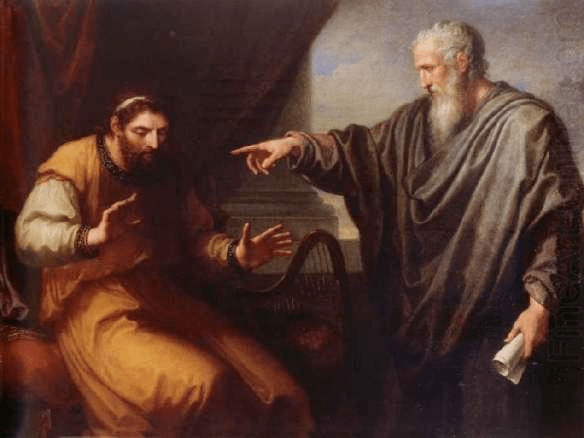
After Nathan had gone home, the Lord struck the child that Uriah’s wife had borne to David, and he became ill. David pleaded with God for the child. He fasted and spent the nights lying in sackcloth on the ground. The elders of his household stood beside him to get him up from the ground, but he refused, and he would not eat any food with them.
On the seventh day the child died. David’s attendants were afraid to tell him that the child was dead, for they thought, “While the child was still living, he wouldn’t listen to us when we spoke to him. How can we now tell him the child is dead? He may do something desperate.”
David noticed that his attendants were whispering among themselves, and he realized the child was dead. “Is the child dead?” he asked.
“Yes,” they replied, “he is dead.”
Then David got up from the ground. After he had washed, put on lotions and changed his clothes, he went into the house of the Lord and worshiped. Then he went to his own house, and at his request they served him food, and he ate.
His attendants asked him, “Why are you acting this way? While the child was alive, you fasted and wept, but now that the child is dead, you get up and eat!”
He answered, “While the child was still alive, I fasted and wept. I thought, ‘Who knows? The Lord may be gracious to me and let the child live.’ But now that he is dead, why should I go on fasting? Can I bring him back again? I will go to him, but he will not return to me.”
Then David comforted his wife Bathsheba, and he went to her and made love to her. She gave birth to a son, and they named him Solomon. The Lord loved him; and because the Lord loved him, he sent word through Nathan the prophet to name him Jedidiah. (New International Version)
The backstory to today’s Old Testament lesson is that King David not only screwed up, but he also jumped off the diving board into a big nasty pool of immoral excrement.
He saw a woman, Bathsheba, and had to have her. Thinking of only his desire, and not her needs, or that she was a married woman, he used his royal authority to get her. And he slept with her. What’s more, she became pregnant by the king.
At that point, David went to the dark side by covering up his immorality and shame. He eventually went so far as to ensure that Bathsheba’s husband, Uriah (who was both an upright man and an innocent victim) was killed in battle. The king again used his authority to arrange a murder to look like a death in military battle.
With Uriah dead, David brought Bathsheba to his palace as another one of his wives. And no one was the wiser… Except God, who was very displeased with the entire affair. So, the Lord sent Nathan the prophet to David. Through the savvy use of parable, Nathan was successful in helping the king to see his own terrible guilt.
To King David’s credit, he came to the point of recognizing his great faults, and repented of his awful doings. And to God’s credit, David was forgiven.
However, despite the reality of repentance and forgiveness, there are still consequences to our actions. And what is heartbreaking, is that the effects of our bad decisions and bad actions can and do affect others.
As a result of one man’s sin, a woman was violated, a man was murdered, and a baby was conceived, born, and soon died.

King David came to the point of understanding this reality. True repentance, forgiveness, and faith, leads us to a real life which exudes genuineness and authenticity. It won’t undo the past; yet, it will affect the present, and can change the future – that is, if we let mercy and grace have its way.
David’s genuine fatherly love came from his restored place, and was shown by his authentic grieving and mourning. He did not want Bathsheba’s baby son to die. Yet, the child did die. Unfortunately, innocent people often become collateral damage because of another’s unthinking actions.
The king’s behavior, after the child died, shows his pained acceptance of the situation. And his consoling of Bathsheba is the first real evidence we have of David thinking of her instead of himself.
The story reassures us that God loves the next child born from Bathsheba and David. This baby (the future King Solomon) will not pay for his father’s crimes; nor will any other child that David fathers.
The typical trajectory of David’s life was to learn from God’s law and from the experiences God gave him. Yet, in the case of Bathsheba and Uriah, King David ended up learning the hard way that he could not rest on his laurels once he was in a secure and successful place in his life.
Maybe because David spent so much of his adult life facing life-and-death situations, that once he could relax a bit and not have to worry about his life, he let his spiritual and emotional guard down and fell into sin.
After committing adultery, David found himself in a spiritual and emotional place he had never been in before. Yet, instead of confessing his crime to God and making things right with Bathsheba and Uriah, he worked to cover up everything.
Specifically, shame is the place that David had never experienced before, at least to this degree. And when shame gets its poisonous talons into us, it is very hard to be open, real, genuine, and authentic.
In an effort to keep the secrets, the lies morph into more bad decisions, and more bad decisions become ever-increasing bad actions. It becomes a downward spiral of icky guilt which will never be assuaged apart from the divine tools of confession, repentance, faith, and reconciliation.
I trust and hope that it will not take a prophet like Nathan to show you and I how egregious some of our decisions and actions actually are.
Instead, we can make the daily decision to practice our spiritual disciplines, so that when we find ourselves in that good position of no longer having to fight for survival, we will be able to exercise wisdom from the largess of God’s grace which fills us.
Have mercy on me, O God,
according to your unfailing love;
according to your great compassion
blot out my transgressions.
Wash away all my iniquity
and cleanse me from my sin. Amen. (Psalm 51:1-2, NIV)

 Rev. Tim Ehrhardt