Abundant Life (1 Kings 8:1-21)

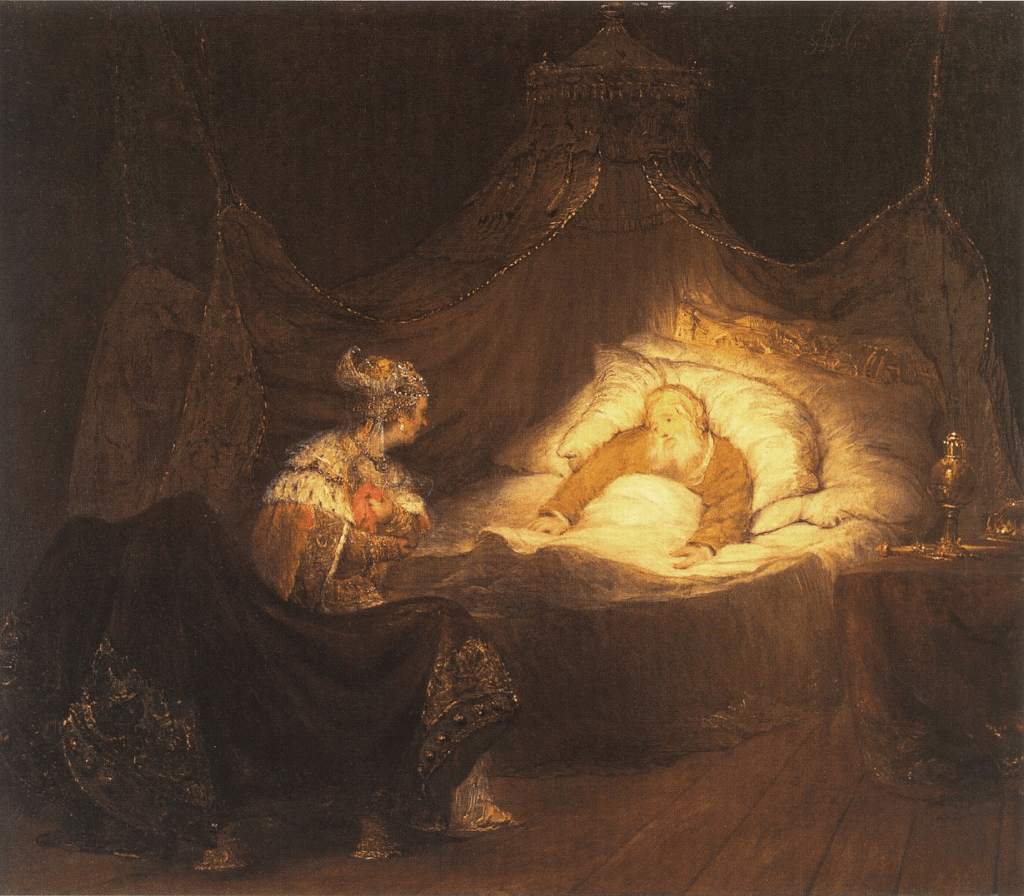
Solomon dedicates the Temple at Jerusalem, by James Tissot (1836-1902)

Solomon then summoned to Jerusalem the elders of Israel and all the heads of the tribes—the leaders of the ancestral families of the Israelites. They were to bring the Ark of the Lord’s Covenant to the Temple from its location in the City of David, also known as Zion. So all the men of Israel assembled before King Solomon at the annual Festival of Shelters, which is held in early autumn in the month of Ethanim.

When all the elders of Israel arrived, the priests picked up the Ark. The priests and Levites brought up the Ark of the Lord along with the special tent and all the sacred items that had been in it. There, before the Ark, King Solomon and the entire community of Israel sacrificed so many sheep, goats, and cattle that no one could keep count!

Then the priests carried the Ark of the Lord’s Covenant into the inner sanctuary of the Temple—the Most Holy Place—and placed it beneath the wings of the cherubim. The cherubim spread their wings over the Ark, forming a canopy over the Ark and its carrying poles. These poles were so long that their ends could be seen from the Holy Place, which is in front of the Most Holy Place, but not from the outside. They are still there to this day. Nothing was in the Ark except the two stone tablets that Moses had placed in it at Mount Sinai, where the Lord made a covenant with the people of Israel when they left the land of Egypt.

When the priests came out of the Holy Place, a thick cloud filled the Temple of the Lord. The priests could not continue their service because of the cloud, for the glorious presence of the Lord filled the Temple of the Lord.

Then Solomon prayed, “O Lord, you have said that you would live in a thick cloud of darkness. Now I have built a glorious Temple for you, a place where you can live forever!”

Then the king turned around to the entire community of Israel standing before him and gave this blessing: “Praise the Lord, the God of Israel, who has kept the promise he made to my father, David. For he told my father, ‘From the day I brought my people Israel out of Egypt, I have never chosen a city among any of the tribes of Israel as the place where a Temple should be built to honor my name. But I have chosen David to be king over my people Israel.’”

Then Solomon said, “My father, David, wanted to build this Temple to honor the name of the Lord, the God of Israel. But the Lord told him, ‘You wanted to build the Temple to honor my name. Your intention is good, but you are not the one to do it. One of your own sons will build the Temple to honor me.’

“And now the Lord has fulfilled the promise he made, for I have become king in my father’s place, and now I sit on the throne of Israel, just as the Lord promised. I have built this Temple to honor the name of the Lord, the God of Israel. And I have prepared a place there for the Ark, which contains the covenant that the Lord made with our ancestors when he brought them out of Egypt.” (New Living Translation)
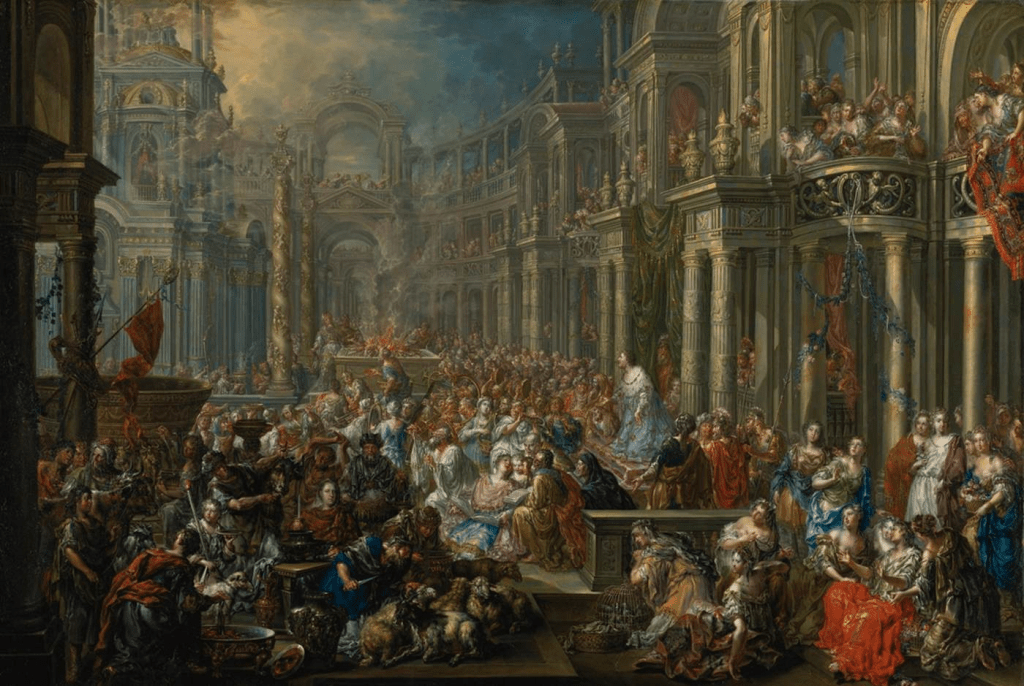
Dedication of Solomon’s Temple in Jerusalem, by Johann Georg Platzer (1704-1761)

I admit, at many times, that I am prone to melancholy. I tend to be quick at accepting blame, and rather slow at owning my good work. Another way of putting this is that it is easier to give than to receive.

Those who have endured a lot of hard circumstances, and persevered through many adversities, can sometimes be reticent to accept the good, the abundant, and the beautiful, whenever it comes to us in this life.

Waiting for the other shoe to drop, far too many people hold back themselves from receiving and enjoying the really good things in life. They worry that the goodness will disappear, or be taken away; and so, they withhold gratitude and blessing, whenever they are in the presence of great abundance.

Just so you know, in case there are those of you who need to hear it spelled out plainly: That’s messed up.

People are meant to be abundantly generous, as well as wildly receptive. It’s likely why there are so many spiritually unhealthy persons in the world.

Bless their hearts, they give a lot, without receiving much, and then their spiritual diarrhea makes it so they can’t give anymore. And they oftentimes give to those who are in such a habit of receiving (and not giving) that the receiver’s spiritual constipation becomes a terrible problem.

Let’s avoid both extremes by letting ourselves both give and receive with equal abandon. No one can be spiritually growing, healthy, and mature without the dynamic of giving and receiving.

Solomon knew how to do both. King Solomon was the king of abundance. He accepted and received big; and he gave and blessed big. Nobody before him or after him received and gave more.

The Temple, in all of its glory and grandeur, with the Ark of the Covenant encrusted with gold as the central object in the building, was all for a God who doesn’t live in houses, a God who is invisible.

In Solomon’s dedication of the Temple, he made it clear that the God of Israel is not, and cannot, be restricted to, or located within, a single place. Thus, the Lord is limitless, and not subject to any human manipulation.

God is free to give with great abandon. And God is also free to take away. Blessed be the name of the Lord God. If we continually try and anticipate or predict what God will do, we will likely be a nervous ball of anxiety all of the time, wondering when the unexpected and/or unwanted will visit us.

It is much better to receive the good things the Lord gives us, and enjoy them while we have them.

“I came that they may have life and have it abundantly.”

Jesus (John 10:10)

Nothing is permanent, with the exception of relationships and love. So, if we can connect the temporal material things of this life in service to the immaterial realities of this universe, then we are in a position to experience peace, joy, and satisfaction.

If and when the material disappears, or is taken away, then it shall neither defeat us, nor destroy us. For our relational connections with God and others exist, and are free flowing, with the energy of gracious receiving and giving as the conduit of abundant life.

Melancholy is important and has its place for us in this present life; yet, so do things like celebration, dedication, joy, exuberance, emotional commitment, and open love. Indeed, to have these in abundance is a reflection of the God of abundance, in whose name we are bold to pray:

God of abundance, you have fed us with the bread of life and cup of salvation; you have united us with Christ and one another; and you have made us one with all your people in heaven and on earth. Now send us forth in the power of your Spirit, that we may proclaim your redeeming love to the world and continue forever in the risen life of Christ our Savior. Amen.

For the Sake of Beauty (1 Kings 7:1-12)

King Solomon’s throne room, by Edward Poynter, 1890

Solomon’s palace took 13 years to build.

Forest Hall was the largest room in the palace. It was 44 meters long, 22 meters wide, and 13.5 meters high, and was lined with cedar from Lebanon. It had 4 rows of cedar pillars, 15 in a row, and they held up 45 cedar beams. The ceiling was covered with cedar. Three rows of windows on each side faced each other, and there were three doors on each side near the front of the hall.

Pillar Hall was 22 meters long and 13.5 meters wide. A covered porch supported by pillars went all the way across the front of the hall.

Solomon’s throne was in Justice Hall, where he judged cases. This hall was completely lined with cedar.

The section of the palace where Solomon lived was behind Justice Hall and looked exactly like it. He had a similar place built for his wife, the daughter of the king of Egypt.

From the foundation all the way to the top, these buildings and the courtyard were made out of the best stones carefully cut to size, then smoothed on every side with saws. The foundation stones were huge, good stones—some of them four and a half meters long and others three and a half meters long. The cedar beams and other stones that had been cut to size were on top of these foundation stones. The walls around the palace courtyard were made out of three layers of cut stones with one layer of cedar beams, just like the front porch and the inner courtyard of the temple. (Contemporary English Version)

By Bible Art

Having secured the throne after his father’s death, King Solomon set himself to the task of following his father David’s ardent desire to build a temple for the Lord. The work took seven years to complete. (1 Kings 5-6)

Then, Solomon turned to building a royal palace with a complex of buildings (or halls). It seems these had the purpose of being both residences and government structures. This architectural achievement took nearly twice as long as constructing the temple of God.

Some commentators are rather hard on Solomon about this fact of taking so much time to build himself a palace. They interpret him as being distracted, almost self-absorbed – that somehow his heart was more into his own buildings than God’s temple.

I don’t really buy into that line of thinking. It seems to me this reads more into the text than what’s there. They could be right. However, it appears such commentary does an anachronistic reading of the text. Taking a standpoint of Solomon’s later devotion to his many wives, and hence their many other gods, a lack of commitment is then superimposed upon the construction projects. It’s as if Solomon finished the temple stuff in order to get his real architectural passions.

I think there’s a more plausible explanation for King Solomon’s dedication to erecting buildings in addition to the temple. The editor of 1 Kings includes the detail and dedication that went into the temple.

Let’s keep in mind that King David had been stockpiling and preparing materials, and planning for the temple, well before he died. Just because the Lord told David that he would not be the one to build it, that Solomon would, did not mean that David kept his thoughts and his hands off of getting as much ready as he could for his son.

What’s more, once Solomon put together such a marvelous and intricate building as the temple, the experience gave him a desire to work on other projects, as well. Solomon had an expansive vision of his kingdom.

As the wisest person on earth, he put his money where his mouth was, by constructing beautiful structures given to justice, and reflecting the abundance of a goodness and justice which comes through living by God’s covenant code.

Did Solomon go overboard? Yes, and no. It depends on the project, and with whom you talk to. The issue of Solomon’s building projects, as I would frame it, has much more to do with demonstrating a particular theology.

The theology I believe Solomon was trying to reflect was that Israel serves a God who is given to beauty, justice, and abundance. And those qualities are also seen in the New Testament. I think of the story when Mary came to Jesus with her expensive and beautiful perfume:

Mary took a very expensive bottle of perfume and poured it on Jesus’ feet. She wiped them with her hair, and the sweet smell of the perfume filled the house.

A disciple named Judas Iscariot was there. He was the one who was going to betray Jesus, and he asked, “Why wasn’t this perfume sold for 300 silver coins and the money given to the poor?” Judas did not really care about the poor. He asked this because he carried the moneybag and sometimes would steal from it.

Jesus replied, “Leave her alone! She has kept this perfume for the day of my burial. You will always have the poor with you, but you won’t always have me.” (John 12:3-7, CEV)

I would argue that Judas Iscariot was the one distracted – and not Mary. Thus, returning to the story of Solomon’s building the palace complex, I would also argue that perhaps some of the commentators, with an eerily familiar criticism, are actually the ones distracted – and not Solomon.

Anyway, I like my positive reading of today’s Old Testament lesson, rather than the others’ negative reading. What about you?…

O heavenly God, who has filled the world with beauty: Open my eyes to see what is beautiful, to behold your gracious hand in all your works. Open my mind to know what is true. Open my heart to love what is good. May I learn to serve you with gladness, justice, and righteousness. Amen.

Pass Along Values (1 Kings 2:1-11)

David’s Dying Charge to Solomon, by Ferdinand Bol (1616-1680)

David’s time was coming to an end. So he commanded Solomon his son, “I’m following the path that the whole earth takes. Be strong and be a man. Guard what is owed to the Lord your God, walking in his ways and observing his laws, his commands, his judgments, and his testimonies, just as it is written in the Instruction from Moses.

“In this way you will succeed in whatever you do and wherever you go. So also the Lord will confirm the word he spoke to me: ‘If your children will take care to walk before me faithfully, with all their heart and all their being, then one of your own children will never fail to be on the throne of Israel.’ 

You should know what Joab, Zeruiah’s son, has done to me and what he did to the two generals of Israel, Abner, Ner’s son, and Amasa, Jether’s son. He murdered them, spilling blood at peacetime and putting the blood of war on the belt around his waist and on the sandals on his feet. So act wisely: Don’t allow him to die a peaceful death. 

“As for Barzillai’s sons from Gilead, show them kindness. Let them eat with you. When I was running away from your brother Absalom, they came to me. 

“Now as for this Shimei, Gera’s son—a Benjaminite from Bahurim—who is with you, he cursed me viciously when I went to Mahanaim. When he came down to meet me at the Jordan, I swore to him by the Lord, ‘Surely I won’t execute you with the sword.’ But you don’t need to excuse him. You are wise and know what to do to him. Give him a violent death.”

Then David lay down with his ancestors and was buried in David’s City. He ruled over Israel forty years—seven years in Hebron and thirty-three years in Jerusalem. (Common English Bible)

David

On David’s deathbed, he ensured that his son Solomon would be king. And David had some pragmatic advice to pass along, before he himself passed away.

Along with an encouragement to remain faithful to God’s covenant stipulations, David communicated some personal scores to Solomon that needed to be settled. Old general Joab, as well as Shimei, a servant from Saul’s old house, were threats to the new king’s reign in Israel and Judah.

Joab and Shimei

King David had a complicated relationship with Joab. At issue for David was the murder of two opponents to the king. Joab had killed them in a time of peace, and not because of a wartime situation.

On top of that, Joab had thrown his lot in with Adonijah, Solomon’s half-brother, who had tried to wriggle onto the throne before David was even gone.

And then there was the character Shimei. He had cursed David repeatedly when yet another half-brother to Solomon, Absalom, engaged in a coup attempt against his father.

Once the threat had passed, Shimei made a quick about face back to David. The king told Shimei that he would not kill him. But with Solomon, David communicated that he was completely free to do what needed to be done with the old rascal Shimei.

Fathers

Ideally, all fathers would have the chance to communicate to their children at the end of their lives. Yet, having been at the bedside of many a father in my work as a hospital chaplain, I’ve not seen many who pass along wisdom and instructions on their deathbed.

Fortunately, there are times when I can help facilitate the conversation between father and family. Yet, unfortunately, there are far too many times when fathers simply die with no loved ones present; or they badger someone to promise to stop doing something.

Rare, however, are the experiences of expressing some sound instruction, along with instructions about how to deal with life.

I realize that wills and documents do much of this work nowadays, yet I still argue that face-to-face communication which reinforces one’s values is always a good idea – especially at the end of one’s life.

Honestly, nobody really needs to wait until they are nearly gone to communicate important values and sage advice to loved ones. It can be done now, before it’s too late.

I’m talking about more than healthcare decisions for the actual end of life situation – but about the grace, forgiveness, wisdom, and/or moral values one wants their loved ones to know; or to reinforce those things that are of upmost importance.

It seems to me that thinking through the following values, and how to communicate them, can be done now, and, if appropriate and possible, at the end of one’s life:

Empathy

Treat others with compassion and understanding. Practice kindness. Consider the emotions of others. Seek to understand another’s point of view. Encourage family members to talk about their feelings. 

Therefore, as God’s choice, holy and loved, put on compassion, kindness, humility, gentleness, and patience. (Colossians 3:12, CEB)

Relationships

In the end, the only thing permanent and enduring is relationships. We cannot take any of our stuff with us. Prioritize time with people, especially family. It only makes sense to value loved ones by putting our time into them.

Be happy with those who are happy, and cry with those who are crying. Consider everyone as equal, and don’t think that you’re better than anyone else. (Romans 12:15-16, CEB)

Honesty

Telling the truth is not always easy, but it’s essential to maintaining trust between people. Life requires knowing and living by the truth.

“You are truly my disciples if you remain faithful to my teaching. Then you will know the truth, and the truth will set you free.” (John 8:31-32, CEB)

Love

Deep affection and attachment connects people and keeps them together. It’s important to verbally express love, as well as to demonstrate it with actions.

Don’t be in debt to anyone, except for the obligation to love each other. Whoever loves another person has fulfilled the Law. (Romans 13:8, CEB)

Commitment

Support one another in difficult times; and do not intentionally harm each other. Don’t shame your family for mistakes they’ve made. Instead, express loyalty and encouragement.

Be the best in this work of grace in the same way that you are the best in everything, such as faith, speech, knowledge, total commitment, and the love we inspired in you. (2 Corinthians 8:7, CEB)

Respect

Treat everyone, and especially family members, with the upmost care and politeness; and discourage disrespectful words and offensive behavior.

Submit to each other out of respect for Christ. (Ephesians 5:21, CEB)

Perseverance

Your family will face many complex challenges in the years ahead. Encourage them to embrace shared goals, practice self-care, and patiently work together in order to overcome obstacles. 

We even take pride in our problems, because we know that trouble produces endurance, endurance produces character, and character produces hope. (Romans 5:3-4, CEB)

It is always open season on passing along wise and good values, no matter whether it’s in a calm or a calamitous season of life.

Almighty God, enable me to be mindful of your mercy and happy to do your will. Bless my family with honest work, sound learning, and good manners. Save us all from violence, division, and confusion; and from pride and arrogance, and all evil. Protect us, and keep us united.

Grant Your wisdom to all in positions of authority and influence, so that there may be justice and peace at home, and obedience and submission everywhere. In times of prosperity, fill our hearts with grace and gratitude, and in times of trouble, help us trust in Your divine justice, righteousness, and goodness; through Jesus Christ our Lord. Amen. 

Dealing with Injustice (1 Kings 1:28-48)

Bathsheba appeals to David, by Arent de Gelder, c.1685

Then King David said, “Call in Bathsheba.” So she came into the king’s presence and stood before him.

The king then took an oath: “As surely as the Lord lives, who has delivered me out of every trouble, I will surely carry out this very day what I swore to you by the Lord, the God of Israel: Solomon your son shall be king after me, and he will sit on my throne in my place.”

Then Bathsheba bowed down with her face to the ground, prostrating herself before the king, and said, “May my lord King David live forever!”

King David said, “Call in Zadok the priest, Nathan the prophet and Benaiah son of Jehoiada.” When they came before the king, he said to them: “Take your lord’s servants with you and have Solomon my son mount my own mule and take him down to Gihon. There have Zadok the priest and Nathan the prophet anoint him king over Israel. Blow the trumpet and shout, ‘Long live King Solomon!’ Then you are to go up with him, and he is to come and sit on my throne and reign in my place. I have appointed him ruler over Israel and Judah.”

Benaiah son of Jehoiada answered the king, “Amen! May the Lord, the God of my lord the king, so declare it. As the Lord was with my lord the king, so may he be with Solomon to make his throne even greater than the throne of my lord King David!”

So Zadok the priest, Nathan the prophet, Benaiah son of Jehoiada, the Kerethites and the Pelethites went down and had Solomon mount King David’s mule, and they escorted him to Gihon. Zadok the priest took the horn of oil from the sacred tent and anointed Solomon. Then they sounded the trumpet and all the people shouted, “Long live King Solomon!” And all the people went up after him, playing pipes and rejoicing greatly, so that the ground shook with the sound.

Adonijah and all the guests who were with him heard it as they were finishing their feast. On hearing the sound of the trumpet, Joab asked, “What’s the meaning of all the noise in the city?”

Even as he was speaking, Jonathan son of Abiathar the priest arrived. Adonijah said, “Come in. A worthy man like you must be bringing good news.”

“Not at all!” Jonathan answered. “Our lord King David has made Solomon king. The king has sent with him Zadok the priest, Nathan the prophet, Benaiah son of Jehoiada, the Kerethites and the Pelethites, and they have put him on the king’s mule, and Zadok the priest and Nathan the prophet have anointed him king at Gihon. From there they have gone up cheering, and the city resounds with it. That’s the noise you hear. Moreover, Solomon has taken his seat on the royal throne. Also, the royal officials have come to congratulate our lord King David, saying, ‘May your God make Solomon’s name more famous than yours and his throne greater than yours!’ And the king bowed in worship on his bed and said, ‘Praise be to the Lord, the God of Israel, who has allowed my eyes to see a successor on my throne today.’” (New International Version)

Solomon at the deathbed of King David, by Giulio Romano (1499-1546)

One of King David’s sons, Adonijah, was a stinker. He tried to pull a fast one on his aging father, in order to try and take the throne. But some of the people caught wind of what was afoot.

Even Nathan the prophet got involved and gave some sage instructions to Bathsheba, Solomon’s mother, so that the king’s wishes could come to fruition – namely, that Solomon would succeed David.

As a result, despite King David’s struggles toward the end of life, he had enough wherewithal to attempt some decisive leadership. He confirmed Solomon as his royal successor.

Despite Adonijah’s attempt to take advantage of his father’s failing capacity and execute a coup d’état, the king immediately took action by anointing and enthroning Solomon without any delay.

The installation of Solomon as king was accomplished so quickly that it caught the conniving Adonijah and his cohorts off guard. King David may have lost several steps in his old age, but he was still someone to be reckoned with. That underestimation would cost the connivers dearly.

To be honest, I don’t like Adonijah. And that’s what the storyteller wants us to feel. We are meant to read the narrative and walk away saying to ourselves that we don’t want to be like Adonijah; we don’t want injustice to have the day; instead, we want King David’s wishes honored, and to see a just and right Ruler ensconced as king.

The Lord is a just God. And since we are people created in God’s image and likeness, we have an inherent sense of justice down deep inside us. So, it drives people nuts whenever there are things happening which are not right nor good.

Everyone faces injustice, and things that are not right, in this life. The trick is to deal with it, without becoming unjust ourselves. It’s not an easy thing to do. It’s tough. So, how do we maintain being just while handling injustice?

The feeling of helplessness is rather uncomfortable, even painful. It doesn’t feel good to think that your efforts at doing right and being just don’t accomplish much of anything, and are only a drop in the bucket of what’s needed. It also doesn’t feel right whenever we see others going through injustice, and we have little to no way in helping the situation.

The first step in dealing with the world’s injustice is to acknowledge it. Don’t purposely ignore it, avoid it, or pretend that it isn’t there. Everything in life must be acknowledged before anything can be done about it – whether it’s dealing with an event, or your own emotions.

So, it is imperative that your care for yourself. And it’s the most important thing in being of service and help to others. Attend to the whole self – body, mind, emotions, and spirit – because it is necessary in order to move through unjust circumstances with health, confidence, and sobriety.

When facing injustice and dealing with it, no matter whether it concerns yourself or another, it’s good to keep in mind that our brains tend to gravitate toward the negative, to the detriment of seeing good and positive things.

Therefore, we must work at keeping our “compassion quotient” high, and not let our compassion turn to fatigue, then burn-out.

It seems that King David continually worked on maintaining a robust spirit and healthy self, so that, even when he was old, his compassionate and wise instincts kicked in – the ones he had spent a lifetime developing.

In contrast, Adonijah appears to have nurtured a self-centered and bitter spirit. He did not attend well to his spiritual and emotional health. His mind turned to the dark thoughts of intrigue and rebellion. Arrogance clouded his right mind. This would not end well for him.

Dealing with injustice is never easy. And it very much requires us to be healthy and just ourselves, so that when we are faced with issues of justice, we can deal with them in a good and right manner.

Almighty God, you have given all peoples one common origin.
It is your will that they be gathered together
as one family in yourself.
Fill the hearts of humanity with the fire of your love
and with the desire to ensure justice for all.
By sharing the good things you give us,
may we secure an equality for all
our brothers and sisters throughout the world.
May there be an end to division, strife and war.
May there be a dawning of a truly human society
built on love and peace. Amen.