Why Are We Here? (Matthew 9:2-13)

Jesus heals and forgives a paralyzed man

Some men brought to him a paralyzed man, lying on a mat. When Jesus saw their faith, he said to the man, “Take heart, son; your sins are forgiven.”

At this, some of the teachers of the law said to themselves, “This fellow is blaspheming!”

Knowing their thoughts, Jesus said, “Why do you entertain evil thoughts in your hearts? Which is easier: to say, ‘Your sins are forgiven,’ or to say, ‘Get up and walk’? But I want you to know that the Son of Man has authority on earth to forgive sins.” So he said to the paralyzed man, “Get up, take your mat and go home.” Then the man got up and went home. When the crowd saw this, they were filled with awe; and they praised God, who had given such authority to man.

As Jesus went on from there, he saw a man named Matthew sitting at the tax collector’s booth. “Follow me,” he told him, and Matthew got up and followed him.

While Jesus was having dinner at Matthew’s house, many tax collectors and sinners came and ate with him and his disciples. When the Pharisees saw this, they asked his disciples, “Why does your teacher eat with tax collectors and sinners?”

On hearing this, Jesus said, “It is not the healthy who need a doctor, but the sick. But go and learn what this means: ‘I desire mercy, not sacrifice.’ For I have not come to call the righteous, but sinners.” (New International Version)

“The church is a hospital for sinners, not a museum of saints.”

Abigail Van Buren (“Dear Abby”)

Why does the Church exist? Why did Jesus come to this earth? What are we supposed to be doing? Does Christianity make any difference in this world? Why are we here?

The Church is not on this earth solely for the benefit of Christians, any more than a hospital exists for the benefit of the doctors or insurance companies.

Rather, the Church is designed to extend the mission of Jesus through proclamation of good news with the restorative touch of grace. The Church is the community of the redeemed, gathered together for worship and encouragement, and then sent into the world to be the continuing presence of Jesus on this earth.

This mean that the Church’s calling is not to find others who can help them with their tithing and budget, or to keep the pews warm with fresh bottoms.

Some folks are not healthy. Some are sick physically, and others spiritually. Even more are emotionally brokenhearted. And then there are those who are sick-and-tired of being sick-and-tired.

Please know that Jesus came neither to condemn nor heap a pile of unrealistic expectations on us. Christ points us to the source of healing and transformation, and invites us to come to him. 

Conversely, there are many other people today who are healthy, spiritually alive, and have a good well-being. And they possess the opportunity to participate in ways that bring holistic healing to the world as Christians. The mission of Jesus is our mission, as well.

Jesus came to bring forgiveness and transformation. In today’s Gospel healing, it was a case where the person’s paralysis was both physical and spiritual. The paralytic found in Jesus healing of both body and soul.
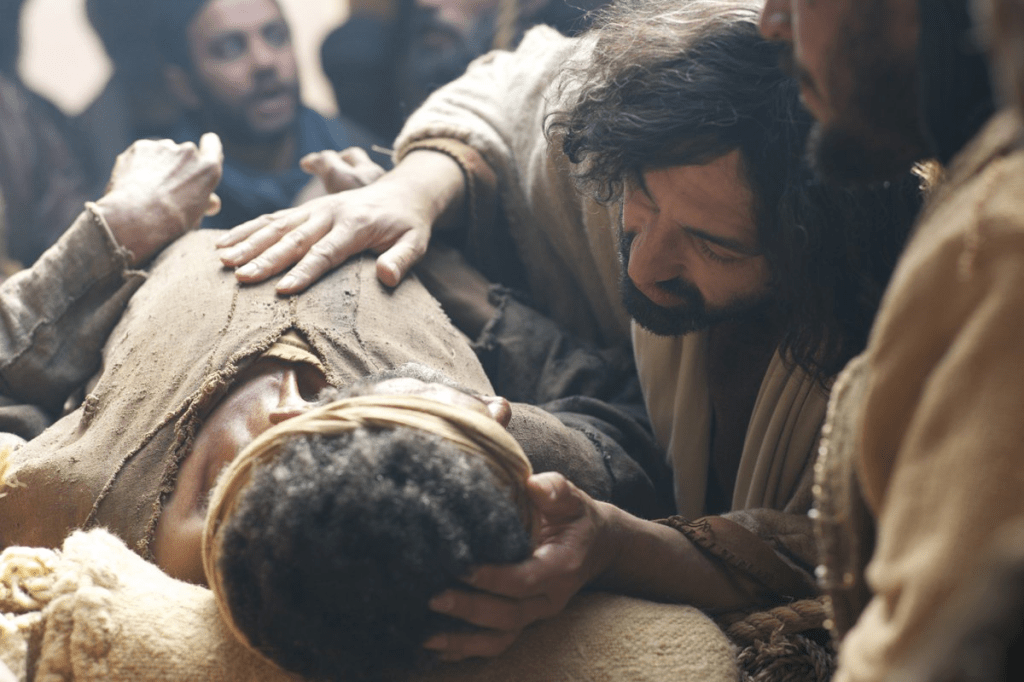
The religious insiders observed the healing of the paralytic. Yet, they didn’t rejoice over it. Instead, they were hung up on Jesus claiming to be God. Although this may have been a hard truth to accept, Jesus labeled their response as evil – because of an inability to perceive the situation as a divine intervention. Since the religious insiders wrongly discerned who Jesus is, they wrongly interpreted the situation. 

It’s important to see Jesus as the Human One who extends compassion and forgiveness. If we fail to see this about Christ, we will get caught up in all kinds of silly matters concerning personal preferences and power plays, based in how we think things should go, rather than how God is shaking out things.

Jesus came to forgive our guilt and shame. Healing the body is good, but it’s not enough. Christ came to heal both the body and the spirit. At the heart of the human condition is spiritual brokenness, and Jesus wants to remove the obstacle of sin and create a new healthy society. This is a radical vision which seeks to encompass all persons – which means Jesus touched many people overlooked by others.

Jesus came to call the despised people of society, the “sinners.” He called Matthew, a tax collector. Tax collectors were hated. They were corrupt characters who extorted money from innocent people. And furthermore, Jesus had dinner with Matthew, along with all of his unsavory buddies. This kind of behavior by Jesus was deeply offensive to upstanding citizens.

However, Jesus did not back down, saying that it’s not the healthy who need a doctor, but the sick. And he backed up his social actions with Scripture by encouraging offended folks to meditate on what the biblical phrase, “I desire mercy, not sacrifice.” (Hosea 6:6)

It is possible to engage in outward rituals of worship, do all the right things, fulfill duty, yet still miss the heart of what God wants for humanity. Mercy is what God wants. Jesus knew this. So, Christ entangled himself with sinners to bring spiritual healing and restoration.

If we want to see God deliver people from their unhealthy situations, we must entangle ourselves with them, into complicated lives that are not pretty, with persons who have been tainted by sin. 

Lots of people are in awful predicaments. Christians, like their Lord, will need to get their hands dirty and their feet wet to extend Christ’s ministry of mercy and forgiveness.

The gospel was never intended to be proclaimed from afar, but up close and personal. The merciful mission of Jesus requires the following three activities:

  1. Intimacy with Jesus. Engaging in the spiritual disciplines of prayer, giving, fasting, reading, and meditating on Scripture. These practices help us to know Christ better and how to respond with mercy.
  2. Intimacy with fellow believers. We are hard-wired by God for community. Superficial relationships only provide superficial community. Christians need to help one another with spiritual growth, and to hold one another accountable for the mission of Christ.
  3. Intimacy with “sinners.” This world is filled with sick, needy, hurting, and lonely people who are locked in unhealthy patterns of living. They need a merciful change of life that comes from the merciful Jesus acting through merciful Christians. 

Mercy, not judgment, is at the heart of all change. For things to be different, we must be acquainted with mercy.

Most merciful God, we confess we have sinned against you in thought, word, deed, and neglect. We have not held fast to your commandments and have strayed from your teachings. We turn away from self-centered actions and pride. For the sake of your Son, Jesus, have mercy on us and forgive us so that we are released from all sinful obstacles. Empower us with your wisdom, revelation, and discernment so that we might be your merciful hands, feet, and words to one another and those who do not yet know you. Amen.

Speak the Good Word (2 Timothy 4:1-5)

St. Paul the Apostle, Unknown artist

I’m giving you this commission in the presence of God and of Christ Jesus, who is coming to judge the living and the dead, and by his appearance and his kingdom. Preach the word. Be ready to do it whether it is convenient or inconvenient. Correct, confront, and encourage with patience and instruction. 

There will come a time when people will not tolerate sound teaching. They will collect teachers who say what they want to hear because they are self-centered. They will turn their back on the truth and turn to myths. But you must keep control of yourself in all circumstances. Endure suffering, do the work of a preacher of the good news, and carry out your service fully. (Common English Bible)

This letter from the Apostle Paul to Pastor Timothy was the last writing he ever crafted. Soon after sending this, according to historical tradition, Paul was martyred for his faith in the city of Rome, having been imprisoned there for two years. The letter contains some final words the Apostle wanted his young protégé to know that were important to him.

Paul left Timothy with a sacred charge to proclaim the gracious message of God – no matter the time nor circumstance – with all the divine patience and spiritual exhortation that the Lord gives.

A Word of Christ

The simple commission of Paul was to preach the word, proclaim the message, spread the good news. Paul called on Timothy to speak the word that God has spoken – the word passed on to him, first through his devout mother, then from his mentor, and finally from all the apostles. It’s a unified message of sound teaching concerning the person and work of Jesus Christ – God-breathed and committed to all God’s people who respond to the message in faith.

The responsibility is to not only hear the message, obey it, and guard it’s truth; the charge is to speak, to lift one’s voice and proclaim the message with confidence and without fear – because it is always open season on the proclamation of the gospel.

I don’t know what sort of picture this evokes for you to “preach the word.” Maybe you envision a preacher behind a pulpit in a church; or a guy with a bullhorn on a street corner; or an obnoxious coworker who takes any opportunity to puke the gospel onto another person; or some other picture which may be foreign to you.

Paul preaches in Athens, Unknown artist, 19th century

Please let me assure you that the Apostle Paul was not talking about any of those sorts of scenarios. The image is one of letting out something which is already inside of you, burning to come out and be heard.

It is to be so full of the life of Christ, that the words which come out of you are filled with that very life – a message of grace, redemption, hope, forgiveness, and love. And communicated in a way that also reflects the person of Jesus – an affect, gestures, posture, and tone of voice that resonates with another and is winsome, not annoying.

A Relevant Word

The person who proclaims the message of Christ does so in order to convince, encourage, rebuke, inform, and love. The messenger tells what another needs to hear, and not necessarily what they want to hear. This is a word that speaks to anyone in any situation within any sort of context or culture.

To speak with relevance in no way waters down the message of Christ. Rather, it means that the speaker takes great pains to talk in such a way as to help another in their own circumstance. Utilizing the mind and emotions, as well as the spirit, the preacher presents ideas, ethics, and feelings in order to announce good news.

And we are to always be patient with others. One must never resort to pressurized sales tactics to force another into the kingdom of God. The Word of God is a gracious message that provides life; and is not a big thick Bible that is used to smack somebody upside the head with condemnation.

Our responsibility is to be faithful in handling the message and proclaiming it with mercy. It is the Holy Spirit’s job to woo people to Jesus and purify them.

Don’t throw all over somebody a bucket of judgment, as if you are acting for God. Impatience, impertinence, impoliteness, and being impetuous, all belong to the devil’s imps, and have nothing to do with announcing good news of great joy for all the people.

An Uncompromising Word

Timothy lived in a society that was difficult in proclaiming the message of Jesus Christ. He lived in a city that had a grand temple to the goddess Artemis. He walked around seeing unethical practices and dubious living. Any of us would likely understand if Timothy shrunk back from having a bold proclamation of Christianity.

Paul speaking in the synagogue, a 12th century Byzantine mosaic

But the Apostle Paul was calling Timothy to preach good news without shrinking or shirking the message. One might be tempted to simply tell others what they’d like to hear and not stir the pot and cause any sort of conflict. Not everyone wants to hear the truth. For everyone who genuinely responds to a truthful and merciful message, there are four more persons who want none of it. They want what they want, and if someone says different, they’ll make their life hell.

These are the conspiracy theorists who would rather entertain spicy nuggets of opinion and speculation, than listen to evidence-based research and professionally peer reviewed material. They ground their ideas according to subjective taste and forsake objective documentation and witness.

Paul did not want Timothy coddling such persons or giving into them in any form whatsoever, because they have a severe hearing problem. People who won’t listen, constantly interrupt others, and believe they are always right, need a good dose of the uncompromising word of Christ.

In the face of those who refuse to listen and use their ears for good, Timothy was exhorted by Paul to be a steady teacher who keeps presenting the truth in intellectually and emotionally responsible ways. Timothy may have to endure suffering and put up with a bunch of simpletons giving him a hard time, but he was never to back down from sound and solid apostolic teaching.

It’s important that we all maintain a sense of emotional calm and intellectual soundness amidst all the crud within a given society. The believer is to avoid a discouragement that leads to abject silence.

Let us not be deterred from saying and doing what is right, just, and good. And let’s make sure that in the words we say and the behavior we display, there is the very life of Jesus Christ oozing out of us.

There are more than enough bad words being spoken every day; let’s instead speak the good word, full of grace and truth.

Soli Deo Gloria

Selective Memory (Psalm 25:1-10)

To you, O Lord, I lift up my soul.
O my God, in you I trust;
    do not let me be put to shame;
    do not let my enemies exult over me.
Do not let those who wait for you be put to shame;
    let them be ashamed who are wantonly treacherous.

Make me to know your ways, O Lord;
    teach me your paths.
Lead me in your truth and teach me,
    for you are the God of my salvation;
    for you I wait all day long.

Be mindful of your mercy, O Lord, and of your steadfast love,
    for they have been from of old.
Do not remember the sins of my youth or my transgressions;
    according to your steadfast love remember me,
    for the sake of your goodness, O Lord!

Good and upright is the Lord;
    therefore he instructs sinners in the way.
He leads the humble in what is right
    and teaches the humble his way.
All the paths of the Lord are steadfast love and faithfulness,
    for those who keep his covenant and his decrees. (New Revised Standard Version)

I admit there are things from my past I am neither proud of nor happy about. Yet, I give praise and thanksgiving to the Lord God Almighty because of divine selective memory. 

“I will forgive their iniquity and remember their sin no more.”

God (Jeremiah 31:34, NRSV)

God remembers according to the divine nature and God’s character of merciful grace and steadfast love. I’m glad the Lord doesn’t act based upon the stupid sins of my younger yesteryear. God freely chooses to forgive and has made the means available for us to experience daily cleansing and victory through the Lord Jesus Christ.

Memory is a major theme in the Old Testament. The importance of remembering pops up again and again throughout Holy Scripture. The way in which our minds and hearts remember past events is of great spiritual significance. 

Remember that you were a slave in the land of Egypt, and the Lord your God brought you out from there with a mighty hand and an outstretched arm; therefore the Lord your God commanded you to keep the Sabbath day. (Deuteronomy 5:15, NRSV)

“And remember, I am with you always, to the end of the age.”

Jesus (Matthew 28:20b, NRSV)

Remember Jesus Christ, raised from the dead, a descendant of David—that is my gospel, for which I suffer hardship, even to the point of being chained like a criminal. But the word of God is not chained. (2 Timothy 2:8-9, NRSV)

We are not to keep dwelling upon and remembering the former indiscretions of ourselves or others. To continue ruminating on a foolish decision or a poor choice only erodes our ability for resilience and perseverance.

The fact of the matter is that God does not hold those past regrets over our heads, and so, neither are we to do it. Forgiveness isn’t only for others; it’s meant to be directed to ourselves, as well. The ability to forgive enables us to leave the past in the past, without belching it up every day and chewing on it, like a cow with her cud.

Sometimes we are prone to remember the things we ought to forget, and forget those things we really should remember. Before us and in our minds continually is to remember the great works of God, especially in redemption. 

Forgetting what lies behind and straining forward to what lies ahead, I press on toward the goal, toward the prize of the heavenly call of God in Christ Jesus. (Philippians 3:13b-14, NRSV)

What we have done or failed to do, and what has happened to us in the past, is not the real problem; the most prescient issue right now is how you and I interpret those past events.

Today we can choose to remember the way God remembers. The health of all our relationships is dependent on this ability. Everyone on planet earth encounters difficult people, challenging relationships, obnoxious neighbors, and hurtful family members. Paying attention to our memory and how we choose to remember can be a significant part of interacting with others. 

I do not cease to give thanks for you as I remember you in my prayers, that the God of our Lord Jesus Christ, the Father of glory, may give you a spirit of wisdom and revelation as you come to know him. (Ephesians 1:16-17, NRSV)

If we like it that God has shown grace to us, then the least we can do is let that same grace flow from us to others – and to ourselves – we who neither deserve it, nor expect it. 

Let’s give thanks to the Lord, for God is good in forgiving sin and showing infinite mercy. And let’s express our gratitude through selfless words and acts of grace which reflect the nature of God.

Gracious God, you do not hold grudges; you always act according to your own loving character. Even though you could have condemned me, you saved me. Despite the fact that I have fallen short of your glory, you delivered me. I today remember your mighty redemptive deeds accomplished in your Son, my Lord, Jesus Christ, who with you and the Holy Spirit are one God, now and forever. To you, blessed Holy Trinity, I give my abiding praise and thanksgiving. Amen.

What Do You Value? (Matthew 6:1-6, 16-21)

The Sermon on the Mount, by Beryl Lewis (1939-2021)

“Be careful not to practice your righteousness in front of others to be seen by them. If you do, you will have no reward from your Father in heaven.

“So when you give to the needy, do not announce it with trumpets, as the hypocrites do in the synagogues and on the streets, to be honored by others. Truly I tell you, they have received their reward in full. But when you give to the needy, do not let your left hand know what your right hand is doing, so that your giving may be in secret. Then your Father, who sees what is done in secret, will reward you.

“And when you pray, do not be like the hypocrites, for they love to pray standing in the synagogues and on the street corners to be seen by others. Truly I tell you, they have received their reward in full. But when you pray, go into your room, close the door and pray to your Father, who is unseen. Then your Father, who sees what is done in secret, will reward you….

“When you fast, do not look somber as the hypocrites do, for they disfigure their faces to show others they are fasting. Truly I tell you, they have received their reward in full. But when you fast, put oil on your head and wash your face, so that it will not be obvious to others that you are fasting, but only to your Father, who is unseen; and your Father, who sees what is done in secret, will reward you.

“Do not store up for yourselves treasures on earth, where moths and vermin destroy, and where thieves break in and steal. But store up for yourselves treasures in heaven, where moths and vermin do not destroy, and where thieves do not break in and steal. For where your treasure is, there your heart will be also. (New International Version)

Spiritual Disciplines

In Christ’s day, there were three spiritual disciplines that were especially important: giving, prayer, and fasting. For the Jewish faithful, these three practices were meant to work together in helping them to know God and serve others. 

Yet, over time, although the disciplines were maintained, they were observed for all the wrong reasons. Jesus was concerned to communicate that not only are people to do the right thing, but that they do the right things for the right reasons.

To do any less, is to be a hypocrite who maintains an outward form of religion, but is inwardly motivated by the praise and recognition of others. Such a person is, in reality, far from God. 

Ash Wednesday is the beginning of Lent on the Christian Calendar. This season is a time devoted to spiritual disciplines, especially fasting.

Fasting

Those who truly hunger and thirst for righteousness take the time eat spiritual food in order to pursue God and seek right relationships in this world. It’s not a matter if we fast, but when.

The Bible has a great deal to say about fasting:

  • Fasting is a sign of humility and brokenness before God in recognizing both personal and corporate guilt. (1 Samuel 7:2-6)
  • Fasting is a means of preparation for ministry. Jesus used fasting in the desert as preparation for his ministry, and to face down the devil (Matthew 4:1-2). And the apostles fasted when seeking God’s direction about a new ministry. (Acts 13:2-3)
  • Fasting is meant to connect with God and serve others; and not to simply go through the motions. (Isaiah 58:3-7)

Therefore, fasting is a time to get in touch with God, to know the divine will, and then to do it. 

God doesn’t operate on a point system. If we only go through the motions of a spiritual discipline, or do it so that others will notice that I am doing my duty, then we have come under the condemnation of Jesus and are proved as hypocrites.

True fasting in an outward practice reflecting an inner attitude of heart; it’s an expression of devotion in order to connect with God and do good works of service to others.

Framing the topic another way: Why don’t we fast? Because it’s culturally okay not to? Because nobody cares whether I do, or don’t?

The spiritual disciplines of giving, praying, fasting, and other Christian practices have changed my life because they are a vital means of connecting with God and engaging the world.

A farmer disciplines himself to plow, plant, and cultivate – not because he wants to impress others (“Y’all see my big ol’ tractor and my implements!?”) but so that he will receive the reward of reaping a harvest at the proper time. 

So, we also, can engage in spiritual disciplines, like fasting, in order to see a harvest of righteousness.

Earthly vs. Heavenly Treasure

Do not store up for yourselves treasures on earth. What are earthly treasures? It’s stuff, money, possessions, as well as control, power, position, and recognition from others.

You may rightly ask, “Is this really, in and of itself, wrong?” No, it’s not. The real question is not whether we possess earthly treasure (because we all do) but rather:

Do I use my earthly treasure to build heavenly treasure? Do I hoard earthly treasure for my own purposes apart from Christ’s kingdom values?

Jesus once illustrated the difference:

Someone in the crowd said to him, “Teacher, tell my brother to divide the inheritance with me.” 

Jesus replied, “Man, who appointed me a judge or an arbiter between you?” 

Then he said to them, “Watch out! Be on your guard against all kinds of greed; life does not consist in an abundance of possessions.” 

And he told them this parable: “The ground of a certain rich man yielded an abundant harvest. He thought to himself, ‘What shall I do? I have no place to store my crops.’ “Then he said, ‘This is what I’ll do. I will tear down my barns and build bigger ones, and there I will store my surplus grain. And I’ll say to myself, “You have plenty of grain laid up for many years. Take life easy; eat, drink and be merry.”’  “But God said to him, ‘You fool! This very night your life will be demanded from you. Then who will get what you have prepared for yourself?’ 

“This is how it will be with whoever stores up things for themselves but is not rich toward God.”(Luke 12:13-21, NIV)

Again, earthly possessions are tools to be used; and not for accumulating personal wealth, esteem, and success for the sake of security in money. Rather, everything the Christian has is for the advancement of God’s kingdom values. 

Why do this? Because earthly treasure is temporary, and heavenly treasure is permanent. 

Is what you are pursuing today really going to matter in 50 billion millennia?

Heavenly treasure is righteousness as defined by Jesus: right relationships with both God and other humans.  Humility, peace, grace, mercy, purity, forgiveness are all relational values. The only thing that we will take with us when we die is relationships.

If I am genuinely committed to God’s kingdom, my most cherished values will be established by God. 

Our real values consume our thoughts and our efforts; what is in our hearts directs our work. And our ultimate values derive from how we perceive our identity. 

For a great many Americans, the primary noun that characterizes and defines us is not American Christians, not American citizens, not American workers; we are known primarily as American Consumers. 

Jesus is not necessarily advocating that we take vows of poverty, or that we ought not to enjoy the good things we have; what he is asking of us is to make a decision where your loyalty is placed.

Spiritual disciplines such as fasting help us to maintain our most cherished values, to see them clearly, and to choose wisely based upon those values.

May it be so, to the glory of God. Amen.