

Spiritual Strength (Daniel 10:2-19)

At that time I, Daniel, mourned for three weeks. I ate no choice food; no meat or wine touched my lips; and I used no lotions at all until the three weeks were over.

On the twenty-fourth day of the first month, as I was standing on the bank of the great river, the Tigris, I looked up and there before me was a man dressed in linen, with a belt of fine gold from Uphaz around his waist. His body was like topaz, his face like lightning, his eyes like flaming torches, his arms and legs like the gleam of burnished bronze, and his voice like the sound of a multitude.

I, Daniel, was the only one who saw the vision; those who were with me did not see it, but such terror overwhelmed them that they fled and hid themselves. So I was left alone, gazing at this great vision; I had no strength left, my face turned deathly pale and I was helpless. Then I heard him speaking, and as I listened to him, I fell into a deep sleep, my face to the ground.

A hand touched me and set me trembling on my hands and knees. He said, “Daniel, you who are highly esteemed, consider carefully the words I am about to speak to you, and stand up, for I have now been sent to you.” And when he said this to me, I stood up trembling.

Then he continued, “Do not be afraid, Daniel. Since the first day that you set your mind to gain understanding and to humble yourself before your God, your words were heard, and I have come in response to them. But the prince of the Persian kingdom resisted me twenty-one days. Then Michael, one of the chief princes, came to help me, because I was detained there with the king of Persia. Now I have come to explain to you what will happen to your people in the future, for the vision concerns a time yet to come.”

While he was saying this to me, I bowed with my face toward the ground and was speechless. Then one who looked like a man touched my lips, and I opened my mouth and began to speak. I said to the one standing before me, “I am overcome with anguish because of the vision, my lord, and I feel very weak. How can I, your servant, talk with you, my lord? My strength is gone and I can hardly breathe.”

Again the one who looked like a man touched me and gave me strength. “Do not be afraid, you who are highly esteemed,” he said. “Peace! Be strong now; be strong.”

When he spoke to me, I was strengthened and said, “Speak, my lord, since you have given me strength.” (New International Version)
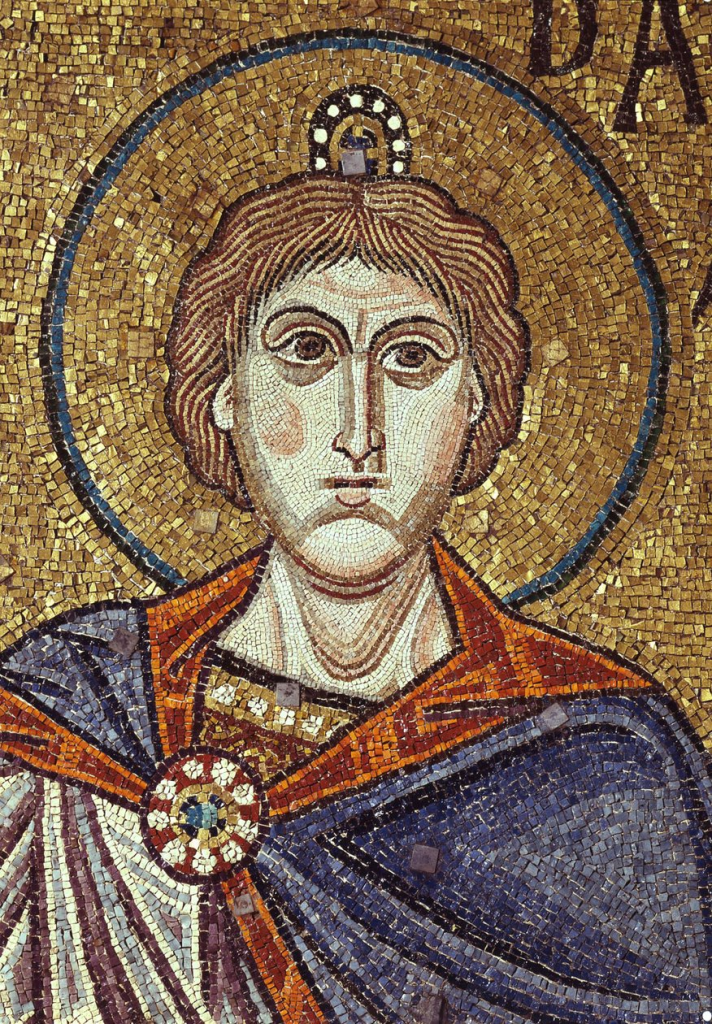
Byzantine mosaic of the prophet Daniel, 12th century, in St. Mark’s Basilica, Venice, Italy

Perhaps you, like me, have had the experience of praying, and feeling as if those prayers were only bouncing off the ceiling and never heard by God. But the Lord has been watching and listening all along. Although we may not get an immediate response, we will most certainly receive an answer to our prayers.

I am encouraged that God listened and was attentive to Daniel. The prophet had put himself in a position to hear God, so that when the Lord responded, Daniel was able to receive what was given to him.

The spiritual disciplines which Daniel was practicing almost seems like the guy was observing Lent. For three weeks, he gave up certain foods, did not eat meat, drank no wine; and he didn’t take a bath. He did all of this because he was troubled in spirit.

Daniel’s outward practices were congruent with his inward disposition. This is a far cry from our modern predilection for keeping up appearances, even though we are dying inside. But Daniel was not like us. He stopped his normal routines in order to give himself to prayer and a partial fast.

The Jews had been in exile for 70 years, and there was no sign of them going back to Jerusalem. And that troubled Daniel to no end – because the prophet Jeremiah had said the people would be in captivity for that long (Jeremiah 29:10). Daniel knew that fulfillment of the Lord’s promises would come by living in Palestine, and not by being exiled in Babylon.

While Daniel and his friends were together in a prayer meeting, Daniel experienced a vision; it was as if the veil separating this three-dimensional space from the spiritual dimension was lifted, and Daniel could see what was happening in the invisible realm.

Daniel’s prayers were being heard; they were not bouncing off the ceiling. And they were heard, I believe, because Daniel prayed according to his understanding of what God wants. He desired to participate in what God wanted, and not what he himself necessarily wanted.

And that is essentially what the Lord Jesus taught his followers in how to pray. We need not try and persuade God, as if we must be spiritual lawyers advocating for what we want. The Lord does not operate by twisting arms or harassing people; and neither ought we to try and treat God that way.

Prayer puts us in sync with what God wants. And as we desire to do God’s will, our prayers will reflect that desire. We only then need to ask. (Matthew 6:5-15; James 4:1-3)

Although God answers prayer, those responses are not always immediately put into effect. Daniel’s vision allowed him to see that there are other forces at work – dark forces – that oppose what God is doing. Sinister monkey wrenches are thrown into good plans and responses for people.

Behind the scenes of our lives, there are invisible powers which are influencing people. This is why our ultimate struggle is not on this visible realm; it is, instead, against the invisible demonic spirits of this present evil age.

Daniel saw and heard that behind the affairs of this world is a hierarchy of evil which seeks to control us for purposes contrary to God’s justice, peace, and goodness. Yet there is also an angelic host who are involved in ensuring that the Lord’s will is accomplished on this earth as it is always done in heaven.

Therefore, sometimes our delays in answered prayer have nothing to do with us; it may be because there is a great conflict happening in a dimension that you and I don’t see. In fact, if we do not have immediate answers to prayer, this is precisely the best time to persevere in prayer and not give up.

Through our perseverance in prayer, like Daniel, we are strengthened in faith. Our connection with God brings us peace and courage, emboldening us for continued wrestling in prayer and dealing with the structural and systemic evil that exists everywhere.

Faith is a belief in things we cannot see. Hope is the confidence of things which can happen. Love is a culmination of faith and hope coming together in order to make a difference in this fallen world. The Lord provides all the strength we need for the struggle. And there is perhaps no better model of how to deal with things and gain spiritual power than the prophet Daniel.

Strengthen us, O Lord, by your grace, so that we may overcome all spiritual enemies; and with pure hearts serve you; through Jesus Christ our Lord, who lives and reigns with you and the Holy Spirit, one God, for ever and ever. Amen.

Learning to Trust (Psalm 4)

Answer me when I cry out, my righteous God!
    Set me free from my troubles!
        Have mercy on me!
        Listen to my prayer!

How long, you people,
    will my reputation be insulted?
How long will you continue
    to love what is worthless
    and go after lies?
Know this: the Lord takes
    personal care of the faithful.
The Lord will hear me
    when I cry out to him.
So be afraid, and don’t sin!
    Think hard about it in your bed
    and weep over it!
Bring righteous offerings,
    and trust the Lord!

Many people say,
    “We can’t find goodness anywhere.
    The light of your face has left us, Lord!”
But you have filled my heart with more joy
    than when their wheat and wine are everywhere!
I will lie down and fall asleep in peace
    because you alone, Lord, let me live in safety. (Common English Bible)

The psalmist, David, was a man after God’s own heart. But that did not mean that he was inoculated from trouble and hardship.

David had a lot of adversity and much difficulty throughout his life. So, it only made sense to him to cry out to the Lord for deliverance and help. God had helped David in the past, and David was confident that the Lord would help him yet again.

We all find ourselves in a tight spot, between a rock and hard place, at times. It’s what we do when we are in that position that is critical. David had a history of looking to God, seeking God’s grace, and soliciting answers to prayer.

David, the psalmist, was a real victim of slander and lies. More than once in his life, he had people out to get him, to actually take his life. Whatever your understanding of stress is, it doesn’t get much more stressful than someone hunting you down like an animal to literally kill you. I’m sure that many times David wondered how long this surreal madness was going to go on.

Whenever we are especially stressed, it can be hard to even breathe. If we aren’t mindful of ourselves, we will take lots of short staccato breaths that only feed anxious signals to the brain. It leaves us in a perpetual state of hypervigilance, almost unable to pray and have thoughts of God.

But we absolutely need to take deep breaths and trust in God’s sustaining presence. We’ll never get to sleep, nor stay at rest, without a sense of the divine presence.

Insomnia happens for a lot of reasons. Many people have diagnosed sleep disorders that are very real medical conditions. Others can’t get a good night’s rest because of poor sleep hygiene by not planning for adequate sleep, drinking too much caffeine during the day, inattention to a healthy diet, or a host of other habits. Some have issues of chronic pain which can make it difficult to sleep well.

And then there are yet others who suffer from racing thoughts, anxiety, and depression. The stress of their waking life is so significant that several hours of deep sleep seems only like some pipe dream. It’s impossible to sleep when the weight of the day is pressing on you. Finding a sense of calm before bed isn’t easy—especially when you can’t unplug from the demands of your day.

I am wondering if many of us will even allow ourselves to unplug and establish some quiet wind-down time. Reading a real book – not one on a backlit tablet device – or talking with a friend or family member are simple ways of easing our anxiety and letting rest come.

The psalmist, David, had a regular practice of meditating on Scripture, recalling the events of God, and expressing gratitude and praise for answered prayer. Each of us has a built-in spiritual rhythm just like we have a circadian rhythm. Always trying to buck those God-given rhythms will inevitably result in being “off,” at the least, and experiencing debilitating depression, at the worst.

Yet, when we learn to move with the unforced rhythms of grace, there is a groove we slip into which serves us well. In other words, what I am trying to say, is that by allowing ourselves to be human, we can discover health.

David neither had delusions, nor illusions, about his enemies, friends, others, and himself. He didn’t try to be somebody he was not. Instead, David had firm and confident convictions about God and the place of prayer.

By taking in a steady diet of David’s psalms, we can learn to hold together both faith and doubt, confidence and confusion, perseverance and perplexity, in ways which strengthens our faith.

Everyone of us who desire God must learn to trust; and it’s in the school of hard knocks where our faith is developed in order to sustain us for a lifetime of service and resilience.

There will always be those who believe ill of us through slander, lies, or outright oppression. In such times, let’s cry out to God for both peace and guidance; and ask the Lord for help in learning to breathe, lie down, and get some rest.

As our trust develops, we may even find the grace and courage to confront our oppressors, so that they can seek their own peace with God.

May Christ be with you, and within you;
May Christ go before you, and linger behind you;
May Christ be on your right, and on your left;
May Christ hover above you, and bring support beneath you;
May the Lord Jesus Christ completely and thoroughly surround you, now and forever. Amen.

If You Ask a Question, Be Ready for the Answer (Mark 12:18-27)

The Pharisees and Sadducees Come to Tempt Jesus, by James Tissot (1836-1902)

Some Sadducees, who say there is no resurrection, came to him and asked him a question, saying, “Teacher, Moses wrote for us that if a man’s brother dies, leaving a wife but no child, the man shall marry the widow and raise up children for his brother. There were seven brothers; the first married and, when he died, left no children,and the second married the widow and died, leaving no children, and the third likewise; none of the seven left children. Last of all the woman herself died. In the resurrection, when they rise, whose wife will she be? For all seven had married her.”

Jesus said to them, “Is not this the reason you are wrong, that you know neither the scriptures nor the power of God? For when people rise from the dead, they neither marry nor are given in marriage but are like angels in heaven. And as for the dead being raised, have you not read in the book of Moses, in the story about the bush, how God said to him, ‘I am the God of Abraham, the God of Isaac, and the God of Jacob’? He is God not of the dead but of the living; you are quite wrong.” (New Revised Standard Version)

Two-thousand years ago, in the first century C.E. (Common Era) the Jewish Sadducees learned the hard way that trying to discredit Jesus in public with silly questions is a bad idea.

Somehow, probably in a back room and perhaps drinking too much wine, they came up with a story designed to show, once and for all, that Jesus was nothing but a hayseed yokel from the bumpkin village of Nazareth who believes in a crazy notion like resurrection.

The Sadducees wanted a very public and definitive display that Jesus was a backward hick, not worth the time of day. So, they concocted a bizarre hypothetical story meant to discredit the supernatural. 

The Sadducees went to the Old Testament, and pointed out in the law that if a man dies without having children, the brother must marry the widow, thus keeping the legacy and land of the dead man in his family. By conjecturing that if this were to happen seven times over, they posed a hypothetical question: Whose wife would she be among all the brothers at this supposed resurrection?

As they were snickering to themselves believing that they had demonstrated the absurdity of resurrection, Jesus turned the tables on the Sadducees. Here are some observational lessons from this Gospel reading for today:

  1. Think again before you try and trip-up Jesus with philosophically ethereal questions.
  2. Consider that you will receive a rebuke from Jesus for being ignorant, mistaken, and wrong, if you try to posture yourself and control how a conversation with him ought to go.
  3. Be aware that Abraham, Isaac, Jacob, and Jesus are all alive. The Sadducees, however, no longer exist.
  4. Realize that Jesus will take the time and attention to listen and give feedback – maybe the kind you weren’t looking for.
  5. Understand that many things we get hung up on, Jesus doesn’t – and what Jesus sticks on, we may act like Teflon and let it slide.

And the lessons could keep coming, because there is always something to learn and discover when being with Jesus.

To deny resurrection is to deny Jesus. Christ died. He’s now alive. Hence, there is a resurrection. More than that, because Christ lives, others live. This is the Christian’s hope. 

I fully understand plenty of people don’t believe in resurrection. That’s their prerogative. I will simply point such a person no further than their own mind and heart. “Search your feelings,” as the Jedi would say, “What do they tell you?” The evidence you need, you already have.

And this was the penultimate lesson of Jesus to the inquisitive Sadducees. They already had the answer to their question for Jesus. It was right under their noses the entire time – right their in the law that they valued so highly. They just plain didn’t see it.

You already have everything you need for life and godliness in this present evil age. There’s no need to play philosophical games with Jesus.

One of the great sages of the last century, Dorothy from The Wizard of Oz, wisely said:

“If I ever go looking for my heart’s desire again, I won’t look any further than my own backyard. Because if it isn’t there, I never really lost it to begin with.”

Resurrection has always been there because God has always been around – even when we don’t see, perceive, or acknowledge the divine. Just because one may not believe in life arising from death, doesn’t mean it isn’t there or doesn’t exist.

It probably would not be a good idea to procrastinate the inevitable end-of-life scenario that awaits us all. Anytime is the right time to do a bit of personal funeral planning. Yet, if we mire it all with the esoteric hypothetical questions about what would happen in the most far-fetched of scenarios, methinks God is big enough and smart enough to see through our puny charade.

Better to ponder what is truly within your own soul, and how Jesus might already be present within and around all things, without us even knowing it. 

A good place to start in peering within is to give a straightforward honest reading of the New Testament Gospels and discover what resonates deeply with you about the person and work of Jesus.

Feel free to question Jesus about anything you want; just brace yourself for what kind of answer you might receive.

Keep Your Spiritual Confidence (Psalm 135)

Praise the Lord!
    Praise the name of the Lord;
    give praise, O servants of the Lord,
you who stand in the house of the Lord,
    in the courts of the house of our God.
Praise the Lord, for the Lord is good;
    sing to his name, for he is gracious.
For the Lord has chosen Jacob for himself,
    Israel as his own possession.

For I know that the Lord is great;
    our Lord is above all gods.
Whatever the Lord pleases he does,
    in heaven and on earth,
    in the seas and all deeps.
He it is who makes the clouds rise at the end of the earth;
    he makes lightnings for the rain
    and brings out the wind from his storehouses.

He it was who struck down the firstborn of Egypt,
    both humans and animals;
he sent signs and wonders
    into your midst, O Egypt,
    against Pharaoh and all his servants.
He struck down many nations
    and killed mighty kings—
Sihon, king of the Amorites,
    and Og, king of Bashan,
    and all the kingdoms of Canaan—
and gave their land as a heritage,
    a heritage to his people Israel.

Your name, O Lord, endures forever,
    your renown, O Lord, throughout all ages.
For the Lord will vindicate his people
    and have compassion on his servants.

The idols of the nations are silver and gold,
    the work of human hands.
They have mouths, but they do not speak;
    they have eyes, but they do not see;
they have ears, but they do not hear,
    a nose, but there is no breath in their mouths.
Those who make them
    and all who trust them
    shall become like them.

O house of Israel, bless the Lord!
    O house of Aaron, bless the Lord!
O house of Levi, bless the Lord!
    You who fear the Lord, bless the Lord!
Blessed be the Lord from Zion,
    he who resides in Jerusalem.
Praise the Lord! (New Revised Standard Version)

Idolatry in the Bible is greatly discouraged. To trust in or worship an idol is a big deal in Holy Scripture, precisely because it is totally worthless. Trusting an idol to do anything for you would be like talking to a bowling ball and asking it to balance your checkbook. In other words, there is no chance whatsoever of a bowling ball or an idol helping you in your life with anything at all.

An idol has zero power or authority to accomplish what you need. Idols are impotent and helpless and can do nothing. Anybody who focuses on something that has no agency to act in the world will soon lose their own personal agency to act in the world. One who practices idolatry will become just like their idol: worthless.

So, if idolatry is so irrelevant, then why do many people put their trust in “gods” other than God? Because so many of us have a form of spiritual attention deficit disorder in which we become attracted to all the shiny deities in front of us. It is no coincidence that idols are consistently lacquered over with gold or silver in order to display an extravagant wealth, communicate prestige, and attract new worshipers.

Slick idol marketing presents that worthless thing as valuable, as something you cannot live without. This ability to seduce others into placing trust and value into the irrelevant object is largely why much of the Old Testament condemns idolatry and encourages destruction of idols.

But this is how you must deal with them; break down their altars, smash their pillars, hew down their sacred poles, and burn their idols with fire… The images of their gods you shall burn with fire. Do not covet the silver or gold that is on them and take it for yourself, because you could be ensnared by it; for it is abhorrent to the Lord your God. (Deuteronomy 7:5, 25, NRSV)

Idolatry drains the energy we could be using for worship and life toward the One true God. The idols are an affront to a committed life of faith relational connections. They are a distraction, siphoning away resources that are better used elsewhere. Perhaps most of all, idolatry skews our worldview; the idolator ceases using common sense, and begins moving toward useless endeavors that do not enrich the entire community.

Instead, we can praise the Lord, because God is good and has our best interests at mind. Not only that, but God also has the ability to follow through with divine promises made. A bowling ball can’t do that! (it can’t even make it so you can throw a perfect 300 bowling game).

God is gracious, and holds us close. We belong to God. Remember all the ways the Lord has delivered people in the past, and let that memory give you confidence moving forward.

One of the best ways to know if the worship of God is intact, is by noticing if worshipers act in generous, gracious ways to uphold the unity and peace of the faith community.

But if a community is characterized by division and special interest groups, and by distortions of faith that only champion their particular brand of belief, then you are likely looking at idolatry. If you observe this, get out fast, while you can.

Whenever people are able to bless one another and bless the world, they themselves have received blessing from God. But if they continually curse each other and bemoan the world, then its time to leave. This earthly life is too short for messing around with a bunch of useless idolatry that gets us nowhere.

Maintaining faith in God – and not in something or someone else – will enable us to deal with our doubts and see the power of the Lord all around us.

O God, come to my assistance; O Lord, make haste to help me. Glory to the Father, and to the Son, and to the Holy Spirit—as it was in the beginning, is now, and will be forever. Amen. Alleluia.