Receive the Blessing (Genesis 48:8-19)

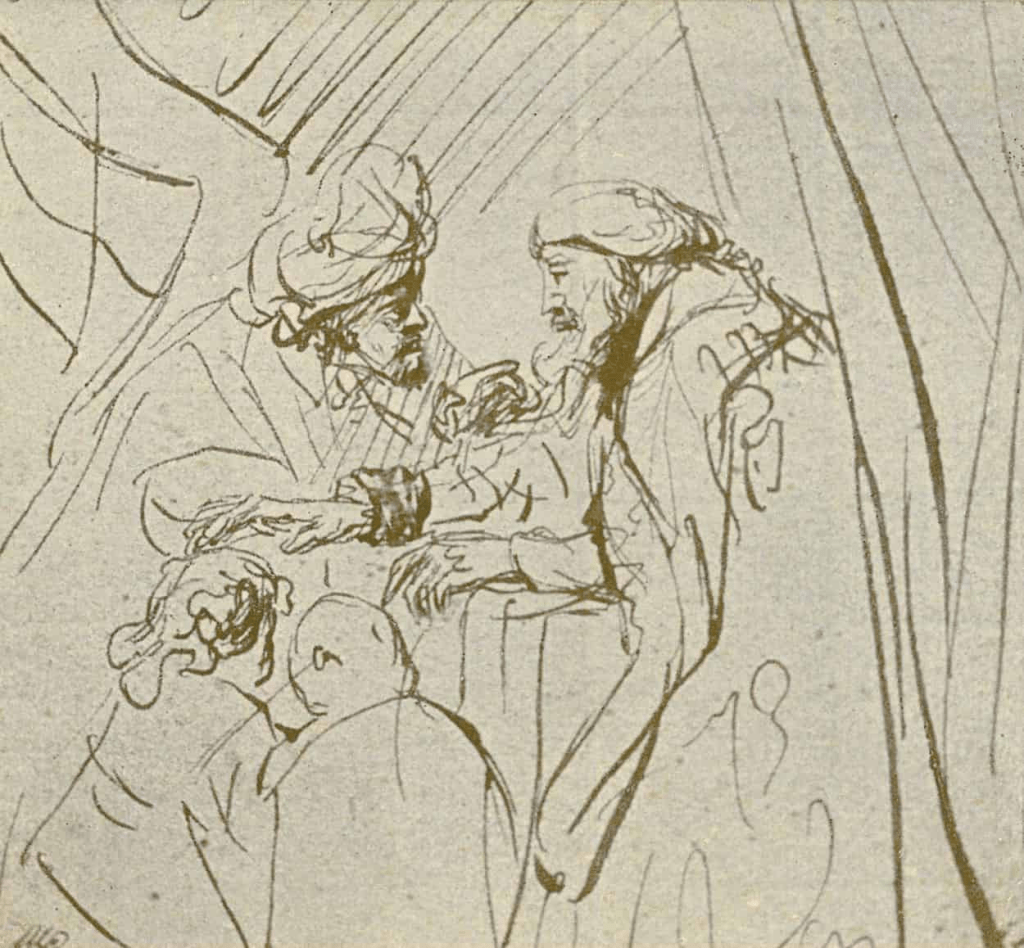
Jacob Blessing Ephraim and Manasseh, by Rembrandt van Rijn (1606-1669)

When Israel saw the sons of Joseph, he asked, “Who are these?”

“They are the sons God has given me here,” Joseph said to his father.

Then Israel said, “Bring them to me so I may bless them.”

Now Israel’s eyes were failing because of old age, and he could hardly see. So Joseph brought his sons close to him, and his father kissed them and embraced them.

Israel said to Joseph, “I never expected to see your face again, and now God has allowed me to see your children too.”

Then Joseph removed them from Israel’s knees and bowed down with his face to the ground. And Joseph took both of them, Ephraim on his right toward Israel’s left hand and Manasseh on his left toward Israel’s right hand, and brought them close to him. But Israel reached out his right hand and put it on Ephraim’s head, though he was the younger, and crossing his arms, he put his left hand on Manasseh’s head, even though Manasseh was the firstborn.

Then he blessed Joseph and said,

“May the God before whom my fathers,
    Abraham and Isaac, walked faithfully,
the God who has been my shepherd
    all my life to this day,
the Angel who has delivered me from all harm
    —may he bless these boys.
May they be called by my name
    and the names of my fathers, Abraham and Isaac,
and may they increase greatly
    on the earth.”

When Joseph saw his father placing his right hand on Ephraim’s head he was displeased; so he took hold of his father’s hand to move it from Ephraim’s head to Manasseh’s head. Joseph said to him, “No, my father, this one is the firstborn; put your right hand on his head.”

But his father refused and said, “I know, my son, I know. He too will become a people, and he too will become great. Nevertheless, his younger brother will be greater than he, and his descendants will become a group of nations.” (New International Version)

Jacob Blessing Ephraim and Manasseh, by Frederick Pickersgill (1820-1900)

Jacob (Israel) was on his deathbed. His son, Joseph, was in charge of all Egypt. Jacob had Joseph bring his two sons to him so that he could bless them. Joseph fully expected that his father would follow the convention of primogeniture, that is, the elder son receives a double inheritance. But that is not what happened. Jacob purposely went against normal convention.

It was not, however, against biblical convention. In the stories of Ishmael and Isaac, Esau and Jacob, the rights of the first-born are superseded by the promises of the next-born.

Family rules, ethnic customs, and cultural procedures are fine. Yet, when those practices become inflexible laws which are never to be different, then we get into trouble. Joseph had an expectation of how the blessing of his sons was to go. Jacob had another idea about it.

“We’ve never done it that way before,” are the seven last words of any institution. Any group organized around that belief is doomed. If we cannot make a distinction between the letter and the spirit of a law, rule, or custom, then our inflexibility will eventually break us.

In the ancient world, and even in many cultures today, birth order determines how things go with families, societal rights, and personal obligations. The firstborn occupies an esteemed position. In Judaism, when the temple still stood, the first fruits and firstborn of animals were considered the best sacrifices.

By blessing the younger son, and going against expected convention, Jacob taught future generations a valuable lesson: A person’s actions and character matter more than birth order. What’s more, being blessed first or last or whenever is not what guarantees future success.

Jacob had firsthand knowledge and experience that life is unpredictable and requires faith in God. One’s life cannot be projected and determined along an upward linear trajectory. We cannot predict what will happen in our lives by laying things out with Cartesian coordinates. Ultimate control belongs to God, not us. And that’s a good thing, because the Lord is good, all the time.

Our Lord, everything you do
    is kind and thoughtful,
and you are near to everyone
    whose prayers are sincere.
You satisfy the desires
    of all your worshipers,
and you come to save them
    when they ask for help.
You take care of everyone
who loves you,
    but you destroy the wicked. (Psalm 145:17-20, CEV)

It’s best to trust in pure goodness than to rely upon human ingenuity. Abraham – who was not a firstborn son, but the youngest of three – received the call from God to receive blessing. Isaac inherited the birthright over his older half-brother Ishmael. Jacob himself received the birthright over his older twin brother Esau. And Joseph, next to the youngest in a long line of sons from Jacob, was the clear head of the clan.

In matters of human faith and divine promises, birth order and typical cultural mores don’t apply. More important is fidelity to God, concern for one’s fellow humanity, and upholding love for the family. And it is these very things that are important going forward. Inevitably, suffering comes. And when it does, birth order, primogeniture, and societal expectations aren’t going to get you through it.

It is likely that the main reason why some folks embrace the adage “we’ve never done it that way before” is because of fear. Doing the same thing over and over again, even if it isn’t helpful anymore or is useless in a particular situation, still feels normal and secure. Moving out in faith is scary; we don’t really know how things are going to shake out.

This is why our concept and understanding of God is so crucial. A good God acts on our best interests and does not act with malevolence toward us.

I prayed to the Lord, and he answered me;
    he freed me from all my fears.
The oppressed look to him and are glad;
    they will never be disappointed. (Psalm 34:4-5, GNT)

Only obeying the letter of the law leads to fear. Only acknowledging the spirit of the law results in bondage. Only by observing both the letter and the spirit of the law will we experience freedom from fear and deliverance from anxious striving for blessing.

Blessing is given freely by the God who delights in doing so. Let the Lord bless you in the ways God wants to do so.

May God have mercy on you, bless you, and show you kindness, today and every day. And may the grace of the Lord Jesus, the love of God the Father, and the encouragement of the Holy Spirit be with you, now and forever. Amen. 

Challenging the Status Quo (Acts 4:1-4)

While Peter and John were speaking to the people, the priests, the captain of the temple guard, and the Sadducees confronted them. They were incensed that the apostles were teaching the people and announcing that the resurrection of the dead was happening because of Jesus. They seized Peter and John and put them in prison until the next day. (It was already evening.) Many who heard the word became believers, and their number grew to about five thousand. (Common English Bible)

I’ll be honest. I like upsetting the status quo. It drives me nuts when a system or group of people get so used to doing things a certain way that there is no room for anything different. Peter and John did exactly that – they went off the beaten path. According to the religious authorities, they were creating trouble, causing a stink, disturbing the peace, and making waves.

At the heart of the disturbance was the authorities’ deep concern of potential social disorder. After all, the Roman Empire with all its great strength was firmly ensconced in Judea. It was already hard enough for Jews to maintain their customs and religious practices. Now, these rabblerouser disciples of Jesus come along with their unorthodox teaching, and threaten the very social fabric of Jewish life. No! Get them out of here!

So, off to jail Peter and John went. That’s how the politics of fear typically works. Being afraid of change leads to removing the object of fear. Stuff the apostles in the gulag. Shut and lock the door. Maybe if they are out of sight they will be out of mind to the people.

But the rulers were too late. A lot of people heard the message of Christ’s resurrection. The number of believers in Jesus swelled into the thousands. Well, now, everyone’s really in a pickle! That is, except the church. Each time the Christians got squelched and silenced, more of them showed up. Oh, my, goodness. The ruling council saw they were multiplying like roaches!

It didn’t help the authorities that these religious bugs continued to interpret their own whippings and jailtime as a positive thing – enjoying the solidarity of suffering with their Lord. Ugh. What’s a decent Sadducee to do with that kind of thinking and behavior?

Apostles Peter and John heal the sick, by Pieter Aertsen (1508-1575)

Turns out nothing can stop resurrection. It cannot be chained, bound, or imprisoned. Once life gets into the hearts of people, there’s no getting it out. The message takes over and consumes the whole person. Then it spreads to another, like an infectious disease.

Before you know it, the entire social order is off kilter. What a bunch of weirdos. Following a dead guy who they say isn’t dead. Walked right out of the grave, they say. Sheesh. Pull yourselves together. So many unhinged delusional people believing in resurrection!

It’s easy for some Christians to be hard on non-Christians, just as it was easy for the ancient Jewish rulers to be hard on others leaving their fold. Sometimes we followers of Jesus forget whence we have come. We can get so upset and worked up in fear.

It could be that our underwear is too tight. More likely, we take the prideful stance of believing that our own status quo is best for everyone. So, there’s no listening, paying attention, or teachable spirits.

Peter, John, and the other apostles just went about proclaiming good news with joy. And the gospel spread. Jesus became known first to thousands, then tens of thousands, hundreds of thousands, and millions. Today, according to the Pew Research Center, there are over 2.5 billion Christians in the world. That’s a lot of people.

Christianity has had two thousand years to create their own status quo, some of it good, some of it not so much.

Yet, at the heart of it all, is the resurrection of Jesus Christ from death. It’s a message that still speaks to billions. And it’s a message Christians need to come back to, whenever they are fearful of others challenging their hegemony.

All the hopes and expectations of Christians everywhere are realized not in maintaining some Constantinian sort of Christendom, but in the resurrection of Jesus Christ the dead. The former does a lot of handwringing over social and cultural issues. The latter has a lot of joy, celebration, and renewal which works itself out in both personal and systemic redemption.

Because the good news of Easter can hardly be contained in a single day’s celebration, it’s message of new life in Christ is like a bright sun of inexhaustible grace to people everywhere – still warming the earth all these centuries later.

The Apostle Peter went on to pen a letter to struggling Christians facing hard circumstances in a world not yet dominated by Christianity, reminding them of the heart of Christian faith:

Praise be to the God and Father of our Lord Jesus Christ! In his great mercy he has given us new birth into a living hope through the resurrection of Jesus Christ from the dead, and into an inheritance that can never perish, spoil or fade. This inheritance is kept in heaven for you, who through faith are shielded by God’s power until the coming of the salvation that is ready to be revealed in the last time. 

In all this you greatly rejoice, though now for a little while you may have had to suffer grief in all kinds of trials. These have come so that the proven genuineness of your faith—of greater worth than gold, which perishes even though refined by fire—may result in praise, glory and honor when Jesus Christ is revealed. 

Though you have not seen him, you love him; and even though you do not see him now, you believe in him and are filled with an inexpressible and glorious joy, for you are receiving the result of your faith, the salvation of your souls. (1 Peter 1:3-9, NIV)

Don’t get stuck in the status quo to the point you cannot see anything outside yourself.

May we come back repeatedly to Christianity’s message so that our faith is strengthened, the church is edified, and the world is blessed. Amen.

The Lord Is My Shepherd (Psalm 23)

Psalm 23, by Cliff Gleason

The Lord is my shepherd;
    I have all that I need.
He lets me rest in green meadows;
    he leads me beside peaceful streams.
    He renews my strength.
He guides me along right paths,
    bringing honor to his name.
Even when I walk
    through the darkest valley,
I will not be afraid,
    for you are close beside me.
Your rod and your staff
    protect and comfort me.
You prepare a feast for me
    in the presence of my enemies.
You honor me by anointing my head with oil.
    My cup overflows with blessings.
Surely your goodness and unfailing love will pursue me
    all the days of my life,
and I will live in the house of the Lord
    forever. (New Living Translation)

This is one of the best known places in the Bible – even for people who are not religious. And that is for good reason. The psalm is timeless in it’s relating to us in our human condition. It taps into our human need for a compassionate presence, secure protection, and abundant provision. I believe that, most of all, Psalm 23 effectively goes to our inner selves and reminds us of our greatest need: God.

My underlying conviction concerning this wonderful psalm is that the reason we adore it so much is because we humans have an innate primal desire for God. Whether we are consciously religious or not, our deepest longing is for connection with the Divine.

Much of humanity, it seems to me, have repressed this desire. Many people bury this longing underneath multiple layers of other interests and competing desires. Others experience the primal desire for God as a yearning for wholeness, completion, or fulfillment.

Yet, regardless of how particular individuals or groups may frame it, humanity’s basic need is to love and be loved – to move ever closer to the source of love. This inner craving is the essence of the human spirit, and it is captured well in a biblical psalm which pictures a person who settled into the God who is Love.

“Our hearts are forever restless until we rest in God.”

St. Augustine

With Psalm 23, our human longing is spelled out in a mere 50 or so words – we can imagine not only being transported, but also being actually transformed into an enjoyable divine/human relationship, set within an idyllic landscape of settled peace, safety, and strength.

Serenity for our anxious racing thoughts becomes a real hope, for there is a shepherd who protects the human flock and ensures that they have everything they need.

It is understandable that the relationship between God and humans is likened to that of a shepherd and sheep. In reality, sheep need a shepherd. They require someone to look out for them and provide for them. Sheep, in my opinion, are not stupid and clueless; they are skittish animals who only function well if they are non-anxious and at peace.

The presence of a caring shepherd makes all the difference. And, more than that, the shepherd does a myriad of needed things for the sheep that they are not able to do themselves, such as protecting them from wolves, finding adequate pasture to feed upon, and relieving them of the intestinal gas from eating all that grass which would literally kill them without the shepherd’s intervention.

Whereas human shepherds may or may not be faithful in their duties and extend genuine care to the flock, God is always present and loving. Moving to the rich pasture of the New Testament, Jesus is described as the Good Shepherd who will care for and preserve the sheep in every way needed. (John 10:1-21)

Psalm 23, by Cliff Gleason

Indeed, with Jesus as the consummate shepherd, people want for nothing and have everything they need. No wolf can snatch them out of his hand, and the mundane tasks of washing their feet is lovingly done for them. With Jesus, the deep yearning of the inner person becomes satisfied; the soul is restored.

Even the implements of a rod and a staff are used for good, and not for ill. An unfaithful shepherd will likely beat the sheep and berate them, only concerned for fleecing them to sell their wool on the market. But Jesus uses the rod to guide and direct in the way we ought to go, for our benefit and well-being. And the staff – the shepherd’s crook – is benevolently used to rein in the strays who don’t realize how in danger they’re in.

Truly, discipline and encouragement are not mutually exclusive concepts; they instead go together as two forms of loving leadership and care. Only those who take the time and effort to correct another are the ones who really care enough to do so.

In the shepherd’s presence, we can exist with a sense of security, even though there is danger all around us. Our longing for peace, and to be secure within oneself, is not a pipe dream, but a real possibility. To be provided for by God in the face of hard circumstances strengthens faith, awakens hope, and fosters love. It becomes an overflowing feast of the soul.

And this goodness is not fleeting. It can be a continuous present reality. Since God is good, all the time, and there is never a time when God is not good, we are continually and actively pursued and shepherded by goodness and not by harm, all the days of our lives.

The threat of death – and even death itself – cannot thwart the avenues of righteousness from being available to us. We can walk the true path toward inner peace and fulfillment, of genuine connection with God and others, without moral or spiritual harm.

There are good and right paths of life. Those avenues are guarded by a gracious God; they will never be destroyed or damaged. If the psalm is correct, and if my core convictions are right, then there is no longer any reasonable or justified basis for fear.

A good care-taking Shepherd is protecting the flock, and providing the sheep with everything they need. We can live a morally strong, ethically sound, and eminently happy life, without being constantly afraid.

Blessed and Good Shepherd of all, by laying down your life for the flock, you reveal your love for all. Lead us from the place of death to the place of abundant life, so that guided by your care for us, we may rightly offer our lives in love for you and our neighbors. Amen.

To Believe, or Not (Mark 16:9-18)

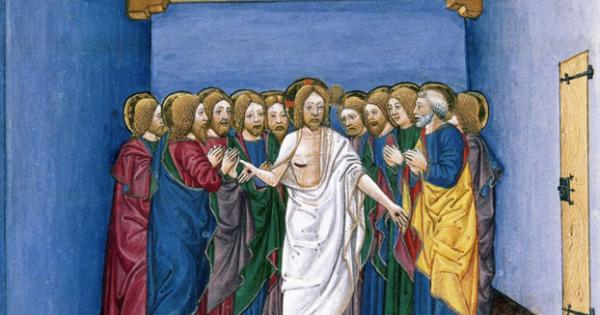
The risen Jesus appears to his disciples, by Unknown Italian artist, 1476

[Note: The earliest manuscripts and some other ancient witnesses do not have verses 9–20.]

When Jesus rose early on the first day of the week, he appeared first to Mary Magdalene, out of whom he had driven seven demons. She went and told those who had been with him and who were mourning and weeping. When they heard that Jesus was alive and that she had seen him, they did not believe it.

Afterward Jesus appeared in a different form to two of them while they were walking in the country. These returned and reported it to the rest; but they did not believe them either.

Later Jesus appeared to the Eleven as they were eating; he rebuked them for their lack of faith and their stubborn refusal to believe those who had seen him after he had risen.

He said to them, “Go into all the world and preach the gospel to all creation. Whoever believes and is baptized will be saved, but whoever does not believe will be condemned. And these signs will accompany those who believe: In my name they will drive out demons; they will speak in new tongues; they will pick up snakes with their hands; and when they drink deadly poison, it will not hurt them at all; they will place their hands on sick people, and they will get well.” (New International Version)

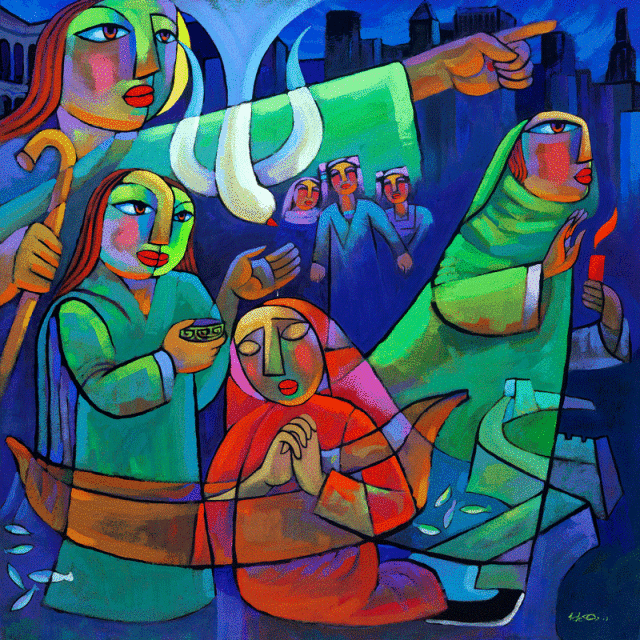
The Great Commission, by He Qi

So, how do you view the Bible? Some view it as a direct communication from God to human authors, as if the Lord actually wrote it all, akin to how Moses received the Ten Commandments. Others see the Bible as a thoroughly human invention of literature about God. And then there are those who are somewhere in-between the two views.

Textual criticism is a branch of study that examines a literary work, and aims to establish the original text. This is important and needed, especially since we have all sorts of ancient pieces of literature. We rely upon learned scholars who are fluent in the original languages, and in the examination of texts, so that we can have reliable translations of those texts.

Therefore, textual criticism of the Bible means thinking critically about manuscripts and variations in the biblical texts found in those manuscripts, in order to identify the original reading of the Bible. Keep in mind that, prior to the invention of the printing press, copies of everything had to be hand written. Scribes were trained scholars who meticulously copied manuscripts; and human error was always a part of the process.

The New Testament was copied by thousands of people in thousands of places in dozens of languages. Though that reality can make textual criticism rather complicated, this diversity is also a blessing; it speaks to the high probability that we have a very close and reliable authentic original Bible – namely because so many people were involved in copying scriptural texts.

Today’s lectionary reading is an entire chunk at the end of Mark’s Gospel that is very difficult to ascertain whether it was original to his writing, or not. If you are of the ilk that the Bible is a God-authored book, you will likely want to resolve this tension. And if you’re not, you just might be rolling your eyes at this point, as if this is all silly stuff that doesn’t matter.

I’m suggesting it is neither as silly nor as serious as some want to make it. It just is. And sometimes we must accept what is, without always having to explain it in objective Enlightenment terms; or relegate it to the realm of the ethereal and mystical.

Instead, we can deal with the text we have in front of us without any wringing of the hands, or ignoring it altogether. And what we have, it seems to me, is this: a text of Scripture that is consistent with the rest of Mark’s Gospel in showing us the nature of both belief and unbelief.

An ancient papyrus fragment of Mark’s Gospel

To believe, or not to believe? That is the question.

Throughout the Gospel of Mark, we are confronted with the choice of believing or disbelieving the acts of Jesus in his earthly ministry. And that issue of faith comes to a head with Christ’s resurrection.

The women exhibited belief. They made the pilgrimage to Christ’s tomb and discovered it empty. It is upon the testimony of women – even though a woman’s testimony was not considered reliable in that day – that believers know Christ is risen from death.

The men, however, are nowhere to be found. One reason for unbelief by people who ought to know better is that they go looking for all the wrong sort of evidence. While on this earth, Jesus refused to be like any sort of worldly ruler; he sought to use his authority by being a servant; and he tapped into the power of humility and love.

If we go limiting our epistemology (the study of how we receive knowledge) then we will likely not discover the truth about much of anything. The male disciples refused to believe the testimony of the female Mary Magdalene. The risen Christ finally showed himself and rebuked the stubborn men.

To see Jesus will take something else, something more, than our standard use of three dimensions and five senses and critical thinking skills. As important and needed as they are, it isn’t enough to truly see the risen Lord. We need to bring in some other epistemic impulses: the conscience and the gut; the spirit and the heart; intuition and experience; and the testimony of witnesses whom we would rather dismiss, than listen to.

Jesus ascends to heaven, but not everyone sees it – for obvious reasons. There are some who may search for evidence their entire lives, never to find it, because they want confirmation by means of their own mentally contrived and culturally conditioned constructs.

The Gospel is neither ant-intellectual nor only understood by the scholarly and learned; the good news of Jesus Christ is both simple and complex, easy to understand and hard to comprehend, compelling and revolting. And there is one thing for sure: the person and work of Jesus will always challenge us, change us, and move us.

The story is still being written, not just with pens and keyboards, with textual criticism and documentary evidence, but with mercy and love upon the tablet of the heart.

Lord, I want to believe. Help me in my unbelief! May I see and hear the risen Savior, through the enablement of the Spirit. Amen.