Born from Above (John 3:1-17)

Visit of Nicodemus to Christ, by John LaFarge, 1880

Now there was a Pharisee named Nicodemus, a leader of the Jews. He came to Jesus by night and said to him, “Rabbi, we know that you are a teacher who has come from God, for no one can do these signs that you do unless God is with that person.” 

Jesus answered him, “Very truly, I tell you, no one can see the kingdom of God without being born from above.”

Nicodemus said to him, “How can anyone be born after having grown old? Can one enter a second time into the mother’s womb and be born?” 

Jesus answered, “Very truly, I tell you, no one can enter the kingdom of God without being born of water and Spirit. What is born of the flesh is flesh, and what is born of the Spirit is spirit. Do not be astonished that I said to you, ‘You must be born from above.’The wind blows where it chooses, and you hear the sound of it, but you do not know where it comes from or where it goes. So it is with everyone who is born of the Spirit.” 

Nicodemus said to him, “How can these things be?” 

Jesus answered him, “Are you the teacher of Israel, and yet you do not understand these things?

“Very truly, I tell you, we speak of what we know and testify to what we have seen, yet you do not receive our testimony. If I have told you about earthly things and you do not believe, how can you believe if I tell you about heavenly things? No one has ascended into heaven except the one who descended from heaven, the Son of Man. And just as Moses lifted up the serpent in the wilderness, so must the Son of Man be lifted up, that whoever believes in him may have eternal life.

“For God so loved the world that he gave his only Son, so that everyone who believes in him may not perish but may have eternal life.

“Indeed, God did not send the Son into the world to condemn the world but in order that the world might be saved through him. (New Revised Standard Version)

Christians serve a triune God – Father, Son, and Spirit. This Holy Trinity of three persons, yet one God, conspires to plan and orchestrate the deliverance of people from sin, death, and hell. The Lord makes it possible for people to be born again.

Maybe you’re ready to tune out with the phrase “born again” or “born from above” because either this is old hat to you; or you want to distance yourself from the obnoxious evangelist who is the pester pup toward others’ salvation.

However, today’s Gospel lesson is for me and you. So instead of tuning out, consider the person of Nicodemus in the story:

  • Served God
  • Good guy
  • Upstanding Jewish citizen
  • Devout and pious man
  • Faithful temple worship attendance
  • Member of a prestigious religious group 

And yet, it was to Nicodemus that Jesus said, “You must be born again.” But why? Because although Nicodemus was a really good egg, he was an adoring fan of Jesus, but not a committed follower of Jesus.

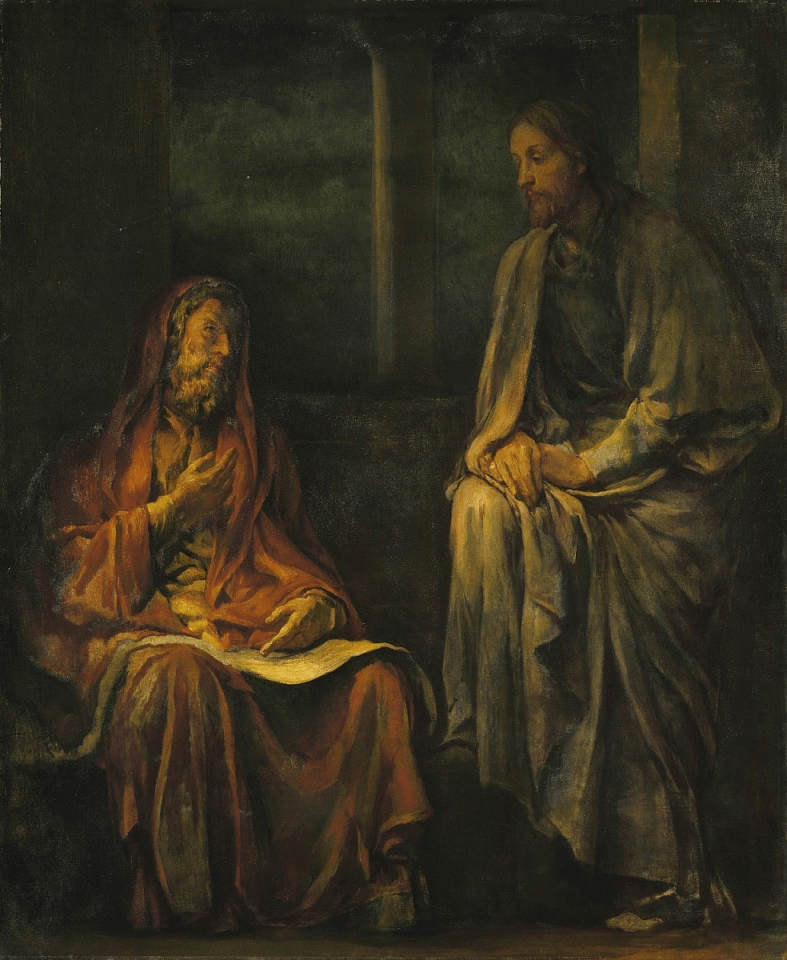
Nicodemus Visiting Christ, by Henry Ossawa Tanner, 1899

Admiration and kudos isn’t the same as taking up your cross and following Christ. Nicodemus didn’t need to adjust his life and make some tweaks here and there; it was time for a new life in walking the path of discipleship with Jesus.

The further away we are from birth, the easier it is to take God for granted; and to have a spiritually settled way of life in which the mystery, wonder, and awe of life is slowly drained from us. That’s why I think two year olds probably know more about God than anyone around – since they can articulate the wonder of life being only a few short years from their birth. 

One night I came home and walked into the kitchen to find my then four-year old grandson unashamedly crawling on all fours with his face barely off the floor. I said, “What in the world are you doing?” He looked up at me with a twinkle in his eye and a serious tone in his voice and said, “I’m sniffing for clues.” 

I honestly do not expect you to sniff for clues on your kitchen floor. But would any of us be found sniffing for clues of God? Would we seek hard and doggedly pursue the Lord? 

Because Nicodemus was such a good guy, he did not see himself in need of new life. Meeting Jesus at night is deeply symbolic of the fact that Nicodemus was literally in the dark about his spiritual condition. He was actually clueless to many of God’s ways, and how the world works in God’s kingdom. Nicodemus maintained a respectable distance as a fan of Jesus.

How do we move from being a fan to a follower of Jesus? 

Believe. To believe in Jesus means to move from only an intellectual faith of acknowledging doctrinal beliefs about Christ and God. There is to be movement from observing the works of God to a life of complete trust as a dedicated follower of Jesus.

Christian discipleship is more than asking Christ to help out in a jam or bad situation. And it is certainly more than praying a particular prayer. Rather, it’s letting Jesus decide what to do with us and remove any shortcomings, character defects, guilt, shame, and general crud from us.

We are to be made pure, to be cleansed – as if we were a new person or born again, from above. There is the willingness to depend on something other than myself, my resources, and my connections.

In Christianity, Jesus is much more than a wise teacher and a miracle worker; Christ is Savior for whom the follower gives complete allegiance to. In other words, we let Jesus use us for divine purposes, instead of us using Jesus for our own puny human purposes.

Let us intentionally and deliberately relinquish control of our lives, and of everything, to Jesus and become his faithful followers. Information is not transformation; and, seeing transformation in another person’s life is not a substitute for transformation in my own life.

Interview Between Jesus and Nicodemus, by James Tissot (1839-1902)

Nicodemus had to grab ahold of the reality that Jesus did not only come to save others, but to save him, as well.  We must be born from above, to have a new life, to be “born of water and spirit.” Nicodemus would have immediately been reminded of John the Baptist’s ministry of a baptizing for the repentance and forgiveness of sins. 

Jesus was letting Nicodemus know that he, too, needed repentance from trusting in those good deeds, and of simply acknowledging Christ. The practices of fasting, praying, and giving; and the dedication to thrift and morality is quite admirable. Yet, these are not the things which move a person from darkness to light. And they don’t give us a leg up to heaven.

Jesus is the One who has worked hard for us. God conceives us as Christians, and then nurtures us in the womb of faith. At some point, we come to full term, and God births us spiritually into new life. 

Maybe it’s time to move from darkness to light; from staying warm and cozy inside the womb to the bright outside world; from being a fan of Jesus to a follower of Jesus; from being in the dark audience to the bright lights of the stage for all to see. 

The issue is not in saving yourself, but to let God be God; and let God do the work in you that God wants to do. 

If there is no gestation from Jesus as Teacher to Jesus as Savior, there is no birth. If there is no gestation from Jesus as Miracle-Worker to Jesus as Savior, there is no birth. 

The Apostle John was making the point here in describing the conversation that if Nicodemus, who is the upstanding religious citizen, needed to be born again by Jesus, then how much more do we need to have a new life, to move from the comfortable confines of being a fan to the playing field of being a follower of Jesus?

Jesus does not need a bunch of groupies admiring him at night. But conversely, we need Jesus.

Fans sometimes confuse their admiration for devotion; people mistake their knowledge of Jesus for an actual relationship with Jesus. Fans assume that their good works and good intentions are sufficient. Yet, new life requires giving up an old life. And that, my friends, is what’s at stake in Christian discipleship.

May God the Holy Trinity make us strong in faith and love, and birth us into new life through Christ our Lord. Guide us in truth and peace; and may the blessing of God Almighty – Father, Son, and Holy Spirit – be among us, and remain with us always. Amen.

A Time of Woe (Isaiah 5:15-24)

The Prophet Isaiah, by Raphael, 1512

So people will be brought low
    and everyone humbled,
    the eyes of the arrogant humbled.
But the Lord Almighty will be exalted by his justice,
    and the holy God will be proved holy by his righteous acts.
Then sheep will graze as in their own pasture;
    lambs will feed among the ruins of the rich.

Woe to those who draw sin along with cords of deceit,
    and wickedness as with cart ropes,
to those who say, “Let God hurry;
    let him hasten his work
    so we may see it.
The plan of the Holy One of Israel—
    let it approach, let it come into view,
    so we may know it.”

Woe to those who call evil good
    and good evil,
who put darkness for light
    and light for darkness,
who put bitter for sweet
    and sweet for bitter.

Woe to those who are wise in their own eyes
    and clever in their own sight.

Woe to those who are heroes at drinking wine
    and champions at mixing drinks,
who acquit the guilty for a bribe,
    but deny justice to the innocent.
Therefore, as tongues of fire lick up straw
    and as dry grass sinks down in the flames,
so their roots will decay
    and their flowers blow away like dust;
for they have rejected the law of the Lord Almighty
    and spurned the word of the Holy One of Israel. (New International Version)

I’m willing to bet that you, like me, have had to contend with some rather annoying and obnoxious people from time to time in your life.

It’s the person whose head is so big, they can barely walk in and out of a room. And when they talk, it’s usually about themselves, the great things they’ve done, and what they think – not framed as opinions but as the truth.

Since this sort of person rarely listens to anyone, they have no clue about the real needs of people in front of them. Their self-inflated importance is to the degree that they don’t ask and are not curious; yet they demand of others. They see no problem with double-standards. It’s okay for them to bribe, even steal from another. But if you cross the self-important person, look out, because they’ll hunt you down like an animal.

Yes, such people exist. And there are typically some deep psychological reasons why they are so arrogant and difficult to be around. Yet the best thing to know about them is that the true Sovereign of the universe, God, is the rightful judge who will handle them.

If you see a path of destruction on the ground, you know a tornado has touched down and done its damage. And if you observe a bunch of people devastated and demoralized, you know that the haughty and self-important person has been through and laid waste to people’s lives.

The Lord almighty is not okay with such people moving about and hurting others with impunity; the wicked will have to contend with the One who knows what’s going on.

God looks and sees – and pronounces appropriate woes (curses) upon those who feign righteousness and holiness, yet in reality do anything but.

You can easily tell what God abhors by what sorts of behavior receives a disapproving woe upon it. God condemns self-indulgence and self-absorption. This shows itself in how one drinks and does business. The sheer accumulation of land, resources, and strong drink – without any sort of regard to one’s neighbor – is a foolish use of wealth.

The self-absorbed and self-important person becomes desensitized to the needs of others. They also become insensitive to God’s concerns and workings in the world. To disregard the poor and needy is to disregard God. Such injustice, resulting from only caring about oneself, is why the Lord levels divine woes upon them.

Actions and inactions both have consequences. Acting selfishly through wanton accumulation is an equal inaction against the community. As a result of so much economic disparity and carelessness in society, God displaces and deports the ones who arrogantly and smugly believed they are secure.

There is accountability in this world, even though it may not sometimes seem like it. There are ethical requirements and moral imperatives. The social laws contained in the covenant code between God and Israel were expected to be honored. So, when they were continually and habitually ignored, the Lord held the people accountable.

The selfishly proud and arrogant, who acquire all they can and become masters of small worlds, will eventually face ruin by means of divine judgment. It’s as if persons had so loaded their backpacks with sin, that it became heavy to the point of self-crushing.

Divine intervention is either a very good thing, or a very bad thing, depending upon who you are. People are expected to be self-aware enough to know the difference between right and wrong, bad and good, just and unjust. To not know this is to be self-addicted and unable to make proper discernments and decisions.

If you are reading or listening to this, you are likely a person who is concerned enough to care for others and is not lost in yourself. Yet, you likely have to contend with a few persons who are only in this life for themselves. So, watch out and do your best to avoid people who do the following:

  • Manipulate through deceptive language. There are some people in positions of authority or power who intentionally obscure, cover up, and confuse things. If you never know how things stand and are doing, then beware.
  • Independent without accountability. There is no interdependent relationships, and only obedience when it suits them. The constant caginess, and lack of vulnerability, is a warning. If you feel like you’re being micro-managed without much ability to ask specific questions and get straight answers, then look out.
  • Distort how things really are. I’m talking about gaslighting. Gaslighting is the attempt by another to accept the gaslighter’s view of reality as your own. And in the gaslighter’s quest, it seems to you as if there is continually chaos and you are off kilter. If you question it to them, then you will most likely be accused of having a problem. It’s not you. So, skedaddle the first chance you get.

The bottom line of it all is that God is rejected and there are people reneging on their commitments to the Lord. You need not be such a person, and you don’t need to live in such a way that another is in complete control of your life – other than God.

Take note of what the Lord dislikes and despises, and keep away from persons who set up themselves as being akin to God.

Grant us, Lord God, a vision of your world as your love would have it:
a world where the weak are protected, and none go hungry or poor;
a world where the riches of creation are shared, and everyone can enjoy them;
a world where different races and cultures live in harmony and mutual respect;
a world where peace is built with justice, and justice is guided by love.
Give us the inspiration and courage to build it, through Jesus Christ our Lord. Amen.

The Thundering Voice of the Lord (Psalm 29)

Ascribe to the Lord, O heavenly beings,
    ascribe to the Lord glory and strength.
Ascribe to the Lord the glory of his name;
    worship the Lord in holy splendor.

The voice of the Lord is over the waters;
    the God of glory thunders,
    the Lord, over mighty waters.
The voice of the Lord is powerful;
    the voice of the Lord is full of majesty.

The voice of the Lord breaks the cedars;
    the Lord breaks the cedars of Lebanon.
He makes Lebanon skip like a calf
    and Sirion like a young wild ox.

The voice of the Lord flashes forth flames of fire.
The voice of the Lord shakes the wilderness;
    the Lord shakes the wilderness of Kadesh.

The voice of the Lord causes the oaks to whirl
    and strips the forest bare,
    and in his temple all say, “Glory!”

The Lord sits enthroned over the flood;
    the Lord sits enthroned as king forever.
May the Lord give strength to his people!
    May the Lord bless his people with peace! (New Revised Standard Version)

I grew up in rural middle America, on the land, and working the land. All of that outdoor work of the farmer makes one very attuned to the weather. In fact, my dad could often predict a coming thunderstorm with an almost precise accuracy.

There is something of a weather report from the psalmist in today’s lesson. He describes a powerful storm forming and moving its way inland from over the sea. It does its damage as a result of high winds, incredible lightning, and of course, the loud rumble of thunder. It is this thunderous display of strength that is the voice of the Lord.

Seven times in Psalm 29 the psalmist repeats the phrase, “the voice of the Lord.” There’s a lot more going on than a meteorological thunderstorm; behind the storm is theological Being who controls all things. The Lord God almighty is not your run-of-the-mill ordinary local deity.

Israel did not have multiple gods of thunder, lightning, clouds, and rain; they worshiped Yahweh, one God, who was Lord of the entire storm, as well as the whole world. The point of the psalmist is that no one, no other god, can compete with this awesome God of Israel.

Yet, despite the theological reality of Israel and their God, there was an entire panoply of gods that the Canaanites worshiped in ancient Palestine. The Canaanite god Baal is mentioned many times in the Old Testament. Baal was the lord of the storm, the god who hung out in the clouds and brought needed rain for the crops to grow.

What’s more, ancient Israel was continually tempted toward the worship of Baal. There were even those who gave the ancient god credit for the harvest of crops. But the psalmist will have none of that business. The real lord of the storm, the actual power behind everything in the universe, is Yahweh.

This is why there is the invitation to praise the Lord. And it isn’t just people who are invited; the heavenly beings are called upon to praise. It’s likely that the psalmist is putting those pagan gods in their place by encouraging them to recognize who is really in charge and in control of all things.

Whatever is going on with the psalmist’s intention, there is clearly a universal and cosmic call to acknowledge the majesty and sovereignty of Yahweh and offer appropriate praise for the One who is over everything.

The description of the powerful thunderstorm is presented as evidence of Yahweh’s power, glory, and sovereignty. It’s as if the entire earth is a temple, with every creature on earth called upon to offer up their praise and honor. Beings in both heaven and earth join together in a great universal choir of praise to the God who makes all things possible.

Even when the rains turn into a flood and brings chaos, God is over those chaotic waters, as well. It is the Lord who brings order from chaos, and who tames the mighty waters. In the New Testament, Jesus demonstrated this godly power in front of the fearful disciples:

A great windstorm arose, and the waves beat into the boat, so that the boat was already being swamped. But he was in the stern, asleep on the cushion, and they woke him up and said to him, “Teacher, do you not care that we are perishing?” And waking up, he rebuked the wind and said to the sea, “Be silent! Be still!” Then the wind ceased, and there was a dead calm. He said to them, “Why are you afraid? Have you still no faith?” And they were filled with great fear and said to one another, “Who then is this, that even the wind and the sea obey him?” (Mark 4:37-41, NRSV)

God, as absolute Sovereign, is able to provide peace and well-being from fearful hearts and anxious minds. And this is something to celebrate, to offer gratitude to God for such absolute authority.

People today may not be tempted to worship Baal; but in the middle of our fear and anxiety of life’s many storms, we might search for help and deliverance from the stock market, technology companies, a capitalist economy, social networking, or our own hard work and ingenuity.

Those things may easily become the gods we worship – offering our time, commitment, money, and emotional energy to them – and leaving God in the dugout of our lives to be available, just in case, as a pinch-hitter. But this approach never accounts for the inevitable game being rained out – perhaps permanently.

Just as the wise person saves their money for the inevitable rainy day, so the spiritual person who is aware of God’s authority and power will wisely invest their time and energies into discovering this God. They will engage in spiritual practices designed for relatable connection.

The believer realizes that, although today might be bright and sunny, there will be a damaging thunderstorm in the future for which preparations must be made now.

The voice of the Lord can be a reassuring presence and a healing balm; or it can be a fearful and devastating experience. How you see it and prepare for it makes a big difference.

Glorious God, I worship and praise you in response to your voice. I join with all the voices of the earth, together with all the voices of the heavens, to praise your glorious name; and to bow down in awe before your mighty power. Amen.

Learn To Do Right (Isaiah 1:1-4, 16-20)

Statue of Isaiah the Prophet, by Salvatore Revelli (1816-1859), Rome, Italy

The vision concerning Judah and Jerusalem that Isaiah son of Amoz saw during the reigns of Uzziah, Jotham, Ahaz and Hezekiah, kings of Judah.

Hear me, you heavens! Listen, earth!
    For the Lord has spoken:
“I reared children and brought them up,
    but they have rebelled against me.
The ox knows its master,
    the donkey its owner’s manger,
but Israel does not know,
    my people do not understand.”

Woe to the sinful nation,
    a people whose guilt is great,
a brood of evildoers,
    children given to corruption!
They have forsaken the Lord;
    they have spurned the Holy One of Israel
    and turned their backs on him…

Wash and make yourselves clean.
    Take your evil deeds out of my sight;
    stop doing wrong.
Learn to do right; seek justice.
    Defend the oppressed.
Take up the cause of the fatherless;
    plead the case of the widow.

“Come now, let us settle the matter,”
    says the Lord.
“Though your sins are like scarlet,
    they shall be as white as snow;
though they are red as crimson,
    they shall be like wool.
If you are willing and obedient,
    you will eat the good things of the land;
but if you resist and rebel,
    you will be devoured by the sword.”
For the mouth of the Lord has spoken. (New International Version)

Whenever the prophet has a vision, everyone better perk up and take notice.

After the northern Jewish kingdom of Israel fell to the Assyrians in 722 B.C.E., they lost their national identity. The southern Jewish kingdom of Judah, and its capitol Jerusalem, continued to exist for nearly a century and a half – even though they were vassals of either the Assyrians or the Babylonians.

Yet, Judah still functioned as its own nation in a semi-independent state. It was during this time that the prophet Isaiah had his vision, under the kingship of those descended from King David.

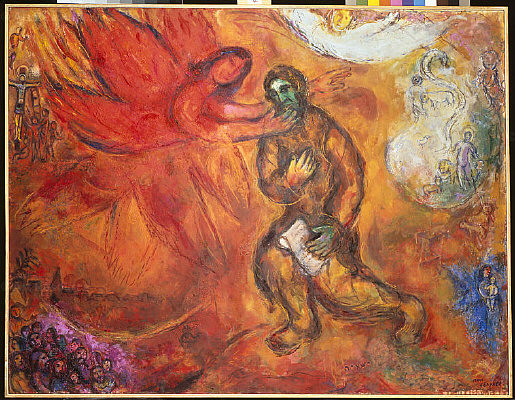
The Prophet Isaiah, by Marc Chagall,1968

The initial section of Isaiah’s prophecy is a series of oracles that establish the relationship between God and the nation of Judah, especially Jerusalem. The gist of God’s message is that the people are guilty of lots of sins.

However, the Lord left a gracious opening for them; their fate was not yet sealed. The nation could repent of their sins and experience a future restoration. God wanted to bring a resolution, and not have the people keep going in their unhealthy ways.

Throughout Isaiah’s vision, God is presented as a Father, with the children being Israel (both northern and southern kingdoms). And Father God has a complaint against them. The people’s principal sins were rebellion and ignorance. They spurned God’s authority, and did not accept their family intimacy with God.

Thus, the Lord is quite disappointed with the people. Heavenly witnesses are called to hear the charges of wrongdoing. The troubles of the nation were to be interpreted as warnings and disciplines, meant to lead them to stop and do right. Yet it seems that the warnings go unheeded by the people. It appears that God’s efforts to woo the people back are in vain.

Although the people’s continued sacrificial worship is merely done as a mere perfunctory act, and without true hearts of devotion for what is just and right, God offered them a chance to make things right, so that they could do justice and embrace righteousness.

God made it clear what it would take to repent: learn to do good; seek justice; recuse the oppressed; defend the orphan; plead for the widow. God even issued an invitation for a divine/human dialogue to happen.

Grace and cleansing from sin are possible, that is, if the people are willing and obedient, instead of remaining rebellious and refusing to do what is right, just, and good.

The nation was at a crossroads and had to make a decision. Would they choose wisely or foolishly?

Decision-making is critical. Some choices are harder than others. Yet the ability to decide is a God-given gift and ability.

Making decisions is fraught with consequences; we may try to anticipate or ignore what might happen with a particular choice. And how we go about decision-making is important. Who do we listen to? What information do we need? How will this choice shake out in the end?

Intentions are not choices, but are simply a mental resolve to do or not do something, at some point. And to not make a decision is to have already made a decision to either procrastinate or not do anything at all.

There are also decisions of duty. This may or may not be admirable. There is also the choice of attitude and energy given to the decision – because a choice of doing one’s duty can be done with joy or grumpiness, excitement or bitterness, with a bright disposition or a flat sullen affect.

It’s not really hard to guess or assess the choices of the people in Judah and Jerusalem in Isaiah’s day. They were doing an outward duty of temple worship, but without any heart to it.

Many of the people looked upon their duty as a sort of magical talisman that would ward off any trouble or army invasion. With that kind of approach, the people looked upon the rest of their time as their own, as discretionary, as the choice to do whatever they wanted to do.

If their business practices were dubious and not quite right, then big deal. After all, they give their money at the temple.

If the leaders played favorites and overlooked the needy person among them, then so what? The poor and oppressed can work harder, right?

And if orphans and widows – who were the most vulnerable persons in society – were not completely cared for, then that’s sad, but too bad for them.

I can picture an ancient city council saying something like, “We have a lot on our plate, dealing with foreign powers, the economy, and political issues. Those needy persons need to get a clue. It’s their own fault for hanging around and not leaving the city for greener pastures. Not our problem.”

Oh, but it very much was their problem. It was everyone’s problem, and each person’s responsibility, to ensure that God’s justice, goodness, and righteousness was infused throughout the entire city and nation.

Hence, the reason for the book of Isaiah. Tackle the moral and ethical problems head on before it’s too late and the gravity of judgment presses everyone out of the land.

What’s needed is a willing heart inclined to walk into divine obedience, without any talkback, and without any negotiations or deals.

God is merciful, and is willing to talk it out. But justice must be done. Needs must be met. People must be cared for. The Lord’s will must be done, here on earth, as it is always done in heaven. Is this what you are about, or not? Will you learn to do right?

Most merciful God, shine the light of your gracious love upon my cold hard heart. Enlighten my mind and dispel the darkness; speak the truth and help me obey; and have pity upon me. Forgive me yet again of my offenses, transgressions, and guilty acts. Grant me the grace to serve you with faithfulness and care for your people with love and purity, today and always. Amen.