What Are You Searching For? (1 Samuel 9:15-27)

Now the day before Saul came, the Lord had revealed to Samuel: “Tomorrow about this time I will send to you a man from the land of Benjamin, and you shall anoint him to be ruler over my people Israel. He shall save my people from the hand of the Philistines, for I have seen the suffering of my people, because their outcry has come to me.” 

When Samuel saw Saul, the Lord told him, “Here is the man of whom I spoke to you. He it is who shall rule over my people.” Then Saul approached Samuel inside the gate and said, “Tell me, please, where is the house of the seer?” 

Samuel answered Saul, “I am the seer; go up before me to the shrine, for today you shall eat with me, and in the morning I will let you go and will tell you all that is on your mind. As for your donkeys that were lost three days ago, give no further thought to them, for they have been found. And on whom is all Israel’s desire fixed, if not on you and on all your ancestral house?” 

Saul answered, “I am only a Benjaminite, from the least of the tribes of Israel, and my family is the humblest of all the families of the tribe of Benjamin. Why then have you spoken to me in this way?”

Then Samuel took Saul and the young man and brought them into the hall and gave them a place at the head of those who had been invited, of whom there were about thirty. And Samuel said to the cook, “Bring the portion I gave you, the one I asked you to put aside.” The cook took up the upper thigh and set it before Saul. Samuel said, “See, what was reserved is set before you. Eat, for it was kept for you for this appointed time, so that you might eat with the guests.”

So Saul ate with Samuel that day. When they came down from the shrine into the town, a bed was spread for Saul on the roof, and he lay down to sleep. Then at the break of dawn Samuel called to Saul upon the roof, “Get up, so that I may send you on your way.” Saul got up, and both he and Samuel went out into the street.

As they were going down to the outskirts of the town, Samuel said to Saul, “Tell the young man to go on before us, and when he has passed on, stop here yourself for a while, that I may make known to you the word of God.” (New Revised Standard Version)

There are many times in our lives when we are on a quest for something that is lost. Saul was on a mission to find some lost donkeys. But, all along, there was a much larger quest taking place; God was on a quest to find a leader for Israel. Saul was wandering and looking for donkeys; he tried to find the “seer” (Samuel) in order to find the animals. He found, however, that he himself was the object of a bigger search.

I wonder how often we look and seek and turn over every rock in order to find something, only to discover that we had the thing all along. And if we were to look a bit deeper into ourselves, I believe we would find that we already have what we need.

We search for an answer, seek for a person who can lead us where we want to be, or go on a quest to find the something, or that someone, which will satisfy our longing for peace, normalcy, or at least, a smidge of relief. Yet, we just might be on the wrong search.

If spiritual guidance is what we want, then what, precisely, do we need? What exactly is it which requires help? We may end up looking like a jack ass, simply because we are searching for one.

In contrast to Saul’s blind searching, Samuel sits patiently and waits, knowing exactly who he’s watching for.

Even though Samuel, as the mouthpiece of God, had warned the people against asking for king, the people still demanded one. Yet, God was flexible and moved with the will of the people. And Samuel trusted the Lord and moved with God. None of this, however, negated the situation of the people’s misguided stubbornness.

The Lord takes our human decision-making, responsibility, and accountability seriously. So, we too, are to weigh our decisions carefully so that they are consistent with good purposes. And when things go sideways, we are to own up to our decisions and actions (or inactions).

Throughout the story, even though Saul looks impressive, he is continually clueless to everything going on. He isn’t aware that the donkeys have been found. He doesn’t know where to look for the seer, and that the seer is Samuel. He isn’t aware of why he is being invited to a feast. Saul was clueless that he was being chosen for a task.

To be unaware is to be driven by the forces within us which we do not recognize. Yet, conversely, to be aware is to have the conscious power of choices; we can choose one path over another because we have awareness of where those paths lead, as well as what is going on inside of us. In other words, we can make decisions wisely with awareness of self, others, and the world.

Saul had none of this awareness. And as his story unfolds throughout the rest of the book of 1 Samuel, we can observe how much he seems out of control and disconnected from himself, others, and the situations around him.

One of things which inevitably results from a lack of self-awareness, is impatience. The life of Saul, as we shall see, is marked by having ants-in-his-pants; he had a hard time waiting. The introduction we have of Saul in today’s story begins to clue us in on the fact that he actively searches for dumb animals, intimating that he himself may not be the brightest bulb in Israel.

Samuel, however, is self-aware, and thus, patient. He is able to wait, and does not give into any anxiety to do differently. Samuel’s quest for humility, wisdom, and knowledge of God helped him become aware and confident.

Which character do you most relate to, Samuel, or Saul? Why? In what ways might you gain a greater awareness of yourself, others in your life, and your circumstances? How might you develop a better awareness of the divine?

Most of all, what is it that you are truly searching for?

Blessed God, help me to see myself and my life through your unconditional love and acceptance of me so that your love and power can flow in and through me. Help me to remember that nothing can separate me from your love. Amen.

Who Do You Look To When Things Are Tough? (1 Samuel 9:1-14)

There was a Benjamite, a man of standing, whose name was Kish son of Abiel, the son of Zeror, the son of Bekorath, the son of Aphiah of Benjamin. Kish had a son named Saul, as handsome a young man as could be found anywhere in Israel, and he was a head taller than anyone else.

Now the donkeys belonging to Saul’s father Kish were lost, and Kish said to his son Saul, “Take one of the servants with you and go and look for the donkeys.” So he passed through the hill country of Ephraim and through the area around Shalisha, but they did not find them. They went on into the district of Shaalim, but the donkeys were not there. Then he passed through the territory of Benjamin, but they did not find them.

When they reached the district of Zuph, Saul said to the servant who was with him, “Come, let’s go back, or my father will stop thinking about the donkeys and start worrying about us.”

But the servant replied, “Look, in this town there is a man of God; he is highly respected, and everything he says comes true. Let’s go there now. Perhaps he will tell us what way to take.”

Saul said to his servant, “If we go, what can we give the man? The food in our sacks is gone. We have no gift to take to the man of God. What do we have?”

The servant answered him again. “Look,” he said, “I have a quarter of a shekel of silver. I will give it to the man of God so that he will tell us what way to take.” (Formerly in Israel, if someone went to inquire of God, they would say, “Come, let us go to the seer,” because the prophet of today used to be called a seer.)

“Good,” Saul said to his servant. “Come, let’s go.” So they set out for the town where the man of God was.

As they were going up the hill to the town, they met some young women coming out to draw water, and they asked them, “Is the seer here?”

“He is,” they answered. “He’s ahead of you. Hurry now; he has just come to our town today, for the people have a sacrifice at the high place. As soon as you enter the town, you will find him before he goes up to the high place to eat. The people will not begin eating until he comes, because he must bless the sacrifice; afterward, those who are invited will eat. Go up now; you should find him about this time.”

They went up to the town, and as they were entering it, there was Samuel, coming toward them on his way up to the high place. (New International Version)

“He who seeking asses, found a kingdom.”

John Milton, Paradise Regained

We are introduced to Saul, who eventually became the infamous first king of Israel. And he is described in almost a kingly sort of tone; his stature and pedigree are impressive. Saul looks the part of someone who could be important, do things, and go places.

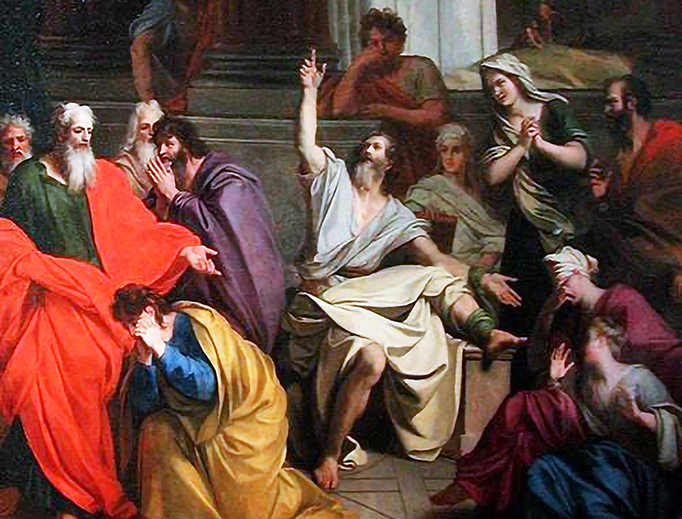
Samuel and Saul, by Dutch painter Claes Moeyaert (1592-1655)

In today’s story, we find Saul to be an obedient and responsible son, going out to find some lost donkeys. By all appearances, Saul was an upright, law-abiding, faithful Jew from the tribe of Benjamin. However, appearances can be rather deceitful. The outward presentation of someone is not always congruent with what is on the inside; and vice versa.

These were the days when Samuel the priest would make a circuit through the country. He made regular rounds as Israel’s judge. Saul and Samuel would encounter each other in a divine appointment. The contrast between the two of them would become ever more pronounced and obvious. But to the point at hand, Saul was simply out looking for some lost animals.

At that time, Israel was facing yet another Philistine military threat. The Philistines were not indigenous to Palestine. The Egyptians referred to them as “sea people;” they originally came from somewhere around the Aegean Sea area and settled in Canaan along the coastal plain between Gaza and Jaffa.

The Philistines expanded their territory, which continually put them at odds with Israel their neighbor. Militarily, the Israelites looked like bumpkins compared to the Philistines – who were skilled warriors with state of the art weapons.

Israel had no king. Instead, they were led by a series of judges who gave rulings throughout the land. Samuel was the last of them because the Israelite tribes determined and demanded that they must have a king in order to face the Philistine threat. (1 Samuel 8:1-21)

Samuel wisely perceived that asking for a king was not going to go well for the people. And he had warned them appropriately. Yet, Israel persisted in wanting to be like all the other nations in having a king to lead an army and fight Israel’s battles.

Although the people loved and appreciated the priest and prophet Samuel, his leadership was regarded as insufficient for the constant anxiety of dealing with the Philistines. It seems the people did not realize or consider what they were asking for, because they got it, and it wasn’t always victory and celebration.

If Israel wanted a king – and someone who looked the part – then that is exactly what they would receive. Saul was tall, strong, and seemed qualified to wage war on the pesky Philistines. Frankly, Saul was a putz who lacked the internal character needed to govern God’s people and ensure God’s will would be done in Israel.

But, again, I get ahead of myself. Reading the account of Saul for the first time, it’s easy for one to not see the signs of a coming personal implosion of the soul.

Sometimes whenever circumstances have been challenging for so long, and difficulty just keeps showing up, we begin to lose our good judgment and start wanting easy solutions for complex problems. And that is what I believe happened to Israel.

The Israelites got tired of the constant Philistine threat – to the point of believing that the grass is greener on the other side of the fence. They thought they needed a king and that everything would be better. And initially it was. But, over the long haul, it proved to be fatal.

For us today, it is good to remember that sound self-discipline through proven spiritual practices, and development of the soul by means of humility, patience, and wisdom, accomplish what is most needed in life.

Becoming weary and tired, we may slowly lose faith. Yet, the ability to persevere, stay the course, and listen well to wise people, can begin to erode and decay through the discouragement of constant adversity.

There is, however, a way to keep going when things are hard. Encourage one another daily. Avoid a critical spirit which drains the energy from others. Be careful who you listen to and take advice from. Become ever more familiar with Holy Scripture and that which is right, just, and good. Rely upon the Lord.

Living a faithful and devoted life to the divine covenant, instead succumbing to human culture, may not be easy; but it will serve us well in the long run.

Father of mercy, alone we have no power in ourselves to help ourselves. When we are discouraged by our weakness, strengthen us to follow Christ, our pattern and our hope; who lives and reigns with you and the Holy Spirit, one God, now and forever. Amen.

The Coming Divine Judgment (Revelation 20:7-15)

Lake of Fire, by David Howard Hitchcock, 1888

When the thousand years are over, Satan will be released from his prison and will go out to deceive the nations in the four corners of the earth—Gog and Magog—and to gather them for battle. In number they are like the sand on the seashore. They marched across the breadth of the earth and surrounded the camp of God’s people, the city he loves. But fire came down from heaven and devoured them. And the devil, who deceived them, was thrown into the lake of burning sulfur, where the beast and the false prophet had been thrown. They will be tormented day and night for ever and ever.

Then I saw a great white throne, and he who was seated on it. The earth and the heavens fled from his presence, and there was no place for them. And I saw the dead, great and small, standing before the throne, and books were opened. Another book was opened, which is the book of life. The dead were judged according to what they had done as recorded in the books. The sea gave up the dead that were in it, and death and Hades gave up the dead that were in them, and each person was judged according to what they had done. Then death and Hades were thrown into the lake of fire. The lake of fire is the second death. Anyone whose name was not found written in the book of life was thrown into the lake of fire. (New International Version)

Almost everything is temporary. All things temporal must come to an end. Therefore, it is foolish to live as if everything we have will last forever.

Conversely, there are a few things which are permanent, namely, God and relationships. So, it only makes sense that we exist for values that will last, while holding very loosely the temporal things. Jesus put the matter like this:

“Do not store up for yourselves treasures on earth, where moths and vermin destroy, and where thieves break in and steal. But store up for yourselves treasures in heaven, where moths and vermin do not destroy, and where thieves do not break in and steal. For where your treasure is, there your heart will be also. (Matthew 6:19-21, NIV)

Yet, despite knowing this, people struggle with their espoused values. Many times, we succumb to the temporal as if it were permanent; and with permanence the things which are temporary. This situation speaks to the power of evil; and evil is not something to trifle with.

Just when we might evil is contained, it isn’t. In today’s lesson, Satan is loosed from his imprisonment, still a threat. That is the nature of evil amongst us; it has the sinister capacity to rebound and wreak havoc in people’s lives.

In the Apostle John’s apocalyptic vision, Satan is joined by Gog and Magog, who represent the nations of the earth. This hearkens back to the prophecy of Ezekiel in the Old Testament (Ezekiel 38-39) in which Gog – the leader of the land of Magog – leads an attack on Jerusalem. In other words, evil comes together and focuses its energies on the people of God in order to destroy them.

However, God intervenes; the destruction the nations intended on God’s people comes upon them. Evil is finally done for, once and for all; it is thoroughly purged from the presence of the righteous.

With evil put in its place, there is nowhere for the old rebellious systems and order of things to exist anymore. A new heaven and a new earth is needed – not just a reconstituted heaven and earth – because that’s how nasty evil really is, that it must be completely purged. New systems are put in place which can accommodate righteousness. Jesus predicted this new reality:

And no one pours new wine into old wineskins. Otherwise, the new wine will burst the skins; the wine will run out and the wineskins will be ruined. No, new wine must be poured into new wineskins.  (Luke 5:37-38, NIV)

When the time comes, all persons will stand as they truly are before the Lord. There can be no making oneself look better than they are, or presenting a particular optic that spins a good look in order to impress. All the actions and deeds of people are laid bare.

God’s grace, along with and human actions, are held together in tension. God grants salvation; and what we humans do with that gift matters a great deal.

Humanity’s works in this life demonstrate what sort of person they actually are. So, if those works are inconsistent and incongruent with how one’s life has been lived, it demonstrates where their hearts truly are; and where their final destination will be.

There is a coming judgment in which death and hell are done away with forever. Anyone whose name is not found in the Book of Life goes the way of death and hell, because when they had the chance to use their temporal life to give permanent life for others, they did not.

The point is not to try and determine who Gog and Magog are; or when in the future this all will happen. The sage person remains far away from such useless folly.

The aim of the Apostle John, for which we must pay attention, is twofold: encourage the faithful; and warn the unfaithful.

The Book of Revelation was given to believers in Jesus, to help them see that suffering, persecution, and hardship is temporary; remain faithful, persevere in faith, and you will see your name written in the Book of Life.

Revelation was also given as great warning sign to those who have put so much stock into power politics, jostling for authority, and oppressing others to get what they want. The positions they hold now are temporary. The oppression they give in this life will be what they receive in the next.

In the end, all things shall be judged rightly. In this, I take great comfort and hope.

Lord Jesus Christ, by your patience in suffering you hallowed earthly pain and gave us the example of obedience to your Father’s will: Be near me in my time of weakness and pain; sustain me by your grace, that my strength and courage may not fail; heal me according to you will; and help me always to believe that what happens to me here is of little account if you hold me in eternal life, my Lord and my God. Amen.

Return to the Lord (1 Samuel 7:3-15)

Samuel prays to the Lord on behalf of the people, by Bible Art

So Samuel said to all the Israelites, “If you are returning to the Lord with all your hearts, then rid yourselves of the foreign gods and the Ashtoreths and commit yourselves to the Lord and serve him only, and he will deliver you out of the hand of the Philistines.” So the Israelites put away their Baals and Ashtoreths, and served the Lord only.

Then Samuel said, “Assemble all Israel at Mizpah, and I will intercede with the Lord for you.” When they had assembled at Mizpah, they drew water and poured it out before the Lord. On that day they fasted and there they confessed, “We have sinned against the Lord.” Now Samuel was serving as leader of Israel at Mizpah.

When the Philistines heard that Israel had assembled at Mizpah, the rulers of the Philistines came up to attack them. When the Israelites heard of it, they were afraid, because of the Philistines. They said to Samuel, “Do not stop crying out to the Lord our God for us, that he may rescue us from the hand of the Philistines.” Then Samuel took a suckling lamb and sacrificed it as a whole burnt offering to the Lord. He cried out to the Lord on Israel’s behalf, and the Lord answered him.

While Samuel was sacrificing the burnt offering, the Philistines drew near to engage Israel in battle. But that day the Lord thundered with loud thunder against the Philistines and threw them into such a panic that they were routed before the Israelites. The men of Israel rushed out of Mizpah and pursued the Philistines, slaughtering them along the way to a point below Beth Kar.

Then Samuel took a stone and set it up between Mizpah and Shen. He named it Ebenezer, saying, “Thus far the Lord has helped us.”

So the Philistines were subdued and they stopped invading Israel’s territory. Throughout Samuel’s lifetime, the hand of the Lord was against the Philistines. The towns from Ekron to Gath that the Philistines had captured from Israel were restored to Israel, and Israel delivered the neighboring territory from the hands of the Philistines. And there was peace between Israel and the Amorites.

Samuel continued as Israel’s leader all the days of his life. (New International Version)

Faithfulness to God matters. One cannot worship the Lord by day, then have a moonlighting job with other gods.

The priest and prophet Samuel helped lead Israel to repentance, and thus, a restoration of right relationship with their God. His leadership made all the difference. Samuel was not like the previous priests of Eli and his sons; nor was he like anyone else who didn’t really know what they were doing.

Samuel performed the appropriate sacrifices correctly; interceded with God on behalf of the people; enabled them to achieve victory; and continually and carefully watched over everything. Samuel was a needed stabilizing force in Israel. He identified sin in the nation and dealt with it wisely. Samuel led them to do right.

I confess my iniquity; I am troubled by my sin.

Psalm 38:18, NIV

Godly sorrow brings repentance that leads to salvation and leaves no regret, but worldly sorrow brings death. (2 Corinthians 7:10, NIV)

Come near to God and he will come near to you. Wash your hands, you sinners, and purify your hearts, you double-minded. Grieve, mourn and wail. Change your laughter to mourning and your joy to gloom. Humble yourselves before the Lord, and he will lift you up. (James 4:8-10, NIV)

Today’s Old Testament lesson brings up important questions of acknowledging disobedience, ignorance, and guilt; and how we are to respond to it.

Whenever we say or do something that we ought not to, it’s like squeezing a big tube of toothpaste out; there’s no way you can get it back in.

I actually did that once when I was a little kid. I saw new tube of toothpaste in the bathroom and wondered what it would be like to squeeze out a big amount. So, I did. It was fun. I did it again, then again and again, until it was all gone.

Knowing that perhaps this toothpaste thing might be a problem, I made an artwork out of it. After I was done, I turned off the light, shut the door, and in my little four-year-old brain, hoped nobody would see it. But oh my, they did!

As we get older, and into adulthood, we discover that we have a capacity to do a lot worse than toothpaste escapades. When we sin, there’s no way to put everything back the way it was before. Everything has changed because of our actions (or inactions). And we cannot make it look better, or put a positive spin on it.

There needs to be repentance – a confession of sin, a coming to God, and letting grace and forgiveness have its way. This is the path to restoration in returning to God, in bringing relational connections together again.

Repentance means that we tell God what we did; and that we’re sad about it. Instead of running away, we run to God and admit our guilt. This, by no means, is easy; but it’s the only way to take care of the problem and to feel better about it. And the Lord won’t make us feel worse, but will help us, no matter what.

Everybody is sad when they are caught doing something bad. But there is a good kind of sad, and a bad kind of sad. The bad kind of sad thinks to self, “I’m so stupid; I can’t do anything right,” and punishes myself for the wrong. On the other hand, the good kind of sad helps us realize that we never want to do that thing ever again; and we look to Jesus to forgive us and be our example of what to do right.

Good leaders, like Samuel, assist us in this process with grace, sensitivity, humility, respect, and a forthright spirit.

Most merciful God, we confess that we have sinned against you in thought, word, and deed, by what we have done, and by what we have left undone. We have not loved you with our whole heart; we have not loved our neighbors as ourselves. We are truly sorry and we humbly repent. For the sake of your Son Jesus Christ, have mercy on us and forgive us; that we may delight in your will, and walk in your ways, to the glory of your Name. Amen.