Spiritual Wisdom and Power (1 Corinthians 2:1-5)

By Bible Art

When I came to you, brothers and sisters, I did not come proclaiming the testimony of God to you with superior speech or wisdom. For I decided to know nothing among you except Jesus Christ and him crucified. And I came to you in weakness and in fear and in much trembling. My speech and my proclamation were made not with persuasive words of wisdom but with a demonstration of the Spirit and of power, so that your faith might rest not on human wisdom but on the power of God. (New Revised Standard Version)

When it comes to proclaiming the gospel – the good news of Christ’s person and work – both the message and the messenger are important.

The Apostle Paul was dialed in and focused on the Cross of Jesus Christ. Although he could have used various methods of persuasion, he was determined to set aside all other means of proclamation, and declare Christ’s Cross as the message and method itself.

This means that Paul also deliberately faded himself into the background, in order to have the Cross of Christ in the foreground. He emphasized his own weakness, his fear and trembling, in order to highlight the strength and majesty of God.

Paul wanted the messenger to point to the message – which meant that all of his speaking allowed God’s Spirit and power to show itself through him, rather than in spite of him.

The Corinthians came to believe the message not because of a big showy demonstration of Paul’s strength, intellect, and wisdom. Instead, they embraced Christian belief because of spiritual power and effort.

If it is spiritual wisdom and power centered in the message of Christ’s Cross which saves us, then it is also more than good enough to sanctify us, as well, and be the core from which all of the Christian life emanates from.

The Apostle understood that he is God’s agent, God’s ambassador, but that God alone is the One who saves humanity and delivers them from sin, death, and hell.

Christ Carrying the Cross, by Martin Schongauer, c. 1480 C.E.

Paul’s argument doesn’t have anything to do with making sure that the word “cross” is said in every sermon and conversation, or that Christians have only one thing to talk about.

Instead, the Apostle wanted the Corinthian Church to distance themselves from their typical of use of worldly philosophical wisdom, in favor of a distinctly spiritual wisdom which demands a certain kind of ministry:

The cross of Jesus Christ is to be the central event in which all of Christian life and ministry revolves around. In other words, the shape of Christianity is cruciform.

And since the cruciform nature of Christianity is our reality, our wisdom is to be received and flow from the Cross of Christ. To do less is to rely upon a different power other than the distinctive spiritual power of Christ’s death.

It isn’t any one of us which breaks through to another’s spirit; the power of God compels a person to listen, receive the message, and be given faith to believe, grow, and spiritually mature.

When the good news of Christ’s person and work takes root and develops within us, then what comes out of us is spiritual power, and not our own homespun worldly human wisdom.

“Wisdom” is the ability to take a body of knowledge and apply it to concrete situations in life.

So, when it comes to spiritual wisdom, Christians mature in the grace and knowledge of the Lord Jesus; then, they learn to take this important body of knowledge and apply it to all of the various circumstances and situations they are faced with every day.

This isn’t to say that worldly wisdom has no merit or significance, or that it is misguided. Rather, it means that this sort of wisdom doesn’t have the ability, the strength, or the power to move and change us, or others, toward deliverance and new life. We need the wisdom of the Spirit for that. And Paul insisted that this wisdom comes from the Cross of Christ.

The crucifixion of Christ is the wise guide for all of the Apostle Paul’s theology, message, and ministry. That singular event was like a massive meteor hitting the ocean of humanity, with a powerful tsunami of spiritual power and grace still making waves up to this very day.

Indeed, the Cross of Christ impacts all of creation, the entire universe. The person and work of Jesus Christ has cosmic implications for the salvation and deliverance of everything from the grip of evil.

On the practical daily level of things, none of this is about trying to do or be better, to somehow work harder at being a Christian or doing Christian mission and ministry. The fact of the matter is that we can only give to others what we have received from God. This means that:

  • The Holy Scriptures are to be received with reverence and fear, as a message given for us to learn and know so well that it becomes as familiar to you as the backdoor of your house.
  • The Christian life is about dying to self, taking up one’s cross and following Christ. If we desire the power of the resurrection, then this will first require embracing and allowing the powerful suffering of the cross to do its work.
  • Faithfulness is at the heart of living. Our task is to show up, pay attention, and speak the truth in love, and let God use this to accomplish the Divine holy will. Being married to outcomes and consequences will likely lead to reliance upon worldly wisdom, and eventually disappointment.
  • The Cross of Christ is what everything and everyone hinges upon. The world does not revolve around you nor me. So, let’s get in sync with the Spirit of God and rely upon the cruciform power provided for us by means of Christ’s death.

O God, who for our redemption gave your only-begotten Son to the death of the cross, and by his glorious resurrection delivered us from the power of our enemy: Grant us so to die daily to sin, that we may evermore live with him in the joy of his resurrection; who lives and reigns now and forever. Amen.


Get Low Enough To See (John 7:25-36)

At that point some of the people of Jerusalem began to ask, “Isn’t this the man they are trying to kill? Here he is, speaking publicly, and they are not saying a word to him. Have the authorities really concluded that he is the Messiah? But we know where this man is from; when the Messiah comes, no one will know where he is from.”

Then Jesus, still teaching in the temple courts, cried out, “Yes, you know me, and you know where I am from. I am not here on my own authority, but he who sent me is true. You do not know him, but I know him because I am from him and he sent me.”

At this they tried to seize him, but no one laid a hand on him, because his hour had not yet come. Still, many in the crowd believed in him. They said, “When the Messiah comes, will he perform more signs than this man?”

The Pharisees heard the crowd whispering such things about him. Then the chief priests and the Pharisees sent temple guards to arrest him.

Jesus said, “I am with you for only a short time, and then I am going to the one who sent me. You will look for me, but you will not find me; and where I am, you cannot come.”

The Jews said to one another, “Where does this man intend to go that we cannot find him? Will he go where our people live scattered among the Greeks, and teach the Greeks? What did he mean when he said, ‘You will look for me, but you will not find me,’ and ‘Where I am, you cannot come’?” (New International Version)

Once in a while, I pray something like this: “Lord, if I’m not seeing you when I ought to, or am not getting something you’re trying to show me, please use your divine baseball bat and whomp me upside the head!”

That’s because, far more often than I would like to admit, I miss seeing the Divine whenever God shows up. That’s true for all of us, as well. We tend to mistake experiencing God when the Lord comes and stands in front of us.

In the New Testament Gospels, some who followed Jesus ended up turning around and going back to their old life. Either the situations with Jesus got too dicey, or Christ’s teaching seemed too confusing. When that happens, it’s too easy to forget Jesus altogether, and never pay attention to him.

There are others who treated Jesus with contempt, simply because they didn’t recognize who he really is. One cannot have faith if they don’t know or acknowledge the object of faith. You cannot believe Jesus if you don’t believe he is from God.

And, of course, there are those who see Christ for who he is. Yet, some of them see Jesus as a threat and want to be rid of him. Others see him as a great healer and teacher, and follow Jesus in order to gain something from him.

However, there are others who see through spiritual eyes and gain the faith to believe and follow him.

All of us, in some way or another in our lives, have misread Jesus and mistaken him for the gardener or some other person.

Many of the Jews in Christ’s own lifetime rejected him because they believed him to be a common nondescript Jew. They knew his parents, and his family. Jesus was too familiar to be special, let alone the Son of God. Besides, everyone knows nothing good comes from the Hicksville that’s Nazareth, right?

The thing is: People miss seeing Jesus for who he is (sometimes including you and me) because we have particular expectations and requirements of our personal Jesus. In other words, it is awfully easy to make Jesus Christ into our own image of how he should be.

Having worked with college students for many years, I continually got a kick out of some of them who had precise requirements for a spouse, and certain expectations of how their potential kids were going to be someday.

It went well beyond having the same core cardinal values. Handsome and beautiful, smart but not too smart, assertive but not sassy, subservient but not a washrag, a 3-point Calvinist but not 5-point, willing to eat anything on the table except weird food that would embarrass, willing to live on a shoestring budget, funny but not quirky…. Actually, I could keep going; there’s a lot more. But you get the idea.

You may be curious as to my counsel to them. I typically said something along the lines of “I guess you’ll never get married, because marriage has nothing to do with any of that stuff. If you’re willing to have your eyes open and see a good person when they come along, and if you’re patient enough to develop a solid relationship built on grace, truth, and love, then you’ll likely find yourself a spouse you can be with for a lifetime.”

I remember one day on a college campus talking with a student after he asked me why he should ever be a Christian. I don’t think he expected my answer. I had already assessed that the guy was looking for a philosophical debate, so I went in a different direction. I said something like:

“I don’t think you should be a Christian. Jesus had people misunderstand him all the time. He was ridiculed and persecuted, tortured and killed. And he had the chutzpah to tell his followers that suffering would be a big part of being his disciple. Many of them followed him anyway. If you’re interested in why they did, we can talk. But if you just want to try and feel good by talking about Jesus, and avoid facing life’s pain and suffering, then I’m not wasting my time. So, what do you want to do?”

We will miss Jesus altogether if we are looking for a particular person. Whenever we get married to specific outcomes, then we’ll miss him for sure.

I wonder how many times Jesus showed up in your life this week, and you didn’t recognize him. In truth, Jesus is with us, by means of the Spirit, all the time. If you don’t see him, it’s not God’s fault, or anybody else’s.

Humility accesses spiritual sight. The religious leaders of Christ’s day were flummoxed and fuming all the time because of their arrogance, and their settled theological and biblical dogma. And so, they could not see who Jesus is, even though he was smack in front of them.

Yet, even though we may be spiritually blind and deaf, and finally see a glimpse and catch a sound of Jesus, that graciously means he is still there, beside you, never having given up on you.

Even a blurry and faint awareness realizes Jesus coming in the people we meet each day who encourage and bless us. Christ even comes and speaks through those we would not expect to hear a word from God.

Whenever we may wonder where Jesus is in our suffering and pain, he is there, sometimes even holding us and carrying us, despite our lack of awareness.

In reality, Jesus is in front of us, beside us, and holding us, all of the time. It’s just a matter of whether we know it, or not. Christ is in everything we experience. He is in both our sadness and joy, the noise and the silence, our work as well as worship, business and leisure, at night when we fall asleep and in the morning when we open our eyes.

So, if we are looking and longing for Christ, he has already come. Jesus came in the most humble forms possible. So, in order to see and experience him, we need to get low enough to see and hear him.

My Lord and my God, help me to see You in all of the ways You come to me today. Teach me not to despise any of the forms in which You come to me as being too common, humble, or ordinary. 

Wake me with Your presence in the morning and tuck me into bed when I sleep. Labor with me in my work today, and cause my leisure to lead to thanksgiving. 

Speak to me through the people You have ordained for me to meet today, and speak even through me, in spite of myself. 

For good and for ill, better and worse, in sickness and health, and in richness and poverty, reveal Yourself to me that I may receive whatever blessing You have chosen for me this day; through Jesus Christ Your Son, my Lord, who with You and the Holy Spirit are One God, now and forever. Amen.

Some Relational Wisdom (Proverbs 25:1-28)

Here are some more
    of Solomon’s proverbs.
They were copied by the officials
    of King Hezekiah of Judah.
God is praised
    for being mysterious;
rulers are praised
    for explaining mysteries.
Who can fully understand
    the thoughts of a ruler?
They reach beyond the sky
    and go deep in the earth.

Silver must be purified
before it can be used
    to make something of value.
Evil people must be removed
before anyone can rule
    with justice.

Don’t try to seem important
    in the court of a ruler.
It’s better for the ruler
    to give you a high position
than for you to be embarrassed
    in front of royal officials.
Be sure you are right
    before you sue someone,
or you might lose your case
    and be embarrassed.

When you and someone else
can’t get along,
    don’t gossip about it.
Others will find out,
and your reputation
    will then be ruined.

The right word
    at the right time
is like precious gold
    set in silver.
Listening to good advice
is worth much more
    than jewelry made of gold.
A messenger you can trust
is just as refreshing
    as cool water in summer.
Broken promises
are worse than rain clouds
    that don’t bring rain.
Patience and gentle talk
can convince a ruler
    and overcome any problem.

Eating too much honey
    can make you sick.
Don’t visit friends too often,
or they will get tired of it
    and start hating you.
Telling lies about friends
    is like attacking them
with clubs and swords
    and sharp arrows.
A friend you can’t trust
    in times of trouble
is like having a toothache
    or a sore foot.
Singing to someone
    in deep sorrow
is like pouring vinegar
    in an open cut.

If your enemies are hungry,
    give them something to eat.
And if they are thirsty,
give them something
    to drink.
This will be the same
as piling burning coals
    on their heads.
And the Lord
    will reward you.
As surely as rain blows in
    from the north,
anger is caused
    by cruel words.
It’s better to stay outside
    on the roof of your house
than to live inside
    with a nagging wife.

Good news from far away
refreshes like cold water
    when you are thirsty.
When a good person gives in
    to the wicked,
it’s like dumping garbage
    in a stream of clear water.
Don’t eat too much honey
    or always want praise.
Losing self-control
leaves you as helpless
    as a city without a wall. (Contemporary English Version)

The wise sayings in this chapter of the Book of Proverbs have to do with relational topics such as: relating to a leader; relating to others; and relating to oneself (self-control).

Relating To a Leader

When it comes to relating to any sort of leader above us, it is best to avoid arrogance and embrace humility.

Whether we realize it, or not, or like it, or not, leaders have a perspective that others don’t. They see the big picture of what is happening, and ideally, make wise decisions based upon all the factors and people involved.

This means that we are not always, maybe not even usually, going to understand what a leader or ruler is doing. This is why it is so important for leaders themselves to consult and collaborate with others, and choose wisely.

Humility isn’t only for followers, it is just as much, perhaps even more, necessary for the leader. Making decisions in a vacuum, or just trusting in one’s own counsel, usually doesn’t work out well. Everyone has character flaws, yet a leader’s flaws, weaknesses, and sins can stick out rather easily to others.

That doesn’t mean, however, that anyone has a right to believe they themselves can do a better job, or know more about how to lead, or have all the information. Because they don’t.

The ways of God are mysterious because it is a very big picture that only the Lord sees. And there are a lot of moving parts and people to all of God’s choices and movements in this world.

The important part, for us, is to recognize the goodness and wisdom of God, and to trust that the Lord – as the God of Love – always does what is right, just, and good, even though it may not always seem that way.

Relating To Others

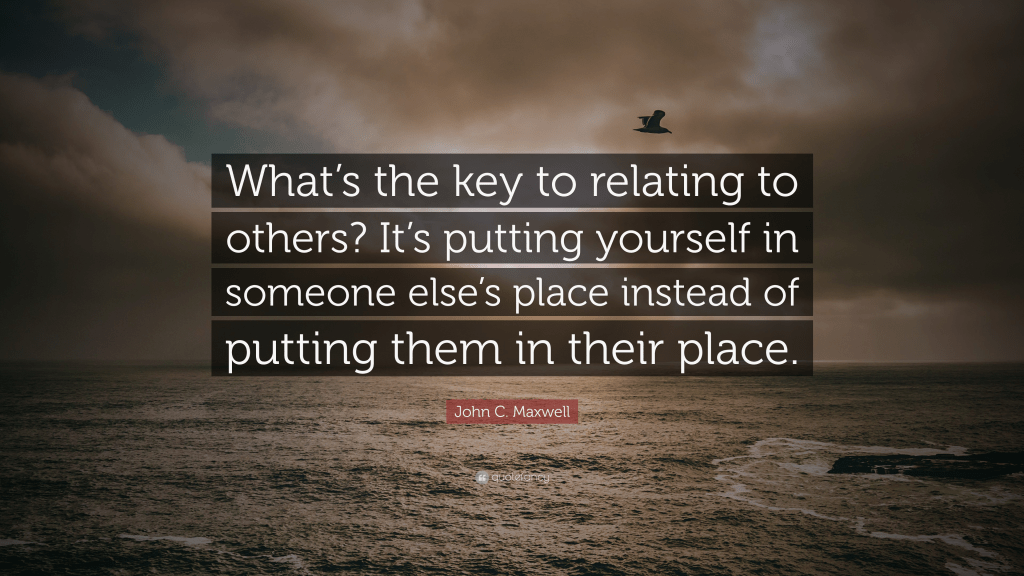
When it comes to how we generally relate to our fellow humanity, we are to show some empathy and deference. The ability to put yourself in another’s shoes is quite important and necessary, in order to relate well to others.

In failing to do this, and only thinking of oneself, we end up overstaying a welcome from someone who was thinking of us; or not paying attention that my morning blessing feels more like a curse to the night owl; or sharing some juicy tidbit of information that isn’t ours to share, so that others listen and pay attention to me.

Today, in this day and age, many persons fail to think of others when they are driving. Far too many people drive as if they own the road, and as if the traffic laws don’t apply to them. If they think of another driver at all, it’s only to curse them for hindering their ability to get to where they want to go.

Relating to Self

In contrast to all of that, we ourselves are to practice self-control and choose to live differently. Instead of cursing, we bless; and rather than selfishness, we practice selflessness.

If we would but all learn to exercise kindness over revenge, our world would be a very different place than it is today. And if we would but choose to speak the truth in love, rather than tell lies in hate or indifference, then there would be a lot less harm and hurt in this old fallen world.

By practicing self-control, we stop the cycle of hate, injustice, and unkindness. But if we choose the path of escalating verbal and/or physical violence, then this only leaves us vulnerable to harm. And it may open a way of having those you care about be harmed, as well.

I myself am the only person I’m in control of. And so I choose to:

  • be honest, trustworthy, and let God provide the judgment and justice needed for others
  • consider others, and think before talking
  • listen to wise counsel, and not entertain the manipulative words of the foolish
  • walk the patient path of wisdom

O God, grant me the wisdom I need in all my relationships. Help me recognize when things may be unsafe. I pray your protection over me and my family when we feel vulnerable. Thank you for having the power to heal broken relationships. Amen.

We Are All In the Same Boat (Romans 3:9-20)

What shall we conclude then? Do we have any advantage? Not at all! For we have already made the charge that Jews and Gentiles alike are all under the power of sin. As it is written:

“There is no one righteous, not even one;
    there is no one who understands;
    there is no one who seeks God.
All have turned away,
    they have together become worthless;
there is no one who does good,
    not even one.”
“Their throats are open graves;
    their tongues practice deceit.”
“The poison of vipers is on their lips.”
    “Their mouths are full of cursing and bitterness.”
“Their feet are swift to shed blood;
    ruin and misery mark their ways,
and the way of peace they do not know.”
    “There is no fear of God before their eyes.”

Now we know that whatever the law says, it says to those who are under the law, so that every mouth may be silenced and the whole world held accountable to God. Therefore no one will be declared righteous in God’s sight by the works of the law; rather, through the law we become conscious of our sin. (New International Version)

Whenever there is division, separation, and polarization between two groups of people, it’s important that someone has the ability to come back to what is true and common to all of us.

And that is what the Apostle Paul did in addressing the two differing groups of people in the ancient Roman Church of both Jewish and Gentile believers in Jesus.

The Jewish Christians, Paul argued, did not have a leg up on the Gentiles, just because of their long history with God. They tended to see themselves as better than their Gentile brothers and sisters in Christ. After all, the Jewish believers reasoned, we don’t have such a background of sinful pagan practices and estrangement from God.

Well, actually they do, however the Apostle did not rehearse his own people’s long history of stubborn rebellion and waywardness from God. Instead, he went back to the scriptures, and reminded the Jewish Christians of something they seemed to have lost sight of:

To be a human being is to be intimately familiar with sin and godlessness, guilt and shame, no matter the group nor the individual. We are all in the same boat.

In saying this, the Apostle Paul was not implying there is not anything good in anyone. Quite the contrary. For what is also true of humanity is that every individual person is a good creature, created from a good Creator, with the divine stamp of God’s image and likeness. There are no exceptions to this.

With all the mudslinging within the church, Paul simply pointed out that there is more than enough blame to go around. All the things that one group accuses another of is also true about they themselves.

And when it comes to sin – all those actions, words, and attitudes we have done and failed to do in loving our fellow humanity, and God – every one of us is in the same boat of guilt before God. There are no exceptions to this.

The power and ubiquity of sin is everywhere. Sin is like a nasty weight which continually burdens the world, and like an acrid fog that is always hanging in the air. We all feel the heaviness; we all breathe the same air.

All of our puny attempts at dividing one another into star-bellied Sneetches, and Sneetches without stars upon thars, is only proof positive of our sinful predilections to acquiesce to sin’s power on this earth.

This means that none of us can claim to take the moral and spiritual high ground. Nobody has an advantage on another. Therefore, it is ridiculous to ever try and implement policies of favoritism, cronyism, or prejudice. Such thinking itself is sinful, and ought to be jettisoned at the first awareness of it.

Whether we know what is right, or not; and whether we have the law and a covenant code, or not, isn’t really the issue. Obeying the law and doing what is right and just, with a good heart, is the real issue for all of us.

But it’s rather difficult to truly embrace justice and righteousness if the heart is no good. In truth, all of us have some rather dark places in our hearts. And until these are addressed, we will keep having all of our humanly contrived divisions and separations based upon a supposed superiority of the other.

The very fact that it is so easy to point out the sin in another, and label them as sinner, ought to tell us that “It takes one to know one.”

All Jews and Gentiles are under the accusation of God’s law, without exception. Everyone is accountable to God and the law. Proper observance of the law is to love God and neighbor – and thus, condemnation under the law is to ignore and disobey God, and to ignore and hate one’s fellow humanity.

What’s more, neither Jew nor Gentile can be justified by the law. Not a one of us can undo our guilt by ourselves.

No amount of work can satisfy the breadth and depth of that guilt. Pledges of perfectionism cannot help us, namely because we don’t even have the ability to follow through on them. Sheer hard work will not do the trick, because it would be like trying to empty the ocean with a kid’s sand toy bucket.

Only grace can reverse things. We need a pardon, and a new heart, which can sync and beat with the holy rhythms of divine love and justice. We need Jesus.

The Apostle Paul eventually got to that point later in his letter. Yet, here, he needed to establish everyone’s commonality of sin, so that they would embrace Jesus together as the one people of God who are in desperate need of his saving work, and the Spirit’s sanctifying work.

Therefore, the proper place to begin in being at peace with God and the world is to confess our own complicity in sin. Let us, then, offer this prayer of confession:

Lord Jesus, we have sinned times without number, and been guilty of pride and unbelief, and of neglect to seek you in our daily lives. Our sins and shortcomings present us with a list of accusations, but we thank you that they will not stand against us, for all have been laid on Christ. Deliver us from every evil habit, every interest of former sins, everything that dims the brightness of your grace in us, everything that prevents us taking delight in you. Amen.