You Live For Whatever You Love (Luke 16:14-18)

The Pharisees, who loved money, heard all this and were sneering at Jesus. He said to them, “You are the ones who justify yourselves in the eyes of others, but God knows your hearts. What people value highly is detestable in God’s sight.

“The Law and the Prophets were proclaimed until John. Since that time, the good news of the kingdom of God is being preached, and everyone is forcing their way into it. It is easier for heaven and earth to disappear than for the least stroke of a pen to drop out of the Law.

“Anyone who divorces his wife and marries another woman commits adultery, and the man who marries a divorced woman commits adultery. (New International Version)

No one can serve two masters. Everyone is committed to something, based upon who or what they are truly serving. Everybody has a master which informs them of ultimate values in life.

In other words, we live for what or whom we love.

Money

The Gospel writer Luke flatly and unequivocally mentioned the Pharisees as loving money. They lived for it. Money was their ultimate value.

With money as master, God is not.

If one’s thoughts, desires, and motives are fueled by Master Money, then that person can say they love and serve God, but they would be lying through their teeth.

If one’s activities are dominated by investments, buying and selling, and conversations with financial planners, then it isn’t God to whom they are praying; Mammon is their God.

The servants of Master Money may attempt to justify themselves, and rationalize their service to Mammon. They might talk about how much they give to charitable organizations, support their local church with monetary gifts, and underwrite a community building project. Yet, the real muster of benevolence is to whom all the money is truly being directed.

Money itself is not the problem; it’s the love of money that’s the issue (1 Timothy 6:10). Such a love of money had taken root into the Pharisee’s heart. They were offended by the words of Jesus, who exposed their true master.

Kingdom

The religious leaders claimed to be all about the Mosaic Law – which is why Jesus addressed this. In Christ’s view, the law and the prophets were until John the Baptist. John’s ministry caused a kerfuffle, because he was the forerunner of Messiah. He pointed to Jesus as the hoped for Savior.

The kingdom of God was at hand. But the religious establishment was too rooted in money as their ultimate deliverer.

Jesus is the Son over God’s house, and the Ruler of God’s empire. Christ is the kingdom. Since the time of John, the kingdom of God has been proclaimed, and everyone is pressing into it.

Multitudes of people flocked and followed Jesus in his earthly ministry. They listened to him talk of God’s kingdom being near. They seized hold of it, striving and pressing to get in.

There were folks who dropped everything, gave up everything, and forsook everything, just to pursue the kingdom of God. Their press toward the kingdom was a reflection of their values. And money had nothing to do with it.

Those who are Christians, in name only, may know something of Jesus and might talk a good line of theology, but they are far from the kingdom of God. They talk, but they don’t press. Someone who presses cries out with the psalmist:

How lovely is your dwelling place,
    Lord Almighty!
My soul yearns, even faints,
    for the courts of the Lord;
my heart and my flesh cry out
    for the living God. (Psalm 84:1-2, NIV)

Someone who presses is ready and willing to do some heavy spiritual lifting. They’ll put in the time and the effort toward the kingdom of God. It’s Jesus they think about, not money.

Law

Believers and followers of Jesus are concerned for what God cares about. And Jesus was concerned about Holy Scripture. He intended on keeping every jot and tittle of the Torah, the Law.

Although we have many differing interpretations of varying passages in the Bible, Jesus is still concerned for the fulfillment of all God’s good promises. Our own angst about upholding the Bible isn’t shared by Christ. Our arguments and divisions don’t sway Jesus into our anxiety.

Christ knows that every word of God shall not fail. It would be easier for the world to spontaneously blow up than for any one word of God to fall away unfulfilled. Money and stuff will pass away, but not God’s Word.

The basic moral and ethical will and law of God hasn’t gone anywhere. Just because the Ten Commandments are not posted publicly anywhere, doesn’t mean they have disappeared.

God’s holy law is like a mirror in front of us, showing us how we are to judge ourselves. The Apostle Paul likened the law to a schoolmaster that drives us to Christ (Galatians 3:24-27).

Furthermore, the law acts as a restraint to evil in the world. It has the value of revealing to us what is not pleasing to God. And if I am pressing into the kingdom of God, I want to know what God loves and hates.

The Pharisees were supposedly the experts in God’s law. Some folks are quite hard on the Pharisees. Yet, rather than bashing on them as a group of people, we need to let the law be our own mirror; we must be concerned with our own righteousness, or lack thereof.

It’s easy for us, along with the old Pharisees, to be legalists – adding principles and traditions to the law that are not the law itself. Holding to these traditions can become as important, or more, as the actual law. They can end up becoming the standard we judge everything by, instead of the actual law, as it is.

Divorce

The morass of traditions surrounding the law is what Jesus was referring to in speaking about divorce. Christ had no use for a husband who could divorce his wife for various incidents, including not being pretty anymore, breaking a dish, or burning the toast.

All of that rigmarole was why Jesus came back to affirming the sanctity of marriage. He pointed out that divorce under conditions of tradition, not law, were tantamount to adultery. Christ was thinking of women’s rights.

In a society in which women were dependent upon men for having their needs met, Jesus did not want women to experience injustice from men. In God’s economy, men are neither free to do whatever they want with women, nor with marriage. Their money needs to be used for wife and family, and not in cleverly contrived ways to get around the law.

We live for what we love. If someone loves money, it will not end well for them. If someone loves God and doing God’s will, then there is life and peace.

Let’s just make sure that we are truly doing God’s will, and not our own secret or unconscious intentions. Because no one can serve two masters.

Blessed God, help me to do Your revealed will fully, gladly, and immediately; and to love You with all my heart, soul, mind, and strength. Enable us all to love our neighbors as ourselves; and to seek the good of people from everywhere. Save us from being unhappy Christians. Deliver us from the sinful habit of complaint. May we rejoice in You, be constant in prayer, and give thanks in all circumstances; through Jesus Christ our Lord, in the strength of the Holy Spirit. Amen.

Live with Integrity (Psalm 26)

Vindicate me, O Lord,
    for I have walked in my integrity,
    and I have trusted in the Lord without wavering.
Prove me, O Lord, and try me;
    test my heart and mind.
For your steadfast love is before my eyes,
    and I walk in faithfulness to you.

I do not sit with the worthless,
    nor do I consort with hypocrites;
I hate the company of evildoers
    and will not sit with the wicked.

I wash my hands in innocence
    and go around your altar, O Lord,
singing aloud a song of thanksgiving
    and telling all your wondrous deeds.

O Lord, I love the house in which you dwell
    and the place where your glory abides.
Do not sweep me away with sinners
    nor my life with the bloodthirsty,
those in whose hands are evil devices
    and whose right hands are full of bribes.

But as for me, I walk in my integrity;
    redeem me and be gracious to me.
My foot stands on level ground;
    in the great congregation I will bless the Lord. (New Revised Standard Version)

Those with integrity long for, and pray for, justice and righteousness. They despise evil and desire the community of faith to be full of love.

Today’s psalm, as well as all of the psalms, are solid prayers which are meant to be prayed by any individual person, at any time, in any era. Those desiring the right, the just, and the good, will especially gravitate toward the psalter and prayer.

The faithful seek to live a morally upright life of integrity, peace, and wholeness. Yet, the psalm is also for those who find themselves unfaithful. They can pray and ask God to search their hearts and bring them to innocence. So, no matter who you are, this psalm is for anyone who wants to connect with the Lord

We have the ability to come before God because God encourages it, and makes it possible for us to approach. The Lord isn’t looking for perfection; God wants some honesty and vulnerability, and for us to realize how utterly dependent creatures we are.

The steadfast love of God is everywhere, and the psalmist recognized this. No matter the situation or circumstance, no matter the place or time, God’s love is present. The reason why we can wrap our faith and commitment around God is that God is consistently and constantly loving in everything.

And whenever we discern and know that this world spins on the axis of love, then we have no desire whatsoever to hang out with those who practice wickedness; we want nothing to do with worthless conversations and actions.

When one has been touched by divine love, not only is there a desire to avoid all evil, but there is also a longing to remain in that love, and to have love be the dominant operative force in all things on this earth.

Once we receive love, we want to give love. And having given love, we desire for the entire world to know this love, which is the true ballast and support of the world.

Without love, there is nothing. With love, all things are possible.

The one who loves does not consort with liars or hypocrites, because such persons indulge deception and selfishness, not openness and respect for others. The lover of God and of righteousness is not found in the company of evildoers.

The lovers amongst us are much too busy providing justice and goodness. The haters amongst us just sit around and curmudgeon on about everything that is messed up in this world, and make fun of all the do-gooders who are so enamored with love.

Which group of people would you rather be around? The lovers or the curmudgeons? Would you like to be in the group who acts like they have everything together? Or would you instead like to be in the group who knows how much they are dependent on the force of love, and of the originator of love, the one who is Love incarnate?

I, personally, would rather be in the community of the redeemed, who know they have been rescued by grace and could fall into wickedness if not for God’s sustaining grace. I have no desire to be in community with people who talk one way and live another.

I would like to be in the place characterized by integrity and love, the sort of place described by the Apostle Paul in his letter to the Romans:

Therefore, I urge you, brothers and sisters, in view of God’s mercy, to offer your bodies as a living sacrifice, holy and pleasing to God—this is your true and proper worship. Do not conform to the pattern of this world, but be transformed by the renewing of your mind. Then you will be able to test and approve what God’s will is—his good, pleasing and perfect will.

For by the grace given me I say to every one of you: Do not think of yourself more highly than you ought, but rather think of yourself with sober judgment, in accordance with the faith God has distributed to each of you….

Love must be sincere. Hate what is evil; cling to what is good. Be devoted to one another in love. Honor one another above yourselves. Never be lacking in zeal, but keep your spiritual fervor, serving the Lord. Be joyful in hope, patient in affliction, faithful in prayer. Share with the Lord’s people who are in need. Practice hospitality.

Bless those who persecute you; bless and do not curse. Rejoice with those who rejoice; mourn with those who mourn. Live in harmony with one another. Do not be proud, but be willing to associate with people of low position. Do not be conceited.

Do not repay anyone evil for evil. Be careful to do what is right in the eyes of everyone. If it is possible, as far as it depends on you, live at peace with everyone. (Romans 12:1-3, 9-18, NIV)

The only thing better than blessing the Lord, is blessing the Lord with an entire congregation of redeemed people who possess integrity, righteousness, and sincere love.

The psalmist, along with the Apostle Paul, lets us know that each of us is responsible for our moral and spiritual integrity. We bear the responsibility to give and receive love. Prayer then becomes much easier and desirable whenever we can pray with a longing for God and God’s righteousness. We really can follow God’s ways and serve the common good of all people with some solid integrity.

Our Father in heaven,
Hallowed be Your name.
Your kingdom come.
Your will be done
On earth as it is in heaven.
Give us this day our daily bread.
And forgive us our debts,
As we forgive our debtors.
And do not lead us into temptation,
But deliver us from the evil one.
For Yours is the kingdom and the power and the glory forever. Amen. (Matthew 6:9-13, NKJV)

Suffering That Is Beyond Understanding (Job 2:11-3:26)

When Job’s three friends, Eliphaz the Temanite, Bildad the Shuhite and Zophar the Naamathite, heard about all the troubles that had come upon him, they set out from their homes and met together by agreement to go and sympathize with him and comfort him. 

When they saw him from a distance, they could hardly recognize him; they began to weep aloud, and they tore their robes and sprinkled dust on their heads. Then they sat on the ground with him for seven days and seven nights. No one said a word to him, because they saw how great his suffering was.

After this, Job opened his mouth and cursed the day of his birth. He said:

“May the day of my birth perish,
    and the night that said, ‘A boy is conceived!’
That day—may it turn to darkness;
    may God above not care about it;
    may no light shine on it.
May gloom and utter darkness claim it once more;
    may a cloud settle over it;
    may blackness overwhelm it.
That night—may thick darkness seize it;
    may it not be included among the days of the year
    nor be entered in any of the months.
May that night be barren;
    may no shout of joy be heard in it.
May those who curse days curse that day,
    those who are ready to rouse Leviathan.
May its morning stars become dark;
    may it wait for daylight in vain
    and not see the first rays of dawn,
for it did not shut the doors of the womb on me
    to hide trouble from my eyes.

“Why did I not perish at birth,
    and die as I came from the womb?
Why were there knees to receive me
    and breasts that I might be nursed?
For now I would be lying down in peace;
    I would be asleep and at rest
with kings and rulers of the earth,
    who built for themselves places now lying in ruins,
with princes who had gold,
    who filled their houses with silver.
Or why was I not hidden away in the ground like a stillborn child,
    like an infant who never saw the light of day?
There the wicked cease from turmoil,
    and there the weary are at rest.
Captives also enjoy their ease;
    they no longer hear the slave driver’s shout.
The small and the great are there,
    and the slaves are freed from their owners.

“Why is light given to those in misery,
    and life to the bitter of soul,
to those who long for death that does not come,
    who search for it more than for hidden treasure,
who are filled with gladness
    and rejoice when they reach the grave?
Why is life given to a man
    whose way is hidden,
    whom God has hedged in?
For sighing has become my daily food;
    my groans pour out like water.
What I feared has come upon me;
    what I dreaded has happened to me.
I have no peace, no quietness;
    I have no rest, but only turmoil.” (New International Version)

Job and His Friends, by Ilya Repin, 1869

By anyone’s definition of trouble, the biblical character of Job was in a world of it. Through a series of terrible calamities in which he lost all his children and his earthly possessions, Job was sitting in misery with painful sores on his body from head to toe.

We as readers of Job’s story, have been informed of the behind the scenes discussion between God and Satan. Out of that conversation, Satan was allowed to do anything to Job except outright kill him. (Job 1:1-12)

Job and his “friends,” however, were not privy to any of that insider information. All they knew was the bald reality concerning Job’s loss of family, property, and health. When the friends heard of the tragedies, they came to visit him. And upon seeing Job, they barely recognized him, devastated from the harsh circumstances of his experiences.

What would you do if you were Job? I’ve seen people give up on life altogether, having gone through a lot less than Job. What would you do if you were the friends? I’ve known people that didn’t even have their friends show up, at all, when they went through extreme difficulties.

Sometimes I feel as if I’m in the business of being a chaplain to the Job’s of this world. I consider myself a creative guy, but the experiences and stories from some of the patients I’ve seen, I don’t think I could ever have imagined. There are hardships some folks have lived through that have no words. “Trauma” is an understatement for them.

That was the spiritual and emotional territory for Job. Yet, he held fast to his commitment toward God. But that didn’t mean Job was going to keep quiet and be passive before God or anyone else.

Job was in such a holistic state of misery that he wished he were never born. Both body and soul were hurting beyond hurt.

It is laughable to me to consider that Job would have ever said anything like, “Well, there are others who have it worse than me!” “I could be more thankful for what I have!” “My wife is alive. I need to be strong for her.” And yet, people in awful situations tell themselves things like this every day.

Then, there are the friends. Within the biblical Book of Job, they are actually at their best in the beginning of the story. That is, they are quiet and don’t say a thing. Later, when they open their mouths, we get them saying shortsighted and ignorant things.

In our quest to make sense of unwanted and unasked for situations, we try to understand what is going on. But not everything is going to make sense. There is a chunk of life that will forever be nonsense to us. And it isn’t our task in this life to figure everything out – namely because there are some things that are well beyond our ever figuring out.

In saying that, it doesn’t mean that I am a nihilist. If you perhaps think that, then maybe you have an inordinate need to know all things and how they work.

Instead, I am pointing out something that may seem simple, in the midst of people’s lives that are incredibly complex with all sorts of strange permutations to them:

  1. If you have been through something life-changing, you need to tell your story to someone. To connect with another person who cares about what you are going through is vital. You cannot live without it.
  2. If your friend has been through something life-changing, you need to listen to their story, without immediate comment or thinking about how to respond. Your caring affect and demeanor is what just may save their life.

This is actually difficult work. Stories can be hard, because life can be hard. Listening is hard, because it hurts to hear another’s pain.

But it is more necessary than you could ever imagine.

As Jesus cried out on the cross, I cry out to you in pain, O God my Creator. Do not forsake me. Grant me relief from this suffering and preserve me in peace; through Jesus Christ my Savior, in the power of the Holy Spirit. Amen.

A Great Reversal (Esther 8:1-17)

Reversal, by Margarita Lypiridou, 2021

That same day King Xerxes gave Queen Esther the estate of Haman, the enemy of the Jews. And Mordecai came into the presence of the king, for Esther had told how he was related to her. The king took off his signet ring, which he had reclaimed from Haman, and presented it to Mordecai. And Esther appointed him over Haman’s estate.

Esther again pleaded with the king, falling at his feet and weeping. She begged him to put an end to the evil plan of Haman the Agagite, which he had devised against the Jews. Then the king extended the gold scepter to Esther and she arose and stood before him.

“If it pleases the king,” she said, “and if he regards me with favor and thinks it the right thing to do, and if he is pleased with me, let an order be written overruling the dispatches that Haman son of Hammedatha, the Agagite, devised and wrote to destroy the Jews in all the king’s provinces. For how can I bear to see disaster fall on my people? How can I bear to see the destruction of my family?”

King Xerxes replied to Queen Esther and to Mordecai the Jew, “Because Haman attacked the Jews, I have given his estate to Esther, and they have impaled him on the pole he set up. Now write another decree in the king’s name in behalf of the Jews as seems best to you, and seal it with the king’s signet ring—for no document written in the king’s name and sealed with his ring can be revoked.”

At once the royal secretaries were summoned—on the twenty-third day of the third month, the month of Sivan. They wrote out all Mordecai’s orders to the Jews, and to the satraps, governors and nobles of the 127 provinces stretching from India to Cush. These orders were written in the script of each province and the language of each people and also to the Jews in their own script and language. Mordecai wrote in the name of King Xerxes, sealed the dispatches with the king’s signet ring, and sent them by mounted couriers, who rode fast horses especially bred for the king.

The king’s edict granted the Jews in every city the right to assemble and protect themselves; to destroy, kill and annihilate the armed men of any nationality or province who might attack them and their women and children, and to plunder the property of their enemies. The day appointed for the Jews to do this in all the provinces of King Xerxes was the thirteenth day of the twelfth month, the month of Adar. A copy of the text of the edict was to be issued as law in every province and made known to the people of every nationality so that the Jews would be ready on that day to avenge themselves on their enemies.

The couriers, riding the royal horses, went out, spurred on by the king’s command, and the edict was issued in the citadel of Susa.

When Mordecai left the king’s presence, he was wearing royal garments of blue and white, a large crown of gold and a purple robe of fine linen. And the city of Susa held a joyous celebration. For the Jews it was a time of happiness and joy, gladness and honor. In every province and in every city to which the edict of the king came, there was joy and gladness among the Jews, with feasting and celebrating. And many people of other nationalities became Jews because fear of the Jews had seized them. (New International Version)

“So the last will be first, and the first will be last.”

Jesus (Matthew 20:16)

Knowing that someone is not who they present themselves as can be maddening. They’re selfish and enamored with having authority, yet everyone thinks they are okay.

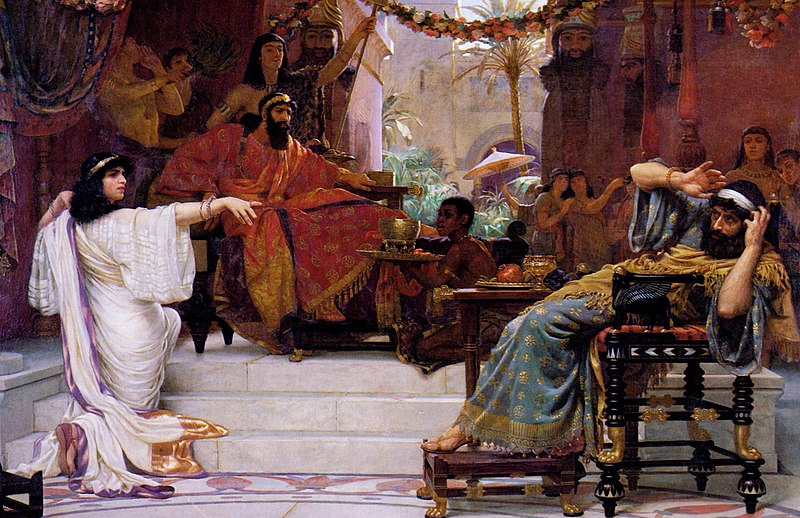
Haman was a bad man who camouflaged himself as important. As the right hand man to King Xerxes of the vast Persian Empire, Haman valued position, power, and attention above all else. But his arrogance proved to be his downfall.

People who are concerned to be seen as important can never get enough. Haman was not satisfied to be the prime minister in the empire, even though millions of people bowed down to him.

Mordecai, a Jew, Queen Esther’s cousin, refused to bow down. He saw the pride and arrogance within Haman to have what only belongs to God.

Haman could not stomach this one Jew dismissing his power and authority. As a person who wanted only “yes men” around him, Haman was determined to eradicate Mordecai. And even that was not enough for him. So, Haman proposed the destruction of all Jews.

He was supposedly an imperial expert on “the Jewish problem.” So, King Xerxes listened to him when he hatched a devious strategy to rid the empire of all Jews. A decree was made that on a particular day the Jews could be destroyed and plundered.

But the real plan that resets all other plans is the plan of God. And God’s plans are for good, not evil; and for Jewish life, not death.

Esther Denouncing Haman, by Ernest Normand, 1888

Pride and arrogance never ends well for the proud and arrogant person. They may have their way for a while, but ultimately such people find that their evil plans come back on themselves.

So, one night when the king was unable to sleep, he had the annals of the kingdom read to him. He heard of Mordecai’s successful effort at saving the king’s life from an assassination plot. The king also learned that Mordecai had never been properly recognized and rewarded.

One of the main differences between the proud and the humble is that arrogant people are obsessed with recognition and rewards; whereas the humble person cares about what is right and just, viewing good deeds as their own reward.

As the king’s trusted right hand man, Haman was consulted as to what ought to be done for someone the king wants to honor. The proud person always believes the honored person is themselves.

So, Haman, believing Xerxes wanted to honor him, suggested an elaborate recognition ritual involving a parade and plenty of accolades.

The king, however, had this in mind for Mordecai. He ordered Haman to be the one who made sure the recognition happened. And that’s not all. Haman would also get retribution for his evil heart.

Behind the scenes of royal power and scuttlebutt, Esther and her people were praying and fasting. Esther had her own plans for good, and not for evil.

Of course, Haman believed that a banquet was being given in his honor by the queen. In reality, not at all.

Esther revealed to the king the true plot and hate against her own people. Enraged, King Xerxes demanded who would dare presume to do such a thing against his beloved queen and her people.

With Haman directly in front of them, Esther pointed out the adversary. And then, the gallows which Haman had made to hang Mordecai were used for his own execution. Thus ended the story of the villain Haman.

There was still, however, the problem of the royal decree to destroy the Jewish people on an appointed day. Haman had been dealt with, but there were still wide-ranging consequences of his actions that remained in effect, and that could only be dealt with at the political level.  

Queen Esther interceded to the king on behalf of her people. Although a decree from the king cannot be revoked, yet another decree could be written in another’s name that would counteract the first. And this is precisely what Mordecai and Esther did, with the king’s full knowledge and blessing to it.

Today’s Old Testament lesson is a great reversal of fortunes if there ever was one. The high position of Haman and his extreme hatred and arrogance are gone. The Jewish people, on the precipice of annihilation, are not only alive, but had the opportunity to pushback on their enemies. Mordecai was not hanged on a gallows, but became in charge of Haman’s entire estate.

This was a restoration beyond what anyone could have thought or imagined. And that is the sort of reversal which God specializes in.

You cannot fool God, so don’t make a fool of yourself! You will harvest what you plant. If you follow your selfish desires, you will harvest destruction, but if you follow the Spirit, you will harvest eternal life. Don’t get tired of helping others. You will be rewarded when the time is right, if you don’t give up. (Galatians 6:7-9, CEV)

God, I am far too often influenced by what others think of me. May I not pretend to be either richer or smarter or nicer than I really am. Please hinder me from trying to attract attention. Don’t let me gloat over praise on one hand or be discouraged by criticism on the other. Nor let me waste time weaving imaginary situations in which the most heroic, charming, witty person present is myself. Show me how to be humble of heart, like you. Amen.