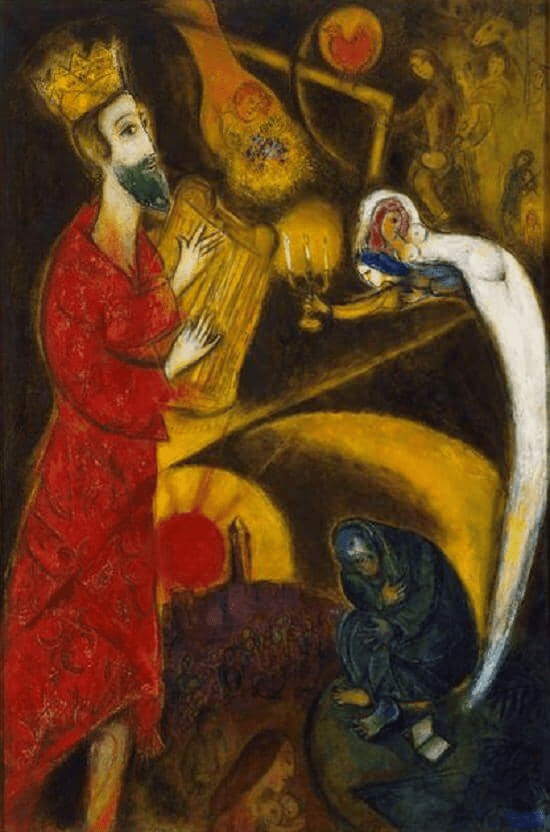
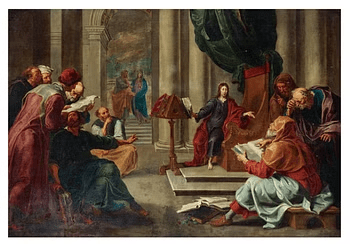
The Most High Shall Lift Up the Needy (Psalm 113)

By Unknown Artist

Praise the Lord!
Praise, O servants of the Lord;
    praise the name of the Lord.

Blessed be the name of the Lord
    from this time on and forevermore.
From the rising of the sun to its setting,
    the name of the Lord is to be praised.
The Lord is high above all nations
    and his glory above the heavens.

Who is like the Lord our God,
    who is seated on high,
who looks far down
    on the heavens and the earth?
He raises the poor from the dust
    and lifts the needy from the ash heap,
to make them sit with princes,
    with the princes of his people.
He gives the barren woman a home,
    making her the joyous mother of children.
Praise the Lord! (New Revised Standard Version)

The psalmist calls for praise to God, because the Lord is the God both far and near, both transcendent (high above and over) and immanent (close by enough to respond quickly).

God is a dynamic force and presence in this world.

It is God who sees the poor and needy from on high, and comes near to lift them and give them a place alongside those in power and with authority.

It is the Lord God almighty who observes the childless woman from afar and draws near to ensure that she becomes a joyful mother.

Today’s psalm is the first of six psalms (Psalms 113-118) which make up the Jewish Hallel – prayers of thanksgiving added to the morning service of worship on the days of festive Jewish holidays. 

This collection of psalms tells a story of God’s merciful acts in history for the people of Israel. The Israelites express joy and thanksgiving, because the Lord noticed them, and actively worked on their behalf.

Christians, too, make use of Psalm 113 for praise and worship. In the stories of both Hannah in the First Testament, and Mary in the Second Testament, the transcendent God listened to them, and was immanently present in helping them to conceive children.

This is a concerned and engaged God, who hears the humble, and lifts them beyond what they can even ask or imagine. (1 Samuel 2:1-10; Luke 1:39-57)

Yet, some may wonder why their prayers have not been answered.

Some are confused as to why God seems aloof in the midst of their needy circumstance.

There are yet many more who are discouraged by all of the terrible natural disasters which devastate people’s lives, and the existence of war and hatred and injustice around the globe.

And there are plenty of women who want children, but are unable to conceive; while there are women with children who treat them poorly.

Where is this good God when there is so much bad going on?

The psalmist exclaimed that God raises the poor, lifts the needy, and gives the barren woman a home. There is, however, no timetable set on precisely when this will happen.

Many a barren woman in the biblical stories was in that position for year after year. Sarah in the Old Testament, and Elizabeth in the New, were two elderly women who had a child in their old age. Beyond what was biologically possible, God nevertheless gave.

There was also many a person in the Bible who died, while never having had a change in their circumstance. Even in such cases, the humble and godly poor person shall be rich in heaven; and the needy person will experience plenty for eternity.

This isn’t meant to be a pat answer now in the present; rather, it points to the need for hope, the confident expectation that the unwanted and awful circumstance I am experiencing today will not always be true of me.

Just one implication of this is that even the destitute can praise God. Even the needy can give thanks, while they are simultaneously crying out for help.

The Christian will someday have a seat with Christ in the heavenlies. This is a hope built into one’s faith commitment. It is a sure thing in the future, just as much as the present reality I currently face.

No matter whether one is rich or poor, in plenty or in want, in a full house of children or none at all – every person has a reason to praise God and express gratitude for the One who sees from on high, and draws near with what is truly helpful for this present time – whether that help is in the form of tangible resources and assistance, or intangible comfort and encouragement.

Unfortunately, there are people in this old fallen world of ours who create the conditions of poverty for others; manipulate circumstances that opens a large gap of need for the underprivileged; and exclude people who are not in power and have no earthly authority.

God does not want injustice for people; oppression and exclusion is inconsistent with the Lord’s sense of justice and mercy. The psalmist affirms those who languish on the ash heap of life that they will be lifted up. Their present experience of despair will not last forever.

A day is coming when those in need will have their justice, where the malevolent forces of this world will be leveled, and the needy will sit with princes.

Discouragement does not have the last word. The day of praise will break through and overcome the day of despair.

Praise be to God!

Almighty and most merciful God, we remember before you all the poor and neglected persons whom it would be easy for us to forget: the homeless and the destitute, the old and the sick, and all who have none to care for them. Help us to heal those who are broken in body or spirit, and to turn their sorrow into joy. Grant this, O God, for the love of your Son, who for our sake became poor, Jesus Christ our Lord. Amen.

Caring For the Aged (1 Timothy 5:1-8)

Do not rebuke an older man harshly, but exhort him as if he were your father. Treat younger men as brothers, older women as mothers, and younger women as sisters, with absolute purity.

Give proper recognition to those widows who are really in need. But if a widow has children or grandchildren, these should learn first of all to put their religion into practice by caring for their own family and so repaying their parents and grandparents, for this is pleasing to God. 

The widow who is really in need and left all alone puts her hope in God and continues night and day to pray and to ask God for help. But the widow who lives for pleasure is dead even while she lives. Give the people these instructions, so that no one may be open to blame. Anyone who does not provide for their relatives, and especially for their own household, has denied the faith and is worse than an unbeliever. (New International Version)

Timothy was the young Pastor of the Church in Ephesus, having been appointed by his mentor, the Apostle Paul. Paul wrote to his protégé in order to clarify and remind Timothy of how to go about his ministerial duties amongst the congregation.

In dealing with older persons, Paul instructed that they must not be dealt with harshly. There needs to be gentleness and moderation in correcting any faults with elders. Old folks already take quite enough medicine they don’t like. No one, especially some whipper-snapper, ought to come along and add some bitter medicine to their regimen.

Instead, provide exhortation which is tolerable, and evidences genuine concern and humility. Make it good medicine.

Timothy was not to allow the older folks to get away with being stinkers. And the way to handle this is by being respectful, considerate, and gentle.

Since the Body of Christ is a family, older men need to be treated as fathers, and older women as mothers. The younger women, too, must be corrected, when necessary. Although it is a delicate task, it needs to be engaged with the same care as the older men.

If Timothy thought about his ministry with people as dealing with his own mother, then he would do it with a great deal of love, humility, grace, and wisdom. Not only is the message to be conveyed; the spirit behind the message is just as important.

Younger women are to be treated as sisters; and young men as brothers. The way everyone is handled is significant. All persons, without exception, need love and attention.

The Apostle pointed out that there are certain groups of people which require special attention. Therefore, distressed widows need to be honored and treated with high regard.

A father to the fatherless, a defender of widows,
    is God in his holy dwelling. (Psalm 68:5, NIV)

Widows are identified in Scripture as those who are under the special care of God. So, how we treat them, is how we are treating God.

Any widow in the church who had no little to no support were to be provided for by the church. In the earliest church, this was important enough to warrant the creating of a new church ministry of deacons. (Acts 6:1-6)

Those widows who have children and/or grandchildren are to be first and foremost cared for by their family. Paul was unequivocable on this point. He insisted that a family with needy members, such as widows, are to put their religion into practice by ensuring that their mother or grandmother or aunt or any widow in the family is given what they need to live.

The Apostle’s directive to Timothy is that the church must not be unnecessarily burdened. Paul’s larger concern, however, was that adult children should honor their parents. That is their first religious duty as Christians. They ought to make a real and substantial effort toward mom and dad by providing for them in their old age, when they need it.

“It is easier for one poor father to bring up ten children, than it is for ten rich children to provide for one poor father.”

Dutch proverb

The provision for needy parents is to be done with a spirit of gratitude, love, and appreciation. I understand that this admonition gets rather dicey when it comes to adult children who were raised by a mother or father who was, at best, a stinker, and at worst, downright mean or abusive.

Yet, the wise Christian will learn to find ways toward returning a curse with a blessing, and so, honors both the parent and God. This in no way requires ignoring one’s own needs; it just means that we will strive to discover how to honor and provide for an aged mom or dad.

Having said that, there is a wide difference between the widow who puts her trust in God, and the widow who lives frivolously with no concern for God or others. The pious widow with no family must be cared for by the church. And the dissolute widow is not to be treated the same. The church, as well as the family, will need to be creative in how to approach such widows.

Each case within both the church and the family needs to be considered on its own merits. There is not necessarily a one-size-fits-all approach in every situation with a needy person. The following verses are helpful for us, as we consider how to assist:

Jesus said to his disciples,

 “A new command I give you: Love one another. As I have loved you, so you must love one another.” (John 13:34, NIV)

“My command is this: Love each other as I have loved you.” (John 15:12, NIV)

And the Apostle Paul said to the Church in Galatia,

“Carry each other’s burdens, and in this way you will fulfill the law of Christ.” (Galatians 6:2, NIV)

Whatever we do, or not do, we are not to neglect needy persons in our family or faith community. To reject or deny such persons is tantamount to rejecting one’s Christian faith.

Let us strive for both duty and delight in caring for the needy amongst us. Both are important. Sheer duty without delight is mere drudgery; it cannot be sustained. And only delight without any duty is irresponsible; it is also unsustainable.

May God’s provision and blessing be with you, as you strive to honor both your biological family, and your spiritual family. Amen.

The Real Thing (Hebrews 9:24-28)

Strange Shadows (Shadows and Substance), by Gertrude Abercrombie, 1950

For Christ did not enter a sanctuary made by human hands, a mere copy of the true one, but he entered into heaven itself, now to appear in the presence of God on our behalf. 

Nor was it to offer himself again and again, as the high priest enters the holy place year after year with blood that is not his own, for then he would have had to suffer again and again since the foundation of the world.

But as it is, he has appeared once for all at the end of the ages to remove sin by the sacrifice of himself. And just as it is appointed for mortals to die once and after that the judgment, so Christ, having been offered once to bear the sins of many, will appear a second time, not to deal with sin but to save those who are eagerly waiting for him. (New Revised Standard Version)

I admit that the Book of Hebrews in the New Testament is one of my favorite books of the Bible. I also recognize that Hebrews is one of the most difficult books to deal with. And specifically, chapter 9 can be quite mind-boggling.

The author of Hebrews, whoever he was actually was, did the intellectually and theologically staggering job of establishing continuity between the two testaments of the Bible.

He compared and contrasted the old (or first) covenant with the new (or second) covenant, examining the Levitical priesthood and its sacrificial system, with Christ as the high priest whose singular sacrifice ended all sacrifices.

The old sacrificial system began on Mount Sinai. Moses sprinkled the sacrificial blood of bulls and goats on both the people and the tabernacle. He was consecrating them, and the sacrificial implements, so that everyone could participate in the worship of Yahweh.

In the new covenantal system, blood is also used to purify. Yet, the heavenly tabernacle could not be cleansed with the blood of animals. It required a better and superior sacrifice. (Hebrews 9:23)

The Sacrifice of Christ, by Elizabeth Wang, 2002

That sacrifice is Jesus. He was both the high priest officiating the ritual, and the actual sacrificial offering. It is the life of Jesus, given in self-sacrificial death, which enables worshipers to come to God without any obstruction whatsoever.

Jesus does not have to keep offering himself. It was a one and done affair. One sacrifice on behalf of everyone. Once for all.

This is, of course, a distinctively Christian view and approach to the problem of guilt, shame, disobedience, and death. It has been a very compelling view for millions of people over the past two millennia.

In whatever way one seeks to understand and make sense of the author’s line of reasoning concerning a Christian approach to sacrifice and dealing with sin, what is apparent to me is that the author talked of a reality that we do not presently see.

The author of Hebrews was lifting up something important that he wanted us to notice. He was pointing out the reality of spiritual forces that have the power to both destroy and give life.

The earthly objects that we can see, touch, feel, hear, and smell are mere representations or shadows of heavenly things.

Many people, if not most people, today would say that invisible things such as our ideas and philosophies of religion are mere mental ways of understanding the objective reality in front of us that we can use our five senses to detect.

But the author of Hebrews insists – and I believe rightly so – that it’s the other way around. Everything we are presently experiencing with our objective senses is a projection of the ultimate invisible reality.

In other words, this entire world will pass away, because it is but a shadow in the history of eternity. The invisible God is the real deal. The heavenly sanctuary is reality. Love is the permanent operating system of eternity, and not your 401(k) or the next political election.

Jesus the Christ has offered himself once for all time, and for all sins. And he did it because the triune God – Father, Son, and Spirit – is a community of unitive love. That is, God is Love. So therefore, God can only do that which is love.

The end of time is not yet here. This present world with all of its inconsistent ways of doing both good and bad is still with us. But Jesus will come again.

The sin issue has been dealt with, once and for all. Christ did that. Jesus will return in order to bring salvation to those who are waiting for him.

If we must wait, let us do it patiently, with all of the faith and endurance it requires. Yet, this is not a passive waiting. We are to be busy proclaiming the good news of God’s invisible realm with both words and sacraments – with the signs and shadows and representations we have that point to the reality of God.

Everything visible and tangible on this earth is mirroring a greater, better, and superior reality which we cannot see with our eyes or touch with our hands.

Christianity is unabashed that all things point to Christ, who is the first and the last, the alpha and omega, the be all and end all of everything.

Come, Lord Jesus, Son of God, Son of Humanity. We long for you to return in glory and set us and this entire sinful world aright with your divine justice.

Be our guest, Lord Jesus, our Savior and Friend. We receive in faith your salvation. We trust that both the physical food and spiritual food you give will sustain us for our work and worship in this world.

May it be so, to the glory of God, and through the enablement of the Holy Spirit. You are one God – Father, Son, and Spirit – in one holy community of Love, now and forevermore. Amen.

Lessons From a Genealogy (Ruth 4:18-22)

Now these are the descendants of Perez: Perez became the father of Hezron, Hezron of Ram, Ram of Amminadab, Amminadab of Nahshon, Nahshon of Salmon, Salmon of Boaz, Boaz of Obed, Obed of Jesse, and Jesse of David. (New Revised Standard Version)

No, I didn’t make a mistake about what the verses are for today from the Revised Common Lectionary. Yes, the Old Testament lesson is a brief genealogy. And yes, there is something to learn from this.

The Bible contains a lot of genealogies. Although they may be boring, with names we have difficulty pronouncing, every genealogy serves the same purpose that it does for your own family history.

Genealogies remind us of our connection with past generations. And this interconnectedness has influenced us in profound ways. You and I are the result of what history has produced. We are who we are, to a significant degree, because of the people who came before us.

By listing someone’s descendants in writing, it indicates an ongoing developing story which has happened, and continues to develop up to the present time, and even into the future.

One aspect about biblical genealogies that must be noted: Ancient compilers of genealogical lists did not often include every single person in the genealogy. They typically listed the more significant persons, and left out persons who barely dented history.

That’s because the biblical writer’s purpose in giving a genealogy was not necessarily to be exact and precise about each individual past actor. Rather, the writer usually has a moral and/or theological reason for providing the list.

For the writer of the Book of Ruth, the reason for this genealogy was to establish the bloodline and pedigree of King David. Perez was a son of the patriarch Judah (and Tamar). Boaz was a descendant of Judah. Boaz married Ruth, and they had a son, Obed, who was the grandfather of David.

I hope that you see the grace in every biblical genealogy. Including in our genealogy for today, we have two women, Tamar and Ruth. Both of them were unlikely candidates for producing a king. And even more unlikely to be included in greatest Christian genealogy of them all, the lineage of Jesus (Matthew 1:1-17)

The Gospel writer Matthew included in his genealogical list a note about Boaz. He was the son of Rahab. Yes, the same Rahab who was the prostitute in Jericho, and became a faithful woman included in God’s covenant community. (Matthew 1:5-6)

Ruth was a “heathen” woman from Moab, a nation which historically was hostile to Judah. Yet, through her own pious actions, Ruth became a worthy member of Judah, and listed as a great mother of the Jewish people.

The brief genealogy we have here is a part of an historical continuity in God’s covenant community. From Abraham to Judah to David to Jesus, and to the Christian Church, this both literal and spiritual heritage is brought about through a daughter-in-law of Naomi the Jew, Ruth.

None of us are truly alone. We are all connected as people. And Christians are spiritually linked to the covenant as God’s people, by faith.

Just as Abraham “believed God, and it was reckoned to him as righteousness,” so, you see, those who believe are the descendants of Abraham. And the scripture, foreseeing that God would reckon as righteous the gentiles by faith, declared the gospel beforehand to Abraham, saying, “All the gentiles shall be blessed in you.” For this reason, those who believe are blessed with Abraham who believed. (Galatians 3:6-9, NRSV)

This connection to the past, prevents us from having an over-individualistic faith in God and relationship to the Lord. We belong to the historical and worldwide communion of saints. We, both personally and communally, belong to God.

For the writer of the Book of Ruth, history is important. Genealogy is significant. God’s covenant matters. The Church’s life is bound up in the person of Christ, in King Jesus, Son of David, Son of Boaz and Ruth, Son of Abraham.

Not only do we belong to God, but we also belong to one another. We belong to ordinary people who showed extraordinary faith.

And it is through ordinary people that God works out divine purposes on this earth for the common good of all people.

We have many grandparents in the faith. We are linked to them by faith. There is a mystical spiritual connection that we enjoy with them. And that connection is shared with others of the faith, as well.

For by the grace given to me I say to everyone among you not to think of yourself more highly than you ought to think but to think with sober judgment, each according to the measure of faith that God has assigned. For as in one body we have many members and not all the members have the same function, so we, who are many, are one body in Christ, and individually we are members one of another. (Romans 12:3-5, NRSV)

Blessed Christ, you do not call us servants, but friends—companions on this mission to see love, peace, and hope made known. You do not leave us to fend for ourselves, but invite us into community with you and others. Draw us closer to you and one another, and help us to become companions and confidants in our collective journey of faith and perseverance. Amen.