Luke 10:25-37 – The Parable of the Good Samaritan

Good Samaritan by He Qi

A legal expert stood up to test Jesus. “Teacher,” he said, “what must I do to gain eternal life?”

Jesus replied, “What is written in the Law? How do you interpret it?”

He responded, “You must love the Lord your God with all your heart, with all your being, with all your strength, and with all your mind, and love your neighbor as yourself.”

Jesus said to him, “You have answered correctly. Do this and you will live.”

But the legal expert wanted to prove that he was right, so he said to Jesus, “And who is my neighbor?”

Jesus replied, “A man went down from Jerusalem to Jericho. He encountered thieves, who stripped him naked, beat him up, and left him near death. Now it just so happened that a priest was also going down the same road. When he saw the injured man, he crossed over to the other side of the road and went on his way. Likewise, a Levite came by that spot, saw the injured man, and crossed over to the other side of the road and went on his way. A Samaritan, who was on a journey, came to where the man was. But when he saw him, he was moved with compassion. The Samaritan went to him and bandaged his wounds, tending them with oil and wine. Then he placed the wounded man on his own donkey, took him to an inn, and took care of him. The next day, he took two full days’ worth of wages and gave them to the innkeeper. He said, ‘Take care of him, and when I return, I will pay you back for any additional costs.’ What do you think? Which one of these three was a neighbor to the man who encountered thieves?”

Then the legal expert said, “The one who demonstrated mercy toward him.”

Jesus told him, “Go and do likewise.” (Common English Bible)

In Christianity, no one justifies themselves. The kingdom of God turns on grace, and not with us working more or harder. As we anticipate Reformation Day, Christians remember the famous posting of the 95 Theses by Martin Luther on the Castle Church door in Wittenberg, Germany in 1517. 

Justification by grace through faith, apart from human effort, is the great theological emphasis and legacy of the Reformers. I suppose one would expect to look at the New Testament books of Romans and Galatians when it comes to dealing with justification. However, there might just be a better place to go….

Christ’s parable of the Good Samaritan is a famous and familiar story to many people, even for those outside of the Christian faith tradition. The parable is likely not the place one thinks to go when considering the Reformation. Yet, this parable is just the right place for considering the grand Reformation doctrine of justification.

“Every week I preach justification by faith to my people, because every week they forget it.”

Martin Luther (1483-1546)

The Gospel writer, Luke, gives us insight into the thought process of the person for whom Jesus told the parable to. That man sought to justify himself. 

When we view the parable from the angle of justification, we see the perspective of the wounded and hapless man, the victim of robbers. He was left for dead, and, indeed, in the story we know that he would die apart from help – the kind of help the man could not do for himself. He was completely dependent on someone to rescue him from his plight.

The Samaritan, the Christ figure in the story, comes and shows the man mercy. This grace was free, lacked any sort of favoritism, and was full of sheer kindness. Without the Samaritan’s actions of binding up the man’s wounds and getting him to a safe place, the victim would have died.  

Reformation Day, and every day, is a good day to celebrate the wonderful and glorious reality that Jesus Christ saves people from their terrible plight. 

Christ’s mercy is not dependent on what kind of people we are but is simply based on need. God graciously gives us the gift of faith and the mercy of deliverance. By Christ’s wounds we are healed. 

Take some time today to reflect on this most gracious of biblical truths: We do not need to justify ourselves. As Christians, we already possess justification by grace alone apart from human effort. 

Read the parable of the Good Samaritan carefully and slowly, absorbing it from this angle of the inability to justify ourselves and the incredible mercy of Christ. Let this wonderful truth sink deep in your soul to bring increased awareness, emotional wholeness, and spiritual healing.

Lord God, heavenly Father, you did not spare your only Son, but gave him up for us all to be our Savior, and along with him you have graciously given us all things. We thank you for your precious, saving gospel, and we pray that you would help us to believe in the name of our Savior faithfully and steadfastly, for he alone is our righteousness and wisdom, our comfort and peace, so that we may stand on the day of his appearing, through Jesus Christ, your dear Son, our Lord. Amen. – A Lutheran Collect of Thanksgiving

Psalm 146 – Underdog

Praise the Lord!

Let all that I am praise the Lord.
    I will praise the Lord as long as I live.
    I will sing praises to my God with my dying breath.

Don’t put your confidence in powerful people;
    there is no help for you there.
When they breathe their last, they return to the earth,
    and all their plans die with them.
But joyful are those who have the God of Israelas their helper,
    whose hope is in the Lord their God.
He made heaven and earth,
    the sea, and everything in them.
    He keeps every promise forever.
He gives justice to the oppressed
    and food to the hungry.
The Lord frees the prisoners.
    The Lord opens the eyes of the blind.
The Lord lifts up those who are weighed down.
    The Lord loves the godly.
The Lord protects the foreigners among us.
    He cares for the orphans and widows,
    but he frustrates the plans of the wicked.

The Lord will reign forever.
    He will be your God, O Jerusalem, throughout the generations.

Praise the Lord! (New Living Translation)

I confess to being a classic cartoon connoisseur. Adults told me when I was a kid that I would outgrow watching them. Well, I’m still waiting for that day. 

One of the cartoons I enjoyed (and still do!) watching is “Underdog” (1964-1973). There is something deep within the human psyche that cheers for the underdog. Wally Cox was the perfect voice for the mild-mannered shoe-shine boy to take his underdog super energy pill and fly through the sky to rescue Sweet Polly Purebread.

That “something” inside us which identifies with the underdog is the justice of G-d. 

It’s important to understand that when the term “justice” is used, it isn’t meant primarily in punitive terms, as we might typically think of it. Rather, justice is providing people with what they need to survive, thrive, and flourish in life. Conversely, withholding needs from individuals or groups of people in this world is “injustice.” 

Today’s Psalm lets us know G-d cares about the underdog – the one who lacks basic material and spiritual provisions for living. 

G-d is deeply concerned for those who are powerless, defenseless, and on the margins of society. The psalmist identifies such persons: the hungry; prisoners; the blind; those bowed down; the orphan; and the widow. All these people represent individuals without ability to be movers and shakers in society. In short, they need G-d and deserve justice.

The Lord delights to use divine power in championing the underdog and lifting them up. What’s more, truth be told, it turns out that all of us are underdogs. Everyone needs G-d. 

We are meant to both receive and provide justice without prejudice or discrimination. Every action and decision we make is really G-d’s grace and enablement to do it. Thus, the logical and reasonable response to such a G-d is praise – to declare our hallelujahs to the One who reigns forever and will always see humanity’s great need. 

So, how will you acknowledge and praise G-d today for divine attributes and actions? Let such praise shape your soul and lift your spirit as you intentionally connect with the gracious G-d who gives us what we need so that we can say, “There’s no need to fear. Underdog is here!”

Almighty God, Father of all mercies, we your unworthy servants give you humble thanks for all your goodness and loving-kindness to us and to all whom you have made. We bless you for our creation, preservation, and all the blessings of this life; but above all for your immeasurable love in the redemption of the world by our Lord Jesus Christ; for the means of grace, and for the hope of glory. Amen.

Hebrews 9:1-12 – Remembering Christ Together

Photo by Krivec Ales on Pexels.com

Now the first covenant had regulations for worship and also an earthly sanctuary. A tabernacle was set up. In its first room were the lampstand and the table with its consecrated bread; this was called the Holy Place. Behind the second curtain was a room called the Most Holy Place, which had the golden altar of incense and the gold-covered ark of the covenant. This ark contained the gold jar of manna, Aaron’s staff that had budded, and the stone tablets of the covenant. Above the ark were the cherubim of the Glory, overshadowing the atonement cover. But we cannot discuss these things in detail now.

When everything had been arranged like this, the priests entered regularly into the outer room to carry on their ministry. But only the high priest entered the inner room, and that only once a year, and never without blood, which he offered for himself and for the sins the people had committed in ignorance. The Holy Spirit was showing by this that the way into the Most Holy Place had not yet been disclosed as long as the first tabernacle was still functioning. This is an illustration for the present time, indicating that the gifts and sacrifices being offered were not able to clear the conscience of the worshiper. They are only a matter of food and drink and various ceremonial washings—external regulations applying until the time of the new order.

But when Christ came as high priest of the good things that are now already here, he went through the greater and more perfect tabernacle that is not made with human hands, that is to say, is not a part of this creation. He did not enter by means of the blood of goats and calves; but he entered the Most Holy Place once for all by his own blood, thus obtaining eternal redemption. (New International Version)

A healthy approach to looking at the whole of the Bible is to see it as an unfolding drama of redemption in six acts: 

  1. Creation of the world.
  2. Fall of humanity.
  3. Israel and the law.
  4. The earthly ministry of Jesus.
  5. The Church. 
  6. Return of Christ.

We are presently in act five, the church age. The previous four acts were all important in leading up to this act, just as the scenes in a play all build upon one another.

So, then, Israel and the law had their place in this drama of redemption. But we are no longer in that act. This is one reason why we do not hold to all the ceremonial and sacrificial stipulations of the old covenant because it has been superseded by the new covenant.

The previous act of the law had its limitations. It was never designed to completely clear the conscience of the worshiper. Its purpose was to be a reminder of sins that points forward to a better time when the sin issue would be settled once and for all. That time has come. 

The person and work of Jesus has completely cleared the conscience of the worshiper because his sacrifice is the sacrifice to end all sacrifices. Christ’s finished work is both thoroughly pervasive and completely permanent.

Therefore, there is no longer any need to languish in guilt as though we were stuck in act three of God’s redemption drama. 

We do not need to be reminded of our sins anymore. Instead, we are to be reminded of Christ’s finished work on the cross, and that his blood has washed away our sins. We are to remember rightly and have Jesus before us continually. Our redemption is not temporal, but permanent. 

Taking some time each day to remind ourselves of this new reality and enjoy act five of the drama is both sage and necessary in order to live a successful Christian life. Here are some wonderful privileges to remember together of being united with Christ contained within the book of Hebrews:

  • Church connects to other like-minded people who help us live for God.

Encourage each other every day while you have the opportunity. If you do this, none of you will be deceived by sin and become stubborn. (Hebrews 3:13, GW)

  • Church creates a sacred space for us to relate to the divine.

So, whenever we are in need, we should come bravely before the throne of our merciful God. There we will be treated with undeserved kindness, and we will find help. (Hebrews 4:16, CEV)

  • Church enables us to reflect on gratitude.

Since we are receiving a kingdom that cannot be shaken, let us be thankful, and so worship God acceptably with reverence and awe. (Hebrews 12:28, NIV)

  • Church provides opportunities to serve and give to others.

Keep on loving one another as brothers and sisters. Do not forget to show hospitality to strangers, for by so doing some people have shown hospitality to angels without knowing it. Continue to remember those in prison as if you were together with them in prison, and those who are mistreated as if you yourselves were suffering. (Hebrews 13:1-3, NIV)

  • Church teaches us forgiveness.

“I will forgive their sins and will no longer remember their wrongs.” (Hebrews 8:12, GNT)

  • Church gives us purpose and meaning.

Because Jesus lives forever, his priesthood lasts forever. Therefore, he is able, once and forever, to savethose who come to God through him. He lives forever to intercede with God on their behalf. (Hebrews 7:24, NLT)

Saving God, you sent your Son, the Lord Jesus, to take care of the sin issue once for all through his blood. I give you unending thanks for your grace. May your Holy Spirit press this reality of forgiveness and clarity of conscience firmly into my mind and heart so that I will always live for you in all things. Amen.

Matthew 20:29-34 – The Irony of the Gospel

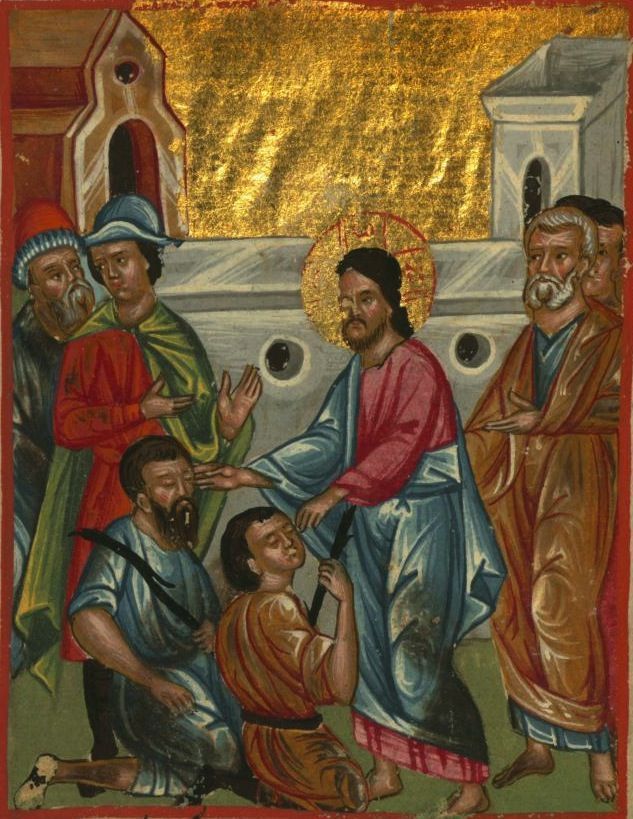
As Jesus and his disciples were leaving Jericho, a large crowd followed him. Two blind men were sitting by the roadside, and when they heard that Jesus was going by, they shouted, “Lord, Son of David, have mercy on us!”

The crowd rebuked them and told them to be quiet, but they shouted all the louder, “Lord, Son of David, have mercy on us!”

Jesus stopped and called them. “What do you want me to do for you?” he asked.

“Lord,” they answered, “we want our sight.”

Jesus had compassion on them and touched their eyes. Immediately they received their sight and followed him. (New International Version)

“Irony” is a term used to describe when an outcome of an event is contrary or different from what is expected.  Here are a few examples: The firehouse burnt down. The police officer got arrested. When I was a little kid, my family doctor’s name was (and I’m not kidding) Dr. Fail. And he smoked like a chimney in his doctor office.

There is an ironic lesson in today’s Gospel lesson: A crowd of people with 20/20 vision are spiritually blind. 

The great need of the crowd is the same need of the two physically blind men: They both needed their eyes opened to Jesus and to what God was doing around them.

Just so you know, Matthew tends not to use the term “crowd” in a favorable way. He views the crowd as a mass of people who are mostly lost, but the crowd themselves tend to think they are just fine. 

Jesus was on his way to Jerusalem, anticipating his passion and death. And we know that it is the crowd that will be the ones who eventually cry to have him crucified. 

Two blind men are marvelously and miraculously healed by Jesus. Ironically, the crowd remained unchanged and in the dark.

First Irony: A large crowd follows Jesus to Jerusalem, but only a few (2, in fact) are actually his followers. 

Throughout Christ’s earthly ministry, all kinds of people followed Jesus for all kinds of reasons. Some wanted to bask in the latest celebrity buzz that Jesus generated. Others wanted to see all the cool stuff he does, like healing people. Some were just plain curious. And a few were interested in being like Jesus by showing selfless compassion. 

Jesus wants genuine, authentic, real disciples who will follow his teaching, and not follow the crowd.

Many people desire to conform, to not stand out, and go with the flow. That’s great if the crowd is godly. Yet many, if not most, crowds of people are not godly. In the Old Testament, a few unruly complainers got the Israelites all stirred up and the result was the making of a golden calf with a complete turning away from the God of Israel. (Exodus 32:1-35)

Second Irony: Out of the massive crowd, it is two blind men that actually see Jesus for who he is, the Son of David.

Spiritual blindness afflicted the crowd. The blind men, however, discern it is Messiah Jesus coming near them. That’s why they go against the crowd by shouting out to him. They don’t care how they look. It doesn’t matter to them that they stick out like a sore thumb. 

Jesus often avoided big crowds. Most of his earthly life occurred away from the centers of power and influence.  Christ constantly swam upstream of the prevailing notions of righteousness. Jesus didn’t cow-tow to the crowd, but paid attention to the powerless and those without influence. 

The Lord Jesus didn’t “work the crowd” as the means of establishing God’s kingdom. He didn’t cozy-up to the rich and powerful. He wanted to avoid celebrity status. Jesus showed extraordinary love to two lowly overlooked people. He used his immense power for the powerless.

Third Irony 3: The ones following Jesus were the ones trying to keep the two needy blind men from Jesus.

One of the most ironic things about church is that sometimes Christ’s own followers are the greatest obstacle to others following Jesus. 

I can just picture a group of ladies shushing the two blind men: “Don’t bother Jesus, he is such a busy man. He has important work to do.” And I can imagine some men standing next to the two blind men and nudging them for shouting at Jesus saying, “Just stop, man, you’re embarrassing yourselves.” 

But the two men won’t stop. They shout all the louder. True and genuine faith is two blind men crying out in desperation for Jesus to help them. 

And Jesus asks a beautiful question: “What do you want me to do for you?” They answered, “We want our sight.” So, Jesus showed compassion and gave them their sight. It’s all rather simple and straightforward. Not only do the two men not listen to the crowd – Jesus doesn’t either. Christ mercifully heals despite what the crowd is saying.

I wonder: Why is it so hard for us to simply ask for what we want?… 

Maybe because we don’t want to buck the crowd, don’t want to look different, or don’t want to admit our need in front of others, we just stick to superficial conversations and insist everything is okey-dokey when it isn’t. 

A crowd of people may not be able to see others because they don’t even see themselves and their place in this world. Perhaps there is a plank in our own eye hindering us from seeing a speck in another’s eye. (Matthew 7:3-5)

It is the pure in heart who will see God (Matthew 5:8). As for the crowd, though seeing, they do not see (Matthew 13:13). If we are concerned about how we will be seen by others, it is likely we will not be seen by God. And we will miss Jesus when he walks by, right in front of us.

Jesus was attentive to the two blind men out of all the people in the crowd because he was listening for them.

Once Jesus listened, he took the time to heal the two men. Jesus could have simply healed them without even stopping. He could have started a healing factory where everyone with a need just got healed, as if they were on some divine conveyor belt to be fixed.

However, Jesus was doing more than giving sight; he was giving the blessing of time and personal response. The gospel is never impersonal, which is why we ought to resist being non-relational in ministry to others. It isn’t about simply meeting a need; it is about blessing other people. And that takes the time of relating to a person.

Jesus, furthermore, touched the men’s eyes. He didn’t have to do that. Christ could have healed without touching. In fact, it may have been gross. Many people had eye diseases with runny pussy eyes in the ancient world. 

Listening, taking time to be personal, and physically touching is how Jesus blessed people. So, we have the dual privilege and opportunity of receiving blessing from Jesus and giving that same blessing to others.

May the God of hope fill you with joy as you seek to bless others in the name of Jesus. Amen.