You are my God. I worship you. In my heart, I long for you, as I would long for a stream in a scorching desert.
I have seen your power and your glory in the place of worship. Your love means more than life to me, and I praise you. As long as I live, I will pray to you. I will sing joyful praises and be filled with excitement like a guest at a banquet.
I think about you before I go to sleep, and my thoughts turn to you during the night. You have helped me, and I sing happy songs in the shadow of your wings. I stay close to you, and your powerful arm supports me.
All who want to kill me will end up in the ground. Swords will run them through, and wild dogs will eat them.
Because of you, our God, the king will celebrate with your faithful followers, but liars will be silent. (Contemporary English Version)
Regulars to this blog know that I believe the Old Testament Psalms to be a vast untapped resource of devotion and prayer for many Christians. The biblical psalms provide believers with words for prayer, song, and thought so that we might remain close and connected to the Lord.
I Will Worship
Worship involves gratitude to God for God’s inherent love; and praise to God for divine works done in the world.
God’s people, gathered together for worship, affords a wonderful opportunity to express gratitude and praise, as well as listen to the stories of others who have experienced the gracious works of God in their lives.
Therefore, both personal and corporate worship is needed. Personal worship, even if engaged daily, will inevitably lead to a truncated understanding of God and God’s Law without corporate worship – because we need the encouragement and the accountability of others for mature spiritual growth. In addition, to only participate in corporate worship, without attending to daily personal worship, leads to a bifurcation between Sunday and our Monday-Friday workaday existence.
Worship isn’t so much an event, as it is a life. So, it makes sense to have healthy rhythms of personal and corporate worship which enable us to glorify God in our neighborhoods, families, workplaces, and faith communities.
I Will Pray
In those dark times when we don’t know what to pray, how to lament, or what to say to God; in the joyful times when we want to proclaim praise, give thanks, or express our blessings and longings; in every season of our lives the psalms help give voice to our relationship with the God of all creation.
Today’s psalm was originally uttered to God when David was roaming in the wilderness avoiding King Saul’s malevolent intent. David prayerfully expressed his yearning, desire, and hope to connect with God and be guided by the Lord, step by step. David praised God in an awkward and adverse circumstance, longing to be satisfied with spiritual food and drink.
I Will Sing
Just as we are to pray the psalms, we are to also speak the psalms out loud with singing. The Psalter Hymnal of old, as well as many contemporary praise and worship songs, are words from the psalms, meant to help, encourage, and give voice to our own current experiences.
Inspired by the psalms, take a few minutes today to sing and/or listen to songs such as, “God You Are My God” by Michael W. Smith, or check out a compilation of music from the psalms, like, “The Psalms Project,” which aims to put all 150 psalms to music. Maybe even craft your own tune to today’s psalm and sing it to the Lord.
I Will Think
Specifically, the psalmist mentions thinking about the Lord before retiring for sleep, as well as turning to God when awake during the night.
In today’s modern (and postmodern) society, anxiety and racing thoughts are ubiquitous – the result of overthinking and fixating on particular troubling thoughts. Contemplating God through reflecting on the psalms can be a way of taming the out-of-control thinking, while positively engrafting sound theology into the inner workings of our brains.
There’s a reason why the daily lectionary has a reading from the psalms every day. It is one of the best sources for practical spirituality and heartfelt worship, as well as transforming the way we think.
I Will Stay Close
Whatever we do, whatever we say, and wherever we go, let the psalms help form and shape within you a profound spirituality which helps foster a deeper connection with the God we long to know more and more.
May our celebrations be raucous and robust because the God of the psalms has showed up and given grace and mercy to our troubling circumstances.
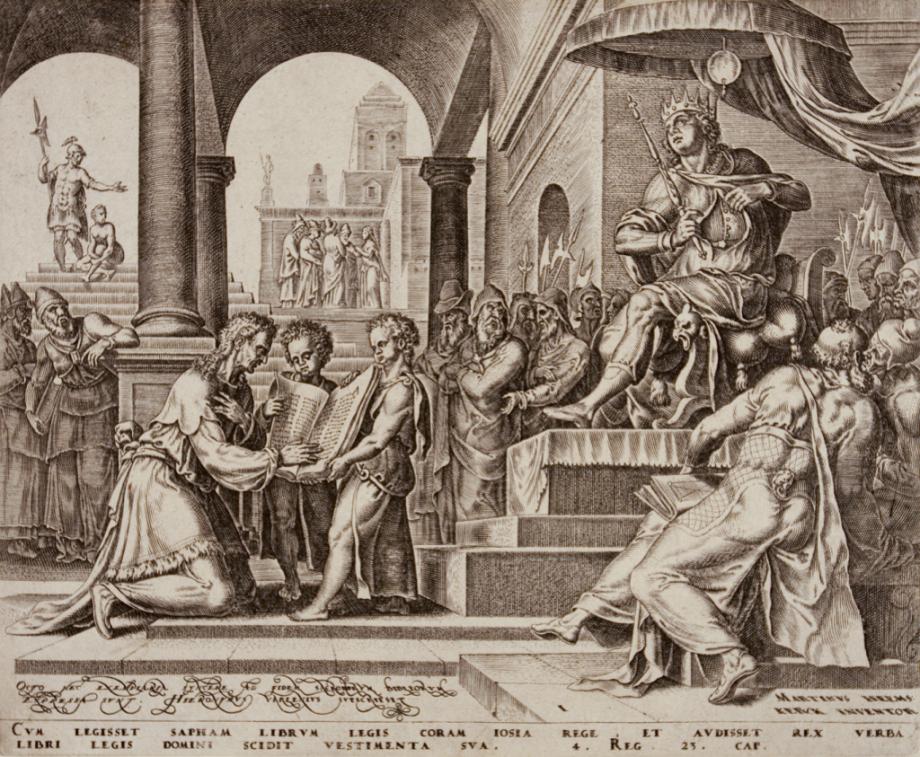
The Book of the Law, Read to King Josiah by Dutch artist Maerten van Heemskerck, c.1569
The king smashed all the altars to smithereens—the altar on the roof shrine of Ahaz, the various altars the kings of Judah had made, the altars of Manasseh that littered the courtyard of The Temple—he smashed them all, pulverized the fragments, and scattered their dust in the Valley of Kidron. The king proceeded to make a clean sweep of all the sex-and-religion shrines that had proliferated east of Jerusalem on the south slope of Abomination Hill, the ones Solomon king of Israel had built to the obscene Sidonian sex goddess Ashtoreth, to Chemosh the dirty-old-god of the Moabites, and to Milcom the depraved god of the Ammonites. He tore apart the altars, chopped down the phallic Asherah-poles, and scattered old bones over the sites. Next, he took care of the altar at the shrine in Bethel that Jeroboam son of Nebat had built—the same Jeroboam who had led Israel into a life of sin. He tore apart the altar, burned down the shrine leaving it in ashes, and then lit fire to the phallic Asherah-pole.
As Josiah looked over the scene, he noticed the tombs on the hillside. He ordered the bones removed from the tombs and had them cremated on the ruined altars, desacralizing the evil altars. This was a fulfillment of the word of God spoken by the Holy Man years before when Jeroboam had stood by the altar at the sacred convocation.
Then the king said, “And that memorial stone—whose is that?”
The men from the city said, “That’s the grave of the Holy Man who spoke the message against the altar at Bethel that you have just fulfilled.”
Josiah said, “Don’t trouble his bones.” So, they left his bones undisturbed, along with the bones of the prophet from Samaria.
But Josiah hadn’t finished. He now moved through all the towns of Samaria where the kings of Israel had built neighborhood sex-and-religion shrines, shrines that had so angered God. He tore the shrines down and left them in ruins—just as at Bethel. He killed all the priests who had conducted the sacrifices and cremated them on their own altars, thus desacralizing the altars. Only then did Josiah return to Jerusalem.
The king now commanded the people, “Celebrate the Passover to God, your God, exactly as directed in this Book of the Covenant.”
This commanded Passover had not been celebrated since the days that the judges judged Israel—none of the kings of Israel and Judah had celebrated it. But in the eighteenth year of the rule of King Josiah this very Passover was celebrated to God in Jerusalem.
Josiah scrubbed the place clean and trashed spirit-mediums, sorcerers, domestic gods, and carved figures—all the vast accumulation of foul and obscene relics and images on display everywhere you looked in Judah and Jerusalem. Josiah did this in obedience to the words of God’s Revelation written in the book that Hilkiah the priest found in The Temple of God.
There was no king to compare with Josiah—neither before nor after—a king who turned in total and repentant obedience to God, heart and mind and strength, following the instructions revealed to and written by Moses. The world would never again see a king like Josiah. (The Message)
The Book of the Law Found, Unknown artist, 1913
To say that King Josiah cleaned house is a significant understatement. Having found the Book of the Law, which was lost for generations deep within the temple, Josiah took its words to heart and set about a campaign of reformation like no king before him.
Indeed, Josiah was determined to restore and implement the Law in the life of the nation of Judah. His zeal knew no bounds. Josiah was doggedly relentless and actively radical in returning the Jews to the true worship of Yahweh.
Josiah did more than reinstitute the Passover and other festivals of the Lord. The king first upended the alternative pagan worship which had become embedded in Judah like a death-dealing cancer. Josiah surgically removed it with ruthless precision.
King Josiah made ashes out of Asherah poles; put pagan priests out of business permanently; and did away with everything contrary to the worship of the One true God, including spiritual mediums, household gods, and sacrificial high places. In order to turn his heart fully to God, he did away with all competing gods.
Repentance, renewal, and reformation requires a two-fold process: 1) Turning away from what is false; and 2) Turning toward what is true.
Turning from spiritually unhealthy ways of living – without turning to God – is merely a half repentance. Furthermore, turning to God – without turning one’s back on damaging lifestyles – is a form of denial and is dangerous.
We are to put off the old clothes of spiritual insensitivity and social injustice. We are to put on the new clothes of righteousness and peace. We are to forsake the old inner person of shame in order to embrace the new life of freedom and joy.
There needs to be a radical removal of sin, so as to replace it with what is just and right. And, keep in mind, that none of this is pretty or romantic. Repentance and renewal is a messy ugly process of dispelling darkness and letting light shine. It is not for the faint of heart.
Where to begin? Make a fierce, brutally honest spiritual inventory of your life. No one can turn from something they are not really aware of. So, create in your schedule some time in the week to connect with God and do the following:
Identify some areas for change, then list the obstacles to turning away from them (e.g., fear, despair, financial repercussions, etc.). Face those obstacles honestly and forthrightly.
Form a rudimentary plan to forsake the old ways and embrace new paths of righteousness. This is only a beginning. Let God take that process and direct it in redemptive and purifying ways.
Holy God, you are jealous for your own glory. Today, I decide to identify and put away all that is contrary to your righteousness and will for my life. And I choose to turn to you with all my heart. In body, soul, and spirit I belong to you. Amen.
14th century painting of Jesus standing before Pilate by Italian artist Duccio di Buoninsegna
Pilate then went back inside the palace, summoned Jesus and asked him, “Are you the king of the Jews?”
“Is that your own idea,” Jesus asked, “or did others talk to you about me?”
“Am I a Jew?” Pilate replied. “Your own people and chief priests handed you over to me. What is it you have done?”
Jesus said, “My kingdom is not of this world. If it were, my servants would fight to prevent my arrest by the Jewish leaders. But now my kingdom is from another place.”
“You are a king, then!” said Pilate.
Jesus answered, “You say that I am a king. In fact, the reason I was born and came into the world is to testify to the truth. Everyone on the side of truth listens to me.” (New International Version)
In Christianity, to worship God means we praise the person and work of Christ and are also spiritually formed through that adoration. Christ the King Sunday focuses our worship on Jesus Christ’s reign over the entire world. It is a proclamation that everything and everyone in all creation is subservient to King Jesus. Furthermore, it is an invitation to actively enjoy Christ’s gracious and benevolent rule over us.
Jesus came to this earth to bring connection and intimacy to God and humanity. We all have relationships in which we want to be closer.
A parent might be dissatisfied, and sad, that one of their children is estranged from them, because they want intimacy.
A spouse may want to have a more relationally intimate marriage, having been distant for too many years.
A teenagers or twenty-something might want to get closer to that special someone.
A friend might be keeping their distance. And although you have conversations with them, they only let you in so far.
We want to go deeper, and it isn’t happening because the other party is not willing.
In this we reflect the image of God within us because God feels that same longing and desire to move deeper and closer to us. The Lord desires intimacy, yet we might keep treating him like he is some untouchable monarch like Queen Elizabeth – as if there is no chance of really getting close, and we wonder if there is any real power there to make a difference.
However, God is not a ruling figurehead, and does not want a casual superficial relationship with us. Christ’s kingship moves closer to people, not further away. Everything Jesus did on this earth was to bring people closer to God because God wants a personal and familiar relationship with us.
Jesus does not want us estranged from God, and he has gone to the greatest lengths possible to make that close relationship possible and real through the cross, resurrection, ascension, and a kingly reign which is near to us. The kingdom of God, with Jesus as King, is a kingdom of closeness and fellowship with the divine.
Christ the King Sunday appropriately challenges us to consider what it means to say that Jesus Christ is the Lord of our life. Jesus Christ, as our Lord and King, means much more than God calling the shots and issuing commands; it means Christ uses his lordship to satisfy his longing to be with us.
Our Gospel lesson for today plunges us into an event we associate with Holy Week. Christ has been arrested by the conniving of his enemies. Since the religious authorities could not put anyone to death, they bring Jesus to the Roman governor, Pontius Pilate, in the hope he will do their dirty work for them.
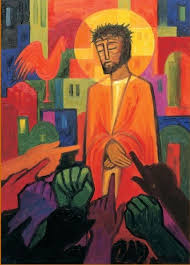
Jesus condemned to death, painting by the Benedictine Sisters of Turvey Abbey
The scene takes place early in the morning at Pilate’s palace. Pilate doesn’t like the Jewish authorities because they put a dent in his career plans through their constant complaints about him to his supervisors in Rome. For purely political reasons, Pilate decides he will satisfy their demand and interview this Jesus who they claim is an enemy of Rome.
The prisoner, Jesus of Nazareth, is brought to Pilate. He is a mess. Christ’s clothes are stained with dirt and blood. His face is bruised and haggard. He has not slept all night. Pilate has heard of Jesus, and so he’s curious to make a personal evaluation of him. Jesus looks nothing like a king to Pilate.
Pilate, in contrast, looks the image of a worldly leader with his power suit on and all the strength of Rome behind him. He hardly has time for this sideshow, this pathetic presentation of leadership in front of him. Jesus looks like nothing more than a kingly wannabe. There is nothing from Christ’s outward appearance that gives any impression he is qualified to be a leader of anybody. We can almost picture Pilate rolling his eyes, saying “so you are the King of the Jews?”
What follows is a strange, convoluted conversation about kingship and truth with a contrast between this world and a world to come. Repeatedly, Jesus makes it clear his kingdom is not of this world. Two thousand years have passed since that dialogue between Jesus and Pilate, yet the same issue remains.
The issue is this: Jesus is calling all of us to follow him – to put his Kingdom first in our lives. In Pilate, we have a symbol of worldly power, which is arbitrary, unprincipled, self-serving, and brutal. Pilate knows the right thing to do but chooses the path of least resistance. He caves to the political pressure, denying the truth which is right under his prominent Roman nose.
Earthly power seeks its own ends. It wants to hold onto control and call the shots. Conversely, Christ’s kingly power is used to serve, to wash feet and meet needs, to move closer to people. Earthly kingdoms use violence to conquer and maintain order and control its subjects. In stark contrast, Christ’s kingdom uses love to transform and unify people around Jesus so that the subjects are with the king and enjoy his rule and reign.
Christ’s kingdom is not of this world. It is counter-cultural and counter-intuitive to how every other leadership structure works on earth. It is an upside-down kingdom that seems like it won’t work or make sense: The way up is down; to be great is not to work for a high position, suck up to the boss, and climb the ladder of wealth and success. Rather, it is to embrace humility and be a servant.
In God’s kingdom, the way to pursue truth is not in forming original ideas and expressing opinions but is found in a person. Truth-seeking disciples will listen to this one voice of Jesus, and filter-out all others. It is a voice calling for submission to his lordship, and to do so because it brings us into an intimate relationship with God.
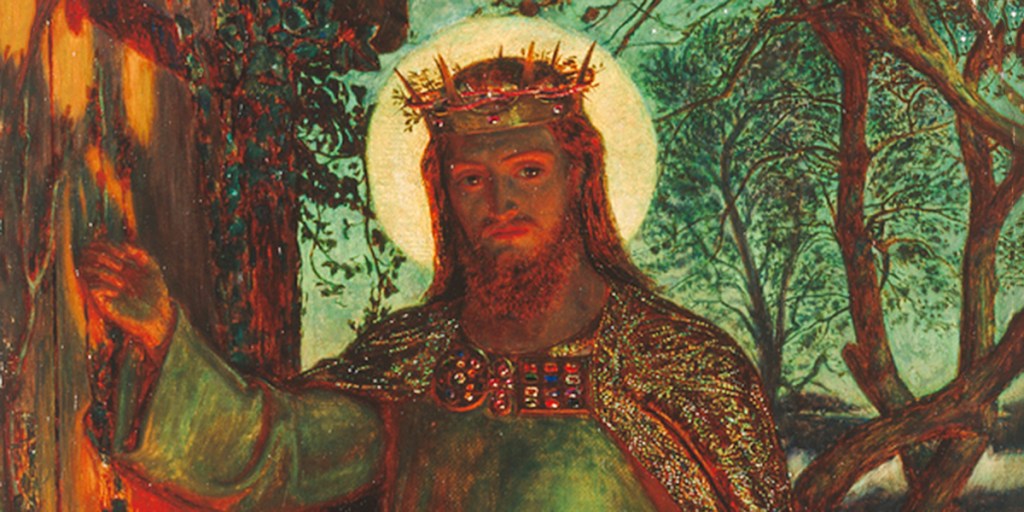
The Light of the World, by English artist William Holman Hunt, 1852
The message of our crucified Savior reigning as King in our lives is not that, having suffered for us, Jesus will somehow keep us from facing difficult times. Instead, Jesus faced a horrible death so that our own tough times can triumph with God’s power to save us and move deeper into our lives. God’s presence and promise is what sustains us, not the avoidance of suffering. Christ as our King means God is with us.
Black Friday and Cyber Monday are almost upon us. This season demonstrates a contrast between two kingdoms. The kingdom of this world calls on us to demonstrate our worth and gain meaningful relationship through grabbing control and obtaining stuff. The pressure in seeking the perfect gift at the perfect price in the hope that if we can bag it, wrap it, and get it under the tree, then we will be perfect, and the perfect family Christmas will happen, and relationships will be great, and everyone will act like I want. Right!?
In contrast, the kingdom Jesus describes assures us we don’t have to prove our worth through endless accomplishments and generous gifts. We don’t need to have the perfect Christmas experience to gain our deepest relational needs. Because, in our baptism, we have been accepted; we are sons and daughters of the living God; and we do not need to achieve greatness through financially and emotionally bleeding ourselves.
In his conversation with Pilate, Jesus said: “My kingdom is not of this world.” When Christians say Jesus Christ is our King, we acknowledge we are his subjects and that we march to the beat of a different drum. The heart of this relationship is our dependence on Jesus who came that we might have life and have it in abundance.
On this Sunday, followers of Jesus Christ boldly state our confidence that, at the end of time, Jesus will come again as King and Ruler of all.
Blessed are those who see the truth by faith and not by sight. Blessed are those who say “Jesus is the King and the Lord of Life” without rolling their eyes or with a selfish agenda but with a sincere conviction that they belong to Jesus and want to be ever closer to him who is the Way, the Truth, and the Life.
Almighty God, everlasting heavenly Father, you break the power of evil and make all things new in your Son Jesus Christ, the King of the universe. Our confidence is firmly in you, Lord Jesus, knowing you will redeem all things and make all things new.
We affirm that our security is not in personal abilities, clever plans, or lucrative jobs; our security is in you alone. Your creation still groans with the pain of living in a fallen world. But you have conquered sin through your love, and it is to your love we rely upon. May all things in heaven and on earth recognize the glory of your kingly rule and never cease to praise you. We ask this through our Lord Jesus Christ, your Son, who lives and reigns with you and the Holy Spirit, one God, now and forever. Amen.
God’s Son comes from heaven and is above all others. Everyone who comes from the earth belongs to the earth and speaks about earthly things. The one who comes from heaven is above all others. He speaks about what he has seen and heard, and yet no one believes him. But everyone who does believe him has shown that God is truthful. The Son was sent to speak God’s message, and he has been given the full power of God’s Spirit.
The Father loves the Son and has given him everything. Everyone who has faith in the Son has eternal life. But no one who rejects him will ever share in that life, and God will be angry with them forever. (Contemporary English Version)
When Jesus ascended to heaven, he left instructions to his disciples to pray and to witness (Acts 1:1-11). Jesus asks of us what he himself does or has already done. The life and ministry of Christ on this earth was marked continually with prayer and bearing witness. Just as Jesus bore witness to what he saw and heard as the Divine Word, so his followers are to do likewise. The evidence and the veracity of Christ’s witness is the giving of God’s Spirit – the One whom confirms this testimony to us.
I, personally, have found Jesus to be precisely whom he claims to be. I have come to accept his testimony as gracious, truthful, and life-giving. I have wholeheartedly embraced the New Testament Gospel accounts of his birth, life, teaching, death, resurrection, and ascension. This belief came neither quickly nor easily for me – it resulted from an honest straightforward reading of the Bible, along with the gracious wooing of the Holy Spirit.
It really isn’t my job to convince you of Jesus Christ’s authenticity and trustworthiness. That is the work of the Holy Spirit. Instead, it is my task to bear witness of the things I have seen and heard concerning Jesus.
My life has been thoroughly turned upside-down because of Jesus. With Jesus, I have been invited into the life of God. By the wounds of Jesus, I have experienced healing of damaged emotions and recovery from spiritual hurts inflicted by others. Through union with Christ, I have grace and forgiveness of things I have done and left undone. With Brother Jesus as my friend and companion, I enjoy loving attention and am never dismissed by him.
The Trinity by Jyoti Sahi
For those who have not read the Gospel accounts and refuse Christ, then, for honesty’s sake, please have the integrity to give Jesus a hearing before you dismiss him with a slight of hand. It is one thing to genuinely no little about Jesus, and it is quite another thing to ignore him when you have knowledge about how to discover him.
For those of us who have read the New Testament Gospels and accept the testimony of Jesus, we come back again and again to his life-giving words and seek continually to follow him in his way of mercy, purity, and peace. We bear witness to how Jesus has changed our lives and offers a life worth living.
Everyone with faith in Jesus has a life-giving connection with God. Those who don’t, don’t. If you disagree with this, then contend with Jesus himself. Give him a hearing. Watch him in action. Observe how he deals with people. See if he lives up to his words. Then, bear witness to what you have seen and heard.
Christian faith is a complete trust in the person and work of Jesus Christ as Lord and Savior. Because God has been revealed as faithful through steadfast love, the Lord gifts people with faith to know the Divine.
Faith, a noun, is closely accompanied by it’s verb, believe. Together, as identical twin sisters, they let us know that both knowledge and action are needed. We need information in knowing what step to take, and an active commitment to actually take that step.
Others’ faith in Jesus led to a man’s healing of both body and soul:
And behold, some people brought to him a paralytic, lying on a bed. And when Jesus saw their faith, he said to the paralytic, “Take heart, my son; your sins are forgiven.” (Matthew 9:2, ESV)
The size of faith is irrelevant; even a smidge of Jesus has incredible power:
“I [Jesus] assure you that if you have faith the size of a mustard seed, you could say to this mountain, ‘Go from here to there,’ and it will go. There will be nothing that you can’t do.” (Matthew 17:20, CEV)
Human weakness and inability is no problem because of faith in Christ:
Everyone who believes has God’s approval through faith in Jesus Christ…. We conclude that a person has God’s approval by faith, not by his own efforts.
Romans 3:22, 28, GW
A person acts upon knowledge of Jesus with total trust in Christ’s finished work of deliverance from all which is evil:
It’s the word of faith that welcomes God to go to work and set things right for us. This is the core of our preaching. Say the welcoming word to God — “Jesus is my Master”— embracing, body and soul, God’s work of doing in us what he did in raising Jesus from the dead. That’s it. You’re not “doing” anything; you’re simply calling out to God, trusting him to do it for you. That’s salvation. With your whole being you embrace God setting things right, and then you say it, right out loud: “God has set everything right between him and me!” (Romans 10:9-12, MSG)
Faith is not an event; it is continual trust in the person and work of Christ for practical living and compassionate serving:
I have been crucified with Christ; and it is no longer I who live, but it is Christ who lives in me. And the life I now live in the flesh I live by faith in the Son of God, who loved me and gave himself for me. (Galatians 2:19b-20, NRSV)
Outward rituals only have their proper place as they help inform belief in order to engage in loving actions:
For in Christ Jesus, neither circumcision nor uncircumcision counts for anything, but only faith working through love. (Galatians 5:6, NAB)
You are saved by God’s grace because of your faith. This salvation is God’s gift. It’s not something you possessed. It’s not something you did that you can be proud of. Instead, we are God’s accomplishment, created in Christ Jesus to do good things. God planned for these good things to be the way that we live our lives. (Ephesians 2:8-10, CEB)
Understanding and experience go together like a hand in a glove:
I keep hearing about your faith in the Lord Jesus and your love for all of God’s people. And I am praying that you will put into action the generosity that comes from your faith as you understand and experience all the good things we have in Christ. (Philemon 5-6, NLT)
Absolute certainty isn’t in the realm of Christian spirituality – there’s always more information one could obtain. Faith discerns, intuits, and knows God is there, and orders it’s steps accordingly with faithful activity:
And without faith it is impossible to please God, for whoever would approach him must believe that he exists and that he rewards those who seek him. (Hebrews 11:6, NRSV)
My brothers and sisters, if people say they have faith, but do nothing, their faith is worth nothing. Can faith like that save them?… Just as a person’s body that does not have a spirit is dead, so faith that does nothing is dead! (James 2:14, 26, NCV)
In the power of the Spirit and in union with Christ, I pray to you, the God and Father of all:
For empowerment by the Spirit, that I may be a faithful witness
For those who wait on You, that they may find renewal
For all people, that they may acknowledge the kingdom of the ascended Christ
For all who are struggling with broken relationships
I commend myself and all for whom I pray, to Your mercy and protection through Jesus Christ, my Lord and Savior. Amen.








 Rev. Tim Ehrhardt