Peace Be Upon Us (Psalm 125)

Those who trust in the Lord are like Mount Zion,
    which cannot be moved but abides forever.
As the mountains surround Jerusalem,
    so the Lord surrounds his people
    from this time on and forevermore.
For the scepter of wickedness shall not rest
    on the land allotted to the righteous,
so that the righteous might not stretch out
    their hands to do wrong.
Do good, O Lord, to those who are good
    and to those who are upright in their hearts.
But those who turn aside to their own crooked ways,
    the Lord will lead away with evildoers.
    Peace be upon Israel! (New Revised Standard Version)

I am profoundly grateful that God is a rock solid mountain who is strong. The Lord is never altered in the basic divine character of merciful grace, steadfast love, and abiding security. The main reason I so deeply appreciate this about God is that this old fallen world is awfully fickle, terribly unreliable, and forever changing.

So, to trust in God is to tether oneself to the ultimate anchor for life. Relationships come and go. People have their own agendas and listen to other people who, in turn, have their own agendas. But God’s plan is purely good, always right, and consistently just. The divine agenda has our best interests at mind.

Being linked to the Lord in faith establishes divine protection, provision, and presence. It’s as if the righteous believer has an invisible security blanket wrapped around them at all times. We are kept in the gracious arms of a loving God.

None of this, however, means that we shall never face grueling circumstances that might even feel like a hellish existence. If the Christian’s Lord Jesus had to undergo suffering before experiencing glory, then how much more do his followers need to expect the same?

Having injustice and wrongdoing in this world is one thing; but having it come from those close to you is quite another thing altogether. Again, the Lord Jesus endured wicked betrayal from Judas Iscariot, one who was within the inner circle of disciples. Yet, the heavenly Father was continually there, surrounding Jesus like the mountain chain, even though it may not have felt like it at many points, especially in the final week of Christ’s life on this earth.

God is good, all the time. Therefore, God knows who is truly good, and who is not. The Lord sees the heart, and clearly discerns the intents and motivations of each person and every group of people on this planet. And since God understands the real nature of a person’s life, the Lord is not fooled by pious sounding and slick talking persons with darkness in their hearts.

The wicked will not endure. God shall eventually lead them away. Like a shepherd separating the sheep from the goats, the Divine Judge will divide the righteous from the wicked. Those who think they can have a secret agenda of crookedness will find out that it’s not so secret after all.

This world, with all it’s inhabitants and systems and societies, needs peace. Sometimes, it seems to me that everyone right now in our contemporary world is upset about something; and they have the rudeness to back it up.

Nations fight nations. People groups attack other people groups. One ethnicity accuses another, and vice versa. Family members are estranged. Lawsuits abound. The judicial courts are beyond full. Unethical practices masquerade within ethical systems and thrive in the shadows. And persons are harmed – lots of them. Lives are destroyed.

I once came home from a day of interacting with patients at the hospital and said to my wife, “You could never dream up the atrocities that one person can do to another.” The short of it is that there is no harmony, no mutual understanding, and thus, no peace, no fulfillment or wholesome way of life for so many.

In the New Testament, the Apostle Paul once cried out concerning the muck of sin, “Who will rescue me from this body of death?” He then went on to answer his own question by saying a simple phrase, “Thanks be to God through Jesus Christ our Lord.” (Romans 7:24)

Yes, for me it’s Jesus. And, for me, that is what this very season of the year is all about. I anticipate the birth of the Christ Child, who came willingly to save us from this manure pile of a situation that is without peace. He became the Prince of Peace, so that we might have the light of life. It was the Apostle John who let us know:

The Word became flesh and blood,
    and moved into the neighborhood.
We saw the glory with our own eyes,
    the one-of-a-kind glory,
    like Father, like Son,
Generous inside and out,
    true from start to finish. (John 1:14, MSG)

Humility, meekness, righteousness, purity, mercy, love, and peace-making – yes, peacemaking – were the hallmarks of Christ’s ministry. These characteristics surrounded him like the divine mountains and shaped every word and each action of Jesus.

It is the time for peace. In fact, it’s high time for it! We have gone long enough provoking others and being provoked. There is a way – the way of peace. And for me, peace is achieved through the ultimate Peacemaker, Jesus Christ, my Lord.

He came and preached peace to you who were far away and peace to those who were near. For through him we both have access to the Father by one Spirit. (Ephesians 2:17-18, NIV)

May you find peace this season because you have discovered the Peacemaker. Peace be upon Israel, and peace to all.

Soli Deo Gloria

Good News For Those In Need (Isaiah 61:1-4, 8-11)

The Spirit of the Sovereign Lord is on me,
    because the Lord has anointed me
    to proclaim good news to the poor.
He has sent me to bind up the brokenhearted,
    to proclaim freedom for the captives
    and release from darkness for the prisoners,
to proclaim the year of the Lord’s favor
    and the day of vengeance of our God,
to comfort all who mourn,
    and provide for those who grieve in Zion—
to bestow on them a crown of beauty
    instead of ashes,
the oil of joy
    instead of mourning,
and a garment of praise
    instead of a spirit of despair.
They will be called oaks of righteousness,
    a planting of the Lord
    for the display of his splendor.

They will rebuild the ancient ruins
    and restore the places long devastated;
they will renew the ruined cities
    that have been devastated for generations…

“For I, the Lord, love justice;
    I hate robbery and wrongdoing.
In my faithfulness I will reward my people
    and make an everlasting covenant with them.
Their descendants will be known among the nations
    and their offspring among the peoples.
All who see them will acknowledge
    that they are a people the Lord has blessed.”

I delight greatly in the Lord;
    my soul rejoices in my God.
For he has clothed me with garments of salvation
    and arrayed me in a robe of his righteousness,
as a bridegroom adorns his head like a priest,
    and as a bride adorns herself with her jewels.
For as the soil makes the sprout come up
    and a garden causes seeds to grow,
so the Sovereign Lord will make righteousness
    and praise spring up before all nations. (New International Version)

This section of Isaiah’s prophecy looks forward to a better day. After centuries of downward spiraling into disobedience, the people found themselves on hard times.

In the prophet’s day, God’s people and their lives needed to be rebuilt, restored, and renewed; they needed salvation and deliverance; and the good news of healing, freedom, and comfort. 

The proclamation of the year of the Lord’s favor is a reference to the Old Testament command to practice the year of Jubilee. The Jubilee was to occur every fiftieth year of Israel’s existence in the Promised Land. For forty-nine years there were individuals and families that would incur debt; indenture themselves into servitude in order to survive; perhaps land in a debtor’s prison; and, work hard in the fields that they once owned. 

The Jubilee Year, by Yoram Raanan

These were, indeed, hard times. But after the forty-nine years, on the fiftieth year, the debts were erased; slaves were freed; fields allowed to rest; and, the land restored back to its original owners.

God’s deliverance is not only spiritual, but also very tangible and real. Salvation is not just otherworldly, merely looking forward to the end of the age; there’s also the anticipation of transformation here and now.

The recipients of good news are those who are in bad circumstances. God turns toward the oppressed, the brokenhearted, the captives, the prisoners, those who mourn, and the faint of spirit. God really does have a special concern for the lowly and the weak. 

It’s significant to note that, Israel as a whole, found themselves in need – not because they were victims of adverse situations – but because they failed to obey the stipulations of their covenant with God. 

For example, we have no evidence that the Israelites actually even practiced the Jubilee. By the time fifty years came down the pike, after God gave them the Promised Land, they had slid so far down the spiritual drain that it was completely off their radar to practice a Jubilee. 

It seems no one had any intention of forgiving debts, freeing their indentured servants, giving back the land to original owners, and providing the land itself with a well-deserved Sabbath rest. 

To not practice the Jubilee was to rob people of their land and be unjust to them. Yet, God loves justice and hates robbery. God pays attention to those who are not getting their very real and tangible needs met. So, God speaks words of hope and deliverance for those in circumstances beyond their ability to cope with.

The first few verses of today’s Old Testament lesson are the words that Jesus turned to and read in the synagogue when he began his earthly ministry. Christ is the ultimate fulfillment of this promise to deliver and provide. He came to usher in a Jubilee celebration that would have no end.

It may be easy to overlook these verses, believing that they don’t pertain to us. Gentiles are under no obligation to practice a Jubilee. After all, many people are blessed, both material and spiritual. Furthermore, we can always identify persons who are in much more need than we are. 

And yet, it’s important to recognize that the maladies of our hearts are very real. There are specific conditions in our lives that leave us in bondage and in need of restoration, renewal, and revitalization, just like the Israelites of old. 

Therefore, we must not suppress those realities and those needs, but name the conditions which are packed away in a closet of our heart deep inside us, such as:

  • the love of things and money
  • severed relationships
  • old grudges
  • hidden addictions
  • domestic violence
  • denial of depression
  • secret affairs
  • fear and anxiety
  • anger and hatred
  • hoarding of resources and greed

Outward smiles and small talk conversations may hide the truth from others, but they do nothing to hide ourselves from a God for whom everything is laid bare.

The good news is not just for someone else who has “obvious” needs. The gospel must touch our lives and bring us freedom, so that we can pass on good news to the legion of social ills that make our world sick. 

There are people all around us who need spiritual and emotional, mental and material help. Yet we will not have eyes to see them, or hearts to help them, if we ourselves stuff our burdens so deep within that we are blind and unable to see others.

What’s more, on the other hand, we may too easily misread these verses in a manner it was never intended to be heard, as if we are more in need than we actually are: 

“The Lord’s Spirit of consumer choices is upon me, because the Lord has anointed me to preach good news to the middle-class. He has sent me to bind up the half-hearted, to proclaim more options for the limited, and release from Black Friday for the buyers, to proclaim the year of the Lord’s Cyber-Monday.” 

We may not be so crass as to say this out loud, but we might tend to misinterpret Bible passages, so as to avoid our own great poverty of heart.

And when we become expert at stuffing our emotions and our needs, we then fail to see the year of Jubilee. We may believe that other people, “those people,” need Isaiah’s words. However, we are also in need of the year of Jubilee. 

The truth for many is that they are either one paycheck, one prodigal kid, one mental health diagnosis, one serious illness, one drink, one affair, or one bad decision away from being one of “those people” – the people we typically identify as in need – the ones that bad things happen to – the ones we do not want to live next door to us.

We may not yet be vulnerable enough to admit our situation; and so, we keep practicing the denial of our spiritual poverty. Everyone is brokenhearted about something or someone, such as:

  • a wayward son or daughter
  • an unfulfilled dream
  • a lost relationship
  • a difficult illness or health diagnosis
  • a crisis situation

In addition, everybody is in bondage to something we would rather not admit; everyone needs renewal and restoration. 

What should we do? Where are we to turn?

Let’s turn from the things that have caused us to be in poverty and in prison, and delight in the Lord our God. Rejoice in the Lord.

God will make a sprout come up, and cause it to grow. 

God will rebuild our ruined souls. 

God will restore the places of our lives that have been devastated. 

God will even renew the places that have not seen renewal for generations. 

It begins with you and me allowing the justice of God to work within us, and not only for other people.

God cannot bring comfort to those who do not mourn; the Lord cannot turn grief into joy if there is no acknowledgment of a dire situation. To be an oak of righteousness, there must be a confession of despair and an allowance of the justice of God through Jesus Christ to work its way completely through us.

Let the Lord replace a head of grief with a crown of beauty. Let God place a garment of praise to replace the stinky clothes of grumbling. And, in this season of Advent, herald the coming of the Christ child as the hope of us all, to the glory of God. Amen.

The Parable of the Two Sons (Matthew 21:28-32)

Wheatfield with Crows, by Vincent van Gogh, 1890

“What do you think about this? A man had two sons. He went to the first and said, ‘Son, go to work in the vineyard today.’

“His son replied, ‘I don’t want to!’ But later he changed his mind and went.

“The father went to the other son and told him the same thing. He replied, ‘I will, sir,’ but he didn’t go.

“Which of the two sons did what the father wanted?”

“The first,” they answered.

Jesus said to them, “I can guarantee this truth: Tax collectors and prostitutes are going into God’s kingdom ahead of you. John came to you and showed you the way that God wants you to live, but you didn’t believe him. The tax collectors and prostitutes believed him. But even after you had seen that, you didn’t change your minds and believe him. (God’s Word Translation)

I once cheated on a college exam. It was a required class for which I was not much interested, so my grade was rather tenuous going into the final exam of the semester. When the professor stepped out of the classroom for a few minutes during the final, my fellow students began sharing answers. I gave in and went with the others.

I got an “A” on the exam and passed the class easily. However, I royally flunked God’s test. After a few days of misery, I went to the professor’s office and confessed what I had done. I was prepared to take a failing grade for both the exam and the class, yet I think the professor was so shocked that I would come and admit such a thing that he worked up my grade right there in front of me… I passed, but just barely.

I originally said “no” to what was right, but then said “yes” and made it right.  For those who practice repentance, there is a God of grace waiting for them. God has no tolerance for those who profess truth with a big “yes” on the outside but are passive-aggressive on the inside and say “no,” undermining the truth by how they live. 

The Sower, by Vincent Van Gogh, 1888

Today’s Gospel lesson highlights entrance into the kingdom of God – and the people entering might surprise us. Turns out, there are spiritual insiders on the outside of the kingdom, and spiritual outsiders as the ones who really inherit the kingdom.

Christ’s parable is a warning to all the spiritually serious: Beware, lest our insider energies be spent in correctness, conformity of belief, and cockiness rather than following Jesus. At the same time, the parable encourages outsiders with the wonderful possibilities of a changed life. 

Jesus was warning those who arrogantly assume they have the inside track by what they believe, and not by doing God’s will. It may be challenging for us to imagine how truly offensive Christ’s story was to the original hearers of the parable, so I restate it in a more contemporary form:

There was a man who was well respected in the community and had two sons. One son grew up and became a respectable member of the community, too. He was a successful businessman and gave lots of money to causes in his community, including new lights for the school football field – which was no small cost.  He only asked that appropriate and prominent recognition be given him with a plaque bearing his name on each of the light poles. 

The other son was not so successful.  He was the one in school who the teachers said, “Why can’t you be more like your brother?”  There was nothing spectacular about this son.  In fact, he lived an ‘alternate lifestyle’ and people murmured behind his back. 

One day the father said to this son: “Son, go and work at my place of business today; I am going away and need you to do some of the tedious paperwork I have gotten behind on.” “No way!” he answered, but later felt heartsick about the way he spoke to his father and decided to go and do all the grunt work his father needed done.

The father went to the well-respected son and said the same thing about needing him to do all the thankless paperwork that was piled up. That son answered, “Yes, sir, I will; anything you need I will do.” But that son did not go. Instead, he chose to go golfing with some people whom he was trying to coy favor with.

After telling the story, Jesus asked all the upstanding faith leaders and the people listening: “Which of the two did what his father wanted?” “The first,” they answered.

Jesus said, “I tell you the truth, folks with different sexual orientations, unemployed persons on the low rung of society, and the religiously different with esoteric beliefs are entering the kingdom of God ahead of you. For you have had heard thousands of sermons about grace and the way of righteousness, yet you did not believe by putting God’s Word into practice; but the others did. And even after you saw how God can change a person’s life from the inside-out, you yourselves did not repent and believe.

For Jesus to tell such a story was so scandalous that, frankly, it got him killed. Specifically, the scandal is this: Merely believing rightly and living as an upstanding citizen is not the way of salvation. Tax collectors and prostitutes were some of the most despised people in Christ’s time. It was assumed they were outside of God.

However, the proof of genuine belief is not lip service but actively obeying God when no one is looking:

My friends, what good is it to say you have faith, when you don’t do anything to show that you really do have faith? Can that kind of faith save you? If you know someone who doesn’t have any clothes or food, you shouldn’t just say, “I hope all goes well for you. I hope you will be warm and have plenty to eat.” What good is it to say this, unless you do something to help? 

Faith that doesn’t lead us to do good deeds is all alone and dead! Suppose someone disagrees and says, “It is possible to have faith without doing kind deeds.” I would answer, “Prove that you have faith without doing kind deeds, and I will prove that I have faith by doing them.” You surely believe there is only one God. That’s fine. Even demons believe this, and it makes them shake with fear. (James 2:14-19, CEV)

The Christian life comes down to obedience, not cheap talk. Jesus wants to bless a lost world in need of God’s love and grace.

If we have ears to listen, we can hear numerous lost souls crying in the dark. If we have eyes to see, there are people caught in addictions standing in front of us. If we have hands willing to labor, needy folks surround us who can neither help themselves nor ask for it.

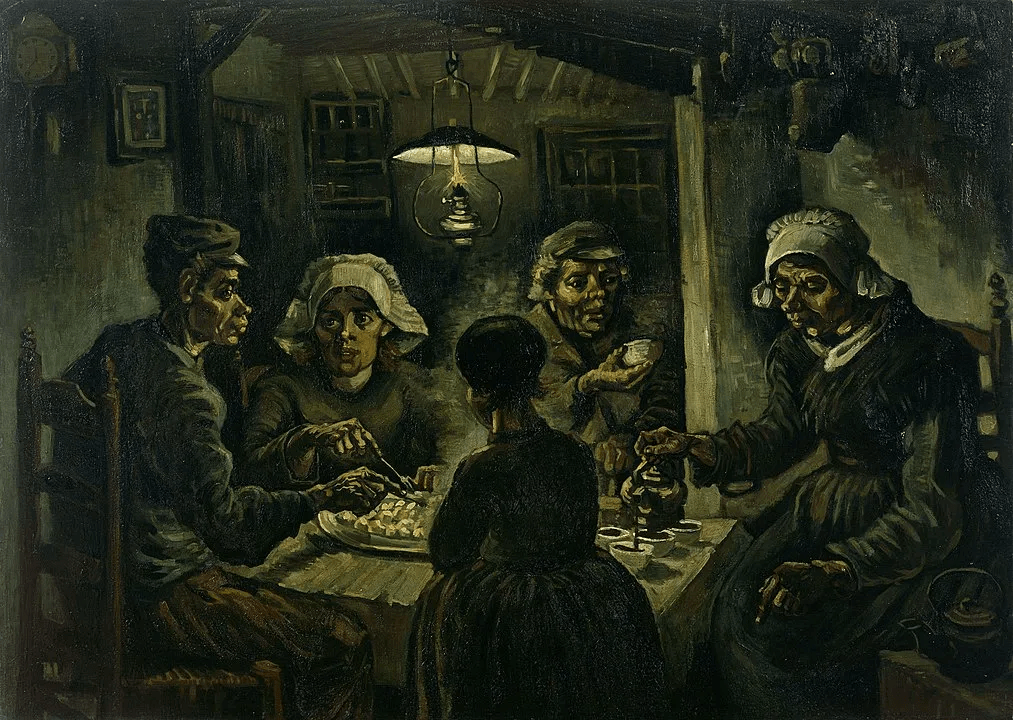
The Potato Eaters, by Vincent Van Gogh, 1885

Honestly, I am heartsick over the grinding loneliness of so many people; the boatloads of shame which thousands secretly carry; and the silent pain experienced by individuals everywhere. I feel this way because I genuinely believe my Lord feels the same. Jesus is looking to activate grace through his people to a world sinking in the depths of incredible human need.

Christ’s parable, however, is more than a warning; it is a story that opens the door of mercy for unlikely people seemingly far from God – people who ruined their lives by saying “no” to God. The parable is an invitation for all the screw-ups and those with little faith to come to Jesus.

There is a rather obscure Scripture reference, tucked away in the Old Testament. David was on the outside looking in. King Saul was on the inside trying to capture and kill him, even though David had done nothing wrong. Here is what happened:

David got away and escaped to the Cave of Adullam. When his brothers and others associated with his family heard where he was, they came down and joined him. Not only that, but all who were down on their luck came around—losers and vagrants and misfits of all sorts. David became their leader. There were about four hundred in all. (1 Samuel 22:1-2, MSG)

This rag-tag group of outsiders in Israel became Israel’s insiders as David eventually became king and these were the “mighty men,” the ones who helped bring Israel into prominence. 

Jesus Christ came into this world and identified himself as the Savior to the outsider when he quoted the prophet Isaiah:

Jesus went to the synagogue on the sabbath day, as was his custom. He stood up to read, and the scroll of the prophet Isaiah was given to him. He unrolled the scroll and found the place where it was written:

“The Spirit of the Lord is upon me,
    because he has anointed me
        to bring good news to the poor.
He has sent me to proclaim release to the captives
    and recovery of sight to the blind,
        to let the oppressed go free,
to proclaim the year of the Lord’s favor.”

And he rolled up the scroll, gave it back to the attendant, and sat down. The eyes of all in the synagogue were fixed on him. Then he began to say to them, “Today this scripture has been fulfilled in your hearing.” (Luke 4:16-21, NRSV)

In Christ, there are no lost causes and no persons too far on the outside to be redeemed. Therefore, now is the time to act on what we believe – to not only affirm right doctrine, but to live out that doctrine in obedience to God’s call.

May it be so, to the glory of God.

A Great Restoration (Psalm 126)

When the Lord restored the fortunes of Zion,
    we were like those who dream.
Then our mouth was filled with laughter
    and our tongue with shouts of joy;
then it was said among the nations,
    “The Lord has done great things for them.”
The Lord has done great things for us,
    and we rejoiced.

Restore our fortunes, O Lord,
    like the watercourses in the Negeb.
May those who sow in tears
    reap with shouts of joy.
Those who go out weeping,
    bearing the seed for sowing,
shall come home with shouts of joy,
    carrying their sheaves. (New Revised Standard Version)

I personally think that God is amazing. The Lord not only brings restoration and wholeness to people; God also reverses people’s fortunes so that what was lost is found again. Indeed, reversal has a prominent place in today’s psalm, inviting us to recognize that God does more than compensate persons in a loss, but also brings about a complete reversal of reality.

God is the expert at restoring people’s fortunes. For a nation who was overrun by the Babylonians, sent into exile, and then had the ability to return from that exile back to Jerusalem, it very much indeed, felt like a grand restoration. The effect it had on the people was profound. The psalmist describes it like this:

It’s like waking from a dream and realizing that it’s reality.

It’s like the best party – full of celebration, singing, and laughter – that anyone has ever experienced.

It’s like being a real live miracle.

Being invaded, attacked, violated, taken away from your home and traumatized – and then living in oppression and having forced suppression in living your life the way you believe you ought to, is an awfully sad and discouraging way to exist.

But then, fortunes are restored. The grieving and lamenting give way to laughter and joy. That feeling of a 500 pound weight on your shoulders is lifted; you now feel light as a feather. And it isn’t only a personal reversal of tangible resources; it’s also a psychological turn around.

The nations frequently mock and ridicule God’s people. They look at the suffering, as if God has abandoned them – or wonder even if there is a God, at all. The thinking of other nations, is that Israel’s God is nothing but a local god who is impotent outside of Judah. Besides, he probably doesn’t care about a bunch of losers anyway, they reason.

Don’t give the other nations a reason to say,
    “Where is their God? Can’t he help them?”
Let us see you punish those people.
    Punish them for killing your servants. (Psalm 79:10, ERV)

But the God of the Bible is no limited territorial being; the Lord is sovereign over all the earth. And this God is able to effect a radical reversal of body, mind, and spirit – even to those other nations. The disrespectful mouths that once mocked are reversed to giving praise to Israel’s God and acknowledging that the Lord has done great things for the people.

This God has both the will and the ability to intervene and effect real change that completely reverses a person’s and even a nation’s life. Once someone has experienced what God can do, they forever know that God can do it again.

One of the things which personally motivates me is that the Lord has changed my life and my fortunes on many occasions – and even used me to help effect a reversal in other people’s lives, as well. So, no matter how bad things get (and sometimes they get awfully darned bad!) I have confidence and trust that a good, merciful, and loving God sees it all, knows it all, and has the power to do something about it. I may have to wait for a while – maybe even an agonizingly long time – yet I am convinced that the same God who restored the fortunes of Israel can reverse my situation, too.

And the change is so wonderfully dramatic, that it’s like a wadi in the desert, a life-giving river that emerges in the bone dry desert, bringing new growth and sustaining animal life, after the rains finally come and reverse the landscape and the environment completely.

We are, however, reminded that a great reversal and a complete restoration does not happen immediately. When the farmer plants in the Spring, it will be months before there is a harvest of crops. It takes time for the seed to germinate, break the soil, and grow into a mature plant, ready for the harvester.

Get-rich schemes rarely work in life, and never really happen in the spiritual life. Renewal, restoration, and a reversal of fortunes is not an instantaneous event, but rather a process that develops and eventually happens. A lot of blood, sweat, and tears go into any meaningful and sustainable process of change. Yet, where there is weeping, the end will be shouts of celebration and joy.

Believers can live expectantly, and fully convinced, that their suffering will eventually give way to glory. Grief and tears will not have the last word; God’s restorative and reversing grace will.

Many of you long for restoration – either for yourselves or for others you love and care about – because you recognize there needs to be a great reversal of fortunes. Advent is the season for waiting, the time for anticipation, knowing that deliverance will come in the form of a baby. And our waiting shall not be in vain.

O Lord our God, accept the fervent prayers of your people; in the multitude of your mercies look with compassion upon us and all who turn to you for help; for you are gracious, O lover of souls, and to you we give glory, Father, Son, and Holy Spirit, now and forever. Amen.