Have Some Spiritual Discernment (Deuteronomy 13:1-5)

Prophet, by Théophile Alexandre Steinlen, 1902

Prophets or interpreters of dreams may promise a miracle or a wonder, in order to lead you to worship and serve gods that you have not worshiped before. Even if what they promise comes true, do not pay any attention to them. The Lord your God is using them to test you, to see if you love the Lord with all your heart. Follow the Lord and honor him; obey him and keep his commands; worship him and be faithful to him. 

But put to death any interpreters of dreams or prophets that tell you to rebel against the Lord, who rescued you from Egypt, where you were slaves. Such people are evil and are trying to lead you away from the life that the Lord has commanded you to live. They must be put to death, in order to rid yourselves of this evil. (Good News Translation)

It’s a foolish notion that a servant of God can have a moonlighting gig with another god. A shortsighted philosophy believes that worshiping God on the Sabbath allows one to then do whatever they want on the other six days. And a downright deadly act is to become enamored with a miracle and then follow the miracle worker who did it, even though they want nothing to do with devotion to the Lord.

It only takes one bad apple to spoil the whole bushel basket of them. Just one rotten egg in a six egg omelet will ruin the entire thing. And one bad prophet amongst the people will end up destroying the congregation. Evil isn’t something to dabble with; instead, wickedness is something to rid yourself of altogether.

“If your right eye causes you to stumble, gouge it out and throw it away. It is better for you to lose one part of your body than for your whole body to be thrown into hell. And if your right hand causes you to stumble, cut it off and throw it away. It is better for you to lose one part of your body than for your whole body to go into hell.” Jesus (Matthew 5:29-30, NIV)

Jesus declared that believers must take decisive, drastic, and radical action against idolatry. Serving other gods, along with the one true God, requires an amputation. The biblical text of both Testaments leaves us no room to believe that it’s okay to dabble in things that the Lord condemns. And if we think we are not hurting anybody to hold onto such a thought, we very much need to think again.

True prophets and preachers don’t lead people into idolatry, no matter how spectacular their omens, wonders, or miraculous signs. False prophets and preachers exist only to test the sincerity of a believer’s love for the Lord. Israel was to take decisive and radical measures to rid themselves of false gods. Failing to do so would certainly lead to idolatry.

These are the regulations and the case laws that you must carefully keep in the fertile land the Lord, your ancestors’ God, has given to you to possess for as long as you live on that land:

You must completely destroy every place where the nations that you are displacing worshipped their gods—whether on high mountains or hills or under leafy green trees. Rip down their altars and shatter their sacred stones. Burn their sacred poles with fire. Hack their gods’ idols into pieces. Wipe out their names from that place.

Don’t act like they did toward the Lord your God! (Deuteronomy 12:1-4, CEB)

Believers of every era need to learn that the occurrence of supernatural manifestations, and/or wild success in ministry, does not automatically authenticate the prophet or preacher.

Theology always takes precedence over miraculous signs and wonders. A growing church doesn’t necessarily mean that God’s favor rests upon it, anymore than a declining church signals God’s displeasure. This is why we are to never add to or take away from God’s Word to people. (Deuteronomy 12:32)

“It is the nature of false prophets to create a conscience where there is none, and to cause conscience to disappear where it does exist.”

Martin Luther

If Christians are ever invited to disobey and rebel against the words and ways of Jesus, they are to refuse the offer. This, of course, requires actually knowing God’s Word and handling the worship of God and the interpretation of God’s Word with great care, humility, and wisdom.

There are many times that false preachers are quite sincere, believing that they are proclaimers of truth, when they are really leading others astray. We are always to be students of Holy Scripture, consistently discerning the difference between truth and error, right and wrong. Let us be careful to avoid the situation of the believers in the New Testament book of Hebrews:

In fact, though by this time you ought to be teachers, you need someone to teach you the elementary truths of God’s word all over again. You need milk, not solid food! Anyone who lives on milk, being still an infant, is not acquainted with the teaching about righteousness. But solid food is for the mature, who by constant use have trained themselves to distinguish good from evil. (Hebrews 5:12-14, NIV)

Let’s be people who take the time and effort to grow in the grace and knowledge of the Lord Jesus; and be patient and humble enough to learn over time what truly pleases the Lord.

Blessed God, give your servant a discerning heart to govern, lead, and teach your people, so that we may all be able to distinguish between right and wrong, doing your divine will and obeying your divine commands, to the glory of Jesus Christ, in the power of the Holy Spirit. Amen.

Christ and Culture (Revelation 2:12-17)

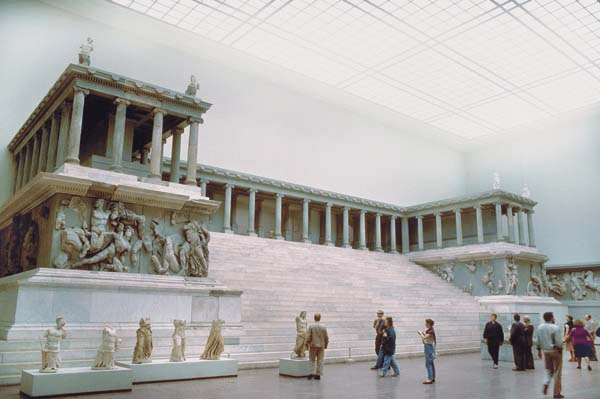
The Altar of Pergamum is considered one of the greatest surviving monuments from antiquity, now located in the Pergamum Museum, Berlin, Germany

“To the angel of the church in Pergamum write:

These are the words of him who has the sharp, double-edged sword. I know where you live—where Satan has his throne. Yet you remain true to my name. You did not renounce your faith in me, not even in the days of Antipas, my faithful witness, who was put to death in your city—where Satan lives.

Nevertheless, I have a few things against you: There are some among you who hold to the teaching of Balaam, who taught Balak to entice the Israelites to sin so that they ate food sacrificed to idols and committed sexual immorality. Likewise, you also have those who hold to the teaching of the Nicolaitans. Repent therefore! Otherwise, I will soon come to you and will fight against them with the sword of my mouth.

Whoever has ears, let them hear what the Spirit says to the churches. To the one who is victorious, I will give some of the hidden manna. I will also give that person a white stone with a new name written on it, known only to the one who receives it. (New International Version)

I’ve lived in one or two places in my life that I might have secretly described as the city where Satan lives. Jesus, however, in words to an ancient church, put it out there that they were living in such a place.

We aren’t told why Jesus described the city of Pergamum that way. Many ancient and important places typically had a prominent temple to some Greek god or goddess. In Pergamum, there existed a temple to Asclepius, the god of healing, symbolized by a snake – which isn’t exactly a positive icon in the worship of God.

The bad names didn’t stop there. Balaam is mentioned. He was a foreigner to Israel who is associated with false prophecy and leading worshipers of God astray. Balaam was blamed for the people’s idolatry and immorality before entering the Promised Land. (Numbers 31:16)

“Probably the greatest tragedy of the church throughout its long and checkered history has been its constant tendency to conform to the prevailing culture instead of developing a Christian counter-culture.”

John R.W. Stott

The name “Nicolaitans” is likely a Greek form of saying “Balaamites.” Thus, they are one in the same thing. It seems that Jesus was pointing a finger directly at particular religious practices consistent with the tradition of Balaam, namely, eating food sacrificed to idols and committing sexual immorality.

Idols and temples and eating were a hot button issue in the earliest church. All the places that churches were established, there were a significant number of Gentile converts from Greek religion to following Christ and worshiping God. And it was anything but a nice easy clean break from the old to the new.

I would surmise that the Balaamites and Nicolaitans are a group of Christian converts from paganism who were embracing a more syncretistic religion, and urging others to do the same – to maintain and engraft some of the Roman values and Greek religious practices so that the church would become more socially accepted and economically viable. Perhaps, they may have reasoned, there would be less persecution and things would generally go better for everyone.

“Some Christians want enough of Christ to be identified with him but not enough to be seriously inconvenienced.”

D.A. Carson

Whereas the Apostle Paul had a more nuanced understanding of the relationship between the church and the culture, the communication to the church at Pergamum was a definitive statement that Nicolaitans are immoral idolaters and the only thing to do in such a case is for them (not the entire congregation as a whole) to repent, stop the syncretism, and start devoting themselves completely to the worship of God alone.

Jesus himself was advocating for a firm refusal in trying to achieve respectability, to make compromises in religious practice. It certainly appears that, at least in the case of Pergamum’s converts, there was to be absolutely no connection with the old religion – not even with eating any meat or anything else that came from the pagan temple.

The Greek god Asclepius was connected with medicine and healing. So, why would this be such a problem for the fledgling church? Why would the city of Pergamum be labeled as the place where Satan lives?

Pergamum was a prominent city. It’s Greek culture, cultural and social traditions, and religious center represented the pinnacle of pagan society. This perhaps explains in part why early Christians viewed the place as a bastion of the devil.

Antipas, the Christian Bishop of Pergamum, is said to have been martyred there at the end of the first century, C.E. – which is around the time when many scholars believe the Book of Revelation was composed.

Whatever was actually going on at the time, there were most certainly significant tensions between the Christian and pagan communities which existed in the ancient city of Pergamum. Avoiding persecution, even death, may have been foremost in the minds of the Nicolaitans – who wanted accommodations with paganism that went too far, even for Jesus.

“Christ claims no man purely as a natural being, but always as one who has become human in a culture; who is not only in culture, but into whom culture has penetrated.”

H. Richard Niebuhr

It’s always been a difficult thing for Christians of every historical age to know how to deal with being in a society that is of a different culture and religion. And every generation of believers need to struggle through and reaffirm what Christian faith looks like wherever they live in this world, and in whatever cultural context they find themselves within.

In the letter to the church at ancient Pergamum, we perhaps find some guidance in Christ’s affirmation of holding onto Christian faith and keeping up a public profession of fidelity to him; and in Christ’s denunciation of diluting that Christian faith with too much accommodation to pagan culture.

Not every believer is going to agree in how to practically proceed with such matters. Yet these are issues worth having constructive conversations about, rather than simply digging into an established personal trench and, from there, lobbing unhelpful volleys of words at those who disagree.

Almighty God and Father of our Lord Jesus Christ, you are a jealous God who will not accept any attachment to other gods. I affirm you as the Most High God, and you will not give your honor or acclaim to idols. Please help us your people to avoid putting anything or anybody above or below you. Amen.

Take Responsibility (Deuteronomy 3:23-29)

It was also at that same time that I begged the Lord: Please, Lord God! You have only begun to show your servant your greatness and your mighty hand. What god in heaven or on earth can act as you do or can perform your deeds and powerful acts? Please let me cross over the Jordan River so I can see the wonderful land that lies beyond it: those beautiful highlands, even the Lebanon region.

But the Lord was angry with me because of you! He wouldn’t listen to me. He said to me: That’s enough from you! Don’t ever ask me about this again! Go up to the top of Mount Pisgah. Look west, north, south, and east. Have a good look, but you will not cross the Jordan River. Instead, command Joshua, strengthen him, and encourage him because he’s the one who will cross the river before this people. He’s the one who will make sure they inherit the land you will see.

After that, we stayed in the valley across from Beth-peor. (Common English Bible)

I wonder if God ever feels like the parents of elementary aged children. “Please, please, puh-leeeze let me have it!” It’s a good thing God is spirit, because there may be some divine eye rolling happening with certain people’s requests.

When Moses pleaded God to allow him to cross the Jordan River into the Promised Land, the Lord forbade him to do so. The reason God gave is that Moses had to bear the brunt of the Lord’s anger on behalf of the community.

But you [Israel] had no faith in the Lord your God about this matter, even though he went ahead of you, scouting places where you should camp, in fire by night, so you could see the road you were taking, and in cloud during the daytime.

The Lord heard what you said. He was angry and he swore: Not even one of these people—this wicked generation!—will see the wonderful land that I promised to give to your ancestors… (The Lord was even angry with me [Moses] because of what you did. “You won’t enter the land either,” God said. “But Nun’s son Joshua, your assistant, will enter it. Strengthen him because he’s the one who will help Israel inherit the land.”) (Deuteronomy 1:32-38, CEB)

Not allowing Moses to enter the land may seem strange to us whose culture prizes individualism and self-reliance. But that was not the culture of ancient Israel. There was a common core belief in corporate responsibility. The leader acted as the representative of the people, and so, Moses was answerable for the community’s sins.

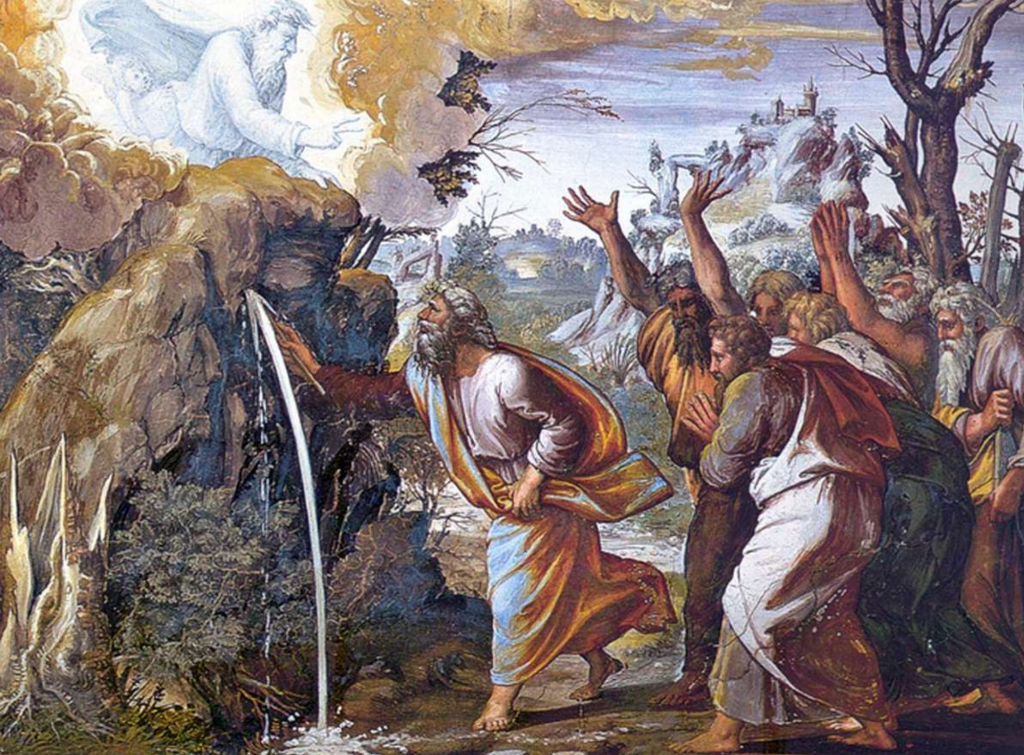
Fresco of Moses and water from the rock, by Raffaello Sanzio da Urbino (Raphael), 1519

Lest we still don’t like what’s going on here, elsewhere in scripture we get a perspective that it was also the lack of faith by Moses that caused him to lose privilege in entering the land:

Moses and Aaron gathered the assembly before the rock. He said to them, “Listen, you rebels! Should we produce water from the rock for you?” Then Moses raised his hand and struck the rock with his staff twice. Out flooded water so that the community and their animals could drink.

The Lord said to Moses and Aaron, “Because you didn’t trust me to show my holiness before the Israelites, you will not bring this assembly into the land that I am giving them.” These were the waters of Meribah, where the Israelites confronted the Lord with controversy and he showed his holiness to them. (Numbers 20:10-13, CEB)

The fact of the matter is that we are responsible for both our personal selves and the entire community of people we are a part of. Indeed, we truly are our brother’s and sister’s keeper.

It’s important that everyone considers what the Lord’s will is – not only personally – but for the common good of all the people. Perhaps this idea is captured best in the fictitious Star Trek adage of the alien Vulcans who would logically examine a decision and say, “The needs of the many outweigh the needs of the few (or the one).”

What’s more, believers in God are meant to consider what is pleasing to the Lord, and not only to one’s personal or communal pleasure. The Lord is God and we are not. Sovereignty belongs to God. Servanthood belongs to us; and our ultimate service is to the Lord.

The bottom line for me is believing that the Lord God is good, all the time, and truly has our best interests at mind and at heart. Since God did not allow Moses into the land, I reason that it was for a greater good that transcended the individual request of Moses to enter.

Maybe that’s a difficult perspective to find whenever we are in the middle of strong desires for something, but it is one that we must struggle to find. Since the Lord is high and holy above everyone and everything, God is able to see the big picture and every angle of a situation.

We, however, only see a very small slice of the total view. So, it only makes sound spiritual sense that we learn to entrust ourselves to the One who sees all and acts according to what is right, just, and good.

Gracious and generous God, Creator and Giver of all that is good, we thank you for our many blessings. We acknowledge that all that we have is from you. We offer you thanks and praise for the beauty of the earth, our work, our family, our loved ones, and all the gifts we have been given.

You are with us always. In each dark hour, you are here. In each bright hour, you are here. Blessed by your grace, may we show gratitude by sharing what we have been given. For by serving our brothers and sisters, we serve you.

We remain ever grateful for your constant love, the gift of your Son Jesus, and the presence of your Holy Spirit with us. Protect and guide us on our personal and collective journeys, as we seek to be your faithful stewards. Amen.

Jesus the Mentor (Mark 3:13-19)

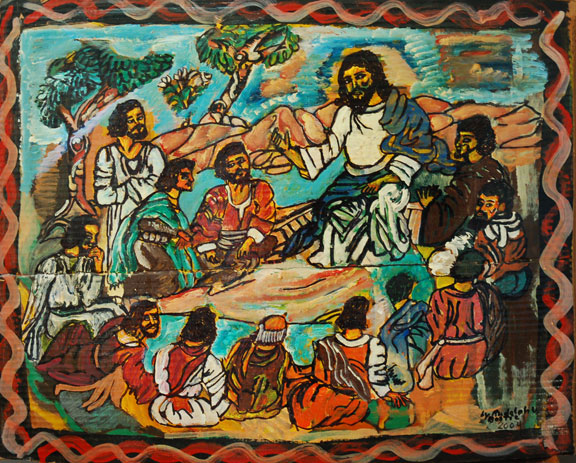
Jesus and the Disciples, by Rudolph Bostic

Jesus went up on a mountainside and called to him those he wanted, and they came to him. He appointed twelve that they might be with him and that he might send them out to preachand to have authority to drive out demons. These are the twelve he appointed: Simon (to whom he gave the name Peter), James son of Zebedee and his brother John (to them he gave the name Boanerges, which means “sons of thunder”), Andrew, Philip, Bartholomew, Matthew, Thomas, James son of Alphaeus, Thaddaeus, Simon the Zealotand Judas Iscariot, who betrayed him. (New International Version)

For me, every place in Holy Scripture is significant, even the seemingly mundane portions of it. Today’s verses might appear rather insignificant. However, there is some important meaning to recording who Christ called as his disciples and why he did it.

Jesus appointed twelve Jewish men to be his close disciples, his apostles. In choosing them, let’s not read into it something that isn’t there. This choosing, in no way, is meant to convey that church leadership boards are always supposed to have twelve men. It seems to me, that if such churches believe this, they ought to go all the way by insisting that they ought also to be Jewish Christians – no Gentiles on the election ballot at the annual meeting!

Excluding women, maintaining a particular number of people to a group, or considering only one ethnicity to leadership is nowhere to be interpreted in this text of Scripture. I can imagine Jesus sitting at the right hand of the Father raising a Spock-like eyebrow to such hermeneutical gymnastics and stating the lone word, “fascinating!”

A disciple is a follower. An apostle is one who is sent out with a specific purpose. Jesus called these particular people in order to send them out with a mission. In other words, Christ’s disciples are really missionaries. And these apostles, these missionaries, are appointed in order that they might be with Jesus, follow him everywhere, learn from him, and then have the received authority to go out and accomplish the mission given them to do.

An apostle can only properly carry out the instructions of the Teacher by first being a disciple who spends copious amounts of time in that Teacher’s presence. Indeed, if we are looking for some contemporary application in these more mundane texts of Scripture, let us find here an insight into our own Christian formation.

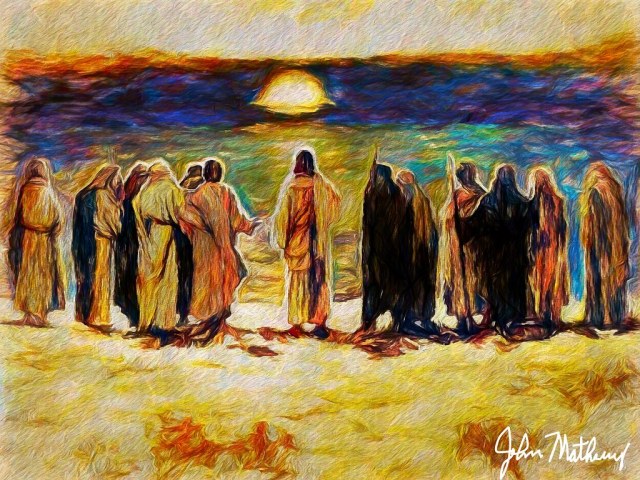
Jesus and the Disciples, by John Mathews

Christian ministry is rightly patterned after the Teacher we follow, Jesus our Lord. Christ himself demonstrated for us the way of mentoring or discipling, through his own words and actions. He called particular individuals, taught them, and equipped them for spiritual warfare in this world by granting them authority to do the work.

If we need a pattern, there it is. It’s a model of mentoring others in the ways of Christian mission and ministry. The idea is that we call, teach, equip, and authorize others in the words and ways of Jesus. I really don’t much care what you call it: Christian discipling, relational mentoring, small group teaching, spiritually forming, or any other word or phrase.

The important thing is to actually understand and do this very Christ-like work of developing mature followers of Jesus who can do the important work of spiritual warfare and ministry, then in turn, develop others. We are to pass on a body of faith and doctrine, of mission and ministry, to a group of people who will do the work. And they then do the same for others.

I rather like the word “mentoring” because for most people it evokes the idea of putting time and effort into some relationships for a specific purpose. And when we look at Christianity as a great mentoring project, perhaps we will see why church is becoming a byword in many parts of the Western world. This also ought to perhaps clue us into how we might move forward as Christians.

I am suggesting that, generally speaking, we have neglected this pattern of Jesus in calling, teaching, equipping, and authorizing. It is one large reason why there is such a decline in church attendance (and participation) in the West. And until we collectively take up this mantle of mentoring ministry, we shall continue to lessen, because we are irrelevant to people’s daily lives – both inside and outside the church.

As a first course of action, I invite you – no matter your age or stage in life – to make it a priority to simply “hang out” with individuals and groups of people. Maybe that sounds like an extrovertish sort of thing to do. However, this invitation is coming from me, an introvert. I didn’t say you have to be the life of the party, or engage in a lot of talking. But I am saying that mature followers of Jesus ought to strongly consider some intentional relationships with people other than family and a few friends.

Hang out around any given church, on any given Sunday, after any given worship service, and you are likely to see small groups of people talking with each other. Those groups typically center around friends according to age. What is often lacking are intentional interactions between the generations.  

Ethiopian Orthodox Church depiction of Christ and his disciples

The younger generations (particularly persons aged 18-29) often need and want to have relationships with more experienced (older!) believers in the faith. Younger adults, however, tend to lack the confidence to go after older adults in order to be mentored or influenced by them. I believe the onus is on the older generations to go after the younger.  

Maybe I’m just old, but it seems like younger generations have an incredible array of relationships, differing levels of friendship, and a complexity to their interactions that I didn’t have “back in my day.” What’s different, it seems, is that their relationships are more gray, and less black and white. And they appear to do a solid amount of hanging out.

Hanging out is typically sitting around with a group of people, eating and drinking, watching movies, studying (or doing bible study) or any other activity. Its doing just about anything, but doing it together with others. And this is the perfect environment for initially establishing how to begin living into the words and ways of Jesus to mentor others.

One of the things we older folks can do is to really understand the reality of younger generations’ relational interactions. For example, when I lived in a university town I used to often just “hang out” with college students, with no agenda other than just being with them. The local Perkins restaurant was at its busiest at midnight, filled with college students hanging out.

There are places in every town and city where young adults go, especially the bar scene. Bars aren’t just places to drink, but are locations of conviviality where persons have the chance to be around one another in a kind of secular church where fellowship happens, looking for a chance to relate meaningfully with others.

All people desire intimacy and want to know that someone else cares about them. This is a very real and felt need. How that need is going to be met can be either legitimate or illegitimate. And we can help with that.

One of the best things we can do for others is to communicate to them that we “have their back,” that we care, love, and genuinely like them.

No one can sniff out a disingenuous attitude quite like a young adult. So, our interactions have to be an authentic desire to be around them. Also, this does not mean we have to pretend to be younger than we are. Instead, one of the greatest needs a young person has is to be in a mentoring relationship with someone older and wiser who can help them navigate life and bring some sort of definition to relationships that they may lack.

The older generations could learn to “hang out” with younger generations and find individuals for whom they can build a solid one on one or group relationship with. If they can have such relationships now, it will serve them for a lifetime.

It seems to me that, as I look at the biblical text, being a mentor, and walking alongside another with love, grace, and wisdom, is built into Christianity by Jesus himself. So, let’s consider how we might best go about this important work.

May your love overflow more and more with knowledge and full insight to help you to determine what really matters, so that in the day of Christ you may be pure and blameless, having produced the harvest of righteousness that comes through Jesus Christ for the glory and praise of God. (Philippians 3:9-11, NRSV)