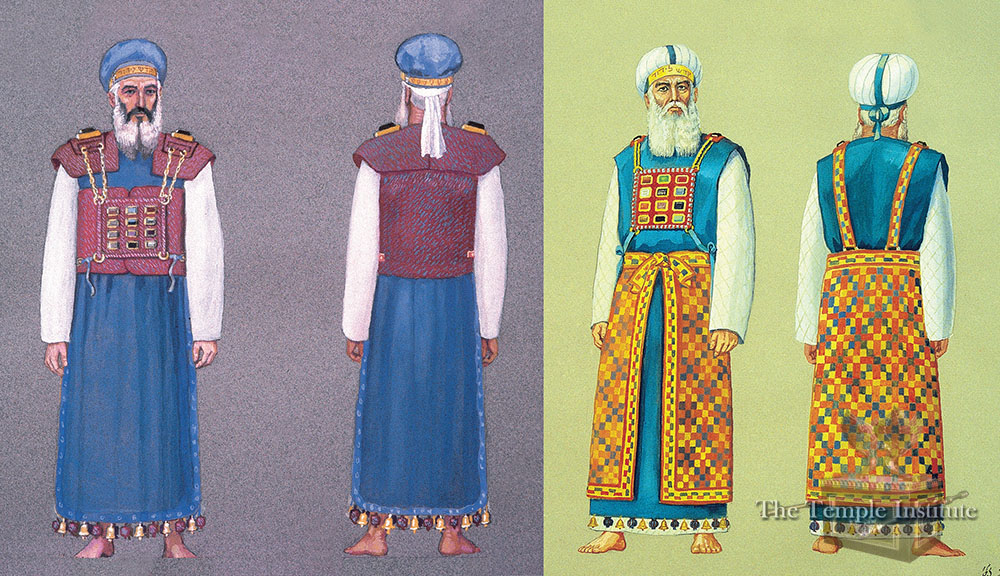
It’s In the Details (Exodus 28:29-38)

Aaron the High Priest

“Whenever Aaron enters the Holy Place, he will bear the names of the sons of Israel over his heart on the breast-piece of decision as a continuing memorial before the Lord. Also put the Urim and the Thummim in the breast-piece, so they may be over Aaron’s heart whenever he enters the presence of the Lord. Thus Aaron will always bear the means of making decisions for the Israelites over his heart before the Lord.

“Make the robe of the ephod entirely of blue cloth, with an opening for the head in its center. There shall be a woven edge like a collar around this opening, so that it will not tear. Make pomegranates of blue, purple and scarlet yarn around the hem of the robe, with gold bells between them. The gold bells and the pomegranates are to alternate around the hem of the robe. Aaron must wear it when he ministers. The sound of the bells will be heard when he enters the Holy Place before the Lord and when he comes out, so that he will not die.

“Make a plate of pure gold and engrave on it as on a seal: holy to the Lord. Fasten a blue cord to it to attach it to the turban; it is to be on the front of the turban. It will be on Aaron’s forehead, and he will bear the guilt involved in the sacred gifts the Israelites consecrate, whatever their gifts may be. It will be on Aaron’s forehead continually so that they will be acceptable to the Lord. (New International Version)

This area of Holy Scripture is likely not one of the more popular places to read. Frankly, it’s boring and pedantic. Yet, contained within the Bible it is, for us to examine.

After giving Moses the Ten Commandments in Exodus 20, the next several chapters, from Exodus 20-31 contain detailed instructions from God concerning the covenant code stipulations with the Israelites. Plans for liturgical and sacrificial worship are covered with a fine tooth comb. Instructions for building implements for worship are precise.

And the special garments of the priests’ clothing are described in detail, both as to their design and the material to be used. It’s as if we’re all sitting in a virtual meeting just trying to stay awake, let alone pay attention. Yet, the fact of the details lets us know that the plan is important.
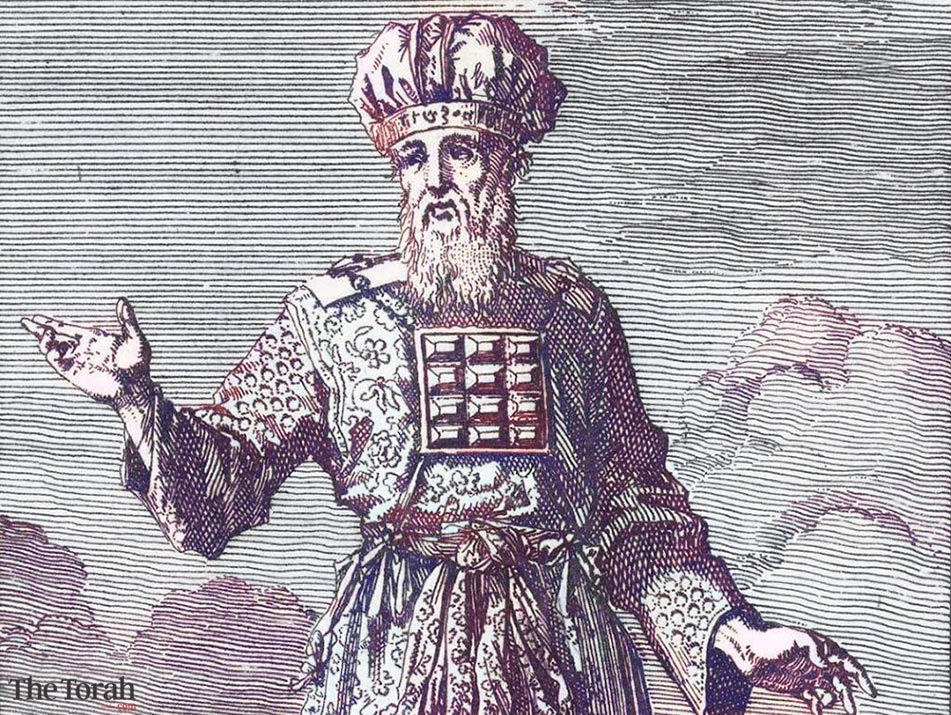
Aaron the High Priest, by Jan Luyken (1669-1712)

Today’s Old Testament lesson deals specifically with the vestments of Aaron, the first high priest of the covenant. An ephod was made – which is a richly embroidered, apron-like vestment having two shoulder straps and ornamental attachments for securing the breastplate, worn with a waistband. (Exodus 28:1-30)

The garment which Aaron was to wear, when he entered the sacred space, symbolically kept the nation of Israel in front of Yahweh, and also over the high priest’s heart.

There was a robe which covered the ephod, equipped with bells. As Aaron moved, the bells rang, signaling that he was coming into and out of the presence of God. Only the high priest was consecrated to enter the most holy place; and the high priest alone wore the special clothing for the unique service which was done.

The entire ritual of the high priest’s service was a visual display of God’s glory and of the reality that no one may enter God’s presence flippantly or carelessly. God is gracious and merciful; and God also has no tolerance for impurity, unrighteousness, and pride.

God expects divine laws, stipulations, and commands to be obeyed without prejudice. The Israelites could not pick and choose what directives from God they would do, or not do. And that is the core of what holiness before the Lord really is.

An interesting observation about this text of Scripture is that Aaron the high priest is given no instructions or commands about what to say when he entered and then left God’s presence. No mantras. No incantations or formulaic words. The inference is that Aaron was silent.

Instead, the garments spoke. “Holy to the Lord” on the plate affixed to the turban said a lot – along with the ephod and the robe, affirming that holiness is needed in order to make any sort of decisions before God.

We never get an explanation in Scripture about what the Urim and Thummim are – which is why, when translating the words from Hebrew, we merely have English transliterations of them. We only know that they were used when making decisions. Evidently, the high priest was an earthly source of God’s wisdom and direction.

Whatever we think about these verses in the book of Exodus, it seems that we are meant to understand that details matter; and how we go about our obedience, down to the last jot and tittle, matters.
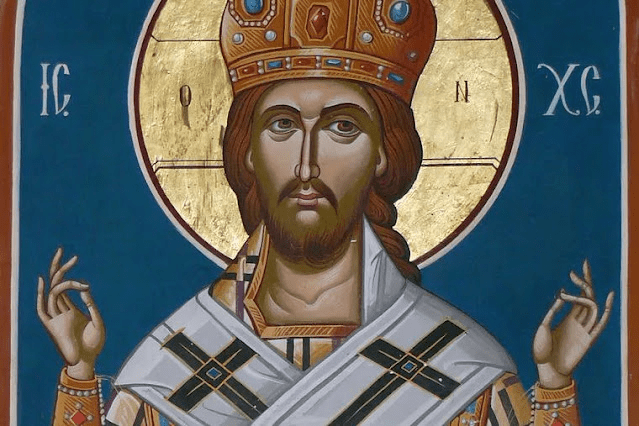
Orthodox icon of Jesus Christ, the High Priest of a New Covenant

In the ministry of Christ, there were people wondering if all of his talk was upending or replacing those detailed imperatives of God. Jesus responded:

“Do not think that I have come to abolish the Law or the Prophets; I have not come to abolish them but to fulfill them. For truly I tell you, until heaven and earth disappear, not the smallest letter, not the least stroke of a pen, will by any means disappear from the Law until everything is accomplished.” (Matthew 5:17-18, NIV)

Jesus furthermore upheld God’s expectation that divine commands be obeyed:

“Therefore anyone who sets aside one of the least of these commands and teaches others accordingly will be called least in the kingdom of heaven, but whoever practices and teaches these commands will be called great in the kingdom of heaven.” (Matthew 5:19, NIV)

At issue was the nature of righteousness – right relations with both God and others. Justice is imperative. Being humble, pure, merciful, and a peacemaker matters. The laws and directives of God are never to be used for walking around like a peacock to display what a wonderfully important and religious person you are.

In other words, the ornate garments of the high priest are not the person; they are special clothing used for a special purpose. Clothes may be important, yet it’s the heart that truly matters. And a heart devoted to God will seek to humbly obey God’s words down to the most minute detail.

O God, by whom the humble are guided, and light rises up in darkness for the godly: Grant us, in all our doubts and uncertainties about obedience, the grace to ask what you would have us to do, that the Spirit of wisdom may save us from all false choices, and that in your light we may see light, and in your straight path may not stumble; through Jesus Christ our Lord. Amen.

Jesus Prays For Us (John 17:6-19)

Word of Life, by Millard Sheets

“I have made your name known to those whom you gave me from the world. They were yours, and you gave them to me, and they have kept your word. Now they know that everything you have given me is from you, for the words that you gave to me I have given to them, and they have received them and know in truth that I came from you, and they have believed that you sent me.

I am asking on their behalf; I am not asking on behalf of the world but on behalf of those whom you gave me, because they are yours. All mine are yours, and yours are mine, and I have been glorified in them. And now I am no longer in the world, but they are in the world, and I am coming to you.

“Holy Father, protect them in your name that you have given me, so that they may be one, as we are one. While I was with them, I protected them in your name that you have given me. I guarded them, and not one of them was lost except the one destined to be lost, so that the scripture might be fulfilled. 

But now I am coming to you, and I speak these things in the world so that they may have my joy made complete in themselves. I have given them your word, and the world has hated them because they do not belong to the world, just as I do not belong to the world. 

“I am not asking you to take them out of the world, but I ask you to protect them from the evil one. They do not belong to the world, just as I do not belong to the world. Sanctify them in the truth; your word is truth. As you have sent me into the world, so I have sent them into the world. And for their sakes I sanctify myself, so that they also may be sanctified in truth. (New Revised Standard Version)

It seems to me only fitting that Jesus concluded his time with the disciples in the Upper Room before his betrayal, crucifixion, and death with prayer. It also seems to me that if you really want to know the heart of a person, listen to them pray.

The prayer of Jesus was thoroughly oriented toward the spiritual needs of his followers – even potential believers who will follow him in the future. And it was a prayer completely devoted toward honoring the heavenly Father through praying consistent with God’s will for this world.

Without the physical presence of Jesus – which would soon be gone – his followers would have to rely on prayer. And Christ was intent on instilling within his disciples the confidence and hope they needed for a solid life of prayer.

For post-resurrection Christians living in an ever-expanding world of oppression, greed, and indifference, we can be encouraged not to settle into despair or loneliness. Why? Because believers can have a solid hope and an abiding trust in the continuing presence of Jesus by means of the Holy Spirit.

God Gives

God gives. Jesus gives. Both the Father and the Son are givers. This is a major reason and motivation for prayer because God is not a reluctant giver. In the act of giving, the Father and the Son are fully on the same page; God is ready and willing to give. The Holy Trinity – Father, Son, and Spirit – are in complete unity, and act as One, in giving to us what we need.

“Those who drink of the water that I will give them will never be thirsty. The water that I will give will become in them a spring of water gushing up to eternal life.” (John 4:14, NRSV)

“Do not work for the food that perishes but for the food that endures for eternal life, which the Son of Man will give you.” (John 6:27, NRSV)

“I give them eternal life, and they will never perish. No one will snatch them out of my hand.” (John 10:28, NRSV)

We Belong

Through giving we are included. Believers and followers of Jesus – having been given the grace of faith – know that they belong to God. Christians are in union with Christ. The redemption which Jesus has secured is a million billion times stronger, and bonds us closer, than any sort of Gorilla glue. And, what’s more, once we belong, we are never forgotten, but always remembered by God.

“The Father knows me, and I know the Father. And I lay down my life for the sheep. I have other sheep that do not belong to this fold. I must bring them also, and they will listen to my voice. So there will be one flock, one shepherd.” (John 10:15-16, NRSV)

Christ the King, statue in Swiebodzin, Poland

The Name of Jesus

Because we belong, we know God’s name. The divine name stands for all that God is and all that God has done. It’s all focused in Christ. In the name of Jesus, through the person and work of Jesus Christ, we have everlasting life, spiritual power, and eternal security.

Now Jesus did many other signs in the presence of his disciples that are not written in this book. But these are written so that you may continue to believe that Jesus is the Messiah, the Son of God, and that through believing you may have life in his name. (John 20:30-31, NRSV)

We Have the Word

The Word became flesh and dwelt among us (John 1:14). Jesus has given to his disciples only those words which he first received from the Father. Those who accept the enfleshed Word and his words have been given power to become God’s children (John 1:12). Because believers belong to God, they know the truth and that truth has set them free.

It is the Christian’s mission to live into the words and ways of Jesus, to follow Christ in thought, word, and deed. The very glory of Jesus in his cross and resurrection is focused within the believing community, who is in union with Christ and belongs to God.

In his prayer, Jesus claimed an intimate oneness in the sharing of concern for people who are the objects of the Father’s gracious giving of love through the Son. All who belong to Christ belong to God, and vice versa. All the love that went into the cross was poured out upon us.

Those who believe in the name of Jesus Christ are the very glory of Jesus, and thus, the glory of God.

Sent Into the World

Because of the Father’s name—because of who the Father is and what the Father has given in love to the Son—we are set apart for truth; the words of God are truth.

Since we belong to God and bear the name of Christ, we don’t belong to the world’s systems of guilt, shame, injustice, and evil. And yet, we are separated from the world for precisely the reason of immersing ourselves in the world. In other words, Christianity is meant for the life of the world, and not as a religion that’s only concerned for itself.

To reach the world, we must be different from it. To reach the world, we need to have boots-on-the-ground in it. To reach the world, Christians are to be both far from the world, and near to the world.

As the Father sent the Son, so the Son sends us into the world – not to be like the world, but to embody the words and ways of Jesus to and for the world.

Just as the world rejected Jesus in his suffering and death, so the world, too, will reject his followers. Which means we will need to pray, a lot! And there is no better scriptural prayer to emulate than the very words of the Lord Jesus, who loved us and gave himself for us.

Holy Father, guard our hearts and minds in Jesus, as we pursue this Christian life which you gave as a gift through Christ, so that we can be united, just as the Father and the Son are one. Although we long for heaven, don’t take us out of the world until we have fulfilled our sacred mission to carry the words and ways of our Lord to the world. Make us holy, and give us everything we need for life in this present evil age; through Jesus Christ your Son, our Lord, who with you and the Holy Spirit are one God, now and forever. Amen.

Who Is In Control? (Psalm 47)

Ascension, by Angela Taylor Perry

Clap your hands, all you peoples;
    shout to God with loud songs of joy.
For the Lord, the Most High, is awesome,
    a great king over all the earth.
He subdued peoples under us
    and nations under our feet.
He chose our heritage for us,
    the pride of Jacob whom he loves.

God has gone up with a shout,
    the Lord with the sound of a trumpet.
Sing praises to God, sing praises;
    sing praises to our King, sing praises.
For God is the king of all the earth;
    sing praises with a psalm.

God is king over the nations;
    God sits on his holy throne.
The princes of the peoples gather
    as the people of the God of Abraham.
For the shields of the earth belong to God;
    he is highly exalted. (New Revised Standard Version)

Who is in control? This is really a big question. We humans seem almost obsessed with the issue of control.

Some people want to be in charge of regulating everything. Others want to exert force over nothing at all. And there are those who continually want to know the clear lines of authority and who is in control, at all times.

Control, in and of itself, is not a bad thing. In fact, it’s a good thing. Taking charge of a situation – and especially of oneself – is often needed. Leadership that is informed, decisive, humble, true, and right, is a must.

The problem comes whenever we try to exert domination over another person, or attempt to command an organization when it isn’t our responsibility to do so.

Ultimate control of all things belongs to God, and not to you or me. The psalmist is insistent that God is the Ruler of the universe; and that all things belong to the Lord. God’s commands are good.

The Lord’s dominion is known as the kingdom of God. Whenever people are in sync with this reality, then they are able to be joyful and celebrate the good, right, and just Being who is in control.

Yet, if people have problems trusting another; desire to always call the shots on everything; and command everyone; there you will find a host of miserable people – with the one trying to exert control as the most miserable of all.

People, instead, are called to self-control. We are to have charge over our own thoughts and actions. It’s important to have sobriety in our lives in which we can use proper restraint, as well as needed initiative.

Be alert and be of sober mind. Your enemy the devil prowls around like a roaring lion looking for someone to devour. (1 Peter 5:8, NIV)

In order to get our lines of authority in the proper places, and to participate in the established rhythms of control in the universe, we are commanded to clap, shout, and sing. Because God has ultimate control, divine initiatives are grounded in goodness, justice, righteousness, and deliverance from evil. The Lord has mercifully acted on behalf of people.

The Lord only asks of us to do things that he himself has done. The psalm states that “God has gone up with a shout.” We shout because God shouts. God rules over the nations, and was not simply some local deity that the ancient Israelites served and worshiped. The divine presence is with those who acknowledge God; they will hear the Lord’s shout.

“No misfortune is seen in Jacob,
    no misery observed in Israel.
The Lord their God is with them;
    the shout of the King is among them.
God brought them out of Egypt;
    they have the strength of a wild ox.” (Numbers 23:20-22, NIV)

We are also told to sing. The reason we do so is because the Lord is high above all people, and is king over the nations. This is something we need to say out loud and to sing, and to not only read silently in our heads. Our ears need to listen to the psalm, to hear the praises of God reverberating on our ear drums.

My people, hear my teaching;
    listen to the words of my mouth. (Psalm 78:1, NIV)

It is perfectly appropriate for Christians to use today’s psalm in reflection upon Ascension Day. Jesus has been lifted up into the sky; God has gone up with a shout. The Lord has equipped us for citizenship in the kingdom of God. We have solid grounds for celebration, shouting, and singing. Jesus is our King.

God put this power to work in Christ when he raised him from the dead and seated him at his right hand in the heavenly places, far above all rule and authority and power and dominion and above every name that is named, not only in this age but also in the age to come. And he has put all things under his feet and has made him the head over all things for the church. (Ephesians 1:20-22, NRSV)

Because of Christ’s ascension, believers in Jesus have the memory of the past, the experience of the present, and a hope for the future. With Jesus in control, there is no need for fear, or for trying to gain control for oneself.

Grant, we pray, Almighty God, that as we believe your only-begotten Son our Lord Jesus Christ to have ascended into heaven, so we may also in heart and mind there ascend, and with him continually dwell; who lives and reigns with you and the Holy Spirit, one God, for ever and ever. Amen.

Ascension of the Lord (Acts 1:1-11)

In my former book, Theophilus, I wrote about all that Jesus began to do and to teach until the day he was taken up to heaven, after giving instructions through the Holy Spirit to the apostles he had chosen. After his suffering, he presented himself to them and gave many convincing proofs that he was alive. He appeared to them over a period of forty days and spoke about the kingdom of God. 

On one occasion, while he was eating with them, he gave them this command: “Do not leave Jerusalem, but wait for the gift my Father promised, which you have heard me speak about. For John baptized with water, but in a few days you will be baptized with the Holy Spirit.”

Then they gathered around him and asked him, “Lord, are you at this time going to restore the kingdom to Israel?”

He said to them: “It is not for you to know the times or dates the Father has set by his own authority. But you will receive power when the Holy Spirit comes on you; and you will be my witnesses in Jerusalem, and in all Judea and Samaria, and to the ends of the earth.”

After he said this, he was taken up before their very eyes, and a cloud hid him from their sight.

They were looking intently up into the sky as he was going, when suddenly two men dressed in white stood beside them. “Men of Galilee,” they said, “why do you stand here looking into the sky? This same Jesus, who has been taken from you into heaven, will come back in the same way you have seen him go into heaven.” (New International Version)

Ascension Day often feels like the weird stepchild in the family of church events in the Christian Year. It’s often overlooked without ever really being missed.

O sure, there are a few congregations that worship on this Thursday, coming 40 days after Easter Sunday. And a few more churches will observe Christ’s ascension this coming Sunday. Yet, most Christians will go about their usual business; thus, in my opinion, for what it’s worth, missing a grand opportunity.

It’s hugely important that Christ is now presently sitting at God’s right hand, offering continual prayers on our behalf to the Father. Ascension Day teaches us, and reminds us, that we have an advocate, a champion who has gone before us and secured deliverance from sin, death, and hell.

On top of it all, Christ’s ascension to heaven means that Jesus is the universal ruler; he commands a kingdom which will never end. Ascension Day proclaims from the heights of the clouds that Jesus is Lord – which means nothing and no one else is. It is because of his ascension that Jesus can authoritatively grant us repentance, forgiveness, and new life.

Speaking of clouds, the reference to a cloud in Christ’s ascension is not a heavenly elevator with a special pass to the umpteenth floor to be with God. The cloud is meant to be a sign of God’s presence – much like the pillar of cloud for the Israelites in the exodus from Egypt; or like the cloud that surrounded Jesus and his disciples on the mount of transfiguration.

Jesus ascending into the cloud is the divine welcome into the Father’s presence. This is a whole lot more than returning to the status quo of things before Christ’s incarnation. No, everything has changed.

The life, ministry, crucifixion, death, and resurrection of Christ makes the ascension possible – and now Jesus is enthroned at the right hand of God. Jesus has permanently impacted the world. The dark forces and the demonic powers of this world have been stripped of their control.

Through humiliation, Christ has been exalted. Jesus gladly bore the shame and rejection that was ours. We now have spiritual freedom and are no longer in bondage to sin, death, and hell.

The stage is set for Pentecost and the giving of the Spirit. You will receive power when the Holy Spirit has come upon you. God’s Spirit is moving in the world to bring a new thing: the birth of the Church and the mystical union of Christ and his Church.

Every good spiritual thing comes through patience and faith; we must wait and trust in God’s good promise. The disciples, of course, saw no need for this waiting thing. They were ready for a restoration of everything immediately.

Unfortunately, their idea of restoration was an old-style sort of kingdom, very hierarchical with themselves in control and calling the shots. These apostles needed to discover what the rule and reign of God was actually all about. It’s not a turning back of the clock to the good old days.

Rather, it’s in doing away with the dark shadows of old ruling oppressions and allowing the divine light of Christ to shine into the world so that hearts are transformed and justice for all is the norm. In other words, all things are being redeemed.

By God’s grace, the Church and all believers will be steadfast in proclaiming good news, teaching the words and ways of Jesus, loving one another, and serving with the model given to us by Christ. The ascension and glorification of Jesus makes this possible.

So, this is a day in which Christian churches and believers are to shake off their collective spiritual A.D.D. (Ascension Deficit Disorder) and stop staring up in the sky, slack-jawed and shoulders hunched. Hopefully, no angels will come along and ask us what we’re doing just standing there.

Jesus will come back when he comes back. You and I aren’t going to know when. Now is the time to get busy with what Jesus just told us to do two minutes ago: Tell everyone about me.

Christians since the time of the ascension have been proclaiming Christ crucified, died, risen, ascended, and coming again. This is a day of joy and celebration for us. Jesus is our ascended and glorified king! The fate of the earth is with the benevolent and mighty Ruler of all. Jesus is Lord!

The great Reformed Confession, the Heidelberg Catechism, question and answer 49, states the following question and answer:

How does Christ’s ascension to heaven benefit us?

First, he is our advocate

            in heaven

            in the presence of his Father.

Second, we have our own flesh in heaven

            as a sure pledge that Christ our head

            will also take us, his members,

            up to himself.

Third, he sends his Spirit to us on earth

            as a corresponding pledge.

            By the Spirit’s power

                        we seek not earthly things

                        but the things above, where Christ is,

                                    sitting at God’s right hand.

Amen.