The Coming Judgment (Revelation 11:1-14)

Then I was given a measuring stick, and I was told, “Go and measure the Temple of God and the altar, and count the number of worshipers. But do not measure the outer courtyard, for it has been turned over to the nations. They will trample the holy city for 42 months. And I will give power to my two witnesses, and they will be clothed in burlap and will prophesy during those 1,260 days.”

These two prophets are the two olive trees and the two lampstands that stand before the Lord of all the earth. If anyone tries to harm them, fire flashes from their mouths and consumes their enemies. This is how anyone who tries to harm them must die. They have power to shut the sky so that no rain will fall for as long as they prophesy. And they have the power to turn the rivers and oceans into blood, and to strike the earth with every kind of plague as often as they wish.

When they complete their testimony, the beast that comes up out of the bottomless pit will declare war against them, and he will conquer them and kill them. And their bodies will lie in the main street of Jerusalem, the city that is figuratively called “Sodom” and “Egypt,” the city where their Lord was crucified. And for three and a half days, all peoples, tribes, languages, and nations will stare at their bodies. No one will be allowed to bury them. All the people who belong to this world will gloat over them and give presents to each other to celebrate the death of the two prophets who had tormented them.

But after three and a half days, God breathed life into them, and they stood up! Terror struck all who were staring at them. Then a loud voice from heaven called to the two prophets, “Come up here!” And they rose to heaven in a cloud as their enemies watched.

At the same time there was a terrible earthquake that destroyed a tenth of the city. Seven thousand people died in that earthquake, and everyone else was terrified and gave glory to the God of heaven.

The second terror is past, but look, the third terror is coming quickly. (New Living Translation)

There are many people who look upon Christians as oppressors and persecutors in history. And they aren’t wrong. From calls to war for the Crusades, to the Spanish Inquisition, and much more, a great deal of blood has been spilled in the name of Christianity.

The Book of Revelation, however, knows nothing of that history, simply because it pre-dates all of it. Many people forget, in it’s first few hundred years, that Christianity was a persecuted religion by all sorts of people.

Christians were often the scapegoats to many a leader’s problems. From throwing Christians to the lions in the Roman Coliseum, to burning them at the stake because of their faith, many a martyr has faced a bloody death.

The Apostle John’s Apocalypse, which is known to us as the Book of Revelation, was a vision given to John in order to encourage the persecuted Christian Church that God knows their suffering; and that Jesus will return to judge the living and the dead.

John’s vision had a message of judgment on those who were persecuting Christians for their faithful witness of Jesus. The believers in Jesus who were suffering at the hands of oppressors, cried out for vindication and retribution against their persecutors.

Today’s portion of Revelation is situated between the sixth and seventh trumpets of God’s judgment (which are the second and third woes upon the earth). This interlude has to do with two godly witnesses. And the whole world is able to see them.

The space which the two witnesses occupy is in the outer courtyard of the Temple. The two of them symbolize all the faithful people of God in the world. They are attacked and killed, having carried out their witness for 1,260 days (42 months).

This is a time, related to the Old Testament prophecy of Daniel, appointed for the godless to overcome the city. But this time of suffering and woe will not last.

The two witnesses are not named or identified. The point is that whomever they are, these two maintain their prophetic witness to the Lord consistently to their martyrdom.

Like their Lord before them, the two witnesses lay dead for three days. Their bodies visible for all to see. The godless inhabitants of earth gloat over them, and celebrate their demise.

But again, like Jesus, the two are raised from death and ascend to heaven. This evokes a mass of fear throughout the world. The fact that the event causes fear and terror, instead of repentance  and penitence, speaks to how warped the people of earth have become.

Indeed, the Book of Revelation is highly symbolized reading, and John’s vision is not easy to understand. Yet, there are a few things we can reflect upon in light of this passage; and some questions we can ask of ourselves:

  1. It is important to be faithful and persevere to the very end of our lives. How will we respond to this present darkness in the world?
  2. The way in which we live our lives is the legacy we leave for others when we are gone. What will we be remembered for?
  3. Our lives speak to others about who the God of heaven is. Therefore, it is profoundly important how we go about living our current mundane daily existence. How, then, shall you and I live?
  4. Our short lives have eternal ramifications, not only for ourselves, but for future generations. In what ways will you build into the next generation and help them persevere in faith?
  5. Everything you and I see today will change. There is a Judgment Day coming, just as sure as summer will transition to autumn and then into winter. What will you do today that prepares for the final season of the earth as we know it?

Although much of John’s apocalyptic vision deals with wickedness reaching a ripeness which releases the wrath of God’s judgment; it is also simultaneously the church’s entrance into her eternal inheritance. Systemic sin, structural evil, and devilish deeds shall be no more.

Even so, come Lord Jesus. May peace soon come to this world, and within our hearts. Amen.

Christ the King Sunday (John 18:33-37)

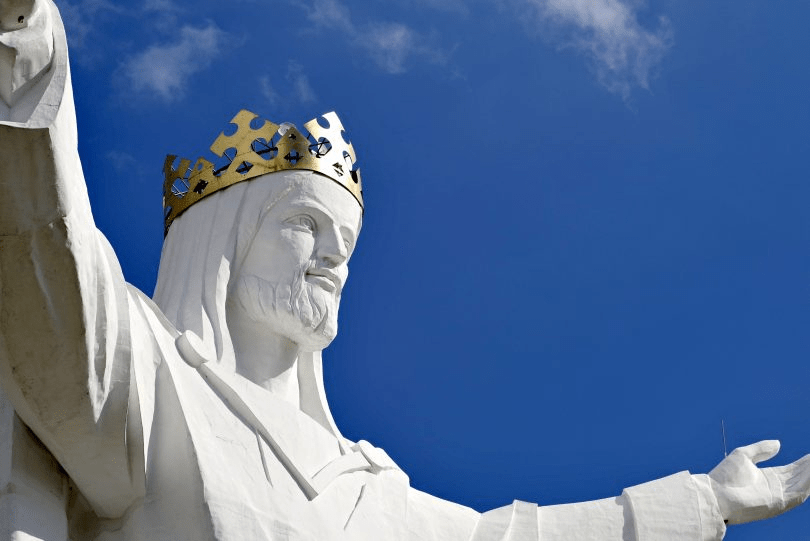
Statue of Christ the King, in Świebodzin, Poland

Then Pilate entered the headquarters again, summoned Jesus, and asked him, “Are you the King of the Jews?” 

Jesus answered, “Do you ask this on your own, or did others tell you about me?” 

Pilate replied, “I am not a Jew, am I? Your own nation and the chief priests have handed you over to me. What have you done?” 

Jesus answered, “My kingdom does not belong to this world. If my kingdom belonged to this world, my followers would be fighting to keep me from being handed over to the Jews. But as it is, my kingdom is not from here.” 

Pilate asked him, “So you are a king?”

Jesus answered, “You say that I am a king. For this I was born, and for this I came into the world, to testify to the truth. Everyone who belongs to the truth listens to my voice.” (New Revised Standard Version)

Each year in the Christian Calendar, Christ the King Sunday is observed as the final Sunday in the liturgical year. It comes at this time, just before the beginning of Advent, in order to consider an important question.

Since Jesus came to this earth in his incarnation to be a king, we must ask, “What kind of a king was Jesus?”

Christ was not, and is not, a king, a ruler (or any other sort of title one wants to use for an authoritative leader) in the same way as was the Roman Emperor, King Herod, or the regional authority of the time, Pontius Pilate.

Jesus was also not like those in authority such as the Jewish High Priest, the Jewish ruling council of the Sanhedrin, or the local synagogue ruler. And Christ is most definitely not like any sort of present day President, Prime Minister, or petty dictator in any of the world’s nations.

Jesus was a king and a ruler who used his power and authority for those on the underbelly of society, that is, people without much, if any, power or authority.

That means Christ the King is concerned to effect a very different set of values from that of any politically dominant governmental system or society that was or is on this earth.

Whether a person or group of people are seeking to win an election, initiate a coup, or effect a change in government, they want their particular system of governing to be in power. They want to call all the shots in a particular place.

That means there will be winners and losers. There will be people in power, and others without it. Some people will benefit from the system, and others will not. Looking at kingship and/or leadership from that perspective, there is a built in failure rate.

The obsession with winning, at a national level, typically involves securing a strong military. Yet, despite military might, soldiers rarely secure any sort of political solution to anything. All it really does is strongarm others into doing what the powerful want done. It does nothing to change the hearts of people.

People in power can be enamored with their authority to do things. And they don’t like it whenever they are not in control of everything. The kings, rulers, and even religious leaders in Christ’s day, were used to controlling public discourse and even the daily lives of common people.

From that sort of worldly understanding of power, Jesus had no real authority. He was this pathetic person standing before a powerful person. Most people would have been begging for their lives. But not Jesus. Christ knew who was really in charge. And it was not Pilate.

Pilate was flummoxed by the presence of Jesus. From Pilate’s perspective, Jesus was not at all acting like a king ought to. Pilate, in his authoritative role, wanted answers about what was going on. But he didn’t realize that his authority was given to him from a power outside the Roman Empire.

Christ’s kingdom is not of this world. Therefore, the power politics and authority positions of that kingdom are nothing what people like Pilate were used to. There was no way that Pilate could use the typical tactics of manipulation, lies, corruption, and leveraging power to come to a satisfactory outcome for himself.

The values of God’s kingdom are quite different from any political government in this world, either past or present.

Jesus had no need to try and be at the top of Pilate’s system, or of the Roman world. So, he wasn’t even going to try and exercise that kind of authority within it. And neither were his disciples. Clubs and swords and pitched battles would not be happening. There was absolutely no need for it whatsoever.

For us today, that means we serve the interests of humility, gentleness, respect, righteousness, mercy, purity, and peace. We are not here on this earth to engage in the routine and typical ways of earthly power politics.

For the Christian, Jesus is King. But this king isn’t riding around in a chariot or a limousine; he comes to us on a jack ass and driving a Subaru.

Jesus is the king with all the power of the universe, and yet is tortured and killed by those with the local society’s authority. That happened not because of weakness or inability, but because of a completely different set of values which have to do with love defeating hate, instead of an army winning a victory.

A God who is crucified is diametrically different than any other deity or authority which has ever existed. The power of love is the ultimate power of doing what is right, just, and good; and letting truth have its way, no matter what.

Christians everywhere must be reminded, on this Christ the King Sunday, that we serve a sovereign king whose power and authority is used to be a humble servant who meets the needs of others.

All Christians, therefore, ought to embrace and engage in becoming gentle folk who bring humble service to others wherever they go. Seeking power, position, prestige, and pedigree is in direct opposition to the values of God’s kingdom, with Christ as King.

Any sort of Christendom, which seeks to control both government and society, or a Christian Nationalism which intends to ensconce personal agendas into society, ought to be rejected.

Christian Nationalism is nothing more than Grape Nuts; just as the cereal is neither grapes nor nuts, so the political movement is neither Christian nor concerned for national interests.

This is a day for the church to reassess what is most important, to affirm its true values, and to evaluate how it really ought to operate in society.

Almighty and everlasting God, whose will it is to restore all things in your well-beloved Son, the King of kings and Lord of lords: Mercifully grant that the peoples of the earth, divided and enslaved by guilt and shame, may be freed and brought together under his most gracious rule; who lives and reigns with you and the Holy Spirit, one God, now and forever. Amen.

Implementing Reform (2 Kings 23:1-14)

Then the king [Josiah] called together all the elders of Judah and Jerusalem. He went up to the temple of the Lord with the people of Judah, the inhabitants of Jerusalem, the priests and the prophets—all the people from the least to the greatest. He read in their hearing all the words of the Book of the Covenant, which had been found in the temple of the Lord. 

The king stood by the pillar and renewed the covenant in the presence of the Lord—to follow the Lord and keep his commands, statutes and decrees with all his heart and all his soul, thus confirming the words of the covenant written in this book. Then all the people pledged themselves to the covenant.

The king ordered Hilkiah the high priest, the priests next in rank and the doorkeepers to remove from the temple of the Lord all the articles made for Baal and Asherah and all the starry hosts. He burned them outside Jerusalem in the fields of the Kidron Valley and took the ashes to Bethel. He did away with the idolatrous priests appointed by the kings of Judah to burn incense on the high places of the towns of Judah and on those around Jerusalem—those who burned incense to Baal, to the sun and moon, to the constellations and to all the starry hosts. 

He took the Asherah pole from the temple of the Lord to the Kidron Valley outside Jerusalem and burned it there. He ground it to powder and scattered the dust over the graves of the common people. He also tore down the quarters of the male shrine prostitutes that were in the temple of the Lord, the quarters where women did weaving for Asherah.

Josiah brought all the priests from the towns of Judah and desecrated the high places, from Geba to Beersheba, where the priests had burned incense. He broke down the gateway at the entrance of the Gate of Joshua, the city governor, which was on the left of the city gate. Although the priests of the high places did not serve at the altar of the Lord in Jerusalem, they ate unleavened bread with their fellow priests.

He desecrated Topheth, which was in the Valley of Ben Hinnom, so no one could use it to sacrifice their son or daughter in the fire to Molek. He removed from the entrance to the temple of the Lord the horses that the kings of Judah had dedicated to the sun. They were in the court near the room of an official named Nathan-Melek. Josiah then burned the chariots dedicated to the sun.

He pulled down the altars the kings of Judah had erected on the roof near the upper room of Ahaz, and the altars Manasseh had built in the two courts of the temple of the Lord. He removed them from there, smashed them to pieces and threw the rubble into the Kidron Valley. 

The king also desecrated the high places that were east of Jerusalem on the south of the Hill of Corruption—the ones Solomon king of Israel had built for Ashtoreth the vile goddess of the Sidonians, for Chemosh the vile god of Moab, and for Molek the detestable god of the people of Ammon. Josiah smashed the sacred stones and cut down the Asherah poles and covered the sites with human bones. (New International Version)

An engraving of King Josiah tearing down the idols, by Philip Galle (1537-1612)

The actions and reforms of King Josiah were bold, pervasive, and challenging.

The Book of Law was found in the Temple. Incredibly, over time, it had been lost. No one had read the words from that large scroll for a very long time. Yet, when Josiah decided to repair the dilapidated Temple, the Torah scroll was found.

Having heard the Torah’s words read to him, Josiah was cut to the heart. He quickly realized that he and the people had strayed far from the laws and commands of their God. So, Josiah was determined to do something about it.

The king decided to reinstate the provisions of the Torah. He assembled people from all levels of Jewish leadership and made a formal covenant to reinstitute the laws found in the scroll.

Over the centuries, other Jewish kings had introduced foreign deities, and built altars to those gods, even within the house of the Lord. There were sacrificial worship practices happening in Judea, from an array of nations with gods at odds with Yahweh, the one true God of Israel.

King Josiah’s purpose was to completely restore the worship of Yahweh, centered in Jerusalem. This meant that all the other gods and their worship practices had to be eliminated. They were defiling the worship of Yahweh.

Beginning in Jerusalem, and going throughout the entire land, Josiah enacted his reforms by removing the altars of foreign gods, high places of worship, and the priests who officiated at them.

Josiah’s reforms had their foundation in a clear set of values. The king knew exactly what he wanted the nation of Judah to be like, which warranted a thorough riddance of everything that was an obstacle to the values espoused in the Torah scroll.

Since Josiah had an objective standard, he was able to aggressively change anything which did not align with those values of worship and practice. And a lot of things had to go in order for the scriptural standard to be enacted and remain.

Most of us are never going to be in a position as Josiah. Yet, we can still bring about the sort of values change that is needed. Change always begins with us personally.

There may be a lot of things in your life, presently, which are obstacles to what you really want. We tend to accumulate a lot of extraneous things in our lives that are not adding to what is most important to us. This is why we often feel so loaded down with all sorts of busyness and activity.

Josiah’s reforms were a national large-scale pruning, so that the true worship of Yahweh could happen. A good place to begin for many of us is to do a regular pruning of our lives, so that we can keep ourselves free of the stuff that doesn’t really matter.

We must rid ourselves of guilt and shame, of the sin which weighs down the soul.

Let us throw off everything that hinders and the sin that so easily entangles. And let us run with perseverance the race marked out for us. (Hebrews 12:1b, NIV)

We need to carefully prune our religious activities, so that we can spiritually grow and mature.

“I am the true vine, and my Father is the gardener. He cuts off every branch in me that bears no fruit, while every branch that does bear fruit he prunes so that it will be even more fruitful… Remain in me, as I also remain in you. No branch can bear fruit by itself; it must remain in the vine. Neither can you bear fruit unless you remain in me.” (John 15:1-4, NIV)

It is good to identify and toss out plans that don’t achieve what we really need and want in life; and are not in sync with what God wants to do in our lives.

In him we were also chosen, having been predestined according to the plan of him who works out everything in conformity with the purpose of his will. (Ephesians 1:11, NIV)

Like a good gardener, it is imperative we keep the garden of our soul free of weeds, insects, and critters that would either choke out or eat away at what is most important in life.

Blessed God, I will try this day to live a simple, sincere and serene life, repelling promptly every thought of discontent, anxiety, discouragement, impurity, and selfishness; cultivating cheerfulness, encouragement, love, and the habit of holy silence; exercising restraint in purchasing, generosity in giving, carefulness in conversation, diligence in work, faithfulness in every task, and faith in all things.

And as I cannot in my own strength do this, nor even with a hope of success attempt it, I look to you, O Lord God my Father, in Jesus my Savior, through the enablement of the Holy Spirit. Amen.

Pillow Thoughts (Psalm 132:1-12)

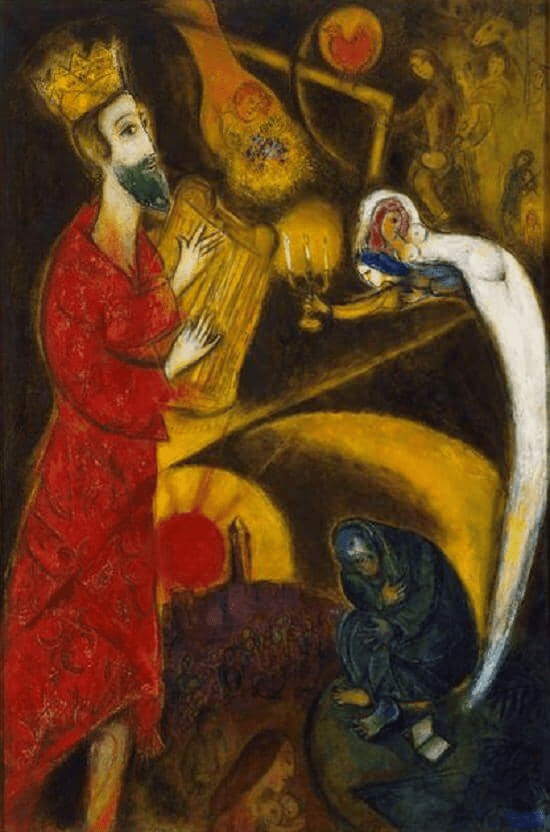
King David, by Marc Chagall, 1962

O Lord, remember in David’s favor
    all the hardships he endured;
how he swore to the Lord
    and vowed to the Mighty One of Jacob,
“I will not enter my house
    or get into my bed;
I will not give sleep to my eyes
    or slumber to my eyelids,
until I find a place for the Lord,
    a dwelling place for the Mighty One of Jacob.”

We heard of it in Ephrathah;
    we found it in the fields of Jaar.
“Let us go to his dwelling place;
    let us worship at his footstool.”

Rise up, O Lord, and go to your resting place,
    you and the ark of your might.
Let your priests be clothed with righteousness,
    and let your faithful shout for joy.
For your servant David’s sake
    do not turn away the face of your anointed one.

The Lord swore to David a sure oath
    from which he will not turn back:
“One of the sons of your body
    I will set on your throne.
If your sons keep my covenant
    and my decrees that I shall teach them,
their sons also, forevermore,
    shall sit on your throne.” (New Revised Standard Version)

King David took great pains in providing for the house of the Lord; and was very concerned about the worship of Yahweh. He went well out of his way to ensure that a temple would be built for his God.

David made as many preparations as he possibly could before his death, so that his son Solomon could follow through and build the temple. The editor of the Book of Chronicles commented on this:

David gave orders to gather together the aliens who were residing in the land of Israel, and he set stonecutters to prepare dressed stones for building the house of God. David also provided great stores of iron for nails for the doors of the gates and for clamps, as well as bronze in quantities beyond weighing, and cedar logs without number—for the Sidonians and Tyrians brought great quantities of cedar to David. 

For David said, “My son Solomon is young and inexperienced, and the house that is to be built for the Lord must be exceedingly magnificent, famous and glorified throughout all lands; I will therefore make preparation for it.” So David provided materials in great quantity before his death. (1 Chronicles 22:2-5, NRSV)

The king did all of this because God came to David and let him know that he would not be the one to build the temple; that job would fall to his son Solomon. (2 Samuel 7:4-13)

David’s final instruction to Solomon and the people had to do with the construction of a house for the Lord his God:

“Now set your mind and heart to seek the Lord your God. Go and build the sanctuary of the Lord God so that the ark of the covenant of the Lord and the holy vessels of God may be brought into the house built for the name of the Lord.” (1 Chronicles 22:19, NRSV)

The worship of God, for David, was to be the central feature of the Jewish people. All Israel and Judah were to encourage one another in worship at God’s house, the Lord’s Temple, in Jerusalem.

The priests of God wore special clothing, and handled the holy implements and the Ark of the Covenant of God. Yet, they were to be also clothed with righteousness, making sure that their outward ceremonial rituals reflected an inner moral purity and holiness before God.

David was bound and determined to not only worship the Lord himself, but to see that the entire nation of Israel had the opportunity to worship together in a central place.

Maybe a question arises for you about why David was so driven to construct a house for God. What is it that motivated King David to spend so much of his planning and energy on making sure that a temple would be constructed for the Lord?

Now when the king was settled in his house and the Lord had given him rest from all his enemies around him, the king said to the prophet Nathan, “See now, I am living in a house of cedar, but the ark of God stays in a tent.” Nathan said to the king, “Go, do all that you have in mind, for the Lord is with you.” (2 Samuel 7:1-3, NRSV)

A lot of events had transpired for David to be in the position of king, with peace all around him. The Lord had been with David, and brought him through the sort of adversities most of us will never know.

Once King David was at the pinnacle of peace and success, his thought were not about how to hold onto power, or to get more of it. He would lay his head on his pillow at night and wonder how he could give back to God for being so faithful.

And considering all that God had accomplished for him and for Israel, it seemed a travesty that he was luxuriating in a fine house, while the Ark of the Covenant – the objective presence of God among the people – was sitting in an old tent. So, David became determined to change that situation, because he could.

I wonder if when you and I are at a place in our lives where we feel safe and secure, prosperous and happy, our thoughts and dreams turn toward how we might give back to God in a worshipful way which will honor the Lord, as well as bless all the people of God.

I am curious what sort of things occupy your mind at night while your head is on your pillow, when you are feeling good about how your life is going.

Many, if not most, people will think about themselves, and what to do with what they have gained and/or accomplished. But what about you?

How will you respond to God’s grace, goodness, deliverance, and protection in your own life? What sort of ideas arise in your mind? What is in your heart to do for God and God’s people?

What are your pillow thoughts at night?

Presence itself is a great gift. The presence of God is incredibly gracious, good, and miraculous. And human presence, with each individual stamped with the image and likeness of God upon them, is also a wonderful gift from the Creator. And very much needed.

David enjoyed the presence of God, and longed for all the people to experience that divine presence. Although the Lord needed no temple to live in, David had in mind to provide one.

I imagine that King David understood that each person is a luminous icon of presence, reflecting God’s image, and needing the presence of God and others in order to have a nation who worships God as commanded in the Mosaic law.

Through communal worship at a designated site in Jerusalem, the Israelites could enjoy the beauty of God’s presence together, as well as the encouragement of one another.

Wherever there is presence and the acknowledgement of God and each other, there is freedom to offer affection, understanding, and respect.

It seems to me that these were the sort of thoughts that ran through King David’s mind, which made him determined to build a house for the Lord his God.

So, what will you do with your thoughts and your life?

Almighty God of all hope, of our thoughts and dreams: In humility, we give you thanks for all of creation; and for everything you give us. We praise you for forgiving us of our guilt and shame, even before we ask. You raise us from our broken state and make us whole. You give us the peace we yearn for.

Blessed God, fill us, your people, with your divine Spirit. Be our light in the darkness. Envelop us with your presence. Orient our hearts toward your justice; and help us always praise you. Let us ever be mindful of your power and grace in the world. Let us live as one with you in grace and in truth. Amen.