Divine Providence (Esther 1:1-20)

The Refusal of Vashti, by Gustave Doré (1832-1883)

These events happened in the days of King Xerxes, who reigned over 127 provinces stretching from India to Ethiopia. At that time Xerxes ruled his empire from his royal throne at the fortress of Susa. In the third year of his reign, he gave a banquet for all his nobles and officials. He invited all the military officers of Persia and Media as well as the princes and nobles of the provinces. The celebration lasted 180 days—a tremendous display of the opulent wealth of his empire and the pomp and splendor of his majesty.

When it was all over, the king gave a banquet for all the people, from the greatest to the least, who were in the fortress of Susa. It lasted for seven days and was held in the courtyard of the palace garden. The courtyard was beautifully decorated with white cotton curtains and blue hangings, which were fastened with white linen cords and purple ribbons to silver rings embedded in marble pillars. Gold and silver couches stood on a mosaic pavement of porphyry, marble, mother-of-pearl, and other costly stones.

Drinks were served in gold goblets of many designs, and there was an abundance of royal wine, reflecting the king’s generosity. By edict of the king, no limits were placed on the drinking, for the king had instructed all his palace officials to serve each man as much as he wanted.

At the same time, Queen Vashti gave a banquet for the women in the royal palace of King Xerxes.

On the seventh day of the feast, when King Xerxes was in high spirits because of the wine, he told the seven eunuchs who attended him—Mehuman, Biztha, Harbona, Bigtha, Abagtha, Zethar, and Carcas—to bring Queen Vashti to him with the royal crown on her head. He wanted the nobles and all the other men to gaze on her beauty, for she was a very beautiful woman. But when they conveyed the king’s order to Queen Vashti, she refused to come. This made the king furious, and he burned with anger.

He immediately consulted with his wise advisers, who knew all the Persian laws and customs, for he always asked their advice. The names of these men were Carshena, Shethar, Admatha, Tarshish, Meres, Marsena, and Memucan—seven nobles of Persia and Media. They met with the king regularly and held the highest positions in the empire.

“What must be done to Queen Vashti?” the king demanded. “What penalty does the law provide for a queen who refuses to obey the king’s orders, properly sent through his eunuchs?”

Memucan answered the king and his nobles, “Queen Vashti has wronged not only the king but also every noble and citizen throughout your empire. Women everywhere will begin to despise their husbands when they learn that Queen Vashti has refused to appear before the king. Before this day is out, the wives of all the king’s nobles throughout Persia and Media will hear what the queen did and will start treating their husbands the same way. There will be no end to their contempt and anger.

“So if it please the king, we suggest that you issue a written decree, a law of the Persians and Medes that cannot be revoked. It should order that Queen Vashti be forever banished from the presence of King Xerxes, and that the king should choose another queen more worthy than she. When this decree is published throughout the king’s vast empire, husbands everywhere, whatever their rank, will receive proper respect from their wives!”

The king and his nobles thought this made good sense, so he followed Memucan’s counsel. (New Living Translation)
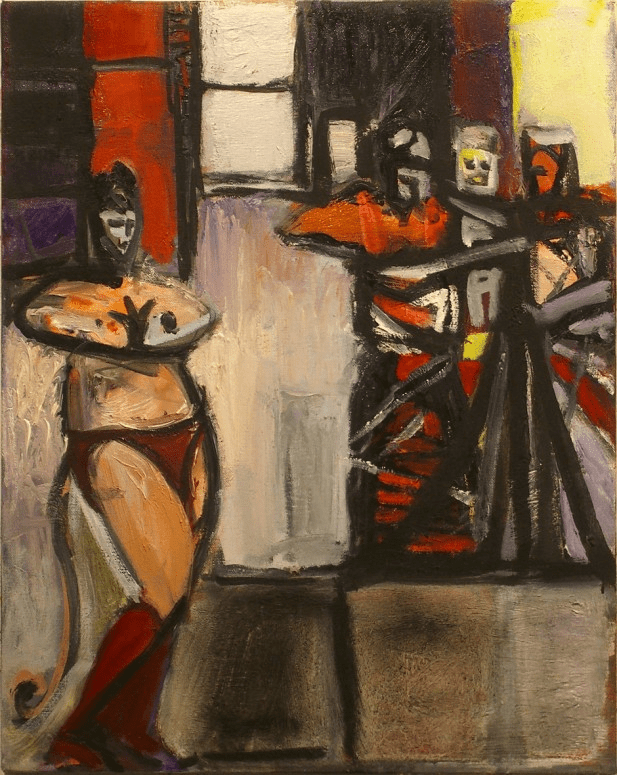
Vashti Refuses, by Richard McBee

The Jews were living in exile. The Babylonian Empire had taken Jerusalem, destroyed the temple, and exiled many of the people to Babylon. Later, the Medes and Persians conquered Babylon and ruled over a vast area of many different peoples.

The story of Esther begins with the story of King Xerxes and Queen Vashti. They were the most powerful people in the world, at that time. This meant that Vashti had more power and authority than any woman on earth, at that time.

Although most women had few rights, Vashti was not one of them. However, when it came to the king, the queen was most definitely second fiddle.

Today, we can understand Vashti’s response to Xerxes. But back then, it was unthinkable. It wasn’t only Xerxes who ruled the land; misogyny did, as well.

Queen Vashti appears in the story as a strong-willed independent woman of power. While the king and queen were each having their respective parties, things started to go sideways.

No limits on the bar meant unlimited drinking. A drunk King Xerxes had one of those moments that seemed logical to the inebriated mind, but was actually nonsensical. He insisted that his queen stop her celebration, leave her guests, get all gussied up in her royal accoutrements, and parade around for a bunch of drunk guys to gawk at.

As readers of the story, we can tell this is not going to have a good ending for Vashti. She was in an impossible situation. She could submit and face humiliation, or worse. So, the queen chose not to abide by the king’s order.

Little did Vashti know that she was paving the way for a new queen to ascend to the side of King Xerxes. The extreme action of Xerxes attempting to use his queen then turned into another action of consulting his advisors and deposing the queen. Vashti was banned from the court, and the kingdom.

Hence, events were set in motion to find a new queen. As the story unfolds, Esther is a young Jewish woman living in this forced diaspora of the Persian Empire. Little did she know that Vashti’s fall was the beginning of her own rise.

“So the last will be first, and the first will be last.”

Jesus (Matthew 20:16)

Although the story of Esther never mentions the word “God,” we see an incredible Providence guiding events through the biblical book of Esther. Young Esther found favor with the king, became queen, and risked her life to save the Jewish people from destruction.

Esther’s story is the Jewish story – a tale of others pronouncing pogroms upon them and attempting to rid themselves of these others who live strangely and differently. But a champion arises; one who bring deliverance.

The Jewish story is one of resilience as a people throughout the millennia. Rather than ignoring, or worse, persecuting Jews, we can observe how they have had to deal with the enduring issues of perseverance through suffering; preserving their identity; and ensuring their survival in the middle of social and cultural pressures.

We also see that just because one is in the courts of power and is not one of the peoples who is persecuted, does not necessarily mean that there is an exemption from harm. Vashti was a powerful woman, but her power didn’t last.

In the end, Vashti was treated more like an oppressed Jew than a privileged Gentile; and Esther would move from powerless to powerful.

And from a Christian perspective, we can see Jesus as the Savior who puts himself at risk to save the world from sin, death, and hell.

And let us run with perseverance the race marked out for us, fixing our eyes on Jesus, the pioneer and perfecter of faith. (Hebrews 12:1b-2a, NIV)

We can, as well, observe that God is not fazed by any big earthly political power. The Lord sees all, knows all, and has the authority to do something about injustice and accomplishing just purposes on this earth.

O God, your never-failing providence sets in order all things both in heaven and earth: Put away from us, we entreat you, all hurtful things, and give us those things which are profitable for us; through Jesus Christ our Lord, who lives and reigns with you and the Holy Spirit, one God, for ever and ever. Amen.

Reverence, Humility, and Contentment (Ecclesiastes 5:1-20)

Guard your steps when you go to the house of God; to draw near to listen is better than the sacrifice offered by fools, for they do not know how to keep from doing evil. Never be rash with your mouth nor let your heart be quick to utter a word before God, for God is in heaven and you upon earth; therefore let your words be few.

For dreams come with many cares, and a fool’s voice with many words.

When you make a vow to God, do not delay fulfilling it, for he has no pleasure in fools. Fulfill what you vow.It is better that you should not vow than that you should vow and not fulfill it. Do not let your mouth lead you into sin, and do not say before the messenger that it was a mistake; why should God be angry at your words and destroy the work of your hands?

With many dreams come vanities and a multitude of words, but fear God.

If you see in a province the oppression of the poor and the violation of justice and right, do not be amazed at the matter, for the high official is watched by a higher, and there are yet higher ones over them. But all things considered, this is an advantage for a land: a king for a plowed field.

The lover of money will not be satisfied with money, nor the lover of wealth with gain. This also is vanity.

When goods increase, those who eat them increase, and what gain has their owner but to see them with his eyes?

Sweet is the sleep of laborers, whether they eat little or much, but the abundance of the rich will not let them sleep.

There is a grievous ill that I have seen under the sun: riches were kept by their owners to their hurt, and those riches were lost in a bad venture; though they are parents of children, they have nothing in their hands. As they came from their mother’s womb, so they shall go again, naked as they came; they shall take nothing for their toil that they may carry away with their hands. This also is a grievous ill: just as they came, so shall they go, and what gain do they have from toiling for the wind? Besides, all their days they eat in darkness, in much anger and sickness and resentment.

This is what I have seen to be good: it is fitting to eat and drink and find enjoyment in all the toil with which one toils under the sun the few days of the life God gives us, for this is our lot. Likewise, all to whom God gives wealth and possessions and whom he enables to enjoy them and to accept their lot and find enjoyment in their toil—this is the gift of God. For they will scarcely brood over the days of their lives because God keeps them occupied with the joy of their hearts. (New Revised Standard Version)

Life can be paradoxically both meaningful and meaningless. Yet, if we can live consistent with who we are and how we were created to be, then it is likely we shall find a semblance of meaning, purpose, and even joy in this present life.

Reverence

Too much talk leads to sin. Be sensible and keep your mouth shut. (Proverbs 10:19, NLT)

We are to be cautious in our speech, especially in addressing God. We must choose our words carefully and deliberately, in prayer, as well as with others.

God is God, and we are not. Therefore, since God is far above us, the high and holy One, it is wise to minimize our talking. There’s no need for lengthy and showy prayers. It is the mark of a fool that talks too much, just as much as it is the mark of a fool to let daydreams occupy too much of their thoughts.

Even fools who keep silent are considered wise; when they close their lips, they are deemed intelligent. (Proverbs 17:28, NRSV)

To be reverent and respectful before God involves not only the volume of words, but also the sanctity of words.

Whenever a person makes a vow or a promise to God, they need to be diligent about fulfilling that vow. The Lord takes our words seriously, and is not pleased with flippant promises that we have little intention of keeping.

On the flipside, good intentions are just that – they do not constitute a promise to do anything. We make vows so that we will be accountable to ourselves and others, and then follow through with the promise, no matter what.

Reneging on any promise, whether the vow is to another or God, is a foolish act with real consequences. Therefore, we should consider our promises well before making them, and avoid being rash.

Humility

All of us have both observed and experienced oppression and injustice of another or a group of people. In our anger, we may want to play both judge and jury. Humility teaches us that this is not our role, and to accept that a right and just God will deal with injustice.

The Lord sneers at those
    who sneer at him,
but he is kind to everyone
    who is humble. (Proverbs 3:34, CEV)

The injustice of this world does not necessarily need to create a deep theological conflict within us. We rarely, if ever, have the big picture on the circumstances and complexities of what is going on. But God does.

The Lord is watching. God neither slumbers nor sleeps. There is never a Divine nap time. So, God knows all, and will handle arrogant people according to their deeds and motives.

People who are proud will soon be disgraced. It is wiser to be modest. (Proverbs 11:2, GNT)

Contentment

It is the proud and arrogant person who never seems content. They continually want more – likely because they have the wrongheaded notion that they deserve more, even if it comes by taking resources from others.

Yet, the reality is that both kings and commoners rely upon the produce which comes from the soil. And regardless of whether a person has lots of money, or not, wealth isn’t the thing which makes for a truly happy life.

So, it is pointless and foolish to hoard food, money, stuff, resources, and even intangible things such as love and encouragement. Having a liberal outlook of sharing and giving creates joy. Misers, however, are typically curmudgeons who rarely smile and enjoy what they have.

The more stuff and wealth a person has, the less it is of benefit to humanity, whenever it is stockpiled and/or selfishly used and spent. Besides, when somebody has a lot, they have a lot to worry about. But workers living a simple life sleep just fine.

It is foolish to work so hard for something, only to end up with nothing you can take with you into eternity; or to have it taken by someone with an evil scheme to get it. On top of it, leaving this life with no humility and charity means that such a person really does leave with absolutely nothing to show for their life.

There’s no need to waste your life by filling it with nothing but aggravation and worry. Life has purpose and joy when there are liberal amounts of gratitude, encouragement, and friendship.

Let’s live today according to what is most important in life. Instead of chasing wealth, power, and control, we have the opportunity – no matter who we or our station in life – to live honestly and reverently, humbly and gently, with satisfaction and contentment.

What will you choose this day?

Almighty God of mercy, thank You for extending grace to me as I humble myself before You. Help me to be careful with my words, and to approach You with reverence and respect. Enable me to listen more and speak less, and to fulfill my vows to You. Guide me in being content with what You have given me and not to be consumed by the pursuit of wealth. I pray for wisdom and discernment in all my dealings and decision-making. Amen.

Two Are Better Than One (Ecclesiastes 4:9-16)

Together, by Tamara McCarty

Two are better than one,
    because they have a good return for their labor:
If either of them falls down,
    one can help the other up.
But pity anyone who falls
    and has no one to help them up.
Also, if two lie down together, they will keep warm.
    But how can one keep warm alone?
Though one may be overpowered,
    two can defend themselves.
A cord of three strands is not quickly broken.

Better a poor but wise youth than an old but foolish king who no longer knows how to heed a warning. The youth may have come from prison to the kingship, or he may have been born in poverty within his kingdom. I saw that all who lived and walked under the sun followed the youth, the king’s successor. There was no end to all the people who were before them. But those who came later were not pleased with the successor. This too is meaningless, a chasing after the wind. (New International Version)

Our very brains and bodies were created and hard-wired for relational connection and support. To have a friend is more than a nice thing; it is vital for our survival and wellness.

If disconnected and absent from friends for too long, we become like Tom Hanks in the movie “Castaway.” We end up talking to volleyballs and personifying them as our best friend.

The neurophysiological mechanisms of the human body are designed for human social interaction. For example, the parasympathetic system of the vagus nerve connects the brain’s emotional and cognitive areas to intestinal functions. This is why whenever we are lonely or have relational problems, we may feel sick to our stomach, or have trouble eating anything, or overeat to deal with the emotions.

First and foremost, friends are people who offer each other complete permission to be themselves; they are permission givers. When we are socially and relationally well, our body’s endocrine system can relax and do it’s necessary job of regulation. That’s because we are able to relax completely in the presence of another person who we know will accept us as we are.

Real friendship always requires a deep surrender to the mixing of souls that a friendship brings into being. To have such a friend is a blessing and a rare gift.

Because of friendship’s special and sacred nature, it is necessary to unite with someone who shares your basic values. This means that we need not turn someone away because they don’t match our perfect picture of what a beloved friend is, nor must we settle for a lesser relationship than we deserve.

In order to live and survive, we humans have three necessary requirements in life: food, shelter, and someone else to love and be loved by. If we have these, then there is nothing else we really need; everything else is just filler. Yet, there’s no need for filler whenever you are already full of friendship.

There is yet another friendship which is important for humans to thrive. We are creatures, created by a relational God. Even though humanity may be estranged from divinity – whether we realize it, or not – we are all on a journey back home to a relationship with God.

We need companions through this journey of our earthly life. And the Teacher of Ecclesiastes tells us that in these friendships we find some security against thieves, accidents, and the chill of the night. Indeed, a friend and companion makes life more safe, satisfying, and comfortable.

Which is why, again, our choice of friends and companions along life’s way are important. It is of vital significance whether those closest to us are wise or foolish.

A wise companion helps us stay on task, and encourages us to persevere in doing right. Such a friend assists us in living a good life full of justice and attention to the common good of all persons.

But a foolish companion drags us down into laziness and gossip; they only help us toward selfish interests that help no one. Might as well eat and drink all you want today, for tomorrow we die, they say.

That sort of counsel will not be found on any successful life plan.

We need solid friends who give us sound advice and counsel. And we also need a friend who is willing to accept our own sage insights.

Those who refuse to take advice, and those who listen to foolish counsel, are headed for disaster.

A fickle crowd who is easily swayed, and equally difficult to please, is a group of people who may know each other, but nobody is a friend. That’s because it takes true companions to get things done and work effectively together toward worthy goals.

Businesses everywhere could use some time reflecting on such relational realities as that.

By Bible Art

And a crowd who chases after the latest fad which comes along is a group of people who have not yet understood how much they need the acknowledgement and leading of their Creator.

Apart from the pursuit of both divine and human friendship, people feel as if they need those fillers in their life. So, they end up having absurd strivings to accumulate wealth, money, stuff, prestige, position, and power. They buy into the notion that they can be radically independent, and use others to get what they want.

Good relationships, however, which seek the betterment of the other and give themselves to something higher and greater than themselves, will find all the riches in life they need.

Neither poverty nor riches has anything to do with life’s ultimate satisfaction and fulfillment. Whether one realizes the “American dream” or not, makes no difference whatsoever.

Accomplishing personal goals means very little, if you have no one to share it with, and no one who says “thank you” for what you’ve done (because you didn’t do anything for them, but for yourself).

In the end, all is meaningless, because everything is temporary… that is, except relationships.

Friendships and true companions are permanent. Relationships are the only thing we take with us. The wise person knows that the world truly spins on the axis of Love.

Loving Creator, God and Father of all, You are the provider of all good things. I pray You to  bring good friendships into the life of all your people. Open my eyes to see people who need me to be a friend for them. Help me to be the friend I desire and long to have; and to serve my fellow humanity. Give us all a friend who will exhort us when needed, be gracious in our weakness, forgive our offenses, and bear our burdens. Amen.

Work, Love, and Dignity (Proverbs 27:1-27)

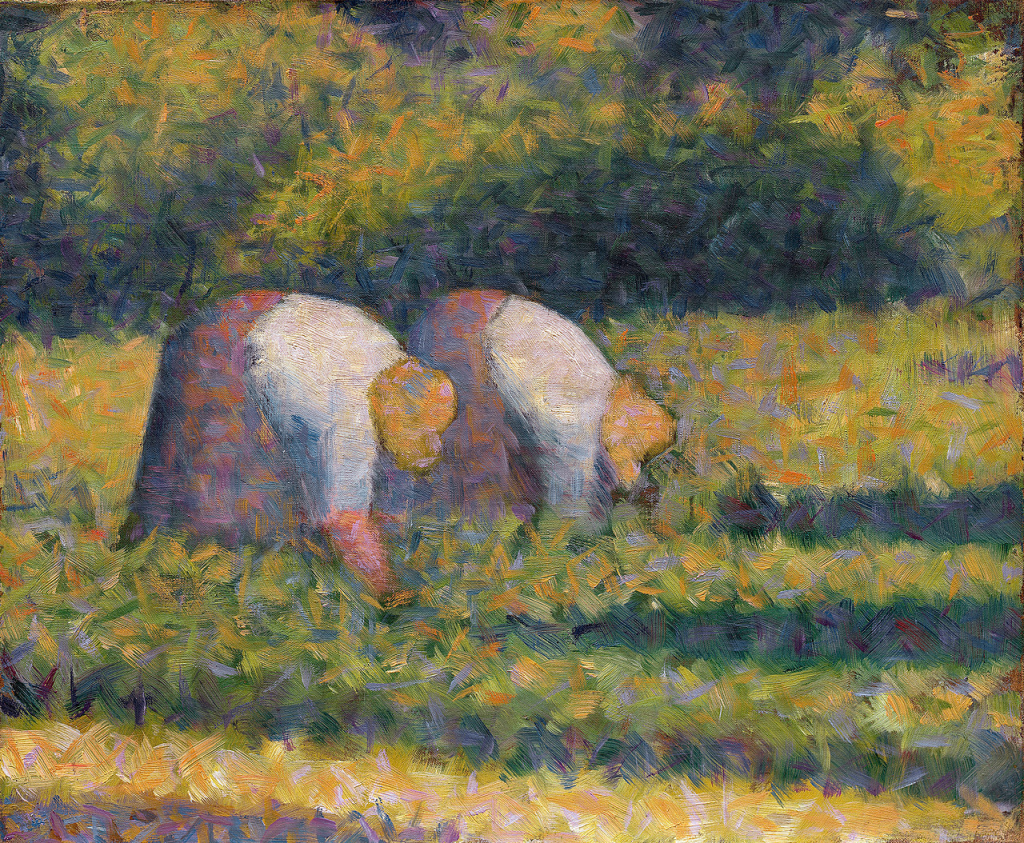
Farm Women at Work, by Georges Seurat (1859-1891)

Do not boast about tomorrow,
    for you do not know what a day may bring.

Let someone else praise you, and not your own mouth;
    an outsider, and not your own lips.

Stone is heavy and sand a burden,
    but a fool’s provocation is heavier than both.

Anger is cruel and fury overwhelming,
    but who can stand before jealousy?

Better is open rebuke
    than hidden love.

Wounds from a friend can be trusted,
    but an enemy multiplies kisses.

One who is full loathes honey from the comb,
    but to the hungry even what is bitter tastes sweet.

Like a bird that flees its nest
    is anyone who flees from home.

Perfume and incense bring joy to the heart,
    and the pleasantness of a friend
    springs from their heartfelt advice.

Do not forsake your friend or a friend of your family,
    and do not go to your relative’s house when disaster strikes you—
    better a neighbor nearby than a relative far away.

Be wise, my son, and bring joy to my heart;
    then I can answer anyone who treats me with contempt.

The prudent see danger and take refuge,
    but the simple keep going and pay the penalty.

Take the garment of one who puts up security for a stranger;
    hold it in pledge if it is done for an outsider.

If anyone loudly blesses their neighbor early in the morning,
    it will be taken as a curse.

A quarrelsome wife is like the dripping
    of a leaky roof in a rainstorm;
restraining her is like restraining the wind
    or grasping oil with the hand.

As iron sharpens iron,
    so one person sharpens another.

The one who guards a fig tree will eat its fruit,
    and whoever protects their master will be honored.

As water reflects the face,
    so one’s life reflects the heart.

Death and Destruction are never satisfied,
    and neither are human eyes.

The crucible for silver and the furnace for gold,
    but people are tested by their praise.

Though you grind a fool in a mortar,
    grinding them like grain with a pestle,
    you will not remove their folly from them.

Be sure you know the condition of your flocks,
    give careful attention to your herds;
for riches do not endure forever,
    and a crown is not secure for all generations.
When the hay is removed and new growth appears
    and the grass from the hills is gathered in,
the lambs will provide you with clothing,
    and the goats with the price of a field.
You will have plenty of goats’ milk to feed your family
    and to nourish your female servants. (New International Version)

Hard Work

The Lord God took the man and put him in the Garden of Eden to work it and take care of it. (Genesis 2:15, NIV)

Work itself is not a result of humanity’s fall. Before Adam and Eve disobeyed God, they were tasked to work and take care of the Garden of Eden. Therefore, work is inherently good. Yet, hard labor is certainly a result of the fall.

What we humans ought to have done through our created nature, now because of the fall into sin and disobedience, we have to work with focused deliberate intention. And even then, we often don’t perform our work as we would like.

“Cursed is the ground because of you;
    through painful toil you will eat food from it
    all the days of your life.
It will produce thorns and thistles for you,
    and you will eat the plants of the field.
By the sweat of your brow
    you will eat your food
until you return to the ground,
    since from it you were taken;
for dust you are
    and to dust you will return.” (Genesis 3:17-19, NIV)

This is why wise persons throughout the ages have given priority to hard work, and branded laziness as detrimental to our human welfare.

Much of our labor is menial and mundane, no matter what the work is. Yet, through vision and persistence, the fruit of our labor eventually breaks through. It is important for us to keep our nose to the grindstone, namely, because this is what it takes to produce, and to keep ourselves out of trouble!

Like a shepherd who cares for the sheep, we are to be present, pay attention, do whatever it takes to help the sheep flourish, and hang in there through the thick and thin of the job.

Diligence and consistency are vital to our hard work. The temptation of get-rich-quick schemes and other supposedly easy paths to success and wealth sometimes rear their heads to lure us away from our daily chores.

Well-kept sheep will produce wool and milk for several years. Riches and achievements and accolades, however, do not necessarily last for long.

Affectionate Love

Hard work and relationships nurtured by affectionate love are meant to go hand-in-hand. In other words, ideally, the duty and diligence of our daily tasks, and the consistency of establishing relational well-being with others, is well-balanced and works seamlessly together.

Loving another entails both encouragement and correction, heartfelt words as well as open words of rebuke. That is, we continually think of what another needs, and what is best for the community as a whole.

Our love must entail what is good for the one being loved, for the one doing the loving, and for the whole community to which both belong. Love leaves angry speeches and jealous motives behind and doesn’t utilize them, because they are tools of hate and hurt.

Gracious Dignity

Everyone is responsible to extend basic human kindness to one another, without exception. We are to listen to and honor our parents and elders; practice self-control and patience with all; and use gentle words in every communication.

Poise under pressure, and motivation to do what is right and good helps to lift the worth and dignity of others. We extend this to people for no other reason than that it is another human being who is in front of us; this is a person in God’s image.

God created mankind in his own image,
    in the image of God he created them;
    male and female he created them. (Genesis 1:27, NIV)

All persons have inherent worth as image-bearers of God. The wise person amongst us knows this and continually applies it in all their words and actions toward others.

Wise people also understand the value of hard work, and the intrinsic worth of work itself. Furthermore, they discern that love is to be the motivation and animating principle in doing work and working with others.

The bottom line of all the proverbial wise saying in today’s lesson is that we are to help and encourage others through both our words and our working actions. Our individual lives are to benefit the whole community, so that we are a blessing to others, as well as to receive blessings from those around us.

In engaging a healthy rhythm of giving and receiving, we reverse the curse, and enable the world to return to Eden.

Almighty God, we pray that You will bless all of our various labor and work in the world. Help us to pray fervently, diligently work hard, and give liberally. In all that we do, enable us to do it with all the love You provide. Amen.