

Psalm 4 – Rhythms of Trust

God, you are my righteousness, my Champion Defender.
    Answer me when I cry for help!
    Whenever I was in distress, you enlarged me.
    I’m being squeezed again—I need your kindness right away!
    Grant me your grace, hear my prayer, and set me free!
Listen to me, you elite among men:
    How long will you defame my honor
    and drag it down into shame?
    Will you ever stop insulting me?
    How long will you set your heart on shadows,
    chasing your lies and delusions?
May we never forget that Yahweh works wonders
    for every one of his devoted lovers.
    And this is how I know that he will answer my every prayer.
Tremble in awe before the Lord, and do not sin against him.
    Be still upon your bed and search your heart before him.
Bring to Yahweh the sacrifice of righteousness and put your trust in him.
Lord, prove them wrong when they say, “God can’t help you!”
    Let the light of your radiant face
    break through and shine upon us!

The intense pleasure you give me
    surpasses the gladness of harvest time,
    even more than when the harvesters
    gaze upon their ripened grain
    and when their new wine overflows.
Now, because of you, Lord, I will lie down in peace and sleep comes at once,
    for no matter what happens, I will live unafraid! (TPT)

This is a psalm of David. It is a heartfelt and confident plea for deliverance.

David had a track record with God. For most of his life, David had a spiritual and relational rhythm of looking to God, trusting God, and resting secure in God.

Small Faith

I’m not sure where the idea popped up amongst some Christians that faith and trust in God means everything in life is going to be hunky-dory and a bowl of cherries. That was not true of any godly character in the Bible. In fact, it seems the more integrity one has in Scripture, the more they faced trouble and suffering.

It is the pea-brained, small-hearted, and gutless who have the time and privilege of leveling criticism and defamation on the ones sincerely trying to make a difference in this world. On the one hand, it is unfortunate that the spiritually devoted must put up with the petulance of puny people. Yet, on the other hand, the faithful recognize God controls all things and uses anything and anyone to shape them as persons who have grown expansive spiritual faculties, enlarged hearts, and gut-feeling compassion. The wise truly learn from all things.

“Trust the Lord completely, and don’t depend on your own knowledge. With every step you take, think about what he wants, and he will help you go the right way.”

Proverbs 3:5-6, ERV

Big Faith

The godly have become so because they have learned over-and-over again to let God champion their cause and defend their personhood. The faithful reflexively cry out to the Lord with all their troubles. The devoted aren’t shy in boldly telling God exactly what they want and need. They find joy in their spirituality, and they let it support them in stressful times.

God has shown them steadfast love. And they are supremely secure in the settled conviction that God has their backs. They believe it so much that followers of God can lay their heads on their pillows at night and fall asleep – despite the reality there are those who would take their life, if given half the chance.

No Sleep

Insomnia happens for a lot of reasons. Many, like me, have sleep apnea and restless leg disorder, both diagnosed medical conditions. Others can’t get a good night’s rest because of poor sleep hygiene by not planning for adequate sleep, drinking too much caffeine during the day, inattention to a healthy diet, or a host of other habits. Some, like my dear wife, have issues of chronic pain which can make it difficult to sleep well.

And then there are yet others who suffer from racing thoughts, anxiety, and depression. The stress of their waking life is so significant that several hours of deep sleep seems only like some pipe dream. It’s impossible to sleep when the weight of the day is pressing on you. Finding a sense of calm before bed isn’t easy—especially when you can’t unplug from the demands of your day.

I am wondering if many of us will even allow ourselves to unplug and establish some quiet wind-down time. Reading a real book – not one on a backlit tablet device – or talking with a friend or family member are simple ways of easing our anxiety and letting rest come.

Sleep ZZzz

The psalmist, David, had a regular practice of meditating on Scripture, recalling the events of God, and expressing gratitude and praise for answered prayer. Each of us has a built-in spiritual rhythm just like we have a circadian rhythm. Always trying to buck those God-given rhythms will inevitably result in being “off,” at the least, and experiencing debilitating depression, at worst.

Yet, when we learn to move with the unforced rhythms of grace, there is a groove we slip into which serves us well. In other words, allowing ourselves to be human brings health.

David had neither delusions nor illusions about his enemies, friends, others, and himself. He didn’t try to be somebody he was not. Instead, David had firm and confident convictions about God and the place of prayer. A steady diet of David’s psalms teaches us to hold together both faith and doubt, confidence and confusion, perseverance and perplexity in ways which strengthens belief.

Christ be with you: Christ within you;
Christ before you: Christ behind you;
Christ on your right: Christ on your left;
Christ above you: Christ beneath you;
Christ around you: now and ever. Amen.

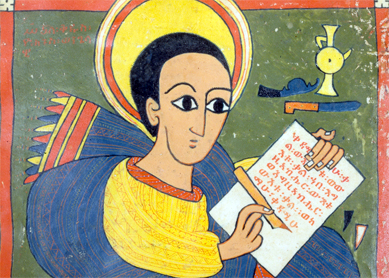
1 John 2:18-25 – Who Is Really the Enemy?

Ethiopian Orthodox Church depiction of St. John the Apostle and Evangelist, c.1540 C.E.

My dear children, the end is near! You have heard that the enemy of Christ is coming. And now many enemies of Christ are already here. So, we know that the end is near. These enemies were in our group, but they left us. They did not really belong with us. If they were really part of our group, they would have stayed with us. But they left. This shows that none of them really belonged with us.

You have the gift that the Holy One gave you. So, you all know the truth. Do you think I am writing this letter because you don’t know the truth? No, I am writing because you do know the truth. And you know that no lie comes from the truth.

So, who is the liar? It is the one who says Jesus is not the Messiah. Whoever says that is the enemy of Christ—the one who does not believe in the Father or in his Son. Whoever does not believe in the Son does not have the Father, but whoever accepts the Son has the Father too.

Be sure that you continue to follow the teaching you heard from the beginning. If you do that, you will always be in the Son and in the Father. And this is what the Son promised us—eternal life. (ERV)

Throughout Christian history there have been churches, ministers, and individuals who have advanced certain persons as being the “antichrist,” enemies of Christ and his followers.

Attempting to identify a particular enemy comes from a theological disposition that believes an antichrist is the first link in a chain of end-times events. Typically, a ruthless or dictatorial ruler, like Mussolini, Hitler, or Stalin received the label of “antichrist.”  For some Protestants, the papacy continually gets set apart as being the antichrist. Even recently, Pope Francis received the dubious title from a group of end-times watchers because they claimed he allowed people to treat him as if he were Jesus, accepting worship and praise.

Yet, the term “antichrist” has not typically been used as a title for one enemy setting-off a bomb of world-ending trauma. The earliest church, following the teaching of the Apostle John, understood antichrist not as an individual, but as a class of people who deny Jesus is the Christ. Indeed, John plainly said the antichrist is anyone who forsakes the Father and the Son. What is so disturbing about John’s talk of antichrist is that these persons arise from within the church, not outside of it.

It has become much too vogue in some circles of Christian evangelicalism to identify and label enemies outside their small groups, leading to a xenophobic attitude of distrust and finger-pointing toward all kinds of people. 

The fingers, however, must first be directed within our own house. It behooves us all to take up the instruction of John to let what we have heard from the beginning abide in us. If what you heard from the beginning abides in you, then you too will abide in the Son and in the Father. 

We are to embrace basic core cardinal truth given us. Then we will not be deceived by some supposed enlightened teacher who detracts from Trinitarian theology.

It is the last hour – but not because of some politician, tyrant, or even religious figure. It is the end-times because Jesus has accomplished redemption for us, and the only event left is the return of Jesus to judge the living and the dead. 

Therefore, we must all live with the possibility and tension that it could be today. We are to be prepared. That preparation comes through proclaiming Jesus in all we say and do – not by obnoxiously ginning up fearmongering through pointing fingers at those we don’t like. Rather, we emulate our Lord in the way of loving God and neighbor.

When a person or group gets labeled by us as “enemy” or “antichrist” then our hate for them seems divinely justified and sanctioned. God, however, is the judge; not us. We are to follow the ethical instruction of Jesus to love our enemies, not curse them through slapping a moniker of “monster,” “devil,” “animal,” or some other non-human label on them.

Weaponizing words in a verbal war which supposedly defends Christianity only shifts the focus off Jesus and onto how horrible another is. One of the great problems of our world, including many corners of Christianity, is that we assume we already know what another believes. So, we fail to listen. We cannot care as we ought because we’ve already formed our judgment.

“The moment someone attaches you to a philosophy or a movement, then they assign all the baggage and all the rest of the philosophy that goes with it to you. And when you want to have a conversation, they will assert that they already know everything important there is to know about you because of that association. And that’s not the way to have a conversation.”

Neil deGrasse Tyson

Within Christianity, there is much more we have in common with one another across the various traditions than that which is different. Yes, spiritual charlatans exist. Let’s just make sure we have done our due diligence in listening to another and being curious before we form our opinions.

Despite our differences, the exchange of ideas and debate among various Christian groups in the early centuries of the church helped to clarify and form a sound Christology. While it may be difficult to avoid labeling individuals in an increasingly complex society, we must act in good faith.

Mighty God, you sent the Son to this earth to fulfill all your good promises. Let me embrace Jesus so fully and completely that the truth of his reality comes pouring out of me in every area of my life.  In his name I pray. Amen.

Mark 12:18-27 – Go Ahead, Ask Jesus Anything

Photo by Pixabay on Pexels.com

Then the Sadducees, who say there is no resurrection, came to him with a question. “Teacher,” they said, “Moses wrote for us that if a man’s brother dies and leaves a wife but no children, the man must marry the widow and raise up offspring for his brother. Now there were seven brothers. The first one married and died without leaving any children. The second one married the widow, but he also died, leaving no child. It was the same with the third. In fact, none of the seven left any children. Last of all, the woman died too. At the resurrection, whose wife will she be, since the seven were married to her?”

Jesus replied, “Are you not in error because you do not know the Scriptures or the power of God? When the dead rise, they will neither marry nor be given in marriage; they will be like the angels in heaven. Now about the dead rising—have you not read in the Book of Moses, in the account of the burning bush, how God said to him, ‘I am the God of Abraham, the God of Isaac, and the God of Jacob’? He is not the God of the dead, but of the living. You are sorely mistaken!” (NIV)

Okay, let’s dive in with some observational lessons from today’s Gospel reading:

  • Don’t be a dip-wad and try to trip-up Jesus with philosophically ethereal questions.
  • If you want to be rebuked by Jesus for being ignorant, mistaken, and wrong, just try and control how a conversation with him ought to go.
  • Abraham, Isaac, Jacob, and Jesus are all alive – Sadducees, not so much.
  • Jesus will take the time and attention to listen and give feedback – maybe the kind you weren’t looking for.
  • What we get hung up on, Jesus doesn’t – and what Jesus sticks on, we act like Teflon about.

Do you want to keep going….?

To deny resurrection is to deny Jesus. Christ died. He’s now alive. Hence, there is a resurrection. More than that, because Christ lives, others live. This is the Christian’s hope. 

I fully understand plenty of people don’t believe in resurrection. That’s fine. I would simply point such a person no further than their own mind and heart. “Search your feelings,” as the Jedi would say, “What do they tell you?”  The evidence you need, you already have.

And this was the penultimate lesson of Jesus to the inquisitive Sadducees. They already had the answer to their question for Jesus. It was right under their noses the entire time. They just didn’t see it.

You already have everything you need for life and godliness in this present evil age.

One of the great sages of the last century, Dorothy from The Wizard of Oz, wisely said:

“If I ever go looking for my heart’s desire again, I won’t look any further than my own backyard.  Because if it isn’t there, I never really lost it to begin with.”

Resurrection has always been there because God has always been around – even when we don’t see, perceive, or acknowledge the divine.

It probably wouldn’t be a good idea to procrastinate the inevitable end of life scenario that awaits us all. Anytime is the right time to do a bit of personal funeral planning. Yet, if we mire it all with the esoteric hypothetical questions about what would happen in the most far-fetched of scenarios, methinks God is big and smart enough to see through our puny charade.

Better to ponder what is truly within your own soul, and how Jesus might already be present within and around all things, without us even knowing it. 

A good place to start in peering within is to give a straightforward honest reading of the New Testament Gospels and discover what resonates deeply with you about the person and work of Jesus.

Feel free to question him about anything you want; just brace yourself for what kind of answer you might receive.

Daniel 6:1-28 – A Time and a Place for Prayer

Daniel in the Lions Den by John August Swanson

Darius decided to appoint one hundred twenty chief administrators throughout the kingdom, and to set over them three main officers to whom they would report so that the king wouldn’t have to be bothered with too much. One of these main officers was Daniel. Because of his extraordinary spirit, Daniel soon surpassed the other officers and the chief administrators—so much so that the king had plans to set him over the entire kingdom. As a result, the other officers and the chief administrators tried to find some problem with Daniel’s work for the kingdom. But they couldn’t find any problem or corruption at all because Daniel was trustworthy. He wasn’t guilty of any negligence or corruption.

So, these men said, “We won’t find any fault in Daniel, unless we can find something to use against him from his religious practice.”

So, these officers and chief administrators ganged together and went to the king. They said to him, “Long live King Darius! All the officers of the kingdom, the ministers, the chief administrators, the royal associates, and the governors advise the king to issue an edict and enforce a law, that for thirty days anyone who says prayers to any god or human being except you, Your Majesty, will be thrown into a pit of lions. Now, Your Majesty, issue the law and sign the document so that it cannot be changed, as per the law of Media and Persia, which cannot be annulled.” Because of this, King Darius signed the document containing the law.

When Daniel learned that the document had been signed, he went to his house. Now his upper room had open windows that faced Jerusalem. Daniel knelt, prayed, and praised his God three times that day, just like he always did. Just then these men, all ganged together, came upon Daniel praying and seeking mercy from his God. They then went and talked to the king about the law: “Your Majesty! Didn’t you sign a law, that for thirty days any person who prays to any god or human being besides you, Your Majesty, would be thrown into a pit of lions?”

The king replied, “The decision is absolutely firm in accordance with the law of Media and Persia, which cannot be annulled.”

So they said to the king, “One of the Judean exiles, Daniel, has ignored you, Your Majesty, as well as the law you signed. He says his prayers three times a day!”

When the king heard this report, he was very unhappy. He decided to rescue Daniel and did everything he could do to save Daniel before the sun went down. But these men, all ganged together, came and said to the king, “You must realize, Your Majesty, that the law of Media and Persia, including every law and edict the king has issued, cannot be changed.”

So, the king gave the order, and they brought Daniel and hurled him into the pit of lions.

The king said to Daniel: “Your God—the one you serve so consistently—will rescue you.”

A single stone was brought and placed over the entrance to the pit. The king sealed it with his own ring and with those of his princes so that Daniel’s situation couldn’t be changed. The king then went home to his palace and fasted through the night. No pleasures were brought to him, and he couldn’t sleep. At dawn, at the first sign of light, the king rose and rushed to the lions’ pit.

As he approached it, he called out to Daniel, worried: “Daniel, servant of the living God! Was your God—the one you serve so consistently—able to rescue you from the lions?”

Then Daniel answered the king: “Long live the king! My God sent his messenger, who shut the lions’ mouths. They haven’t touched me because I was judged innocent before my God. I haven’t done anything wrong to you either, Your Majesty.”

The king was thrilled. He commanded that Daniel be brought up out of the pit, and Daniel was lifted out. Not a scratch was found on him, because he trusted in his God. The king then ordered that the men who had accused Daniel be brought and thrown into the lions’ pit—including their wives and children. They hadn’t even reached the bottom of the pit before the lions overpowered them, crushing all their bones.

Then King Darius wrote the following decree:

To all the peoples, nations, and languages inhabiting the entire earth: I wish you much peace.I now issue this command: In every region of my kingdom, all people must fear and revere Daniel’s God because:

He is the living God.
    God stands firm forever.
His kingship is indestructible.
    God’s rule will last until the end of time.
He is rescuer and savior;
    God performs signs and miracles in heaven and on earth.
Here’s the proof:
    He rescued Daniel from the lions’ power.

And so, Daniel was made prosperous during the rule of Darius and during the rule of Cyrus the Persian. (CEB)

“If your day is hemmed in with prayer, it is less likely to come unraveled.”

Cynthia Lewis

When Daniel learned about King Darius’ decree, he went home to his upstairs room where the windows opened toward Jerusalem. Three times a day he got down on his knees and prayed, giving thanks to his God, just as he had always done. (Daniel 6:10).

It was Daniel’s regular habit of prayer which gave him the strength to ignore the king’s edict. Daniel was kept safe, not by being saved from the lions’ den, but in the lions’ den. Daniel is our best model in the Bible of one who consistently prayed, no matter the situation. Two characteristics of Daniel’s prayer stands out: a planned approach to prayer; and perseverance in prayer.

We need a plan for prayer.

Daniel had an intentional plan for prayer. He also prayed spontaneously throughout his life – all the time. That, however, was not his bread-and-butter daily life of prayer. Daniel had set times in which he prayed three times a day. 

I am not insisting we all ought to pray at the set times of 6am, 12pm, and 6pm, as Daniel did every day (although that is good biblical plan to emulate!). Yet, I will insist there needs to be some planning behind carving out time for prayer every day. We need to approach prayer with the same deliberate discipline we approach anything else – like housework, writing a paper, sports practice, or getting work accomplished on the job.

Prayer is the way we escape the gravitational pull of our fleshly lives and enter God’s orbit. It takes much planning, energy, commitment, and focus. And it is all worth it.

We need a set time and a set place to pray. Just as we set aside a special room in our house for sleeping (bedroom) and a particular place to sleep (bed) so we need a sacred space just for prayer. We understand the value of a good night’s sleep. So, we plan to go to bed at night and arise in the morning. In the same way, we must arrange a time and place for prayer. The value we place on prayer is demonstrated by our planning for it.

We need perseverance in prayer.

Daniel was a teenager when the Babylonians came to Jerusalem, tore down the wall, and took the best young people of the city into captivity. When the lions’ den event unfolded, Daniel was an old man of about 80 years old. For over sixty years, Daniel prayed three times a day, every day, without fail. His prayers were consistent and sustained. He never gave up. 

The reason Daniel always opened his window and prayed toward Jerusalem is that he was praying consistent with God’s promise. The exiles would someday return to Jerusalem. So, Daniel looked out his window every day, three times a day, praying repeatedly for God’s help and peace.

Daniel was so consistent about prayer that when the jealous rascals in the king’s service went after him, it did absolutely nothing to deter him from his usual routine. Daniel maintained his focus without being sidelined by all the drama. He kept up his regular practice of prayer in the same place at the same time. It is interesting his enemies knew exactly when and where Daniel would be praying every day, and they set their trap according to that knowledge.

Daniel was incredibly calm in facing the lions because of his planned, deliberate, and consistent practice of prayer. Daniel’s ability, confidence, courage, and lack of worry was not simply because he was some extraordinary person. Rather, he had decades of practiced prayer which equipped him for just such an encounter.

Daniel’s posture in prayer was consistently on his knees. It reminded him of his true position, not as a high mucky muck in the kingdom of Darius with all its rights and privileges, but as a humble servant in God’s kingdom with all its joy and responsibility.

Considering Daniel’s example of prayer, it would be wise for us to do some solid planning. Identify and set aside a dedicated space for prayer. Arrange your schedule so that prayer is a priority. You’ll be glad you did!

Our Beloved Father, dwelling in the heavenly realms,
    may the glory of your name
    be the center on which our lives turn.
Manifest your kingdom realm,
    and cause your every purpose to be fulfilled on earth,
    just as it is in heaven.
We acknowledge you as our Provider
    of all we need each day.
Forgive us the wrongs we have done as we ourselves
    release forgiveness to those who have wronged us.
Rescue us every time we face tribulation
    and set us free from evil.
    For you are the King who rules
    with power and glory forever. Amen. (Matthew 6:9-13, TPT)