2 John 1:1-6 – Love Must Have It’s Way, or It Isn’t Love

Heart painting by Ivan Guaderrama

My dear congregation, I, your pastor, love you in very truth. And I’m not alone—everyone who knows the Truth that has taken up permanent residence in us loves you.

Let grace, mercy, and peace be with us in truth and love from God the Father and from Jesus Christ, Son of the Father!

I can’t tell you how happy I am to learn that many members of your congregation are diligent in living out the Truth, exactly as commanded by the Father. But permit me a reminder, friends, and this is not a new commandment but simply a repetition of our original and basic charter: that we love each other. Love means following his commandments, and his unifying commandment is that you conduct your lives in love. This is the first thing you heard, and nothing has changed. (MSG)

An Absence of Love

It seems no matter where we look there are groups of people with entrenched ways of looking at things. And so, their solutions to the great problems of community, nation, and world narrowly focus on one way of thinking. Those answers rarely consider John’s message. The fix usually involves the belief that one group of folks know better for every other group. It is pride, condescension, and selfishness all rolled up into a tidy package of hate to be distributed to all who oppose the sanctified plan.

Good grief. We need a bit of humility to consult voices on the margins of society – to be open in finding understanding in remote places. Sometimes, the answers to significant issues are tucked away somewhere nobody looks. The brief letter of the Apostle John to the Church is nestled in a place within the New Testament where few believers ever peek. 

Perhaps love itself has become a forgotten virtue among the very people entrusted to uphold its beauty and grace.

It is my unshakable conviction, based upon the consistent witness of Saint John the Evangelist, that everything in the Christian life rises and falls with love. Even to say this with such brash boldness is a gross understatement. That’s because love is more than an idea, a feeling, and a practice.

God is Love

God extends loving words and actions because love is the stuff that God is made up of. The very character of God is love, through and through. There is never a time when God is not loving. God’s anger and wrath are expressions of love – for God is opposed to all that which is unloving. Therefore, God extends justice and confronts sin so that love will freely flow once again amongst humanity and all creation.

John is known as the Apostle of love. He consistently espoused the primacy and permanence of love whenever he had the chance. Truth and love go together, always. John says to the church, “We love you because the truth is now in our hearts, and it will be there forever.”

The true muster of the Church and of individual believers is their love. It doesn’t matter how right or important the cause is. If the strategy to implement that cause leaves love out of the equation, it is a fool’s errand.

A profound lack of love is the litmus test that belies a faulty and heretical doctrine of Jesus. The absence of love is always the clue there is going to be some impure teaching behind it. The real enemy of Christ is the one who claims Christianity but does not love in either word or deed. If we really want to love God, we will love one another, and vice-versa.

Love and Truth Always Go Together

To embrace truth is to love a group of people wherever they are. It is to see them, listen to them, then act on their behalf. Far too often Christians are known for their hubris in superimposing on others what those others need – believing they already know the truth of both Bible and them.

Love abides with the truth of a people. Genuine love seeks the truth and responds accordingly. Love is willing to find out what the issues are of a people. Assuming others need our money, our plans, our service, or our solutions assumes we already understand their situation apart from hearing from them.

Love is longsuffering. It is willing to sit with folks for as long as it takes. Love orients itself around the patient and careful application of biblical truth to the truth of a people. And that takes a great deal of time and effort. There are no shortcuts to love. Love must have its way, or it isn’t love. Since God is love, God must have his way in us first.

Maybe we need to come back again and again to the great ode to love expressed by the Apostle Paul. After all, the consistent witness of truth throughout the Bible is love.

Love, the Motivation of Our Lives

If I were to speak with eloquence in earth’s many languages, and in the heavenly tongues of angels, yet I didn’t express myself with love, my words would be reduced to the hollow sound of nothing more than a clanging cymbal.

And if I were to have the gift of prophecy with a profound understanding of God’s hidden secrets, and if I possessed unending supernatural knowledge, and if I had the greatest gift of faith that could move mountains, but have never learned to love, then I am nothing.

And if I were to be so generous as to give away what I own to feed the poor, and to offer my body to be burned as a martyr, without the pure motive of love, I would gain nothing of value.

Love is large and incredibly patient. Love is gentle and consistently kind to all. It refuses to be jealous when blessing comes to someone else. Love does not brag about one’s achievements nor inflate its own importance. Love does not traffic in shame and disrespect, nor selfishly seek its own honor. Love is not easily irritated or quick to take offense. Love joyfully celebrates honesty and finds no delight in what is wrong. Love is a safe place of shelter, for it never stops believing the best for others. Love never takes failure as defeat, for it never gives up.

Perfect Love

Love never stops loving. It extends beyond the gift of prophecy, which eventually fades away. It is more enduring than tongues, which will one day fall silent. Love remains long after words of knowledge are forgotten. Our present knowledge and our prophecies are but partial, but when love’s perfection arrives, the partial will fade away. When I was a child, I spoke about childish matters, for I saw things like a child and reasoned like a child. But the day came when I matured, and I set aside my childish ways.

For now, we see but a faint reflection of riddles and mysteries as though reflected in a mirror, but one day we will see face-to-face. My understanding is incomplete now, but one day I will understand everything, just as everything about me has been fully understood. Until then, there are three things that remain: faith, hope, and love—yet love surpasses them all. So, above all else, let love be the beautiful prize for which you run. (1 Corinthians 13, TPT)

Amen.

Psalm 150 – Praising God

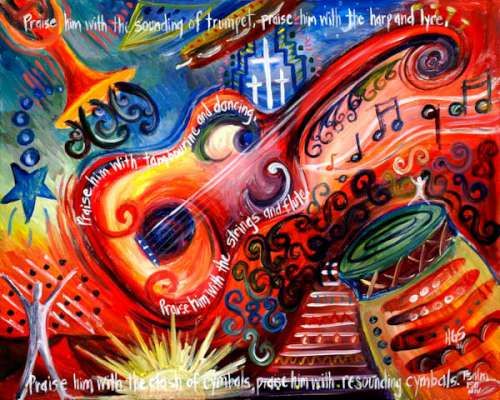
Psalm 150 by Hope G. Smith

Shout praises to the Lord!
    Praise God in his temple.
    Praise him in heaven,
    his mighty fortress.
Praise our God!
    His deeds are wonderful,
    too marvelous to describe.

Praise God with trumpets
    and all kinds of harps.
Praise him with tambourines
    and dancing,
    with stringed instruments
    and woodwinds.
Praise God with cymbals,
    with clashing cymbals.
Let every living creature
praise the Lord.
    Shout praises to the Lord! (CEV)

There is a time for quiet reflection and contemplation, and there is a time for jubilant shouts of praise. The biblical psalms mirror the full range of human emotion. Having moved through the ups and downs of doubt, curiosity, anger, lament, and trust, it is appropriate that the psalter ends with lots of joyful noise.

I grew up in a generation where children were expected to be quiet in church. Not surprisingly, as a child, I found the church worship service on Sunday to be the most boring hour of my week. After a Saturday of morning cartoons, sugary cereal, All-Star Wrestling, and playing outside in the dirt with my brother, Sunday morning was typically a big letdown.

All I have to say about that, and about cranky old women shushing kids in church, is that the adults somehow forgot to read Psalm 150. Maybe if us big people were better about encouraging our little people to dance in the aisles, blow a kazoo as loud as they can, and freely give a shout to the Lord, then perhaps there would be a lot fewer defections from church worship services.

“Praise is the rehearsal of our eternal song. By grace we learn to sing, and in glory we continue to sing. What will some of you do when you get to heaven, if you go on grumbling all the way? Do not hope to get to heaven in that style. But now begin to bless the name of the Lord.”

Charles Haddon Spurgeon

But don’t think I’m advocating going all out noise, all the time. Just as it is neither necessary nor appropriate to always shout everything you say, and skip everywhere you go, so the worship of God needs to encompass the broad scope of the human condition. Silence, meditation, and stillness have their important place. In a desire to make church fun, some Christians have created imbalanced experiences of only victory in Jesus.

One of the reasons I follow the Christian Year with its liturgical movements is that it holds and maintains the balance of worship and the theological tension of both crucifixion and resurrection. We need healthy rhythms of sorrow and joy, stillness and movement, quietness and shouting.

The Church is currently in the Christian season of Eastertide. It is a focused time of celebration – which is why we have biblical sections in this time of year like Psalm 150. This is the appropriate time to lift loud praise to God for the risen Christ and celebrate salvation and new life in Jesus.

I’m not really a numbers kind of guy, yet its easy to notice the word “praise” occurs 10 times in a psalm of just 6 verses. And 7 musical instruments are mentioned. Methinks we’re supposed to not miss something here.

“Through Jesus, therefore, let us continually offer to God a sacrifice of praise—the fruit of lips that openly profess his name.”

hebrews 13:15, NIv

Praise is to happen in heaven and earth, in all creation, out in the world as well as inside the walls of the church building. It is to be done with voice, dance, drums, horns, woodwinds, and stringed instruments. Because God has done wonderful and marvelous acts throughout the earth, people are to respond with profuse gratitude expressed with lots of emotion.

Just so you know, that means sourpuss Christians who wrongheadedly believe human feelings ought to be stuffed and suppressed, need some remedial theological education about who God is and exactly what he expects from people. Somebody, please dispense the laxative of Psalm 150 to loosen their spiritual constipation!

God gave us our breath, and we are to use it for praise. If we see the entire book of Psalms as a life, then it is fitting the final psalm ends with sanguine praise. Indeed, when a person is at end of life, do they have reason to praise? A life of walking with God through thick and thin will inevitably end with recounting the ways in which the Lord has shown up and delivered. They want musical praise filling their last days and minutes.

That is exactly what Duke Ellington did in the twilight of his life. On January 19, 1968, Ellington performed a concert of sacred music at St. John the Divine cathedral in New York City. Among the original songs he performed and later recorded was his musical interpretation of Psalm 150. He called it “Praise God and Dance.”

Duke Ellington said that this praise music, and the two other albums of sacred music he recorded, were “the most important thing I have ever done.” When Ellington performed “Praise God and Dance” at the ancient Church of Santa Maria del Mar in Barcelona, Spain, the congregation spontaneously burst into the aisles with dancing and singing.

The whole person is to be involved in praise – mind, body, emotions, and spirit – because God is Lord of all of us, not just the spiritual dimension.

Make a joyful noise to the Lord, all the earth; break forth into joyous song and sing praises. Sing praises to the Lord with the lyre, with the lyre and the sound of melody. With trumpets and the sound of the horn make a joyful noise before the King, the Lord. (Psalm 98:4-6, NRSV)

I will bless you every day. I will praise your name forever and always. The Lord is great and so worthy of praise! God’s greatness can’t be grasped. (Psalm 145:2-3, CEB)

Praise the Lord! My whole being, praise the Lord. I will praise the Lord all my life; I will sing praises to my God as long as I live. (Psalm 146:1-2, NCV)

Shout praises to the Lord! Our God is kind, and it is right and good to sing praises to him. (Psalm 147:1, CEV)

Amen.

1 John 3:1-7 – Children of God, Loved by God

Welcome, friends! The Christian’s true status and identity cannot be changed any more than a tiger can change his stripes. An abundant life of love flows freely and organically from the person secure in their identity in Christ. Click the videos below and let us bask in the reality of our position in Jesus Christ….

1 John 3:1-7, Pastor Tim Ehrhardt
Who You Say I Am Lyric Video – Hillsong Worship, 2018. Written by Reuben Morgan and Ben Fielding.

May the love of the Lord Jesus draw you to himself.
May the power of the Lord Jesus strengthen you in his service.
May the joy of the Lord Jesus fill your hearts.
And may the blessing of God almighty – the Father, the Son, and the Holy Spirit – be among you and remain with you always. Amen.

Luke 22:24-30 – Just Shadow Jesus

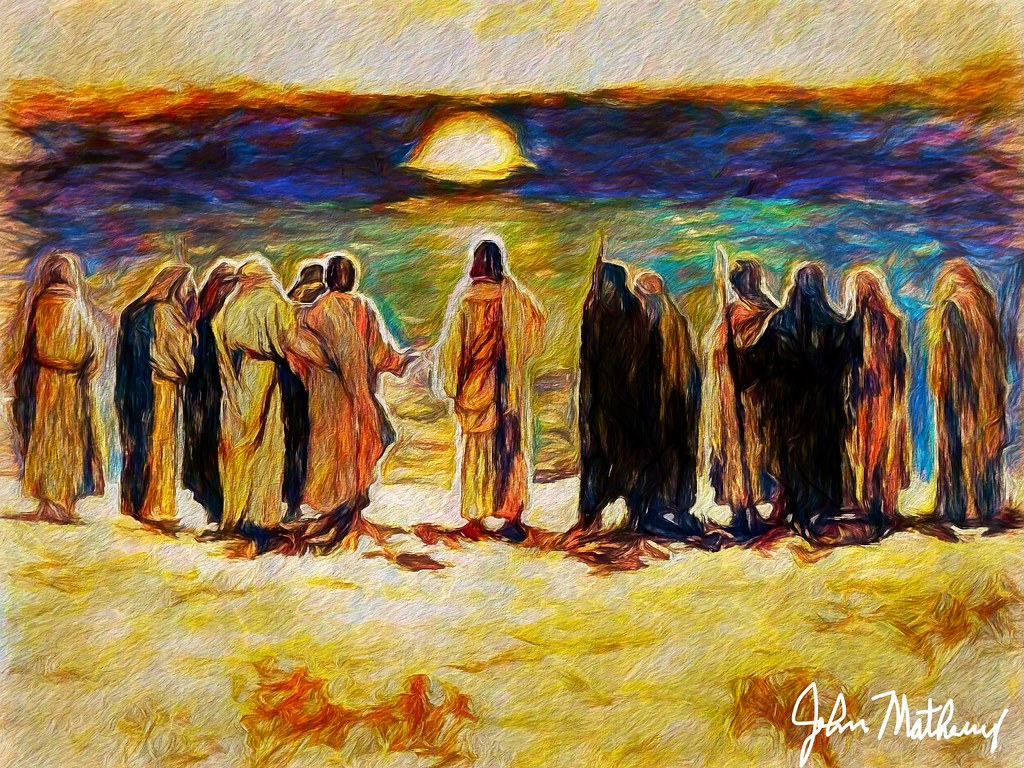
Digital painting of Jesus and the disciples by John Mathews

A dispute also arose among them as to which of them was considered to be greatest. Jesus said to them, “The kings of the Gentiles lord it over them; and those who exercise authority over them call themselves Benefactors. But you are not to be like that. Instead, the greatest among you should be like the youngest, and the one who rules like the one who serves. For who is greater, the one who is at the table or the one who serves? Is it not the one who is at the table? But I am among you as one who serves. You are those who have stood by me in my trials. And I confer on you a kingdom, just as my Father conferred one on me, so that you may eat and drink at my table in my kingdom and sit on thrones, judging the twelve tribes of Israel. (NIV)

Jesus is a different sort of leader.

While the kings of his day were concerned with power and using their authority to ensure even more power and privilege, Jesus went about things differently. In a world of patronage where it was necessary for the lower classes to connect with and suck-up to the higher classes, Jesus operated by a different system.

Jesus, Lord of the universe, King of creation, absolute Leader of the Church, and Ruler over God’s realm was and is a servant of the people.

“Follow my example: Even the Son of Man did not come for people to serve him. He came to serve others and to give his life to save many people.”

mark 10:45, erv

On the surface, striving to be the best might seem noble and good. Yes, working toward being the greatest might motivate us to do all things with excellence. It can solve a lot of problems and issues. On the other hand, it may also result in attitudes and behavior which fosters unhealthy competition and an inordinate focus on becoming the greatest.

Think about it. Not everyone can be the greatest. If everyone is, nobody is. This results in lower self-esteem for nearly everybody. And it creates ripe conditions for leadership paranoia in which the greatest is always looking over their shoulder worrying about being toppled from their lofty position. At the least, all this ballyhoo about greatness only takes away from caring for the people who most need our efforts – family members get the shaft from someone with an imbalanced life who is laser-focused on getting to the top and staying there.

It’s as if a person is living a one-dimensional existence in a three-dimensional world. It won’t work. Fortunately, we don’t have to live like that.

Jesus shows us a better way.

Jesus was present to his disciples. He is present to us in the person of the Holy Spirit. Christ encouraged relational connections and using one’s gifts, talents, and abilities for the common good of all people. For Jesus Christ, the dynamics of power and authority are not to be leveraged for personal greatness but for collective uplift. Authority is to be carefully applied for everyone’s benefit, including those we think don’t deserve it.

The disciples understood far too little about the community their leader was trying to build. Judas Iscariot is likely the one disciple who first realized what Jesus was truly up to. The greatest are the least and the least are the greatest. It wasn’t what Judas signed up for, so he cut his losses and betrayed Jesus.

True exaltation is a gift of grace. The kingdom of God turns on mercy and operates on the economy of grace. It is those who faithfully serve who will sit with Jesus, the ultimate Servant, at the table. Peacocks and pretenders will never realize their dream to be the center of attention.

In a great twist of irony, those who wish to compete and occupy a high standing will discover they have worked to obtain the lowest rung on the ladder leaning against the wall of Satan’s kingdom.

Jesus consistently, patiently, and carefully established the kingdom of God on earth. He went about his task in a manner none of us would even consider. He focused on character, not skills; willing hearts, not intelligent brains; new life, not reformed habits. On the job orientation involved following Jesus around everywhere.

Just shadow Jesus.

Here I am washing your feet. Do the same. Here I am being present to and serving the poor, the lonely, the outcast, the moral failure, and the lowest of society. Do the same. Here I am showing sacrificial self-emptying unconditional love. Do the same. Just shadow me. Do what I do, period.

An obsession with greatness will inevitably lead to petty kingdom building enterprises. Instead, we are to love the neighbor next to us. We make room at the committee table for somebody who looks, acts, and talks different than me. We freely let Jesus live through us, thus, giving the gift of him to those we encounter. We purposely look for ways to serve underprivileged communities rather than use the people living there in ways to make us look better.

Indeed, this following Jesus thing is subversive – even for many professing Christians.

What will you do?

Go in peace to love and serve the Lord, in the name of Christ. Amen.