


Mark 6:30-34 – The Ethics of Rest and Work

The apostles gathered around Jesus and reported to him all they had done and taught. Then, because so many people were coming and going that they did not even have a chance to eat, he said to them, “Come with me by yourselves to a quiet place and get some rest.”

So, they went away by themselves in a boat to a solitary place. But many who saw them leaving recognized them and ran on foot from all the towns and got there ahead of them. When Jesus landed and saw a large crowd, he had compassion on them, because they were like sheep without a shepherd. So, he began teaching them many things. (NIV)

The Protestant work ethic is a real thing.

Although the German sociologist, Max Weber, coined the term, the idea has been around since the Reformation. Since I’m an old white Protestant minister with Northern European heritage, I can testify firsthand that phrases like “quiet place,” “get some rest,” and “solitary place” aren’t in my tribe’s vocabulary.

The typical understanding of sin in the Protestant work ethic is laziness, sloth, procrastination, and disorder. Heck, even sleeping and eating are viewed more as necessary evils than healthy practices. Hard industrious work is considered a high value. All other activities fall underneath it.

So, it is not surprising that today’s Gospel lesson rarely gets attention from anybody, especially with people who share my heritage. Yet, there it is in Holy Scripture for all to read. And I can’t think of any better or sage advice to give my fellow Protestant Christians as “get some rest.”

Having heard my share of folks, after me insisting they practice some self-care, say goofy things like, “I’ll have plenty of time to rest when I die,” I now go full-frontal retort with my own words that go something like, “And that death will happen a lot sooner than you think, if you don’t obey the Lord through solitude and rest.”

Moving from guilt to grace.

Although I know better, I often find myself burning the candle at both ends. Its far too easy for me to forget eating lunch because of work. And I sometimes catch myself wanting to justify to others the reason for putting my feet up for a few minutes. Make no mistake about it: The Protestant work ethic is mostly motivated by guilt, not grace.

Perhaps we need to say the phrase of Jesus out loud, using several different versions of the Bible. Go ahead. Say the following, slowly… gently… as if Christ himself were speaking directly to you….

“Come with me by yourselves to a quiet place and get some rest.” (NIV)

“Come, let’s take a break and find a secluded place where you can rest a while.” (TPT)

“Come away to a deserted place all by yourselves and rest a while.” (NRSV)

“Come with me privately to an isolated place and rest a while.” (NET)

“Let’s go off by ourselves to a quiet place and rest awhile.” (NLT)

“Let’s go to a place where we can be alone and get some rest.”

Jesus (Mark 6:31, CEV)

I want us to see what a gracious invitation we are being extended by our Lord. This is the same Lord who said:

“Come to me, all you who are struggling hard and carrying heavy loads, and I will give you rest. Put on my yoke and learn from me. I’m gentle and humble. And you will find rest for yourselves. My yoke is easy to bear, and my burden is light.” (Matthew 11:28-30, CEB)

At odds with Christian discipleship.

It is high time we see that much of the Protestant work ethic is at odds with Christian discipleship. Although the ethic rightly lifts the need for faith to be expressed in diligence, discipline, and frugality, it elevates hard work as a visible sign of God’s grace. So, ironically, people end up working their tails off to prove the grace in their lives. And it has created a false self for many who are fearful of being seen by others as slothful and irreligious.

For example, I once had an elderly parishioner who often told me how little sleep she got, the part-time job she held, and the many volunteer opportunities she regularly engaged. I thought it odd that an older person could truly do so much without much rest. And my hunch proved spot on. Turns out she fudged on how many hours she really worked and slept, sometimes outright lying to me.

This lady felt compelled to prove to me, her Pastor, that she was on the straight and narrow, doing the things a good Protestant Christian does. What is sad about this is that the stories are multiplied with many other dear people obsessively relating to me untrue facts about themselves so that I will accept and affirm their superior religiosity expressed in hard work.

However, the axis of the world does not spin on effort and working harder but on grace and love. Behind all the posturing and continually striving for an almost superhuman work ethic are terribly insecure folk who need to rest in the grace of God in Christ.

Embracing both work and rest.

None of this is to say that work is somehow bad. No, work is inherently good. Adam and Eve were placed in the Garden of Eden to work it and tend to it. We need not denigrate work to emphasize rest. Whereas you might doth protest that younger generations today have no idea what hard work is, I will pushback by saying they intuitively see the foolishness of the Protestant work ethic and want to steer clear of it.

Millennials, I argue, are ready to roll up their sleeves and work hard. They just need a bit of direction from us older generations. And that guidance cannot be in the form of disparaging them. Rather it needs to be gracious, forging real mentoring relationships which are helpful.

So, let’s get a hold of what Jesus did: He worked, yes, worked, to get his disciples to a place of rest and refreshment. Christ wanted nothing to do with compulsively working without proper care of body and soul. Rest must come before work. We do well to follow his example.

Be present, O merciful God, and give us refreshment through the anxieties of the day and the silent hours of the night so that we who are wearied by the changes and chances of this fleeting world may rest upon your eternal changelessness, through Jesus Christ our Lord. Amen.

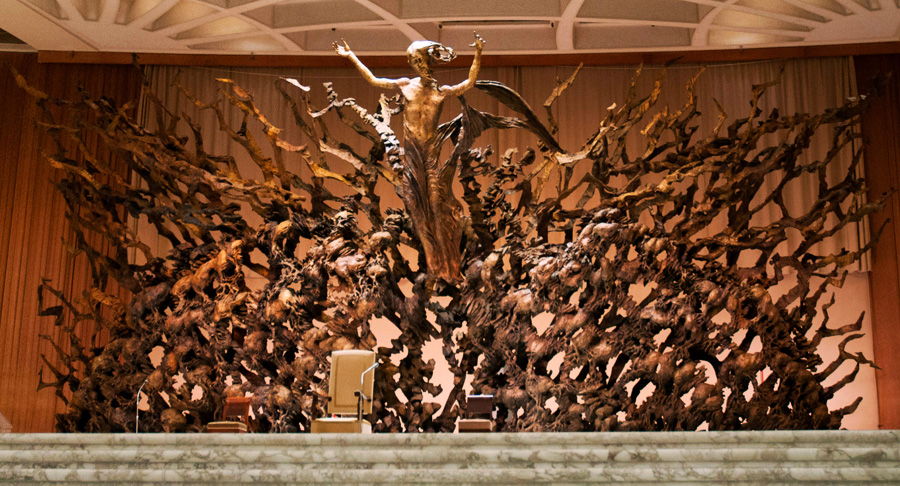
Acts 4:1-4 – The Message of Resurrection

La Resurrezione by Italian sculptor Pericle Fazzini (1913-1987)

The priests and the captain of the temple guard and the Sadducees came up to Peter and John while they were speaking to the people.They were greatly disturbed because the apostles were teaching the people, proclaiming in Jesus the resurrection of the dead. They seized Peter and John and, because it was evening, they put them in jail until the next day. But many who heard the message believed; so, the number of men who believed grew to about five thousand. (NIV)

There’s nothing quite like upsetting the status quo. And that’s exactly what the apostles Peter and John were doing. Creating trouble, causing a stink, disturbing the peace, and making waves. At least, that’s how the ruling authorities saw the upstart Christians’ activity.

At the heart of the disturbance was the authorities’ deep concern of potential social disorder. After all, the Roman Empire with all its great strength was firmly ensconced in Judea. It was already hard enough trying to maintain Jewish customs and religious practices. Now, these rabblerousers come along with their unorthodox teaching and threaten the very social fabric of Jewish life. No! Get them out of here!

So, off to jail Peter and John went. That’s how the politics of fear typically works. Being afraid of change leads to removing the object of fear. Stuff the apostles in the gulag. Shut and lock the door. Maybe if they are out of sight they will be out of mind to the people.

The rulers were too late. So many people heard the message of Christ’s resurrection that the number of believers in Jesus swelled into the thousands. Well, now, everyone’s really in a pickle! Except the church. Each time the Christians get squelched and silenced, more of them show up. Oh, my, goodness. They’re multiplying like roaches!

It doesn’t help the ruling authorities that these religious bugs continue to interpret their own whippings and jailtime as a positive thing – enjoying the solidarity of suffering with their Lord. Ugh. What’s a decent Sadducee to do?

Turns out nothing can stop resurrection. It cannot be chained, bound, or imprisoned. Once life gets into the hearts of people, there’s no getting it out. The message just takes over and consumes the whole person. Then it spreads to another, like some infectious disease.

Before you know it, the entire social order is off kilter. What a bunch of weirdos. Following a dead guy who they say isn’t dead. Walked right out of the grave, they say. Sheesh. Pull yourselves together. So many unhinged delusional people believing in resurrection!

“Here’s to the crazy ones. The misfits. The rebels. The troublemakers. The round pegs in the square holes. The ones who see things differently. They’re not fond of rules. And they have no respect for the status quo. You can quote them, disagree with them, glorify or vilify them. About the only thing you can’t do is ignore them. Because they change things. They push the human race forward. And while some may see them as the crazy ones, we see genius. Because the people who are crazy enough to think they can change the world, are the ones who do.”

Rob Siltanen

It’s easy for some Christians to be hard on non-Christians, just as it was easy for the ancient Jewish rulers to be hard on others leaving their fold. Sometimes we followers of Jesus forget whence we have come. We can get so upset and worked up in fear. Could be our underwear is too tight. More likely, we take the prideful stance of believing our status quo is best for everyone. So, there’s no listening, paying attention, or teachable spirits.

Peter, John, and the other apostles just went about proclaiming good news with joy. And the gospel spread. Jesus became known first to thousands, then tens of thousands, hundreds of thousands, and millions. Today, according to the Pew Research Center, there are 2.5 billion Christians in the world. That’s a lot of people. Christianity has had two thousand years to create their own status quo, some of it good, some of it not so much.

Yet, at the heart of it all, is the resurrection of Jesus Christ from death. It’s a message that still speaks to billions. And it’s a message Christians need to come back to whenever they are fearful of others challenging their hegemony.

All the hopes and expectations of Christians everywhere are realized not in maintaining some Constantinian sort of Christendom but in the resurrection of Jesus Christ the dead. The former does a lot of handwringing over social and cultural issues. The latter has a lot of joy, celebration, and renewal which works itself out in both personal and systemic redemption.

Because the good news of Easter can hardly be contained in a single day’s celebration, it’s message of new life in Christ is like a bright sun of inexhaustible grace to people everywhere – still warming the earth all these centuries later.

The Apostle Peter went on to pen a letter to struggling Christians facing hard circumstances in a world not yet dominated by Christianity, reminding them of the heart of Christian faith:

Praise be to the God and Father of our Lord Jesus Christ! In his great mercy he has given us new birth into a living hope through the resurrection of Jesus Christ from the dead, and into an inheritance that can never perish, spoil or fade. This inheritance is kept in heaven for you, who through faith are shielded by God’s power until the coming of the salvation that is ready to be revealed in the last time. In all this you greatly rejoice, though now for a little while you may have had to suffer grief in all kinds of trials. These have come so that the proven genuineness of your faith—of greater worth than gold, which perishes even though refined by fire—may result in praise, glory and honor when Jesus Christ is revealed. Though you have not seen him, you love him; and even though you do not see him now, you believe in him and are filled with an inexpressible and glorious joy, for you are receiving the result of your faith, the salvation of your souls.

1 Peter 1:3-9, NIV

May we come back repeatedly to Christianity’s message so that our faith is strengthened, the church is edified, and the world is blessed. Amen.

Psalm 23 – God Is Bigger Than Your Valley

Photo by Temo Berishvili on Pexels.com

You, Lord, are my shepherd.
    I will never be in need.
     You let me rest in fields
    of green grass.
You lead me to streams
of peaceful water,
    and you refresh my life.

You are true to your name,
    and you lead me
    along the right paths.
 I may walk through valleys
as dark as death,
    but I won’t be afraid.
You are with me,
    and your shepherd’s rod
    makes me feel safe.

 You treat me to a feast,
    while my enemies watch.
You honor me as your guest,
    and you fill my cup
    until it overflows.
Your kindness and love
will always be with me
    each day of my life,
    and I will live forever
    in your house, Lord. (CEV)

Psalm 23 is a familiar place in Holy Scripture, even for many who are not followers of God.  Far from just a funeral prayer, this psalm contains a singular and timeless message:

No matter the circumstance, nor whatever the need, God is enough. The Lord of all creation is bigger than your darkest valley.

That’s what I remind myself every time life hands me a knuckle-sandwich. God is here. God is with me. Despite all that is wrong, unjust, and askew in this old fallen world, the Lord’s will and way overcomes everything.

Divine beauty has a way of breaking through to the most challenging and desperate of experiences. We have everything we need with God. Spring reminds us there is always the hope of new life. The anticipation of trees budding and flowers blooming help us remember that the dull hibernation of winter shall break out with glorious warmth and color. Everything will change, even if it doesn’t seem like it, at the time.

The Lord provides no matter the need.

God protects despite the overwhelming dilemma. Divine power overshadows the darkest of valleys. The presence of God is everywhere. Even though we sometimes sit flummoxed about how our financial budget is going to budge or whether we have the continued energy to deal with that person or situation, with the God of the Bible, we shall never be in want of anything.

Today is a good day to punctuate your schedule with a prayerful reading of Psalm 23. As you can well see, it only takes a minute to read, maybe a few to read carefully and slowly. Use your cellphone alarm or some other means for some set times today. When the alarm goes off, take a few minutes for Psalm 23 to decenter your thoughts from worry, anxiety, and the fatigue of the day. Let it center you in the sovereignty and grace of God. Maybe use a different translation each time you read.  Here is Psalm 23 again in another version of the Bible:

The Lord is my shepherd;
    I have all that I need.
He lets me rest in green meadows;
    he leads me beside peaceful streams.

     He renews my strength.
He guides me along right paths,
    bringing honor to his name.
 Even when I walk
    through the darkest valley,
I will not be afraid,
    for you are close beside me.
Your rod and your staff
    protect and comfort me.
You prepare a feast for me
    in the presence of my enemies.
You honor me by anointing my head with oil.
    My cup overflows with blessings.
Surely your goodness and unfailing love will pursue me
    all the days of my life,
and I will live in the house of the Lord
    forever. (NLT)

Amen.

Proverbs 9:1-6 – Lady Wisdom’s Invitation

Divine Wisdom by Shiloh Sophia McCloud

Wisdom has built her house
    with its seven columns.
She has prepared the meat
and set out the wine.
    Her feast is ready.

She has sent her servant women
    to announce her invitation
    from the highest hills:
“Everyone who is ignorant
    or foolish is invited!
    All of you are welcome
    to my meat and wine.
If you want to live,
    give up your foolishness
    and let understanding
    guide your steps.” (CEV)

Wisdom is personified as a wise woman calling out to us. Her message is a passionate appeal to take the path of insight through God’s revealed will. She encourages us to leave our simple ways and walk in the way of insight. 

The word “wisdom” in Scripture is the careful application of God’s Word to concrete situations in our lives. During our daily life, paying attention to wisdom and following her instructions is vital to experiencing success in the Christian walk, and in all of life.

Obstructing the ability to listen for wisdom’s call is the fact that too many people are downright impatient. The deliberate ways of wisdom take far too much time for them. They want the bottom-line, the skinny on wisdom. However, to let wisdom teach us her ways, we need to slow down enough to hear, accept, and engraft wise practices of living. Working and living harder and faster when we encounter difficulties only betrays our great need for Lady Wisdom’s instruction.

It is the immature simpleton who refuses to wait on the lessons that wisdom wants to impart. Wisdom cannot be gained quickly. Her teachings are learned slowly with careful application over time. Wisdom is something of a marinade, and if we don’t allow the proper time, we are unable to live well. We will then, at best, be bland and dull, and at worst, be an unsavory presence in the world.

Another foolish obstacle to receiving wisdom is the search for simple solutions to complex problems. Wisdom calls us to leave such ineffective and short-sighted ways and take the high road of consultation, collaboration, and humble learning.

Rather than always rush to Google for answers to our questions; instead of allowing another person to make decisions for us; in place of implementing sheer pragmatic plans, please allow wisdom to penetrate the mind and heart so that what comes out is thoroughly godly and biblical. 

Where is the place to start? Reverence of the Lord is the beginning of wisdom, and knowledge of the Holy One is insight. There is no substitute to committing oneself to the regular and daily regimen of reading God’s Holy Word and seeking to put it into practice.

All-Wise God, the One who is never in a hurry, create in me a wise mind and heart.  Help me to sit still long enough for wisdom to bring biblical and spiritual maturity to my life, through Jesus Christ in the power of the Holy Spirit.  Amen.