2 Samuel 6:6-12 – Doing the Wrong Thing for the Right Reason Is Still the Wrong Thing

When they came to the threshing floor of Nakon, Uzzah reached out and took hold of the ark of God, because the oxen stumbled. The Lord’s anger burned against Uzzah because of his irreverent act; therefore, God struck him down, and he died there beside the ark of God.

Then David was angry because the Lord’s wrath had broken out against Uzzah, and to this day that place is called Perez Uzzah.

David was afraid of the Lord that day and said, “How can the ark of the Lord ever come to me?” He was not willing to take the ark of the Lord to be with him in the City of David. Instead, he took it to the house of Obed-Edom the Gittite. The ark of the Lord remained in the house of Obed-Edom the Gittite for three months, and the Lord blessed him and his entire household.

Now King David was told, “The Lord has blessed the household of Obed-Edom and everything he has, because of the ark of God.” So, David went to bring up the ark of God from the house of Obed-Edom to the City of David with rejoicing. (New International Version)

“What you think is the right road may lead to death.”

Proverbs 14:12, GNT

The narrator who originally told and wrote this story wanted to communicate something of God to us, as well as our relationship to the Lord. It’s important to understand why God rained on David’s hoedown. At that time in the history of Israel, the Ark of the Covenant was the foremost symbol that God was present with the people. 

Contained within the ark were the tablets of the Ten Commandments (the symbol of God’s Word); the staff of Aaron, the first priest (the symbol of God’s choice); and a pot of manna (the symbol of God’s provision). The ark was a holy object, pointing to a holy God.

The ark of the Lord was built at the time of Moses when all of the ritual laws of God were established. Those laws included details concerning the offerings people were to bring and how to approach God in worship. The latter part of the book of Exodus describes all the prescriptions of how to construct the sacred articles for worship. 

The ark was at the center of it all, representing the presence of God among his people. That was nearly five-hundred years before David. The ark had become a familiar object in the life of Israel, always there, continually being the symbol of God to the people.

We have all likely had the experience of something becoming so familiar to us that we begin to lose sight of how important and valuable it really is. And it is not until we lose it, or something traumatic happens, that we come back to our senses and again take stock of its true significance. 

The Israelites had become lethargic and apathetic toward the worship of God, and it led to some disheartening and tragic circumstances. God’s people need to continually be on guard against the opiate of familiarity dulling our senses to the importance of true worship.

Moving the Ark of the Lord’s Covenant to Jerusalem was one of the first acts David did as the king of Israel and Judah. God was with David and brought him success against his enemies. David enjoyed a close walk with the Lord. Yet, he could still make mistakes. Even though David’s heart was in the right place, he made a huge error which was an affront to God. 

The way in which we treat God, the things of God, and God’s word and worship, are of vital importance and value.

King David had the best of intentions, bringing up the ark to Jerusalem and giving it a prominent place in the center of Jewish life. This was a good thing, a good plan. The problem, however, came in the way the ark was carried from one place to another. The book of Exodus lays out in careful detail how the ark is to be transported. (Exodus 25:10-22; 37:1-9)

Two Levites, Uzzah and Ahio, were charged with taking care of the ark. Only the Levites could handle the ark and all the holy objects of worship that went along with it. Since it was their job, they should have known better than to carry the ark of the Lord on a cart. 

“If you love me, show it by doing what I’ve told you.”

Jesus (John 14:15, MSG)

God had clearly told Moses the ark was to always have two long poles of acacia wood overlaid with gold inserted into four gold rings of the ark. In fact, the ark itself was made of acacia wood and overlaid with gold.  The ark was to always be carried on the shoulders of the Levites with the two poles.

We are not told why Uzzah and Ahio are pulling the ark on a cart with oxen instead of carrying it in the prescribed way. Perhaps it was because the ark was very heavy. It was no cake walk carrying the ark around.  Maybe they decided it would be more expedient and easier to have some much stronger oxen pull the ark on a nice new cart; it would save a lot of energy bringing it over a long distance. 

Actually, when you think about it, this makes a lot of sense. It is quite pragmatic. However, God was not okay with this arrangement. When the oxen stumbled and the ark was in danger of falling off the cart, Uzzah reflexively reached out to steady it.  That was the last act Uzzah ever did on this earth. God put him down for his “irreverent act.”

We must neither decide nor evaluate the worship of God by common sense pragmatism, what we think will work best, or how we feel it ought to be done. Everything in the church is to pay attention to the holiness of God through our obedience. Whenever we avoid the prescriptions of God, however best those intentions might be, is not a good thing and people will get hurt. 

One can never justify an action which goes against God’s Word, just because people are praising God and their hearts are in the right place. It doesn’t necessarily mean what is being done is okay.

David’s first response was anger, then fear. Although he gave his best effort, it resulted in God’s disfavor. Upon reflection, David realized that he perhaps took for granted the ark could be moved any way they wanted to move it. 

Whenever we value efficiency and expediency over obedience and submission to God’s holiness, there will be trouble with God. The great sin of Uzzah, resulting in his death, was that he was managing God. 

We do not take care of God; God takes care of us. God will not bow to us and allow creatures to manage the Creator. The Lord wants pure unadulterated obedient worship from people in the way it is to be done.

Doing the wrong thing for the right reason is still the wrong thing to do. David had to learn that the hard way. Let’s learn from his mistake.

Blessed Lord, who graciously provides us instruction for our good, give us faith to receive your word, understanding to know what it means, and the will to put it into practice, through Jesus Christ our Lord. Amen.

Numbers 10:11-36 – The Center of Worship

On the twentieth day of the second month of that same year, the cloud over the sacred tent moved on. So, the Israelites broke camp and left the Sinai Desert. And sometime later, the cloud stopped in the Paran Desert. This was the first time the Lord had told Moses to command the people of Israel to move on.

Judah and the tribes that camped alongside it marched out first, carrying their banner. Nahshon son of Amminadab was the leader of the Judah tribe, Nethanel son of Zuar was the leader of the Issachar tribe, and Eliab son of Helon was the leader of the Zebulun tribe.

The sacred tent had been taken down, and the Gershonites and the Merarites carried it, marching behind the Judah camp.

Reuben and the tribes that camped alongside it marched out second, carrying their banner. Elizur son of Shedeur was the leader of the Reuben tribe, Shelumiel son of Zurishaddai was the leader of the Simeon tribe, and Eliasaph son of Deuel was the leader of the Gad tribe.

Next were the Kohathites, carrying the objects for the sacred tent, which was to be set up before they arrived at the new camp.

Ephraim and the tribes that camped alongside it marched next, carrying their banner. Elishama son of Ammihud was the leader of the Ephraim tribe, Gamaliel son of Pedahzur was the leader of the Manasseh tribe,and Abidan son of Gideoni was the leader of the Benjamin tribe.

Dan and the tribes that camped alongside it were to protect the Israelites against an attack from behind, and so they marched last, carrying their banner. Ahiezer son of Ammishaddai was the leader of the tribe of Dan, Pagiel son of Ochran was the leader of the Asher tribe, and Ahira son of Enan was the leader of the Naphtali tribe.

This was the order in which the Israelites marched each time they moved their camp.

Hobab the Midianite, the father-in-law of Moses, was there. And Moses said to him, “We’re leaving for the place the Lord has promised us. He has said that all will go well for us. So come along, and we will make sure that all goes well for you.”

“No, I won’t go,” Hobab answered. “I’m returning home to be with my own people.”

“Please go with us!” Moses said. “You can be our guide because you know the places to camp in the desert. Besides that, if you go, we will give you a share of the good things the Lord gives us.”

The people of Israel began their journey from Mount Sinai. They traveled three days, and the Levites who carried the sacred chest led the way, so the Lord could show them where to camp. And the cloud always stayed with them.

Each day as the Israelites began their journey, Moses would pray, “Our Lord, defeat your enemies and make them run!” And when they stopped to set up camp, he would pray, “Our Lord, stay close to Israel’s thousands and thousands of people.” (Contemporary English Version)

“The most important feature of sacred space is found in what it is by definition: the place of God’s presence. The cosmic-temple idea recognizes that God is here and that all of this is his. It is this theology that becomes the basis for our respect of our world.”

John Walton

These verses from the book of Numbers might, at first glance, seem irrelevant to contemporary worshipers of God. The Old Testament book of Numbers matter-of-factly informs us of how the ancient Israelites set out in the desert by stages according to their respective tribes and how they proceeded when stopping their sojourns. Yet, if we take the time to engage in pilgrimage with the Israelites, we observe the heart of worship and life for God’s people.

The tabernacle, that is, the ark of the covenant with its accompanying tent and holy articles, was the primary symbol for Israel of God’s presence. As such, the tabernacle was at the actual center of Israelite life, both physically and spiritually. The tabernacle would leave first and be set up by the tribe of Levites before the other tribes came and encamped around it – completely encircling the tent housing the ark.

Observing this constant ancient ritual in the desert begs several questions for us today: 

Is God at the center of our life and worship? 

Or do we expect the Lord to come and bless our already camped-out thoughts, ideas, and practices? 

If God is truly at the center of all we do, what is the evidence this is so? 

Are we patient to wait for God’s leading to present itself? 

Or do we act and then seek God to give his stamp of approval over it? 

The wise believer will allow God to set the agenda and pace of our life journey, and not the other way around.

Sovereign God, you always lead in a way that is good, just, and right. Help me to slow down long enough to enter into the rest and connection with your will that I so desperately need through Jesus my Lord. Amen.

*Above painting: Israel Encamped Roundabout the Tabernacle in the Wilderness of Sinai
by John W. Kelchner (1866-1942)

Colossians 4:2-18 – The Christian Life as Its Meant To Be Lived

Devote yourselves to prayer, being watchful and thankful. And pray for us, too, that God may open a door for our message, so that we may proclaim the mystery of Christ, for which I am in chains. Pray that I may proclaim it clearly, as I should. Be wise in the way you act toward outsiders; make the most of every opportunity. Let your conversation be always full of grace, seasoned with salt, so that you may know how to answer everyone.

Tychicus will tell you all the news about me. He is a dear brother, a faithful minister and fellow servant in the Lord. I am sending him to you for the express purpose that you may know about our circumstances and that he may encourage your hearts. He is coming with Onesimus, our faithful and dear brother, who is one of you. They will tell you everything that is happening here.

My fellow prisoner Aristarchus sends you his greetings, as does Mark, the cousin of Barnabas. (You have received instructions about him; if he comes to you, welcome him.) Jesus, who is called Justus, also sends greetings. These are the only Jews among my co-workers for the kingdom of God, and they have proved a comfort to me. Epaphras, who is one of you and a servant of Christ Jesus, sends greetings. He is always wrestling in prayer for you, that you may stand firm in all the will of God, mature and fully assured. I vouch for him that he is working hard for you and for those at Laodicea and Hierapolis. Our dear friend Luke, the doctor, and Demas send greetings. Give my greetings to the brothers and sisters at Laodicea, and to Nympha and the church in her house.

After this letter has been read to you, see that it is also read in the church of the Laodiceans and that you in turn read the letter from Laodicea.

Tell Archippus: “See to it that you complete the ministry you have received in the Lord.”

I, Paul, write this greeting in my own hand. Remember my chains. Grace be with you. (New International Version)

Every church has its problems. Much like individual believers, each faith community has its own character and personality – which makes their particular issues unique to them.

The Apostle Paul wrote his letter to the church in the ancient city of Colossae to address an issue which was weighing on his heart.

Broadly speaking, the problem of the church was legalism. That is, boiling down and condensing the Christian life into spiritual rules to live by. Although, on the surface, that may not sound so terrible, for Paul it was damaging to Christianity.

Whenever anyone or any group of people systematize Christianity into a list, it is a fool’s errand. Let’s face it: the worship of God, and thus the Christian life, is, for the most part, ethereal and mysterious. Throughout church history there have been legions of folks who have attempted to nail down Christianity into laws we can clearly see and hold people accountable to.

Whether it is making human contrived lists of sins to avoid and codifying them as something like the Terrible Ten or the Nasty Nine; or whether it is trying to humanly comprehend salvation in a tidy Five Spiritual Laws or Basic Principles for Life – all this predilection for list-making does nothing but discourage the Christian heart and divide one another about things that just don’t matter.

Paul wanted all his churches to be encouraged and united in the love of God in Christ through the enablement of the Holy Spirit. This requires prayer – lots of it! Because we must live by faith, trusting God for each step to take in the Christian life, rather than relying on the list to tell me what to do.

So, that’s why Paul ended his letter to the church on a note exhorting the people to never give up praying.

“Prayer enlarges the heart until it is capable of Containing God’s gift of himself.”

Mother Teresa (1910-1997)

Devoting ourselves to prayer means that we will need to quit devoting ourselves to something else – namely, the nice, neat, packaged formula of do’s and don’ts on the list. Paul didn’t just want the people to adopt a different list; he wanted all the lists tossed into hell!

Instead of always trying to control outcomes, Paul wanted perseverance in prayer without knowing what the result and outcome would be. His deep desire was that believers would rely on God and the mystery of Christ. He longed for the church to pray with all their doubts and uncertainties – not believing they always needed sure answers for everything.

The Christian life cannot be made into some geeky algorithm so that we can avoid suffering, know all the right things to say in a conversation, and always keep God happy. God is not some algebra equation to figure out. He is not a gumball machine to put a quarter in and get what you want. He is not Santa God. 

Christianity requires living in the tension of not knowing everything and yet having cogent answers for others who inquire about our faith.  It is a dynamic relationship in which we must continually interact in prayer to God as we largely improvise our lives, spontaneously applying what understanding we have for each situation we face.

“The whole reason why we pray is to be united into the vision and contemplation of God to whom we pray.”

Julian of Norwich (1342-c.1416)

Christians need an ongoing dialogue with the God who answers in his own good time, according to his own good will. We are to make good use of the time God has given through choosing our words with others wisely as we simultaneously carry on a silent prayer conversation with God. This is a Christianity that’s far above rules and laws and checklists. It is Christianity as it’s meant to be lived, depending on Jesus, and relaxed in the Spirit.

This takes practice, practice, practice. Failure is both inevitable and expected. And that’s okay. We’re not living by lists and human contrived rules. We’re living a new life in the power of Christ’s resurrection.

God of Mystery, the One who conceals and reveals, forgive me for my attempts at reducing faith to a few spiritual rules to keep. Help me to speak in ways which are gracious, loving, and redemptive. May the person and work of Jesus come tumbling out of my mouth while I inhale the breath of your Holy Spirit. Amen.

*Above paintings of prayer by African artist Angu Walters

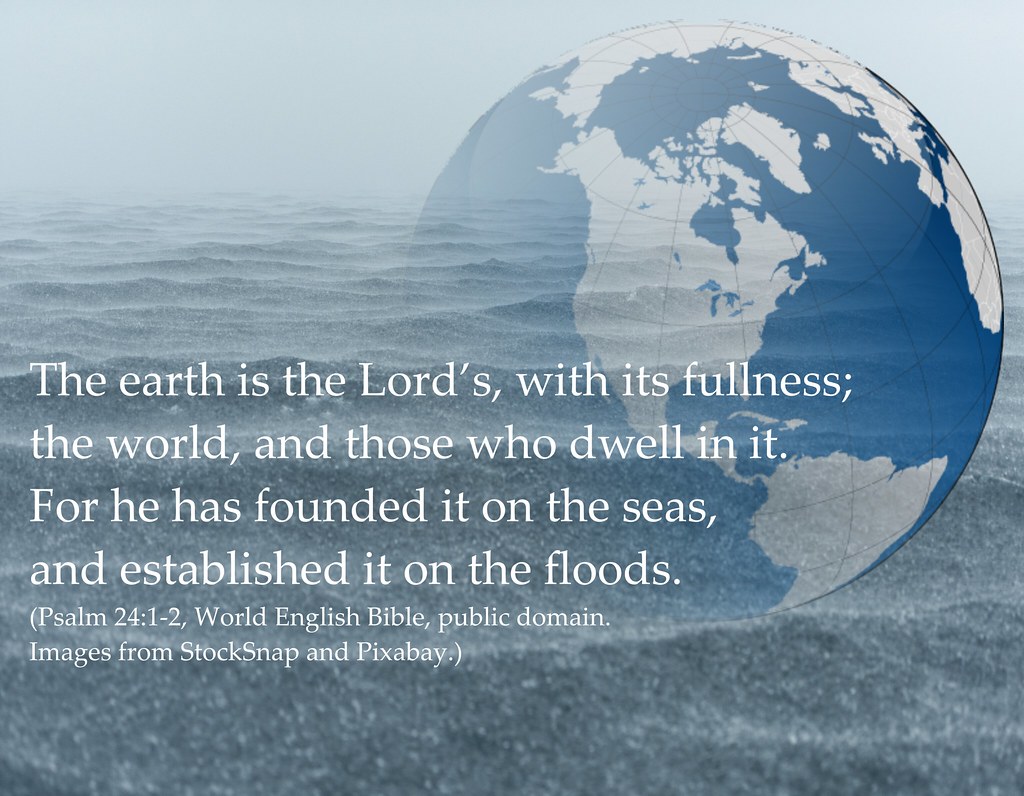
Psalm 24 – It All Belongs to God

The earth and everything on it
    belong to the Lord.
    The world and its people
    belong to him.
The Lord placed it all
    on the oceans and rivers.

Who may climb the Lord’s hill
    or stand in his holy temple?
Only those who do right
    for the right reasons,
    and don’t worship idols
    or tell lies under oath.
The Lord God, who saves them,
    will bless and reward them,
    because they worship and serve
    the God of Jacob.
Open the ancient gates,
    so that the glorious king
    may come in.

Who is this glorious king?
    He is our Lord, a strong
    and mighty warrior.

Open the ancient gates,
    so that the glorious king
    may come in.

Who is this glorious king?
    He is our Lord,
    the All-Powerful!
(Contemporary English Version)

Abraham Kuyper (1837-1920) was born in the Netherlands. He was a church minister, university professor, and politician – having established a Christian university, as well as served in the Dutch parliament and as Prime Minister of the Netherlands.

Kuyper labored throughout his life to flesh-out the theological implications of a sovereign God. He consistently insisted all we do as humans is to be integrated and brought under the lordship of Jesus Christ. He believed firmly that all things belong to God in Christ and all the fragments of our lives are to be oriented and integrated around our Creator’s great claim upon us as creatures. Whether a pastor, teacher, or politician, every vocation, each activity, and all thoughts and intents rightly belong to God.

In other words, religion and spirituality cannot be kept within superimposed limits. There is no separation of any one domain of human thought from the rest, no isolation of any one domain of human life from another or from Christ.

The spiritual life is not limited to merely the ethereal. It is both celestial and terrestrial – heavenly and earthly – concerned for the immaterial and the material. God cares about it all because it all belongs to God.

God owns the world. So, the implications of this for us is huge. It means we don’t really own anything. We are simply stewarding all that God has given us – including our very lives. The chaos of this world, from a biblical perspective, comes from creatures attempting to assert their own sovereignty and control things. Since we were not created to be little gods roaming about doing our own thing, the inevitable result is a topsy-turvy world.

God’s divine claim and ownership of the world means that absolute authority does not rest with nations, states, or leaders. Everything we see, as well as what we don’t see, belongs to the Lord. Part of the task of believers is to confess and bear witness to God’s rightful and benevolent rule in this world. In fact, Christians everywhere pray toward this end every week: Your kingdom come, your will be done, on earth, as it is in heaven.

The circle of life, within Holy Scripture, is the Creator God bestowing life and relationship to created humans, who then respond by practicing just and righteous living – thereby receiving renewal from the Lord and life anew. Theoretically, this movement can go unbroken. It is a regular celebration, for the believer, in consistent rhythms of worship and adoration of God.

When we are able to get in the intended divine groove of faith, life, and worship, we will discover our meaning and purpose in the world. By rightly ordering our lives, centering and grounding them in the gracious and loving relationship of Creator and creature, then we find true blessing because it enjoys an intuited stamp of approval by the God who makes life possible.

In the Christian tradition, Jesus is the Victor, the King of Glory. All the promises and hopes of people are found and focused, in Christ. We enter through Jesus, the door of life, to deliverance from death and all that separates us from God, others, and self.

Jesus comes to bring blessing, justice, righteousness, mercy, purity, and peace. For this is how the world was meant to operate from the beginning. We are to open the ancient door of faith, especially when the Lord comes knocking:

Listen! I am standing and knocking at your door. If you hear my voice and open the door, I will come in and we will eat together. Everyone who wins the victory will sit with me on my throne, just as I won the victory and sat with my Father on his throne. If you have ears, listen to what the Spirit says to the churches. (Revelation 3:20-22, CEV)

Old Abraham Kuyper might be long dead, yet he got it right, if we are able to hear him:

“Whatever people may do, to whatever they may apply their hands – in agriculture, in commerce, and in industry, or in mind, in the world of art, and science – they are, in whatsoever it may be, constantly standing before the face of God. They are employed in the service of God. They have strictly to obey God. And above all, they must aim at the glory of his God.”

Abraham Kuyper

Blessed Lord, Creator of heaven and earth, though I am quite capable of fretting, complaining, and lamenting about how out of control things seem, the truth is that nothing is outside your grip. I may not always see your hand, discern your heart, or like your ways, but you are God and there is no other. So, continue to renew my thinking, gentle my heart, and deepen my worship. I humbly and gladly affirm that you are God, and I am not, through Jesus Christ, my Lord, who with you and the Holy Spirit reign sovereign as one God, now and forever. Amen.