Psalm 14 – On the Significance of God

Statue of George Washington, outside the National Gallery, Washington D.C.

Godless fools say in their hearts,
“There is no God.”
They are corrupt.
They do disgusting things.
There is no one who does good things.
The Lord looks down from heaven on Adam’s descendants
to see if there is anyone who acts wisely,
if there is anyone who seeks help from God.
Everyone has turned away.
Together they have become rotten to the core.
No one, not even one person, does good things.
Are all those troublemakers,
those who devour my people as if they were devouring food,
so ignorant that they do not call on the Lord?
There they are—panic-stricken
because God is with the person who is righteous.
They put the advice of oppressed people to shame
because the Lord is their refuge.

If only salvation for Israel would come from Zion!
When the Lord restores the fortunes of his people,
Jacob will rejoice.
Israel will be glad
. (God’s Word Translation)

George Washington, first President of the United States, in his farewell address to the nation in 1796, constructed his encouragements to the American people on the basis of virtue. 

Only a virtuous people, Washington believed, could cause the American experiment to succeed among the family of nations. Virtue, for Washington, could only occur through the twin pillars of religion and morality. He stated:

“Observe good faith and justice towards all nations; cultivate peace and harmony with all. Religion and morality enjoin this conduct; and can it be, that good policy does not equally enjoin it – It will be worthy of a free, enlightened, and at no distant period, a great nation, to give to mankind the magnanimous and too novel example of a people always guided by an exalted justice and benevolence. Who can doubt that, in the course of time and things, the fruits of such a plan would richly repay any temporary advantages which might be lost by a steady adherence to it? Can it be that Providence has not connected the permanent felicity of a nation with its virtue? The experiment, at least, is recommended by every sentiment which ennobles human nature. Alas! is it rendered impossible by its vices?”

George Washington, Farewell Address, 1796

Washington was no fool. He understood that the guiding hand of Providence [God] was necessary to the flourishing of a free and happy people. 

Indeed, the ancient psalmist would agree. When humanity is untethered from their own deep spirituality, they become worthless, heartless, cruel and can rarely do right by others. 

Whatever Washington’s true personal sensibilities were about theology, he most certainly was convinced that belief in God along with the Scripture’s moral guidance were needed for a fledgling nation. The people’s ability to recognize and engraft religion into their lives would be a must for America.

Unmooring ourselves from the moral compass within us and forsaking the Creator leads to vice – whereas enjoining God and paying attention to the divine leads to virtue. 

It is not wise to ignore the God of all creation. From the psalmist’s perspective, through daily attentiveness and devotion to the Lord, moral and ethical ways can take root and produce justice, reconciliation, and peace.

Sovereign God, you rule the nations through your wise and benevolent reign. Help me to participate with you in your grand kingdom enterprise so that I can make decisions consistent with true morality, for the sake of Jesus, in the power of your Holy Spirit. Amen.

John 4:31-38 – Real Food

Meanwhile his disciples urged him, “Rabbi, eat something.”

But he said to them, “I have food to eat that you know nothing about.”

Then his disciples said to each other, “Could someone have brought him food?”

“My food,” said Jesus, “is to do the will of him who sent me and to finish his work. Don’t you have a saying, ‘It’s still four months until harvest’? I tell you, open your eyes and look at the fields! They are ripe for harvest. Even now the one who reaps draws a wage and harvests a crop for eternal life, so that the sower and the reaper may be glad together. Thus, the saying ‘One sows, and another reaps’ is true. I sent you to reap what you have not worked for. Others have done the hard work, and you have reaped the benefits of their labor.” (New International Version)

Today’s Gospel narrative reads something like the stereotypical mother concerned for her son saying, “Sit down and eat some of Mama’s pasta. You need some food!” As if preparing and serving a meal will make everything better.

Food has both the power to bring us together, as well as separate us. A meal can create the conditions for fellowship, acceptance, and enjoyment. Eating can bond people together through hospitable love. On the other hand, sitting down to eat can also be a way to avoid painful emotions. In this manner, eating becomes an obstacle to giving and receiving love.

It seems Christ’s disciples were doing the latter. They were uncomfortable and perhaps a bit stressed. Looking to fill up with food instead of with God, the disciples’ sense of unfulfillment was coming out sideways by opening the refrigerator, poking through the meager leftovers, and putting the emphasis on feeling better.

I know we can be hard on the disciples in the Gospels. Their ups and downs from faith to fear and back to faith again can be weird. Yet, through it all, I believe their hearts (excepting Judas Iscariot) were in the right place.

Jesus could see through the entire scenario and put the focus off eating. He addressed the disciples’ soul hunger through putting the spotlight on doing the will of God. Deep within they were hungering and thirsting for righteousness.

Paying attention to our vocation and discovering our humble work in the service of God, rather than a vacation to the pantry to cover our unwanted feelings, is the essence of Christ’s interaction with his disciples.

People are much more ready for the gospel of Jesus than we think. There are times we can become so insular, and lost within our own heads, that we are then unable to see the world as ripe for a harvest of people who are actually eager to be gathered into the community of the redeemed.

Jesus just had a significant interaction with the Samaritan woman. Back in that day, you just didn’t have dialogues with half-breed Samaritans – an unholy mix of Jewish and hated ancient Assyrian Gentile blood – let alone a man talking with a woman of disrepute who experienced several failed marriages.

Christ had a way of doing the will of God, despite conventional thinking of the time. And a lot of people got their undies in a bundle from it. The disciples, having a front seat to most of Christ’s shenanigans, did a few too many palms to the forehead, believing their Rabbi’s un-orthopraxis was going to make him unpopular. They feared no one would follow him.

Looks like the disciples didn’t quite get that one right.

The Samaritan woman received Jesus as Living Water, having her ultimate needs met by the penultimate Lord of all. The disciples hadn’t quite caught up to this, so fell back on their old ways of physical food and drink to assuage the weirdness happening inside them.

The woman was gushing over with Living Water, becoming a wellspring of good news to her community. Whereas the disciples (eventually becoming an incredible fountain of the gospel after Christ’s death and resurrection) are here nothing but an annoying drip from the kitchen faucet.

A non-descript ethnically suspect woman of dubious character coming to faith was meant by Jesus to open the disciples’ eyes to a new reality: The good news of Christ is meant for the world, not just Jewish men.

The disciples were given the opportunity to participate in the world’s takeover – a mission of bringing the love of God where love wasn’t present, of helping all kinds of people awaken to the deep spirituality within them, of lifting their downcast faces of guilt and shame to see the Living God wanting to bless the world with the body and blood of Jesus.

For this is real food and real drink.

Many believers in Jesus today think they are working hard for the Lord by seeking people for their churches. Yet, the real work is being done by the triune God – the heavenly Father who scans the world and seeks spiritual misfits to bless; the gracious and truthful Son who put hands and feet to that blessing; and the wild Holy Spirit who moves in unpredictable ways – are working infinitely harder for our churches, our families, our neighborhoods, and our world.

All of our work, no matter how big or small, is made possible by the pre-work of the Holy Trinity. The great Three-in-One has done all the preparations of chopping the onions, mincing the garlic, slicing the carrots, and peeling the potatoes so that we, his followers, can make a savory stew of diverse people sharing a common pot of God’s love and hospitality.

This is the food we know nothing about, and that God knows intimately.

O God, you made us in your own image, and you have redeemed us through your Son Jesus Christ: Look with compassion on the whole human family; take away the arrogance and hatred which infect our hearts; break down the walls that separate us; unite us in bonds of love; and work through our struggle and confusion to accomplish your purposes on earth; that, in your good time, all nations and races may serve you in harmony around your heavenly throne; through Jesus Christ our Lord. Amen.

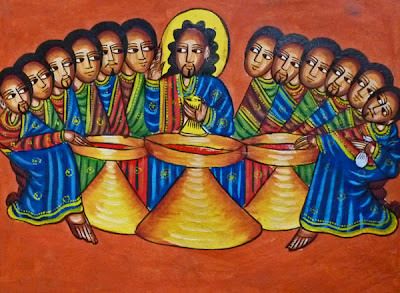
*Above painting: Ethiopian Orthodox Church depiction of the Last Supper

Colossians 3:12-17 – Wear the Right Clothes

God loves you and has chosen you as his own special people. So be gentle, kind, humble, meek, and patient. Put up with each other, and forgive anyone who does you wrong, just as Christ has forgiven you. Love is more important than anything else. It is what ties everything completely together.

Each one of you is part of the body of Christ, and you were chosen to live together in peace. So let the peace that comes from Christ control your thoughts. And be grateful. Let the message about Christ completely fill your lives, while you use all your wisdom to teach and instruct each other. With thankful hearts, sing psalms, hymns, and spiritual songs to God. Whatever you say or do should be done in the name of the Lord Jesus, as you give thanks to God the Father because of him. (Contemporary English Version)

New life is fantastic!… Until it isn’t.

Like a new car eventually losing its new car smell, so it is quite easy for the Christian to experience the mountaintop of transformation, only to lug back down and walk through the boring old valley.

And it’s fun to have a new set of clothes… until they wear out, go out of style, or fall apart in the washing machine. the thing about those new clothes we were so excited about when we got them is that they are wearing out.

When I was eight-years-old (a long time ago!) I still remember my favorite pair of jeans. I wore them every day. My Mom had to order me to take them off so she could wash them. Finally, after having several patches sewn on them, having grown too much, and with the material so thin you could see through them in places, that old ratty pair of jeans actually just fell off my body in a heap, as if to say, “Enough is enough, boy!”

Our nice white spiritual clothes, given to us through Christ’s resurrection, are to be our favorites. We need to clothe ourselves in them every day.

Because of Christ’s redemptive events of crucifixion and resurrection, believers can experience new life, free from sin, death, and hell.  Oh, it isn’t that we never need to deal with evil; we very much do. The difference is that we now have a new awareness of our spirituality.  And with awareness comes choices. 

If we aren’t aware of our feelings, our spirit, and/or old nature, well, then, it’s as if we operate on auto-pilot – losing altitude in an immanent descent into tragedy. When we are aware of our inner selves, then we mindfully ascend through the clouds to join Christ.

You were taught, with regard to your former way of life, to put off your old self, which is being corrupted by its deceitful desires; to be made new in the attitude of your minds; and to put on the new self, created to be like God in true righteousness and holiness.

Ephesians 4:22-24, NIV

We can make choices about what to wear. With awareness, we look in the mirror and see that the grave clothes need to come off. The old raggedy garments of pride and hubris, greed and immorality, selfish lust, jealous envy, spiritual gluttony, unholy anger, and complacency get taken off and tossed in the garbage. 

We then go to God’s expansive walk-in closet and choose the bright raiment of compassion, kindness, humility, gentleness, patience, forgiveness, and grab the beautiful coat of love which covers it all with such dignity and honor.

It would be super weird to try and put the new clothes over the old raggedy grave clothes. That’s not only gross, but it’s also downright wrongheaded. Practical Christianity always involves two actions: taking-off and putting-on. 

“No one cuts up a fine silk scarf to patch old work clothes; you want fabrics that match. And you don’t put your wine in cracked bottles.”

Matthew 9:16-17, MSG

Human willpower and/or ingenuity tries to live a virtuous life while ignoring the vices. This will not do for the Christian. The endearing qualities we so desire to possess cannot be obtained without first dealing with the crud of sin which clings to us like so many stinky dirty clothes. To put this in theological terms: the cross and resurrection go together. Sin must be put to death before a victorious life is put on.

Once we have acknowledged sin, let Christ take it all off, and put on the new clothes. Then we’re ready to hit the town in style!  We walk out the door with a tremendous sense of peace, knowing God in Christ has cleaned us up.  We stroll into the world with lips whistling and a song in our hearts – singing with gratitude for what the risen Christ has accomplished on our behalf. 

After all, we just put on expensive clothes and it didn’t cost us a dime.  In fact, we’re so darned thankful that we don’t just talk to others, we sing our words to them – even though we can’t carry a tune.  It doesn’t matter.  Our coat of love compels us.

Almighty and everlasting God, you willed that our Savior should take upon him our clothing of death upon the cross so that all humanity would have the privilege of wearing humility, gratitude, and love. Mercifully grant that we may both follow the example of Christ’s life, and also be made aware of our participation in his glorious resurrection, in the power of your Holy Spirit.  Amen.

2 Samuel 10:1-5 – Misunderstood

Sometime later, King Nahash of Ammon died, and his son Hanun became king. David said, “Nahash was kind to me, and I will be kind to his son.” So, he sent some officials to the country of Ammon to tell Hanun how sorry he was that his father had died.

But Hanun’s officials told him, “Do you really believe David is honoring your father by sending these people to comfort you? He probably sent them to spy on our city, so he can destroy it.” Hanun arrested David’s officials and had their beards shaved off on one side of their faces. He had their robes cut off just below the waist, and then he sent them away. They were terribly ashamed.

When David found out what had happened to his officials, he sent a message and told them, “Stay in Jericho until your beards grow back. Then you can come home.” (Contemporary English Version)

Showing mercy, grace, and good faith doesn’t always have a happy ending.

Sometimes people get burned for their genuine gracious overtures. Not only do some folks not return or reciprocate with grace. There are times when someone refuses it and even responds with criticism and judgment.

King David was at the pinnacle of his rule. All Israel and Judah were under his gracious authority. David acted as a godly sovereign when he sought to use his power to show kindness and grace to those in his kingdom, even to those who were related to his former enemy, Saul. (2 Samuel 9:1-12)

Yet when David kept up his gracious ways and sent a delegation to the Ammonites in order to bring compassion to a grieving nation, they not only spurned the kindness but attributed evil intent to it.

Why in the world would they do such a thing? Why did Hanun, the new ruler of Ammon, reject David’s kindness? Because he severely misinterpreted David’s motives, and completely misjudged David’s intentions.

It is important to make wise assessments of others, and not quick judgments about people or their situations.

Being misunderstood is downright difficult to swallow. Yet we can avoid sinful reactions and respond with grace, even if grace isn’t being shown to us:

  • We can be gracious by not always needing to have the last word. Any fool can get easily get sucked into an argument. Know when to stop talking.

Too much talk leads to sin. Be sensible and keep your mouth shut. (Proverbs 10:19, NLT)

Even fools may be thought wise and intelligent if they stay quiet and keep their mouths shut. (Proverbs 17:28, GNT)

  • We can be gracious through cultivating a humble spirit. Pride assumes that another can be silenced with the power of words. What’s more, wounded pride typically manifests itself by gossiping to others about our hurt.

Destructive people produce conflict; gossips alienate close friends. (Proverbs 16:28, CEB)

Pride leads to destruction; humility leads to honor. (Proverbs 18:12, CEV)

God opposes arrogant people, but he is kind to humble people. (James 4:6, GW)

  • We can be gracious by developing our capacity for civility and empathy. Often when someone spews their off-base judgments and criticisms upon us, they have a world of their own past personal hurt behind the angry diatribe. We can choose to be gently curious about this, discovering why there is such a visceral reaction to our kindness.

“I tell you, love your enemies and pray for those who persecute you, that you may be children of your Father in heaven. He causes his sun to rise on the evil and the good and sends rain on the righteous and the unrighteous.” (Matthew 5:44-45, NIV)

Show respect for all people. Love your brothers and sisters in God’s family. Respect God and honor the king. (1 Peter 2:17, ERV)

  • We can be gracious through tapping into an inner storehouse of wisdom. Knowledge puffs up. Love builds up. Wisdom is insight into reality. For the believer, it is the ability to take God’s Word and lovingly apply it to the lived experience we are enduring.

Hold on to wisdom, and it will take care of you. Love it, and it will keep you safe. Wisdom is the most important thing; so, get wisdom. If it costs everything you have, get understanding. (Proverbs 4:6-7, NCV)

It is true, of course, that “all of us have knowledge,” as they say. Such knowledge, however, puffs a person up with pride; but love builds up. (1 Corinthians, 8:1, GNT)

One of life’s hard lessons is that bestowing grace and mercy to others does not necessarily mean they will receive it and respond in kind. 

In fact, there are some individuals who refuse grace and give back only scorn and derision. Even the Lord Jesus experienced this like no other before or after him. Christ endured all the foulness and degradation of a cruel cross because there were people who refused to see that he was extending God’s grace to them. He turned scorn on its head by despising shame and enduring pain so that we would be spared of such ignominy. (Hebrews 12:2-3)

In those times when we, at best, scratch our heads, and, at worst, weep uncontrollably over having our genuine love paid back with harsh misunderstanding, it is a good reminder that we are imitating the life of our precious Lord Jesus who knows exactly what shame is and what a profound lack of mercy can do. 

It is in the seasons and events of life which produce frustration that we understand this: Perfect peace will not be found in this life. So, we more fully attach ourselves to Jesus and find genuine grace and the solidarity of faith and love.

Consider what Christ went through; how he put up with so much hatred from those misinterpreting and misjudging him. Do not let yourselves become discouraged and give up from gross misunderstanding.

Loving God, I give you thanks for sending your Son, the Lord Jesus. Christ is the pioneer of my faith. Just as he endured the cross, scorning its shame, and sat down at your right hand, so help me to live into the grace you offer through Christ’s redemptive events so that I might persevere with grace through all the unmerciful acts of this world. Amen.