

John 4:7-26 – Living Water

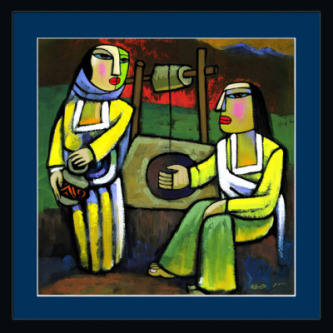
Samaritan Woman at the Well by He Qi

When a Samaritan woman came to draw water, Jesus said to her, “Will you give me a drink?” (His disciples had gone into the town to buy food.)

The Samaritan woman said to him, “You are a Jew, and I am a Samaritan woman. How can you ask me for a drink?” (For Jews do not associate with Samaritans.)

Jesus answered her, “If you knew the gift of God and who it is that asks you for a drink, you would have asked him, and he would have given you living water.”

“Sir,” the woman said, “you have nothing to draw with and the well is deep. Where can you get this living water? Are you greater than our father Jacob, who gave us the well and drank from it himself, as did also his sons and his livestock?”

Jesus answered, “Everyone who drinks this water will be thirsty again, but whoever drinks the water I give them will never thirst. Indeed, the water I give them will become in them a spring of water welling up to eternal life.”

The woman said to him, “Sir, give me this water so that I won’t get thirsty and have to keep coming here to draw water.”

He told her, “Go, call your husband and come back.”

“I have no husband,” she replied.

Jesus said to her, “You are right when you say you have no husband. The fact is, you have had five husbands, and the man you now have is not your husband. What you have just said is quite true.”

“Sir,” the woman said, “I can see that you are a prophet. Our ancestors worshiped on this mountain, but you Jews claim that the place where we must worship is in Jerusalem.”

“Woman,” Jesus replied, “believe me, a time is coming when you will worship the Father neither on this mountain nor in Jerusalem. You Samaritans worship what you do not know; we worship what we do know, for salvation is from the Jews. Yet a time is coming and has now come when the true worshipers will worship the Father in the Spirit and in truth, for they are the kind of worshipers the Father seeks. God is spirit, and his worshipers must worship in the Spirit and in truth.”

The woman said, “I know that Messiah” (called Christ) “is coming. When he comes, he will explain everything to us.”

Then Jesus declared, “I, the one speaking to you—I am he.” (New International Version)

Jesus and the Samaritan Woman by He Qi

Many years ago, I was the pastor of a small congregation north of Detroit, Michigan. Many of the people in the community viewed the big city as a place of disrepute. So, they avoided going into the heart of the great city as much as possible.

The locale of Samaria was viewed much the same way by many Jews back in Christ’s day. Samaritans were seen as untrustworthy, a mongrel people with a mix of Jewish and ancient Assyrian blood. And their religion was most suspect of all – an amalgam of Jewish and Gentile practices.

Jesus, however, didn’t avoid the territory. He confidently walked through Samaria and had no problem stopping to rest on his journey in a foreign area. That’s because Jesus didn’t class people into groups, nor did he attach adjectives to people, such as “those” Samaritans.

Jesus had no obstacles between himself and others.

Which is why an organic conversation happened between Jesus and a Samaritan woman. Christ simply saw a human being who happened to be a woman and a Samaritan. He acknowledged both her gender and her ethnicity without those being a problem. Not even Christ’s knowledge of her string of husbands was a problem in conversing with her.

Every time I read this narrative of Jesus interacting with the Samaritan woman, I wonder and use my imagination about all the non-verbal communication. I am sure the conversation was as much about Christ’s affect, gestures, and tone of voice, as it was his well placed words. I fully believe his verbal and non-verbal communication was perfectly congruent with each other, giving the woman a compelling sense that her ultimate needs could be met with the living well of a person in front of her.

Water gives life. And Jesus, as living water, gives new life. A bunch of failed relationships testified to the woman’s dissatisfaction. Even though we hear no more about her after this story in the Bible, we as readers get the overwhelming sense that the woman finally found satisfaction. The love which kept slipping through her fingers now had staying power.

I am sure the Samaritan woman discovered true worship, in spirit and in truth.

I still remember my first encounter, at least my first aware experience, with the living Christ. I am quite sure Jesus was near me for a long time, without me knowing his presence. Words will never truly capture the overwhelming sense of love, acceptance, mercy, kindness, and deep satisfaction – a contentment and gratification which has stuck with me now for decades.

Messiah, “Savior,” is an apt term for Jesus. He certainly saved me from myself. And Christ has never left me nor forsaken me – always there, always available, always loving with both tender love and tough love.

I’m glad that Jesus didn’t consider this earth like the city of Detroit – a place to avoid – but willingly came to encounter people like the Samaritan woman, and me. And this is the basis of true worship.

“Have faith in me, and you will have life-giving water flowing from deep inside you, just as the Scriptures say.” (John 7:38, CEV)

Lord Jesus, Son of God, Savior of humanity, there is a river flowing straight from your heart into mine — replenishing, renewing, sustaining. May you, as Living Water, be persistent in me, breaking through every barrier in its path. Send this hydro-power through the dark crevices of my heart like a mighty flood overcoming and pushing everything out of the way that blocks its path. I want my heart to be washed clean of any debris cluttering and blocking your life-giving flow. May your love overflow onto your people — your grace, your mercy — into the lives of those we encounter, to your glory and honor, in spirit, and in truth. Amen.

Psalm 111 – Praise

painting by P.J. Bruzzi

Shout praises to the Lord!
    With all my heart
I will thank the Lord
    when his people meet.
The Lord has done
    many wonderful things!
Everyone who is pleased
with God’s marvelous deeds
    will keep them in mind.
Everything the Lord does
    is glorious and majestic,
    and his power to bring justice
    will never end.

The Lord God is famous
for his wonderful deeds,
    and he is kind and merciful.
He gives food to his worshipers
    and always keeps his agreement
    with them.
He has shown his mighty power
    to his people
    and has given them the lands
    of other nations.

God is always honest and fair,
    and his laws can be trusted.
    They are true and right
    and will stand forever.
God rescued his people,
    and he will never break
his agreement with them.
    He is fearsome and holy.

Respect and obey the Lord!
This is the first step
    to wisdom and good sense.
    God will always be respected. (Contemporary English Version)

Sometimes we forget. Difficult challenges, heavy stress, or daunting responsibilities might become the focus of our lives to such a degree that we lose sight of the big picture. Today’s psalm helps us to back up the truck and take a sweeping panoramic view. The backdrop to all those concerns we presently experience is a Divine Being who is unfazed by any trouble. In other words, God’s got this.

The basis for this settled faith is a realization of who God is and what God has done.

Whereas change and loss is a reality all people must navigate, it is a comfort to know there are some things which never change. God is the One who is the same yesterday, today, and forever. God’s character is always right, just, and good. And God makes good on all promises.

Throughout the psalter, there are admonitions to praise the Lord. I personally do not believe the reason for this is because God requires adoration, like some self-centered narcissist. No, I think it has to do with God knowing we have a need to praise.

Our brains are complex organs. There is a lot we don’t know about it. Yet, what we now know is that things like gratitude, adoration, beauty, affirmation, and praise changes our brain chemistry in a healthy way.

Yes, praising the Lord perfectly syncs with our brains in such a way as to cause mental health.

People’s lives are improved when we are attentive to God’s law, God’s promises, and God’s works. Attention to these will surely result in praise. Everything God has created is good. All creation bears witness to the beauty and majesty of its Creator.

Believers throughout the millennia are a great cloud of witnesses, testifying to the veracity of God’s benevolent and gracious deeds. And together with them, we anticipate with confident faith the culmination of God’s promises when Jesus returns. This is basic Christian theology – and it is theology which is robustly sustains us through any type of trouble.

People need to delight in what is good, right, just, and beautiful.

Our brains are designed for it. The acknowledgment of the good is a sacred conduit which links us to the Designer of all that is good. Enjoyment of food and drink, fellowship with friends, participation in family life, and worshiping together with believers who share our most cherished spiritual values, is a gift from a benevolent God. It is worthy of offering praise.

God feeds us in many ways – with both physical and spiritual food. Pausing for gratefulness and thanksgiving is an appropriate and mentally healthy way of responding to the gift of nourishment. And acknowledging that all God’s commands and laws are trustworthy, through lifting prayers of gratitude for such a rich bounty of spiritual food, moves us into a healthy groove of wellness.

All of this healthy living is the way of wisdom. Attention to God and God’s Word is the starting place for a wise way of being in the world. The biblical psalms are much like a tutor which teaches us the best paths to walk in our daily life.

When we take the narrow road of righteousness, we discover the gifts of understanding informed by wisdom, self-control established through sage counsel, and knowledge guided by love.

The activity which bookends and binds such gifts together is praise to the Lord. Praise is what opens us up to the possibilities of life as it is meant to be lived. To press the transformation and enjoyment even deeper, believers shout their praise with raucous noise.

For true spirituality is not always staid and silent. It is also boisterous and loud.

Open my lips, O Lord, and my mouth shall proclaim your praise. Let the words of my mouth and the meditation of my heart be acceptable in your sight, O Lord, my strength and my Redeemer. Glory be to the Father, to the Son, and to the Holy Spirit, as it was in the beginning, it is now, and ever shall be, forever and ever. Amen.

1 Kings 1:1-30 – Facing Death

King David was now an old man, and he always felt cold, even under a lot of blankets. His officials said, “Your Majesty, we will look for a young woman to take care of you. She can lie down beside you and keep you warm.” They looked everywhere in Israel until they found a beautiful young woman named Abishag, who lived in the town of Shunem. They brought her to David, and she took care of him. But David did not have sex with her.

Adonijah was the son of David and Haggith. He was Absalom’s younger brother and was very handsome. One day, Adonijah started bragging, “I’m going to make myself king!” So, he got some chariots and horses, and he hired fifty men as bodyguards. David did not want to hurt his feelings, so he never asked Adonijah why he was doing these things.

Adonijah met with Joab the son of Zeruiah and Abiathar the priest and asked them if they would help him become king. Both of them agreed to help. But Zadok the priest, Benaiah the son of Jehoiada, Nathan the prophet, Shimei, Rei, and David’s bodyguards all refused.

Adonijah invited his brothers and David’s officials from Judah to go with him to Crawling Rock near Rogel Spring, where he sacrificed some sheep, cattle, and fat calves. But he did not invite Nathan, Benaiah, David’s bodyguards, or his own brother Solomon.

When Nathan heard what had happened, he asked Bathsheba, Solomon’s mother:

Have you heard that Adonijah the son of Haggith has made himself king? But David doesn’t know a thing about it. You and your son Solomon will be killed, unless you do what I tell you. Go say to David, “You promised me that Solomon would be the next king. So why is Adonijah now king?”

While you are still talking to David, I’ll come in and tell him that everything you said is true.

Meanwhile, David was in his bedroom where Abishag was taking care of him because he was so old. Bathsheba went in and bowed down.

“What can I do for you?” David asked.

Bathsheba answered:

Your Majesty, you promised me in the name of the Lord your God that my son Solomon would be the next king.But Adonijah has already been made king, and you didn’t know anything about it.He sacrificed a lot of cattle, calves, and sheep. And he invited Abiathar the priest, Joab your army commander, and all your sons to be there, except Solomon, your loyal servant.

Your Majesty, everyone in Israel is waiting for you to announce who will be the next king. If you don’t, they will say that Solomon and I have rebelled. They will treat us like criminals and kill us as soon as you die.

Just then, Nathan the prophet arrived. Someone told David that he was there, and Nathan came in. He bowed with his face to the ground and said:

Your Majesty, did you say that Adonijah would be king? Earlier today, he sacrificed a lot of cattle, calves, and sheep. He invited the army commanders, Abiathar, and all your sons to be there. Right now, they are eating and drinking and shouting, “Long live King Adonijah!” But he didn’t invite me or Zadok the priest or Benaiah or Solomon. Did you say they could do this without telling the rest of us who would be the next king?

David said, “Tell Bathsheba to come here.” She came and stood in front of him. Then he said, “The living Lord God of Israel has kept me safe. And so today, I will keep the promise I made to you in his name: Solomon will be the next king!” (Contemporary English Version)

Death isn’t exactly a popular subject. You might think, since all of us will eventually experience it personally, and most of us have seen it up close through dying loved ones, we would talk it up as something to face and deal with squarely…. Yet, we don’t.

Death ought to teach us how to live, how to face our limitations, and how to accept hardship and the inevitable.  Through today’s Old Testament lesson, I want us to observe four differing responses to the impending death of King David:

King David’s Servants

The servants of David treated his downward health as a problem to be solved. They were essentially sidestepping the whole death situation. The servants knew the David who was vigorous and took on enemies and problems. They wanted him to act like a king, so they looked for the miracle cure of a virgin who would be some sort of fix for David. In the ancient world, a king’s vitality was always linked to his sexual vigor. The servants thought if they could arouse David, he would be back to his old kingly self. In other words, the servants were trying to avoid death. And, of course, it didn’t work.

King David’s Son, Adonijah

Whereas the servants were scheming a way to get the old David back in the saddle, Adonijah was impatient to see his father David in the grave. He wanted his dad, the king, out of the way so he could pursue his own kingship. So, Adonijah simply proclaimed himself king, maybe hoping to hasten David’s death. Adonijah was just looking for his own opportunity and ended up losing his own life for it. Adonijah never understood the true dynamics of life and death – that life is complicated, and death should be honored, not used for personal gain.

King David’s Wife, Bathsheba

Bathsheba wanted to make sure her son Solomon became king. Reading today’s narrative, you might wonder why King David needed a virgin – where in the world was his wife!?  Bathsheba shows up to see David, not because she wanted to keep him warm and comfort him, but because she was concerned for her son. For Bathsheba, David simply became a means to an end – someone who could help her negotiate a difficult situation.

King David’s Caregiver, Abishag

Throughout this story, we have no recorded words from Abishag. Everyone else had plenty to say. In contrast to all of the other people, Abishag is simply a witness to David’s deteriorating health, and eventual death. She is like a hospice worker, who exists to ease the person’s pain in the end of life. In this, we can perhaps learn more from Abishag than from anyone else – to be present, to listen, to serve.

Unfortunately, death brings out the worst in some people. But if we will face death and not view it as a problem to be solved, an opportunity to be seized, or a difficulty to be negotiated, I believe we will find the grace of God when we become sacred witnesses to death.

The Lord Jesus faced death. Christ didn’t try to avoid death. He wasn’t impatient to get it over with. And it was not a difficulty to stoically endure. Our Lord’s death is our life – and it has brought meaning to both our lives and to our own eventual deaths.

Into your hands, O merciful Savior, we commend all your servants staring death in the face today. We, your people, humbly ask that you acknowledge these sheep of your own fold, these lambs of your own flock, and these sinners of your own redeeming. Receive them into the arms of your mercy, into the blessed rest of everlasting peace, and into the glorious company of the saints in light. Amen.

John 6:35-40 – The Bread of Life

I Am the Bread of Life by Joseph Matar

Jesus said, “I am the Bread of Life. The person who aligns with me hungers no more and thirsts no more, ever. I have told you this explicitly because even though you have seen me in action, you don’t really believe me. Every person the Father gives me eventually comes running to me. And once that person is with me, I hold on and don’t let go. I came down from heaven not to follow my own agenda but to accomplish the will of the One who sent me.

“This, in a nutshell, is that will: that everything handed over to me by the Father be completed—not a single detail missed—and at the wrap-up of time I have everything, and everyone put together, upright and whole. This is what my Father wants: that anyone who sees the Son and trusts who he is and what he does and then aligns with him will enter real life, eternal life. My part is to put them on their feet alive and whole at the completion of time.” (The Message)

Bread has always been a food staple throughout human history. Whereas many people today try and avoid bread because of either carbohydrates or gluten, a lack of bread in the ancient world usually meant people would starve to death. Bread is a big deal.

So, when Jesus gave a self-description as the Bread of Life, he was saying a lot.

The cup we use in the Lord’s Supper and for which we give thanks to God: when we drink from it, we are sharing in the blood of Christ. And the bread we break, when we eat it, we are sharing in the body of Christ. (1 Corinthians 10:16, GNT)

After the Israelites were delivered by God from their bondage in Egypt, and found themselves in the desert without food, the divine provision of manna – a unique kind of bread – literally showed up on the desert floor every morning. It was just enough for everyone for that day. Once the Israelites entered the Promised Land, the manna disappeared.

As Jesus entered fully into his earthly ministry, throngs of people began following him. At one point, the thousands of men, women, and children were together with nothing but a couple of fish and a few loaves of bread. Much like the miraculous provision of manna which sustained their ancestors centuries earlier, Jesus multiplied the measly morsels of bread into enough to feed the entire bunch, with leftovers.

Little is much when God is in it. Just a smidgeon of Jesus is enough to fill a crowd of growling stomachs.

The Lord Jesus is not like a loaf of bread bought in a grocery store which has all kinds of funky additives, loaded up with sugars, and questionable ingredients you can’t even pronounce. Christ is fortified with everything we need to thrive and flourish. Jesus is so packed with good stuff that a seemingly paltry communion wafer is filling and satisfying.

The bread that comes down from heaven isn’t like what your ancestors ate. They died, but whoever eats this bread will live forever. (John 6:58, CEV)

Just as bread is a simple mixture of water and flour, so partaking of Jesus is rather uncomplicated. There aren’t hoops to jump through or lengthy recipes to follow. If we simply align ourselves with Christ, come to him and believe, we will never be hungry again.

The world needs bread. They ask for bread. In response, Jesus gave them himself.

Give us the bread we need for today. (Matthew 6:11, CEB)

All the world has to offer, and of which so many humans strive to obtain and accumulate treasures on earth, money and possessions, does not bring ultimate satisfaction. The drive for more is never satiated. Humanity is afflicted with boredom, dissatisfaction, anxiety, and worry over losing what they have and fretting about how they can obtain just one more thing in the misguided belief their fear will finally melt.

But it doesn’t. So, like a hamster running in a wheel and going nowhere, there is the constant activity of racing thoughts and workaholic behavior to try and somehow keep ahead. Yet, authentic rest never comes. The more the striving, the more the anxiety.

There is a divine/human responsibility and cooperative at work. Jesus will hold us secure. And we need to let him do it, and fully align our lives according to Christ’s words and ways. The divine bread is available. God isn’t going to force feed us. We will need to take and eat.

It requires faith to take and eat. We might wonder: Will I like it? Is it really going to satisfy me? What if I’m allergic to it? Do I need some other food handy to eat in case I gag or vomit? Will there be pie? Mac & cheese? Bacon? (insert your own comfort food) Do I have to eat alone?

Try it. You’ll like it.

My own experience of having tasted much of what the world has to offer, and tasting the good flavor of God’s grace, I can say that I never want to go back to the gruel of guilt and shame.

I have tasted and seen that the Lord is good. And that is what I want for you, too.

Taste and see that the Lord is good; blessed is the one who takes refuge in him. (Psalm 34:8, NIV)

The bread is for me, and it is for you. There is plenty of bread for the life of everyone in the world. No rationing is necessary. This is the place of abundance.

“I am the living bread which came down from heaven. If anyone eats of this bread, he will live forever; and the bread that I shall give is My flesh, which I shall give for the life of the world.” (John 6:51, NKJV)

Almighty and everlasting God, I thank and praise you for feeding me with Jesus, the Bread of Life. Send your Holy Spirit so that I may by faith obtain and eternally enjoy your divine grace, the forgiveness of sins, unity with Christ, and everlasting life; through Jesus Christ my Lord. Amen.