Hope for the Perfectionist


            Perfectionism, in my humble opinion, is one of the greatest maladies affecting the church today.  One of the reasons for this is that it perpetually goes un-diagnosed.  After all, the church servant who will go over and above putting in hours to make the ministry team successful is hailed by others.  The pastor who will drop everything at any time for a parishioner receives accolades as one who cares.  The teacher who crafts a lesson in such incredible detail awes her students.  It goes beyond the walls of the church, as well.  The woman who keeps a perfect physique garners the respect and attention of both men and women.  The man who works tirelessly for the company and his clients may receive awards and promotions, and the praise of his boss.
 
            But it all has a steep price:  the inability to distinguish between excellence and perfection, and the cost of becoming hopelessly depressed.  Perfectionists constantly “should” and “ought” themselves to death.  Their work, no matter how good, is never good enough.  “I should have done better.”  “I ought to be able to do better.”  “I must be, do, and look better.”  Instead of viewing life’s opportunities as challenges to be welcomed, the perfectionist sees life as one unending insurmountable mountain to climb, never quite reaching the top.  The constant companions of perfectionist people are disappointment, condemnation, frustration, and perceived failure.  It is an internal world of self-deprecation based on the lie that I can’t just be good enough – I have to be perfect.


            People might like to always have a perfectionist doing the work (which is why they continually get asked to do everything!) but, to put it both biblically and bluntly, perfectionism is sin.  Perfectionism is a nice shiny way of saying legalism.  Legalists rigidly overemphasize external results, do’s and don’ts, rules and regulations, and have expectations for themselves and others that can never be attained.  Sound familiar?  The perfectionist fits right into this sinful way of thinking.  In other words, the legalist/perfectionist has a fragile spirituality dependent on personal performance.  They have such a finely tuned sense of guilt that it is literally impossible to ever meet their own standards.  No wonder many perfectionists struggle mightily with anxiety attacks and depression.
 
            There is only one antidote to perfectionism:  unconditional approval from God.  That is, grace is the elixir of life.  Grace is the only thing the perfectionist can’t work to obtain.  God’s grace is freely given, not dependent on abilities, and un-repayable.   God’s loving acceptance of us has nothing to do with our worthiness.  Recovery for the perfectionist can only occur by a radical acceptance of grace.  Perfectionists have been so programmed by themselves to impossible performance and conditional love that this extreme gift of grace is hard to take.  Change won’t happen overnight, and that’s okay.  It’s okay because God deals with us according to grace, not by earning spiritual merit badges.  The renewal that brings transformation of the perfectionist mind is typically a process.  Here is a really radical idea and thought for the perfectionist:  enjoy the process.  When you have caught yourself going back to the pig sty of perfectionism, instead of beating yourself up, go ahead and laugh at yourself and your own fallibility.  Perfectionists take themselves way too serious.  Anytime they can lighten up, it lights up the face of God (in a non-performance sort of way!).
 
            Jesus said that we should come to him because he will give us rest (Matthew 11:28-30).  He said that his yoke is easy, and his burden is light.  It isn’t anything like the heavy yoke of legalistic perfectionism.  So, take that good news from Jesus and enjoy a better way to live.  Jesus will never leave you, nor forsake you, even when you screw up.
 
Arise, my soul, arise; shake off thy guilty fears;
The bleeding Sacrifice in my behalf appears:
Before the throne my surety stands, before the throne my Surety stands,
My name is written on His hands.  –Charles Wesley

Loving God with All Your Strength


God loves the smell of your sweat.  You might stink to high heaven from hard work but for God it is a sweet aroma and sacred incense.  God loves it because it brings him glory when we break a sweat loving him with all of our energy (Mark 12:30).  Love isn’t primarily measured by words spoken, but by calories burned (1 John 3:18).  We are to use all of our strength to love God.  Using our hands and our effort is as valuable to God as using our brains.
 
            We should feel free to go hard after God with all our strength.  We need not have any hesitation about using our very tangible efforts in work as loving God.  But because we only have so much strength and energy, we need to make sure we are not wasting any of our energy on sin.  Too many of us waste our energy on things we can’t have and stuff that we can’t control.  If we spend a bunch of energy on things like pride, anger, and selfishness then we only end up wasting even more energy on guilt, shame, and regret.  Nothing saps our strength more than sin.  So, then, we need to keep busy doing the right things.
 
            Loving God with all our strength requires limits and healthy rhythms of life.  If we understand the importance and value of hard work, we much too often wrongly think that the answer to most things is to work harder.  You don’t do that with your car.  You don’t see a red light come on the dash and automatically say, “Oh! there is a problem with my car – I will drive it harder and longer and the problem will go away.” 
 
            Some Christians have a bent toward working themselves into the ground, not using their God-given brains to tell them that this is not loving God.  Many persons feel the pressure of responsibility, the fear of failure, the obsessive need for perfectionism, and the just plain stress of dealing with people and conflict.  So, we ignore our better judgment and put our foot to the accelerator.  It is no wonder, then, that people have crack-ups and breakdowns, both emotionally and physically.  Some individuals find the shame of failure too unbearable to let up on the gas pedal, and so keep going day after day worried that they might be letting someone down.  Wise and rightly ordered priorities come from well-rested Christians.  So, it must be remembered that keeping the Sabbath affords an opportunity to put all our energy into loving God in ways that we cannot on the other six days.  
 
            On the other extreme, laziness can easily creep in because the classic spiritual disciplines of Bible reading, solitude and silence, prayer and fasting, and giving rarely clamor for our immediate attention.  We may have so many other irons in the fire that the very relational activities that help us connect with the Lord Jesus get squeezed out.  Tyranny of the urgent is a harsh taskmaster, and we rarely slow down long enough to realize that we have drifted far from God and are in danger of ignoring Christ and his salvation out of sheer neglect (Hebrews 2:1-4). 
 
            Let us, then, put all our strength into loving God, rather than simply loving the idea of loving God.  All relationships take work.  So, if we claim to be Christians it only makes sense to use the best time of our day each day to relationally connect with Christ and seek to connect with other Christians in fellowship.  Now is not the time to feel guilty for what you have not done, but to accept the grace that is in Jesus and enjoy his presence and his Church.  Blessed are those who hunger for righteousness, for they shall be filled.

Loving God with All Your Mind


“What do you have in there worth living for?” That is just one of many quotable lines from The Princess Bride.  Miracle Max was trying to find out if he could rescue the young Wesley from certain death.  Turns out he was only “mostly dead.”  What came out of Wesley when Miracle Max pressed on him was “true love.”  It is always a great story:  true love is never satisfied; true love conquers all. True love has an insatiable desire to know more and more about the object of its affection.  To love God with all of our minds is to want to learn more and more about Him, to know Him better and better.  It is to have a constant curiosity about God.  And the really cool thing about this is that God has given us the brains to accommodate this curiosity about Him.
 
            The average brain is only the size of a softball and weighs about 3 pounds, yet neurologists estimate that we have the capacity to learn something new every second of every minute of every hour of every day for the next 300 million years.  We have the mental equipment to love God.
 
            So, then, to just want to know the right answers about God and Scripture without putting any thinking behind it is to miss the whole point of Christianity.  Simply wanting the Cliffs Notes to the Bible and/or perusing God For Dummies is to miss the entire direction of love.  Loving God is about curiosity and learning, a desire to know the object of my affection.
 
            Since we are to love God with our minds, we ought to invite questions and curiosity rather than shutting it down.  Adults of all stripes:  kids and teenagers and college students who ask questions is a good thing; let them flex their brains.  There are too many adult Christians in this world that feel threatened by healthy robust questioning.  We are not just to fill up with correct information, as if the sheer accumulation of right doctrine is all there is to it.  We are to have a deep experiential knowledge of God that leads to learning about him more and more.  It is never satisfied, and the learning never ends.  Our minds are like muscles – they must be used and exercised on a consistent basis because if we stop learning we stop loving.  And I’m not talking about Sodoku puzzles.  I’m talking about stretching our minds with reading Scripture and good Christian books.  I’m talking about getting into discussions about God, Christ, and the Bible that broadens our understanding and deepens our faith. 
 
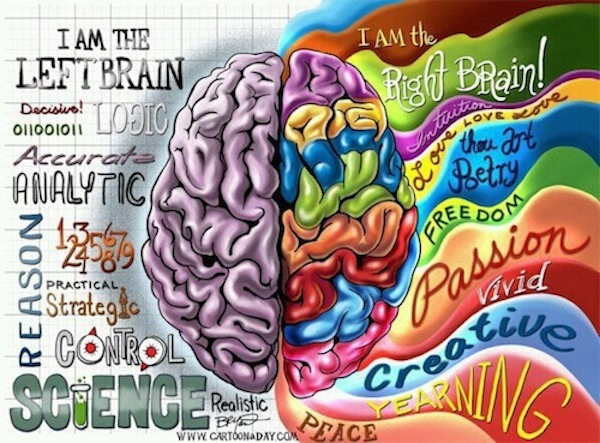
            We are to love God with all our minds; loving God with half your brain isn’t going to cut it.  Some people are dominantly left-brained people, that is, they are bent toward being logical, analytical, practical, and think mostly in concrete black and white terms.  There are other people who are heavily right-brained, that is, they are much more artistic, intuitive, creative, imaginative, humorous, even sarcastic, and tend to speak more poetically with lots of satire and metaphors.  If we are to love God with all our minds we will seek to use all of our brains, both the right and the left parts of it.


            One of the problems we run into is that the mind of sinful people is death (Romans 8:6).  Death means separation.  They are separated from God in their minds.  To have a sinful mind is to have a small brain.  The sinful mind isn’t interested in genuine critical thinking – only in stubbornly expressing opinions.  Sinful people aren’t using their brains, or only a small part of them.  But God wants to sanctify our whole brains.  That means we are to be transformed by the renewing of our minds (Romans 12:2).  We are to use all our minds to love Him.  That means we will value the left brain orientation of desiring to know the bottom line and being results driven.  We will embrace order and discipline, and use all the tools of reason and logic, learning critical thinking skills that can serve us in growing and knowing and loving God and God’s people.  But it also means we will value the right brain orientation of embracing mystery, paradox, and gray areas, enjoying the process of discovery and probing the deepest issues of scripture and humanity – all the while being comfortable with asking questions and not always having the answers.
 
Loving God means we will tap into all our minds, not just half our brains.  The Bible itself engages us in a mentally holistic approach.  We have, for example, the linear arguments of New Testament epistles, as well as the creative and poetic approach of the prophets and the psalms.  We are to combine the right brain value of viewing the Christian life as a road in which we journey along, and the left brain pursuit of the goal to win the prize for which we are called heavenward in Christ Jesus.
 
Do you love God with all your mind?   How can you engage all of your brain to love God?  What contribution can you make to God’s people with your intelligence and creativity?  Will you seek to have your mind renewed?  May your mind be so flooded with God’s grace that the thoughts and words that come out of it is true love.

Loving God with All Our Soul


God sees so much more than we do.  Sometimes we forget that.  We don’t see like God does, so there are times we wonder where he is.  But God does see every obedient act done in secret, each prayer uttered in the privacy of our closet, and all the places where his people have selflessly given themselves to love and compassion.  We have a need to see God’s glory.  We need to not just see the muck of the world in all its awful muckiness; we equally need a newfound sense of God’s wonder and beauty, to reclaim the soul of Christianity.
 
            To love God with all my soul means the deepest parts of my life are flooded with God’s glory, awed by His majesty, mystery, and beauty.  We are to perceive the glory and wonder of God that is all around us.  It is to be thankful, deeply thankful for everything – even for the personal hardship and suffering that I face.  I’m thankful for it because it is one means by which I can better know God and see His glory.  Peter said, Dear friends, do not be surprised at the painful trial you are suffering, as though something strange were happening to you.  But rejoice that you participate in the sufferings of Christ, so that you may be overjoyed when his glory is revealed.  If you are insulted because of the name of Christ, you are blessed, for the Spirit of glory and of God rests on you (1 Peter 4:12-14).
 
            Apart from Christ we don’t see this perspective, we don’t see the world as it is; we only see the world as we are (and so we think that how we understand things is the way things really are or, at least, should be).  Being full of God’s glory makes life, even if it is hard, wonderful because then we see with spiritual perception.  The human eye can only perceive light waves between 0.000004 and 0.000007 centimeters long.  In other words our visual range is the equivalent of one playing card on a stack of cards stretching halfway across the universe.  But God sees the entire range of light, and to love God with all our soul is to see life and reality from His perception of things.
 
            The best way to cultivate a love for God with all my soul and see His beauty is to meditate on Scripture and on creation.  Literally take time to smell the roses.  If you walk or drive the same route every day, make a commitment each day to see one thing you have never seen before.  Then, praise God for it.  What is more, every one of us has the privilege and opportunity to read or listen to God’s Word every day.  It needs to be as much of a routine as getting out of bed.  Each time you open your bible, determine to read it slowly and carefully seeing one thing in Scripture that you have never seen before.  Then, praise God for that perception.
 
We don’t just need a little soul in our love for God; we are to love God with all of our souls (Mark 12:30).  Middle class white people with Northern European ancestry (my church) are not known for their soul.  There is no Dutch Soul Food restaurant anywhere that I am aware of.  I have never seen a German-American Hip-Hop Club.  Maybe it is time to change the perception that we Christians have no soul.  Let’s not try and domesticate this very basic command of Scripture to love God with all our souls.  Yes, it may look different for us than some other people, but it is no less a command.  We ought to be so filled with God’s glory and wonder that we unashamedly raise our hands in praise, fall on our knees in prayer and adoration, and chatter all the time about Jesus – Deuteronomy 6:7 says to talk about God and his commands when you sit at home and when you walk along the road, when you lie down and when you get up.  We are to be excited about living for God because God wants us to love Him with lots of flavor!
 
What moves your soul to action?  David Platt, a pastor in Birmingham, Alabama once spent ten days in China.  His plan was to move around the country, but he first visited some local house church leaders.  He never went anywhere else in the country.  They were supposed to meet for a short bible study.  Instead, it turned into a ten day 8-12 hour a day teaching of Scripture.  After that first day the Chinese leaders asked David Platt:  “Would you be willing to teach us about all the books of the Old Testament while you are here?”  Pastor Platt laughed and said, “All the Old Testament?  That would take a long time.”  Here was their collective response:  “We will do whatever it takes.  Most of us are farmers, and we work all day, but we will leave our fields unattended for the next couple of weeks if we can learn the Old Testament.”
 
The hunger for God by many around the world is huge and immense.  They love God with all their soul to the point of doing whatever it takes to know God better and live for Him.  For too many of us, we are conditioned to simply give God our scraps – some of our discretionary income; whatever time we might have left-over from our work and other activities; showing up for church if it doesn’t conflict with something else, as if God were our pet that we just give the table scraps. 
 
Will you do whatever it takes to love God with all your soul?  Do you perceive and see the grace of God all around you?