All Saints’ Day


In all times and every place throughout history God has specialized in taking imperfect and broken people and transformed and used them for his own glory and honor.  On the Christian calendar, November 1 is the day each year to remember the saints who have gone before us.  This day is meant to be an intentional way of not forgetting the people, friends and family as well as long-dead historical saints, who have made a significant impact in our spiritual lives.
 
All Saints’ Day should not be a focus on extraordinary persons so much as on the grace and work of ordinary Christians who faithfully lived their lives.  We give thanks for the gift of how they lived their faith each and every day.  We also remember that all believers in Jesus are united and connected through the cross.
 
            Remembering is a prominent theme in Scripture.  Well over a hundred times we are told to remember God’s covenant and actions on behalf of his people; to remember those less fortunate; and, to remember the important people in our lives who influenced us in our journey of faith.  The writer of Hebrews exhorted Christians with this:  Remember your leaders, who spoke the word of God to you.  Consider the outcome of their way of life and imitate their faith (Hebrews 13:7). 
 
            We are to be inspired in the present with the actions of faithful saints of the past.  They are to serve as a model of faithfulness so that they we will persevere in our Christian lives and not give up.  Through biblical stories of very human persons being used of God, as well as reading biographies of godly people who were given to God in service, we can be motivated to be patient and keep persevering until Jesus returns.
 
            Who were the people in your life that went out of their way to communicate the gospel to you both with words and with actions?  Who were those persons who labored behind the scenes in prayer so that you and others would know Jesus?  If any of those persons are still around, and you know where they are, remember them.  Drop them a note.  Express to them a simple thank you for their influence in your life.  In doing so, you will not only encourage that person, but it will help you remember and re-engage with something in your life that you may have forgotten or have just taken for granted for too long.
 
            Gordon McDonald, a Christian pastor and writer, at the passing of a lifelong mentor, recalled his loyalty and the crucial counsel he gave in a crisis:  “He was there when, many years later, my life fell apart because of a failure for which I was totally responsible. In our worst moments of shame and humiliation, he came and lived in our home for a week and helped us do a searing examination of our lives. We will always remember his words: ‘”You are both momentarily in a great darkness. You have a choice to make. You can—as do so many—deny this terrible pain, or blame it on others, or run away from it. Or, you can embrace this pain together and let it do its purifying work as you hear the things God means to whisper into your hearts during the process. If you choose the latter, I expect you will have an adventurous future modeling what true repentance and grace is all about.’”


            We are not to live our Christian lives in isolation from others, as if we do not need them.  We are here today because someone significantly influenced us in the way of Jesus.  And we will continue to persevere and thrive in the faith only when we remember those who have gone before us and allow those here in the present to journey with us along this road of faith.


Family Faith Formation


            The default setting for most people is that they continue being in the present what they have been in the past.  For many persons, the only way they really know how to live their lives is by drawing upon how they have been raised.  Rarely do people’s thoughts and behavior change dramatically without some big-time exposure to new relationships or to completely different experiences.  As a generalization, only when people face insurmountable challenges and unsatisfying solutions do they consider a different path from the one that they have always known.  In other words, people don’t usually change unless they have to.
 
            This is why faith formation within a family is so very important.  If a family’s modus operandi is mostly doing their own thing, like watching their own TV shows in separate rooms or pursuing only personal goals, then faith formation will likely be negligible.  But if a family makes it priority and intentionally pursues eating meals together, discussing shared experiences, and reading Scripture and other works of literature as a family, then the likelihood of a significant faith formation will occur. 
 
            Families may place importance on church attendance.  Yet, if that attendance is not followed through with family discussions and by looking for ways to put the sermon or worship event into practice, then church may have little impact upon any given family member.  Sociologist Christian Smith has discovered in his research that in order to sustain high levels of religious commitment through the adolescent and emerging adult years, several factors are present, including:  a strong faith commitment among parents that provides significant modeling; shared faith experiences in families; personal and family practice of prayer; other supportive faith-minded adults; close relationships between family members; and, frequent Scripture reading, along with the openness to ask questions.  Smith furthermore found that within such families kids had few religious doubts and tended to place a much higher importance on religious faith.
 
            This combination of a teenager’s parental spiritual practice, the importance placed on faith, prayer, and Bible-reading within a family makes an enormous difference in what will happen to that teen when he/she enters the twenty-something years – a time when many young adults dropout of church.  Perhaps one of the most significant reasons why a twenty-something moves away from a sustained faith commitment is that he/she never really had a firm foundation of faith as demonstrated and lived-out within the home.  If our past family situations hold such a prominent place in how we shape our lives, then it behooves us to ensure that as parents, grandparents, and significant others that we make the default setting one of confident faith and serious engagement with Holy Scripture.


            “Train a child in the way he should go, and when he is old he will not turn from it” (Proverbs 22:6) is not a promise of the Bible, but a short pithy statement of experiential truth for most people.  A significant way of helping kids to grow a strong faith is by helping families grow strong in their own faith formation.  Churches and Christian organizations would do well to put their energies in such directions.  In so doing, they can be a default setting for a generation of emerging adults.

Reformation Sunday


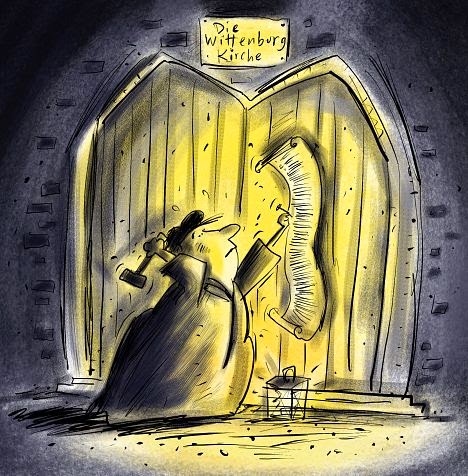
We all may be familiar with the fact that Martin Luther posted his 95 Theses on the door of the Wittenberg castle church which sparked the Protestant Reformation, but we are probably less familiar with the theological meat of Luther’s reforming spirit, his Heidelberg Disputation of 1518, written the year following the 95 Theses.
 
            In his Disputation, Luther contrasted two opposing ways of approaching Christianity.  He called these two ways the theology of the cross and the theology of glory.  The cross, as expressed by Luther, is God’s attack on human sin.  It is the death of Christ that is central to Christianity, and one must embrace the cross and rely completely and totally upon Christ’s finished work on the cross to handle human sin.  It is through being crucified with Christ that we find the way to human flourishing and life.  In other words, righteousness is gained only by grace through faith in Christ.
 
            The theology of glory is the opposing way of the cross.  For Luther, the wicked person, and the vilest offender of God is not the person who has done all kinds of outward sinning that we readily see.  You perhaps have an idea in your head of what the worst of sinners is like.  My guess is that it probably has something to do with an actual sinful lifestyle or particular evil acts. 
 
            Luther, however, insisted that the worst of sinners are those people who do good works, who pursue a theology of glory.  More specifically, the wicked person is the one who has clean living and does all kinds of nice things, but does them disconnected from God by wanting others to see their good actions.  Another way of putting it is that the wicked person is one who seeks to gain glory for him/herself, rather than giving glory to God.
 
            Our good works, Luther insisted, are the greatest hindrance to being a truly righteous person and living in the way of the cross.  It is far too easy to place faith in our good works done apart from God, rather than having a naked trust in Christ alone.  It is far too easy to do good things for the primary purpose of having others observe our goodness, rather than do them out of the good soil of being planted in God’s Word.  The only remedy for sin is the cross, and the sinner is one who lives life apart from that cross, trusting in him/herself so that people can recognize them and give them their due respect and praise.
 
            Here is what Luther had to say in a nutshell concerning his thoughts:  “It is impossible for a person not to be puffed by his good works unless he has first been deflated and destroyed by suffering and evil until he knows that he is worthless and that his works are not his but God’s.”
 
            So, then, the answer to this problem of doing good works out of our intention of gaining glory for ourselves is not to avoid good works, but to do them from the good soil of being planted in the law of God and being connected to the vine of Christ. 


            Reformation Sunday is a time to remember, and a time to repent.  We remember that we are saved by grace alone through faith alone in Jesus Christ.  We also take the time to repent of our works done apart from Christ and acted for the accolades of others.  Perhaps what we need today is another Reformation, that is, a reformation of spiritual habits that truly connect us to the vine of Christ – practices that shape our lives around the person and work of Jesus, and not around the idols of our hearts that make us look good and impress others.  What will you choose on this day?

Covenant vs. Contract


            It is a beautiful thing when someone makes a promise to you and follows through.  Whether it is someone promising to give free child-care, or to help out with a project that needs to be completed, promises kept are a kind of human glue that bonds us together as people.  When two people get married, they have a ceremony in order to publically make promises to one another – vows to remain faithful and to do everything within their power for the betterment of each other and the relationship, no matter the circumstances.
 
            God is a promise-making and promise-keeping God.  When humanity fell, God set in motion a plan to redeem his creation back to himself.  A healthy way to look at the whole of Holy Scripture is to understand that God has entered into covenant with his people.  That simply means that God has graciously made promises to certain persons – vows that he will fulfill.  The fulfillment of God’s promises is found in the person and work of Jesus, through his life, death, resurrection, ascension and glorification.  In Christ, we are redeemed and made holy.  Our proper response to God is to place our faith in those promises. 
 
            However, there are those who view a relationship with God not based on covenant promises, but more like a contract.  In a contract, promises are not made, but a deal is brokered.  On the practical level it operates something like this:  if I do good works, have clean living, and do what is right, God will bless me; and, if I don’t, God will punish me.  In a covenant understanding, when we fail or are disobedient, we confess our sins and God is faithful to forgive us and cleanse us.  But in a contract, when we fail we lose.  Relating to God according to a contract is like believing that life is like a math equation; if I do my part, God must do his.  And if God tells me to do something, I’d better do it or else.
 
            Too many Christians live by a contractual understanding of relating to God.  I knew a woman who was a very nice sweet person.  She grew up in a Christian home, never got into trouble, and did everything expected of her.  But when she became ill with a rare disease, her faith began to unravel.  She simply could not understand or make sense of the reality that she had been good all of her life and was dying a slow death.  Since 2+2=4, she thought that God was not holding up his end of the deal; the equation was not working the way it was supposed to work.
 
            On the outside, two people may be doing all the same things – serving in the church and doing a range of good deeds.  But on the inside, the motivation between the two may be very different.  One serves out of obligation to a contract; the other serves out of heart response to a covenant God who has made and fulfilled promises of salvation.  The litmus test of discerning between the two typically occurs when life does not turn out the way we expect, that is, when suffering and hard circumstances knock us hard on our rear ends.
 
            A legalistic view of the Christian life will always discern our relationship with God as a contract; we must do certain things in order to hold up the bargain.  But a grace-filled view of the Christian life has behind it a proper view of God as the One who has given us his very great and precious promises, despite the fact that we have done nothing to deserve them.


            Which view do you hold?  Can you accept a God who relates to you based on love and grace, and not on your performance, or lack thereof?  The Christian life does not work on the idea that if I do my part, and God does his, that everything will be hunky-dory.  Instead, the wonder and beauty of Christianity is that there is a God who steps in and saves when we have done nothing to earn or deserve it.  The proper life response to this is living obediently out of gratitude for such a grace.  May our churches be filled with thankful believers.