
God Cares About Worship


            The presence of God is both comforting and dangerous.  His holiness is like a fire, giving us light and warmth; but get too close to the flame and you will get burned, even destroyed.  The following statement should perhaps be obvious, but nevertheless needs to be said explicitly:  We as the church of Jesus Christ do not get to tell God what we are to be doing and how to go about it.  We have collective promises and blessings given to us as God’s people; but at the same time we have individual responsibilities to know the will of God and do it in the way he prescribes to do it (see 2 Samuel 6).
 
            God cares about his worship.  If we worship any old way we want without consideration of how God wants it done, or if we just critically watch worship without engaging in it, then the only thing we have to anticipate is the displeasure, even the judgment of God.  But if we will pay attention to God and his Word and are careful to do what God wants in the way he wants it done, then we will enjoy his divine stamp of approval.
 
            The church is first and foremost a worshiping community of redeemed persons through the blood of Christ, which are given to the world in order to glorify God before them.  1 Chronicles 16 gives an account of David’s worship service in bringing the ark to Jerusalem, which included a psalm of thanksgiving to God that he wrote himself to be sung by Asaph and his associates, the worship leaders.  Here is part of that psalm:
 
Sing to the LORD, all the earth; proclaim his salvation day after day.  Declare his glory among the nations, his marvelous deeds among all peoples.  For great is the LORD and most worthy of praise; he is to be feared above all gods.  For all the gods of the nations are idols, but the LORD made the heavens.  Splendor and majesty are before him; strength and joy in his dwelling place.  Ascribe to the LORD, O families of nations, ascribe to the LORD glory and strength, ascribe to the LORD the glory due his name.  Bring an offering and come before him; worship the LORD in the splendor of his holiness (1 Chronicles 16:23-29).
 
After the worship service, after the psalm had been sung by Asaph and the singers, the text says that all the people said ‘Amen’ and ‘Praise the LORD. But this was not the end.
 
            It goes on to say: David left Asaph and his associates before the ark of the covenant of the LORD to minister there regularly, according to each day’s requirements.  He also left Obed-Edom and his sixty-eight associates to minister with them….  David left Zakok the priest and his fellow priests before the tabernacle of the LORD to present burnt offerings to the LORD regularly, morning and evening.  And the text goes on to name the people who would be in charge of the musical instruments.
 
            Here’s the deal:  David instituted that in Israel the worship of God was to take place every day – not just one day a week.  What is more, David hired hundreds of musicians, singers, and worship leaders to minister before the Lord every single day, twice a day.  Most American Christians today do not even worship every Sunday, let alone every day.  While almost 40% attend church, on any given Sunday, only 17% of Americans are actually in church on Sunday.  That means that not only are fewer people worshiping together, the ones that do are doing it more infrequently.  American Christians might bemoan the morality and lack of spirituality in our nation, but when we as God’s people have no intention of being a worshiping community, then, we have nowhere else to look but our own individual lives and our own local church.  What is more, every conceivable instrument and voice was used to praise God in worship.  New songs were written continually by David, and arranged by Asaph, the lead worship person. 


While we have our plans and conceive of our ideas for our lives, God is waiting for us to worship him each and every day.  We might think of spending some time each morning when we arise, and each evening at bedtime, in worship doing the following spiritual practices, even if in brief:  remembering God, and who we are; singing to him; confessing sin; claiming forgiveness; reading the Word of God; and, prayer.  If we all devoted ourselves to worship in such a way, then we might begin to imagine God opening to us blessing upon blessing.

The Need for Lament, Part 2


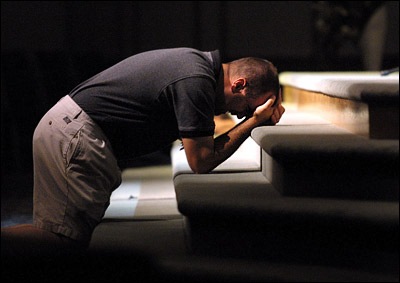
We all accumulate a host of losses over the course of a lifetime.  Many of them are small losses; some of them are devastating losses.  The death of children, disability, rape, abuse, cancer, infertility, suicide, and betrayal are all examples of crushing loss – losses that need to experience lament.  All these losses are irreversible; we cannot return to how things once were.  We must push forward by grieving each loss.  And as we lurch ahead we cling to these words from Holy Scripture:  Because of the LORD’s great love we are not consumed, for his compassions never fail.  They are new every morning; great is your faithfulness (Lamentations 3:22-23).
 
            So, how do we lament our losses in a healthy way?  Here is what the prophet Jeremiah did in the book of Lamentations:
  1. Jeremiah remembered his afflictions and his losses.  We need to avoid superficial repentance and forgiveness.  We must own and feel the pain of the loss before we can begin to offer a mature forgiveness.
  2. Jeremiah paid attention to faith, hope, and love.  This can only be done if we are alert to the process of grieving.  Elizabeth Kubler-Ross was the person who identified the famous five stages of grief:  denial, anger, bargaining, depression, and resolution/acceptance.  We rarely move neatly through each stage.  The important thing is that we get to the place of seeing God’s committed love to us not just in spite of the suffering but because of it.
  3. Jeremiah did not minimize his pain and suffering.  We must sit with our pain.  Do not sluff off a loss by saying others have it worse, or that it is nothing.  Year after year many Christians do not confront the losses of life, minimizing their failures and disappointments.  The result is a profound inability to face pain, and has led to shallow spirituality and an acute lack of compassion.
  4. Jeremiah prophesied about how Jesus grieved.  His message predicted what Jesus faced in his passion.  The prophet Isaiah described the Messiah as a man of sorrows and acquainted with grief (Isaiah 53:3).  Peter Scazzero, in his book The Emotionally Healthy Church, points out what Jesus did not say, and what he did say at particular events in his ministry.  At the tomb of Lazarus, Jesus did not say “Come on everyone, stop all this crying” but wept with the people.  When entering Jerusalem, Jesus did not say “too bad guys, I’m moving on without you” but lamented over the city desiring to gather them as a hen does her chicks.  On the cross, Jesus did not say “Lighten up everyone; God is good; he will be victorious!”  But instead said, “My God, my God, why have you forsaken me?”  Hebrews 5:8 tells us that Jesus “learned obedience from what he suffered.”
Grieving is an indispensable part of a full-orbed spirituality and emotional health.  Life does not always make sense.  There is deep mystery to the ways of God.  The Lord is doing patient and careful work inside of each one of us.  While he is busy within our souls, we will likely feel lost and disconnected, not seeing the full tapestry of what he is creating.  Weariness, loneliness, a sense that prayers are not being heard, and a feeling of helplessness are all common experiences of God’s reconstruction of a broken spirit.
 
People who have truly lamented their losses are not hard to spot.  They have a greater capacity to wait on God and be patient toward others.  They are kinder and more compassionate.  They lack pretense and are liberated from trying to impress others.  They are comfortable with mystery, not having to be certain about every theological minutiae.  They are humble, gentle, and meek.  They are able to see God not only in the glorious and victorious, but in the mundane, banal, and lowly.  They are more at home with themselves and with God.  People transformed through the power of lament are equipped to live and love others as Jesus did.


            So, then, the church really ought to be the best place on planet earth for people to be open in their grief, find openness in love, and effectively move through a process of lament so that they become mature disciples able to help others with the comfort they have received.  Let us pray toward that end.

The Need for Lament

 
We all face situations at some point in our lives which cause us to grieve.  In fact, grief can and does attach itself to any significant change or loss.  Bereavement, divorce, major surgery, losing a job, bankruptcy, and a host of adverse circumstances are all, understandably, events that bring grief to our lives.  They are all events we would rather not face.  What is more, grief can also attach itself to the positive changes of life:  moving to a new house in a new area; the empty nest; getting married; having children; a beloved pastor leaving a congregation; or, beginning a new job.  These all result through some sort of loss, even if that loss were chosen and necessary.
 
            The worst possible way to approach any of these kinds of situations, for good or for ill is to ignore them, minimize them, say they are simply in the past, and just move on.  It is actually unbiblical to take such an attitude because Scripture discerns that we need to lament our losses.  We have an entire book of the Bible given to lamenting a grievous loss (Lamentations).
 
            The prophet Jeremiah was called by God to pronounce judgment against Jerusalem.  And not only was Jeremiah to proclaim a very unpopular message, he was given the promise that the people would not listen to him and that Jerusalem would be destroyed with the people being sent into exile.  The prophecy of Jeremiah is a long extended message of a melancholy messenger preaching exactly what the Lord wanted him to preach.  God’s words came true.  The people did not repent of their empty worship and wayward lifestyles.  They persecuted Jeremiah for speaking words of judgment.  The Babylonians came and tore down the walls of Jerusalem, decimated the city and the temple, and carried off the people into exile.
 
            Jeremiah, in his grief over the ruined city of Jerusalem, wept and lamented the loss of this once great city with its grand temple.  It was only after an extended lamentation that Jeremiah turned his attention toward the love of God, his compassions becoming new every morning, and the hope of a new existence without Jerusalem at the center of Jewish life (Lamentations 3:19-33).  Jeremiah lost everything but his own life.  He had much to grieve over.
 
            Without exception, none of us can have the hope of love, compassion, and new life apart from the need to first lament our losses.  There is a popular phrase in our culture that we need to use very sparingly in our conversations with others who have experienced loss: “Get over it!” is often used much too quickly and can short circuit the grief process and puts grieving people in the awkward position of not seeing the power of lament through to its end of acceptance, resolution, and fresh hope.  Far too many people in both the world and even the church remain stuck in some stage or level of grief, unable to effectively move on because others expect them to be joyful and triumphant when they really feel downright awful and now guilty on top of it for being sad.
 
            Embracing lament is the only pathway to knowing compassion and becoming a compassionate person like Jesus.  Wallpapering over our losses without lamenting them is at the root of many if not most of the emotional problems in the church today.  Jerry Sittser wrote an important book, A Grace Disguised: How the Soul Grows Through Loss.  He was driving his family’s minivan when a drunk driver crossed the road and hit them head on.  In an instant he watched three generations of his family die in front of his eyes:  his mother, his wife, and his daughter.  If anyone knows the need and the power of lament it is Jerry Sittser.  Here is what he says:  “Catastrophic loss by definition precludes recovery.  It will transform us or destroy us, but it will never leave us the same….  I did not get over my loved ones loss; rather I absorbed the loss into my life until it became part of who I am.  Sorrow took up permanent residence in my soul and enlarged it.”
 
Grieving is an indispensable part of a full-orbed spirituality and emotional health.  Life does not always make sense.  There is deep mystery to the ways of God.  The Lord is doing patient and careful work inside of grieving people.  While he is busy within our souls, we will likely feel lost and disconnected, not seeing the full tapestry of what he is creating.  Weariness, loneliness, a sense that prayers are not being heard, and a feeling of helplessness are all common experiences of God’s reconstruction of a broken spirit.


Maybe we are always running, working, and playing because we are constantly trying to keep grief from catching up to us.  Slow down and let it catch you.  Let it do its intense and powerful work within you.  Let the church be a place of deep healing where the need for lament results in a more compassionate congregation.  

Confronting Courage


David and Goliath is one of the best known stories in the entire Bible (1 Samuel 17:1-50).  It is a classic example of what can be accomplished through one person who chooses to exercise the courage of faith.  This story has served as one of the greatest inspirations for believers down through the centuries to see God give victory to his people against dramatically overwhelming odds.  The New Testament exhorts us to live by faith; but this Old Testament chapter demonstrates to us what can happen when a person of faith chooses to put that faith into action.
 
            In the ancient world, a typical tactic of warfare was that, when the battle lines were drawn, a champion from each side was chosen and they would fight together, just the two of them, on behalf of the entire army.  It was a fight to the death, and the losing side would submit to the winning side.  This was a way of preventing the terrible carnage of war.  It also created some incredible individual champions.  A champion would be selected not only for his ability to fight, but also for his impressive stature so that there was an intimidation factor to it all.
 
            Saul was the King of Israel.  He was the logical choice for the combat since he was a head taller than all the other Israelites, and was a rather impressive looking soldier.  But compared to Goliath, Saul looked like a midget.  The intimidation factor worked.  Saul was downright afraid and was not about to put himself out there to face a giant.
 
            The explanation for the two contrasting responses between David and Saul toward Goliath is simple:  David was brave because of faith in God; Saul was fearful because he was not a man of faith in God.  The opposite of faith is not unbelief; it is fear.  As the muscle of faith grows and develops through trusting God in the daily stresses of life, fear begins to melt away.  The development of faith is a process, and it takes much time.  Through daily spiritual disciplines of Bible reading and prayer; and, putting what we read into practice; the faith muscle begins to grow large and strong so that God is preparing us to face down some pretty big giants.
 
            Men, in particular, need to confront two great fears:  being found inadequate; and, being controlled by another person or circumstance.  Those two fears were evident in Saul.  He felt inadequate because he compared himself to Goliath.  He felt controlled by the situation because the Philistines were picking a fight.  So, he did nothing.  There are many men who would rather do nothing in the church than be labelled as inadequate or controlled.
 
            David, in contrast, had practice at facing down foes, the bear and the lion, who threatened the sheep.  David was often out in the countryside all by himself as a shepherd, and his skills were developed in the place where no one was looking.  So, the way to deal with our development of faith is to be assertive in owning our relationship with God on a daily basis, as well as stepping out and serving the local church with courage. 
 
            It was not just Saul that was intimidated by Goliath; the entire army of Israel was hiding behind the battle lines cringing in fear.  In contrast, David discerned that there was no reason to avoid a big bullying blowhard.  It appears that David was the only person able to see Goliath as he really was:  a small person in comparison to a big God.  By faith, David understood that Goliath is no match for God.
 
            One person full of faith can accomplish the improbable while an army full of fear cannot accomplish a thing.  We might have a tendency to think that everything in church ministry has to be large with a big splash to it.  Somehow if we had an elaborate program with lots of people, then we could accomplish big things for God.  Yet, we need to step out in courageous faith.  Oftentimes we want an army of people because then we can still hide behind other people’s bravery while continuing to nurse our secret fears and insecurities. 


            Here is a reality check:  No other person can do our faith and relational work for us.  The Beaver Cleaver philosophy of life works something like this:  if I get in trouble or in a pickle of some sort, I’ll just ignore it and hope it goes away.  But Goliath is not going anywhere.  He will still be there tomorrow.  But if we will own the spiritual boot camp that God wants to put us through, then we will be prepared like David to take on the giant.  The greatest single element every church needs is people full of faith who have the wisdom to confront the true problems it faces.  Let that one sink into your forehead….