Faith in Jesus Changes Everything


Having done my share of weddings, I can tell you that something always goes awry and not according to plan.  Sometimes it is a big thing, sometimes a small thing.  I have had best men forget rings, bridesmaids faint, sound systems go out, and, both grooms and brides either laugh or cry so much that they can’t say their vows.  And then there is the reception.  I have been at receptions where we had to wait two hours for the food to be ready, places where different food had to be served than planned, and situations where there was no alcohol and circumstances where there was probably too much alcohol.
 
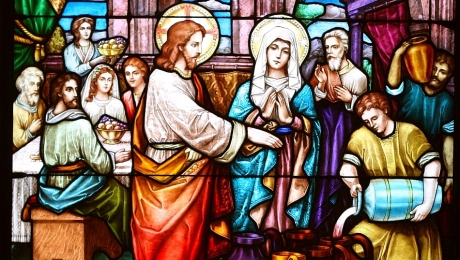
            Back in Christ’s day, a wedding ceremony lasted a full week with a feast at the groom’s home.  Running out of wine constituted a real social crisis.  Sometimes we forget that Jesus attended weddings and participated in gladness, celebration, and joy (John 2:1-11).  God is not always some dour upset divine Being who has no place for a party.  When a person places his/her faith in Christ, it does not necessarily mean taking vows of chastity, poverty, and going without the enjoyable things of this created world.  In fact, it makes complete sense that Christians above all other people would be people of deep faith and lots of celebration.
 
            Since Christians have been liberated from the fear of death; since they have meaning and purpose to life; since they are forgiven and made right by Christ, justified by him, there really ought to be a preoccupation with parties, banquets, feasts, and general merriment.  Christians ought to attract people to the church quite literally by the fun there is in being a Christian.
 
            If that piques your interest, and you are finding that your church experience is not always an enjoyable one, then pay attention to three important observations about faith in Jesus from the miracle of the wedding at Cana.
 
1.      Nobody looked for Jesus until the wine was gone.
 
            Old wine is still wine, and it was enough to keep the guests from seeking Jesus.  Many people do not pursue faith in Jesus until the old something runs out.  Those old attitudes, actions, habits, hurts, insecurities, and information are what we rely on and return to when things are rough.  But those old things can get in the way of faith in Jesus.  Sometimes the old just has to completely dry up and go away until we are truly open to Jesus.
 
            There are times when God allows all the old friends, old reliance, and old habits to run out so that there is no possible way of going back to it.  In order to embrace a new and living faith in Jesus Christ, the past trust in certain ways of doing things must go away.  This is why people most often come to faith in Christ in a time of crisis or trouble.  The rug has been pulled out from underneath them and they have no one and nowhere to look.  Sometimes, until the old is stripped away we cannot see the new possibilities of a fresh faith in Jesus.
 
2.      Obedience has to be mixed with faith.
 
            If we want Jesus to move in our churches, then we must do what he says.  Jesus commanded the servants at the wedding in Cana to fill the jars with water.  Fill them with water.  Without knowing the end of the story, this makes no sense at all.  But obeying Jesus was important because without it there is no miracle.  We really need to quit looking at what we have lost and no longer possess, and look to Jesus, giving him what we do have.  Jesus can do something with whatever we give him.  If it is only water, then he can turn water into wine.
 
            It is easy to become discouraged.  But sometimes only a few people who do what Jesus says, is enough.  They might not have much, but they bring what they have, and they end up seeing God’s glory.  We can trust Jesus by doing something simple:  give him what you have instead of wishing you had something more or different.
 
            Jesus did not explain himself.  He did not lay out his goals and strategy to the people.  Jesus just told the servants to fill the jars with water.  If you are a person of simple prayer, offer your prayers to Jesus and watch what he can do with them.  If you are a simple servant, give your service to Jesus and let him transform it into the miraculous. 


3.      The response of the disciples is that they believed.
 
            The disciples put their faith in Jesus.  Here is thought to think about:  maybe faith is kindled through parties and food more than it is through abstaining from stuff.  Perhaps the kingdom of God is marked predominantly by radical hospitality because it may illicit faith in people more than anything else.  Maybe the party-planning fun-loving playful otters in the church are the ones to take the lead in showing us the way to faith in Jesus.  Maybe eating and drinking with people is the avenue of showing Jesus to others.
 
            Faith is not a static one-time event.  Rather, faith is a process of getting to know Jesus, like having an easy conversation with him across the table.  Like an ever-deepening friendship, being in the company of Jesus can bring us great joy and gladness.


            Church ministry is meant to be enjoyable and liberating; it is not meant to be overly austere and difficult.  We are to delight in the good gifts that God has provided.  The miraculous sign of the wedding feast points to God’s grace.  Jesus is the source of every good thing; faith in him changes everything.  Since Jesus is here, God is with us.  Because God is present, let the party begin!

God Alone Justifies


God alone makes people right (Romans 8:33; Luke 18:9-14).  Because it is God who justifies, we do not have to!  We do not need to defend ourselves, make ourselves look good, or fool ourselves into believing that we are what we want others to think of us.  Insisting that we are always okay and right only creates division, separates people into bad and good, fosters disharmony, and is an affront to God.  To pursue what is already provided by God’s grace is sin.
 
            I realize I am using strong language here about self-justification.  But consider its origins.  It goes all the way back to the original sin of Adam and Eve.  They were told by God that they could eat from any tree in the garden; but they were given strict instructions not to eat of the tree of the knowledge of good and evil.  Have you ever wondered why God deemed it so important not to eat of that specific tree?  The knowledge of good and evil actually seems like it might be useful, even necessary.  So, why completely avoid that tree?  When Adam and Eve ate from it their eyes were opened to a different perspective, a new reality that changed the way humanity deals with one another.  From that point forward people began drawing lines down the middle and placing themselves on the good side while vilifying those on the other side, the bad side.
 
            Adam and Even started justifying their actions, their attitudes, and their behavior on the day they fell by drawing lines between good and evil.  Adam drew a line between him and Eve.  Eve gave him the fruit; she is on the other side.  Eve drew a line between her and the serpent.  Adam drew a line between himself and God!  Ever since our original ancestors started drawing lines and taking sides, it has never stopped.  We draw political lines and place ourselves on the good side while demonizing the other side.  We draw religious lines and place ourselves on the good side while distancing ourselves from our fellow humanity and calling them evil.  We draw lines between classes, races, gender, and ethnicities.  We are constantly drawing lines and taking sides.  Violence, war, and every other sin in the world come from the original sin of self-justification:  I am okay, you are not.
 
            In the movie, What About Bob? Bill Murray was asked by his therapist why he was divorced.  His answer:  “There are two kinds of people in the world; those who like Neil Diamond, and those who don’t; my wife loved him.”  Bob drew a line, placing himself on the good side of it while implying that his ex-wife was on the other side, the bad side.  Ever since the fall of humanity we keep drawing lines and justifying our attitudes and our actions.
 
            Self-justification always compares itself with others.  People who think that it is their job to always be right are constantly concerned about other people; they need to know what is going on with them.  They keep their ear to the ground because they must be vigilant to keep the lines drawn and distinguish themselves from those on the other side, the bad side.
 
            But when we are justified by God and he makes us right by his own grace, the curse upon humanity is reversed.  Everything changes and reverts to its original design.  Our souls are rebuilt and become robust and vigorous not through effort and work, but through relaxation and rest in Christ’s finished work.  There is now no fear because there is no condemnation for those who are in Christ Jesus.  There is no comparisons needed anymore because God is enough, Christ is sufficient.  There is no more worry about how we look to others; instead, there is contentment and satisfaction in the love of God in Christ.


Only God can justify!  Righteousness is a gift.  Until we know this, receive the gift, and live in it, we will continue in vain to make ourselves look good and be on the right side of everything while making others look bad.  It is not the job of church ministries to group people into who is in and who is out, who is bad and who is good; rather, church ministry is to proclaim the righteousness of Christ as the only means of making people right.  If there are no sides to take, then we are all in life together.  Until we get to that point, there is no progress.  But when we do, there is peace, love, and abundant joy that God would save such as sinner as I.

Praise the Lord


We are made to praise the Lord.  It is in our spiritual DNA to give adoration, praise, and honor to God.  Praise is not just meant for the times when our circumstances are going well; it is also for the despondent times, the times of difficulty, and the situations which are downright hard.  It is always open season on praising the Lord, no matter what is going on in and around us.  Praise can help to re-orient our lives around God instead of remaining stuck in being dis-oriented.  Whether in good times or bad, we are to praise the Lord. 
 
            Everything and everyone is to praise the Lord (Psalm 148).  Because God has created and continues to impact every nook and cranny of his creation, the entire universe, every creature, and all humanity have the common task to praise the Lord.  The outer reaches of the universe, everything out there which we cannot even see, are to praise the Lord.  The earth and everything in it is to praise the Lord.  The forces of nature are to praise the Lord.  The landscape, the flora and fauna, animals and humans are, together with all creation, to praise the Lord.  Young people, old people, men and women no matter who they are or where they come from are to praise the Lord.  The proper purpose of everything and everyone that exists is to give adoration and praise to God.
 
            Praise to the Lord is the recognition that God deserves praise from everyone, and the way to do that is to bow, yield, and submit to him.  “Praise the Lord” is the Hebrew “hallelujah.”  Hallelujah literally means “to raise the hands.”  Raising the hands is not just for Pentecostals! It is a symbol of submission and joy.  To have open hands lifted toward heaven is to convey to God that we will obey him and live for him in everything.  Praising the Lord, lifting the hands, is not only to occur in church; praising the Lord is to happen everywhere.  We are to lift our arms in reverent submission at our workplaces when we land a client or have a good day, as well as when we are overwhelmed and cranky people demean us.  It is always open season on praising the Lord, and it is not limited to a certain set of good circumstances.
 
            We are to raise our hands and praise the Lord when our neighbors care about us and look out for us, as well as when they make noise and irritate us with their less than kept up yards and houses.  Yielding to God’s purposes for our lives is not dependent upon whether we have good neighbors or not.  We are to praise the Lord and raise our hands when our marriages are life-giving and thriving, as well as when our relationship with our spouse is dry, dull, and going nowhere.  It is always open season on praising the Lord and reflecting his image through love.  We are to praise the Lord over our kids, not only when they do what is right but we are to raise our hands with hallelujah when they are complete stinkers and drive us nuts.  We are to use our hands to praise and enact obedience, not refuse to praise and use them for violence through finger pointing, fist shaking, and even hitting.
 
            In adversity we praise the Lord because it gives us a chance to put our faith into action.  In times when someone is being insensitive and callous, it provides the opportunity to praise the Lord and love them because God loves us.  It is very difficult to see God with your head down and your shoulders slumped; raise your hands, lift up your head and praise the Lord!
 
At all times, and in all places, in every circumstance and with each situation we are to raise our hands in hallelujah to Jesus for saving us from our misguided ways and bringing us back into fellowship with God.  Sometimes we go through experiences that leave us feeling alone, as if no one else has ever known such pain.  At other times we encounter such sentiments of joy that we wonder if there are people who have ever known such elation.  And then there are the typical, ordinary, mundane times of the daily grind, the living of each day almost on auto-pilot – going through the motions without much thought to what we are doing or where we are going.
 
            No matter our current situation, every day and every situation is a summons to praise the Lord.  God’s claim upon our lives ought to lead us toward raising the hands to him.  The person who truly praises God is marked by three things:  a deep humility, understanding that they are not God; expressive gratitude, recognizing God’s actions and living in patience; and, unity, a sense of common purpose with all humanity and all creation to praise the Lord. 


            There is to be a seamless transition from praising God in church settings to praising him in all other environments.  Our adoration of God is to be consistent across the entire spectrum of our lives.  By God’s grace our Sunday worship will train us to carry our adoration of Christ into daily praise.  May it be so, to the glory of God.

Peace on Earth, Goodwill to All?


It was the prophet Micah who prophesied that the Messiah would come from the small village of Bethlehem (Micah 5:2-5).  In Micah’s day there was no “peace on earth, goodwill to all.”  It helps to have some historical context in order to understand and appreciate the promise of God.
 
            Ever since the time of Solomon the kingdom was divided between north and south:  the northern kingdom of Israel with Samaria as its capital; and, the southern kingdom of Judah with Jerusalem as its capital.  In the 8th century B.C. the powerful Assyrian Empire conquered the northern kingdom of Israel.  They deported many of the Israelites and re-populated the cities with their own people.  This is why the Jews in Jesus’ day looked down on Samaritans.  They pejoratively viewed them as “half-breeds” who were a mix of Jewish and Assyrian descent.
 
            The Assyrian takeover of Israel not only left the northern kingdom in shambles but had a large impact on the southern kingdom of Judah.  All of Judah and Jerusalem were in extreme duress.  Even though Judah had not been conquered and was intact, they were still forced to pay tribute to the Assyrians in order to keep them at bay.  The problem became even more exacerbated because the leadership of Judah wanted to maintain their power and lifestyle.  They expected the poor to shoulder the burden of the tribute to the Assyrians.
 
            In addition, thousands of refugees from Israel were flooding into Judah and Jerusalem.  They had lost their homes, their land, and had nothing but their lives.  So, the already scant resources in Judah were pushed to the brink.  Judah was a mess.  Those in authority and power, the ones with the resources that could make something of a difference, ended up taking advantage of the situation by buying fields and land at a fraction of its worth because people were just trying to survive.  In some cases the leadership leveraged their power by pushing people off their land and taking it over.  It was anything but a time of security, peace, and actions of goodwill.
 
            Into this terrible situation of hardship and survival Micah’s message was that a new kind of leader will come.  He will have humble origins, just like the common oppressed people of Judah.  The refugees, the displaced farmers, and the poor will have a champion.  He will feed them and shepherd them, leading them to green pastures.  This leader will serve the people instead of the people serving the leader.
 
            As Christians, we understand this prophecy to speak of our Messiah Jesus.  This is why we look at Scriptures like this one during the season of Advent.  Just as the ancient Jews needed hope and the promise of a different ruler, so today we, too, need hope and the anticipation of the leader who will come again with an agenda using power for security, peace, and goodwill.
 
            Jesus is the promised one to come.  His exercise of leadership and power is different than earthly politicians and officials.  Israel and Judah had been so filled with bad kings and self-serving leadership over the centuries that Christ’s disciples could barely conceive of a different kind of rule.  This is why Jesus called his disciples together and said, “You know that those who are regarded as rulers of the Gentiles lord it over them, and their high officials exercise authority over them.  Not so with you.  Instead, whoever wants to become great among you must be your servant, and whoever wants to be first must be slave of all.  For even the Son of Man did not come to be served, but to serve, and to give his life as a ransom for many” (Mark 10:42-43).


            The greatest Christmas gift we can give this season is the gift of our lives to Jesus Christ, the promised Messiah.  When we see that God always keeps his promises; when we gain the understanding that Jesus is the fulfillment of all those good promises; and, when we receive the gift of the Spirit, it is not a duty but a delight to give ourselves to the triune God who has orchestrated salvation for us.  Since Jesus loves and serves us, it is a small thing for us to give ourselves to him in return.  May this be the reason for your joy, peace, and goodwill this season, to the glory of God.