Good Friday


            At first glance, “Good Friday” might seem a bit oxymoronic for a day observing the torture and death of an innocent man.  Yet, it is very good in the sense that the crucifixion of Jesus Christ meant the redemption of the world.  On this day Christians remember and commemorate the events that led up to the cross; unpack those events and interpret them with profound meaning and significance; and, worship Jesus with heartfelt gratitude in light of this redemptive event.
 
            The bulk of the New Testament Gospels of Matthew, Mark, Luke, and John are given over to the final week of Christ’s life, especially leading to the cross.  Good Friday worship services often take a somber form due to the brevity of Christ’s experience on the cross.  Christians remember the last words of Christ, and recognize the significant impact his death had on the immediate persons around him.  Believers also contemplate the lasting results of that singular death as an atoning sacrifice; perfect love; reconciliation between God and humanity; victory over evil; and, redeeming all creation.
 
            Sadness, then, is far from the only emotive expression on this day.  It is appropriate to feel wonder, gratitude, and deep satisfaction for the accomplishment of deliverance from the power of sin.  Thus, we not only remember the suffering of Christ, but what that horrible suffering accomplished.  In fact, the cross of Jesus is so significant that an eternity of considering its impact could not plumb the depths of its far-reaching effects.
 
            With all that has been said, one would think that Good Friday is a hugely observed day on the Christian Calendar.  Yet, it is not.  The bottom line is that the cross is not popular.  Not only do unchurched folk care not to think about it, but church attenders would like to be mindful about other things than the cross.  Episcopal priest Fleming Rutledge has adroitly put her finger on the problem:  “Religious people want visionary experiences and spiritual uplift; secular people want proofs, arguments, demonstrations, philosophy, and science.  The striking fact is that neither one of these groups wants to hear about the cross.”  Indeed, as the Apostle Paul has said, the cross of Christ is “a stumbling block to Jews and folly to Gentiles” (1 Corinthians 1:23).
 
            Our contemporary religious milieu celebrates and promotes self-styled spirituality; it is the “in” thing to eschew church and develop a personalized religion that fits the demands of the modern (or postmodern) world.  The cross, however, is “out;” too much blood and sacrifice, and not enough of what I’m looking for in life.  Perhaps we should think long and hard on Hebrews 13:12-13 – “Jesus suffered outside the gate in order to sanctify the people through his own blood.  Therefore let us go forth to him outside the camp, and bear the abuse he endured.”


            The extent of Good Friday goes far beyond just a day on the calendar; it is the fulcrum upon which all of Christianity hinges.  So, today, let us contemplate the cross, observe the salvation accomplished through Christ’s death, and offer prayers and petitions for those who need deliverance from the power of evil.  In short, let us worship God in Jesus Christ because of the cross.  Amen.

Maundy Thursday


            We are journeying with Jesus through Holy Week, the most sacred time of the Christian Year.  When we think about Holy Week, we are familiar with Good Friday and certainly Easter; but Maundy Thursday?  On this day the church remembers the last evening that Jesus shared with his disciples in the upper room before his arrest and crucifixion.  The experiences in the upper room were highly significant because this was the last teaching, modeling, and instruction Jesus gave before facing the cross.
 
            Maundy Thursday, then, marks three important events in Christ’s Last Supper with his disciples:  the washing of the disciples’ feet; the instituting of the Lord’s Supper; and, the giving of a “new” commandment to love one another.  Let’s briefly unpack these three impactful words and actions from Jesus.
 
            For Jesus, this was all about and for love, God’s love.  On that fateful night, having loved his disciples for the past three years, Jesus showed them the full extent of his love by taking the posture of a servant and washing each and every one of the disciples’ feet, including Judas.  After demonstrating for them a totally humble service, Jesus said, “I have set you an example that you should do as I have done for you” (John 13:15).  This was an incredible act of love.  We need to rightly observe that Jesus Christ loves me just as I am, and not as I should be.  He loves me even with my dirty stinky feet, my herky-jerky commitment to him, and my pre-meditated sin. 
 
            Not only did Jesus wash the disciples’ feet, but he lifted the cup of wine and boldly asserted:  “Take this and divide it among you.  For I tell you I will not drink again of the fruit of the vine until the kingdom of God comes.”  And he took the bread, gave thanks and broke it, and gave it to them, saying, “This is my body given for you, do this in remembrance of me.”  In the same way, after the supper he took the cup saying, “This cup is the new covenant in my blood, which is poured out for you” (Luke 22:17-20).  Because of these words of Jesus, the church everywhere throughout the world, for two millennia, have practiced this communion, this supper so that we might have the redemptive events of Jesus pressed firmly into both our minds and our hearts by means of the visceral and common elements of bread and wine.  We are to not just know about Jesus, but are to experience being united with him.
 
            Having washed the disciples’ feet, and proclaimed to them the meaning of his impending death, Jesus gave them a clear commandment:  Love one another, using the same model he had showed them (John 13:34-35).  We represent Christ on this earth when we carefully, diligently, and persistently practice love.  Although love was by no means a new concept for the disciples, in the form and teaching of Jesus love was shown with four distinctions:  Jesus as the new model of love; a new motive of love, that Christ first loved me; a new motivatorto help us love, the Holy Spirit; and, a new mission, the evangelization of the world using the power of Christ’s love to accomplish it.


            So, you see, Maundy Thursday is a highly significant day on the Church Calendar – one which deserves to be observed, and an opportunity to remember the important words and actions of Jesus on our behalf.  Through Jesus Christ we are to live always in love, modeling our life and church ministry after him.  In Christ we are to allow love to characterize our life together as we proclaim God’s love in preaching and sacrament.  A watching world will only take notice and desire to be a part of our fellowship if we are deeply and profoundly centered in the love of God in Christ.  This is the reality that Maundy Thursday brings to us.

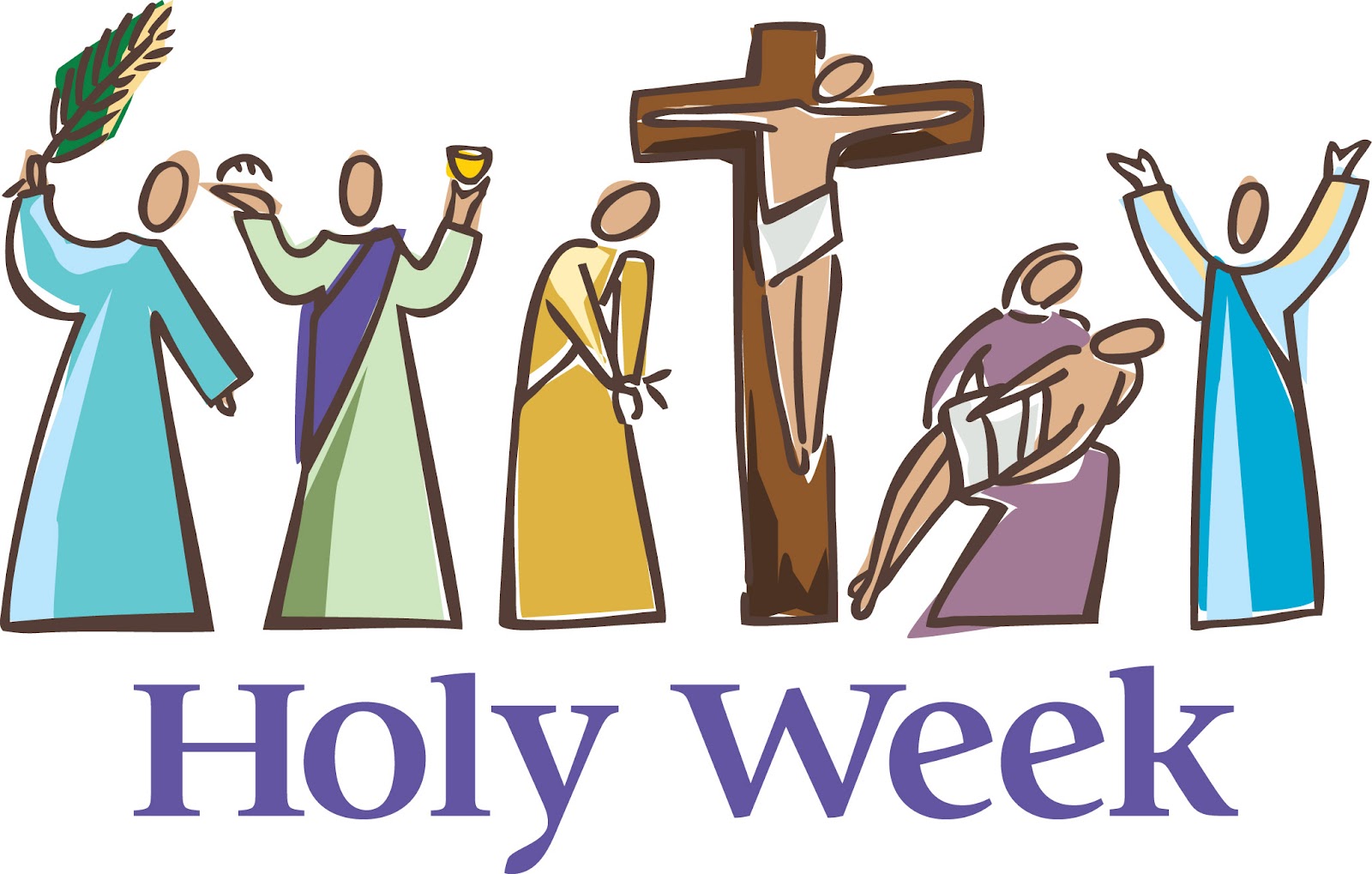
Holy Week


            Each year at this time I go through a bit of lamenting about the timing of the Christian observance of Holy Week, that eight day stretch from Palm Sunday to Easter Sunday in which we especially remember the significance of Christ’s redemptive events.  In my locale, Spring Break always occurs during Holy Week which means that a chunk of families are typically gone.  What is more, March Madness is happening in which an even bigger slice of people are glued to their televisions watching or their smartphones live-streaming the games.  As a pastor, sometimes I feel a bit like a voice crying out in the wilderness wondering if anyone can hear me.
 
            Yet, the reality is that remembering the person and work of Jesus, observing his teachings, and seeking to follow him in all things is an uphill climb throughout the entire year when faced with the rest of the culture’s manner of keeping time and observing life-habits.  For most people, it is not the popular thing to do to be on fire for Jesus; it is not the easy to do to radically observe Jesus in everything.  But maybe this isn’t such a bad thing, after all.  Maybe all of this helps us to be quite intentional about living for Jesus and remembering him.  Perhaps it is a unique opportunity to follow Christ each day equipped with a plan and a prayer to seek God through our work, our families, and even our churches.
 
            Observing Holy Week is certainly not commanded in Scripture.  Yet it is a wonderful opportunity to swim against the current of cultural values and fully embrace the biblical values of journeying with Jesus through life.  Just as birthday and anniversary celebrations allows us a different rhythm for a time, or as holidays provide us with certain family traditions, so Holy Week can be for us an expected time of contemplation and reflection resulting in a great celebratory feast and joy.  As we journey with Jesus, consider these special days:
 
Palm Sunday is a focus on the entry of Christ into Jerusalem to shouts of “Hosanna! Blessed is he who comes in the name of the Lord!”
 
Maundy Thursday marks three significant events in Christ’s last week:  his washing of the disciples’ feet; his institution of the Lord’s Supper; and, his new commandment to love one another.
 
Good Friday marks the death of Jesus Christ.  It is “good” because his death means redemption for the world.  We especially remember why the cross is so very important, that it is the once for all sacrifice to end all sacrifices.  There is now eternal forgiveness.
 
Easter Sunday is the culmination of all the expectations of God’s people, and the fulfillment of all God’s promises to them in Christ.  We rejoice, celebrate, and renew our love and commitment to God for raising Jesus from death.  His resurrection means new life for us.
 
            Observing Holy Week can take the form of attending special church services; the opportunity to read through one of the Gospels over the course of the week with other believers; or focus on the passion narratives in each Gospel.  For the Christian, these are the fundamentals of our faith, the base upon which our lives are constructed.  We return to these again and again so that for the entirety of the year we can live in careful devotion to the Savior who has brought us salvation from sin and offers new life.


            Holy Week is an opportunity for the church to remember and give thanks with both quiet gratitude and loud shouts of praise, with solemn reflection and expressive response.  There is no time like it in the year.

The Place of Suffering


The New Testament writer, Paul, wanted to know “the fellowship of sharing in Christ’s sufferings” (Philippians 3:10).  Let’s be really honest from the start:  we don’t like suffering, and we often spend an inordinate amount of time and energy trying to avoid pain.  Yet, the real issue is not whether we will suffer, but whether we will suffer as Christians.  We all will face suffering; it is just a matter of whether we suffer because of our own poor choices or because we are living for Jesus (1 Peter 2:20-21; 4:1, 12-13).
 
When the athlete goes into the weight-room, he/she is purposely going in there to suffer.  There will be grunting and straining and difficulty.  There will be a ripping and tearing-down of muscle fibers.  There will be pain.  But there cannot be growth and development without it.  One cannot simply go into a weight-room and sit and watch other people lift weights and believe that you will get in shape.  Showing-up at church to watch, listen to a sermon, and observe the worship does not make one a stronger Christian; it is the heavy lifting of getting into the Word of God for oneself, wrestling in prayer, and struggling to have that spiritual conversation with another person that are just a few of the ways that we are going to grow and develop.  What is more, God will put us through circumstances that we would not choose for ourselves in order to place us in a position to know Jesus. 
 
When Paul talked about becoming like Jesus in his death, this was his way of saying that some things need to die in life in order for new growth to occur.  For example, fire is actually an important part of Yellowstone National Park.  According to ecology experts, “fire promotes habitat diversity by removing the forest overstory, allowing different plant communities to become established, and preventing trees from becoming established in grassland. Fire increases the rate that nutrients become available to plants by rapidly releasing them from wood and forest litter and by hastening the weathering of soil minerals.”  In other words, fire is necessary for environmental growth.
 
Let me put this in layman’s terms when it comes to Christianity:  suffering is a necessary part of the Christian’s life because it creates the conditions for new life and growth and releases fresh sources of God’s grace into the church.  We are to put to death anger, rage, malice, slander, lying, and useless language.  They are to be replaced with compassion, kindness, humility, gentleness and patience, forgiveness, and love (Colossians 3:7-14).  This only happens when we have Jesus Christ as our ultimate priority, our highest value, and our surpassing greatness.  We have no intention of putting bad attitudes and behaviors to death if Jesus Christ is not our ultimate priority and highest value.  But if Jesus is the surpassing worth of our lives, then we will seek to do whatever we can to know him (Philippians 3:4-14).
 
There are a lot of voices out there competing for our attention in today’s world.  A lot of people want to get noticed.  Even more ideas want to get spread.  Whom and what we choose to listen to and obey is of great importance.  The vital essence and core value of Christianity is Jesus.  Do not settle for a status-quo, watered-down version of cultural Christianity.  Embrace Jesus, which means embracing both his cross and resurrection. 


So, what will you do to cultivate your relationship with Jesus?  We all must:  transfer our trust from ourselves to God; value what God values; be a student of God’s Word (in order to know Jesus better); be a person of prayer (because you cannot know Jesus apart from prayer); and start living for what is most important, jettisoning everything that gets in the way between you and Jesus, even if it hurts.