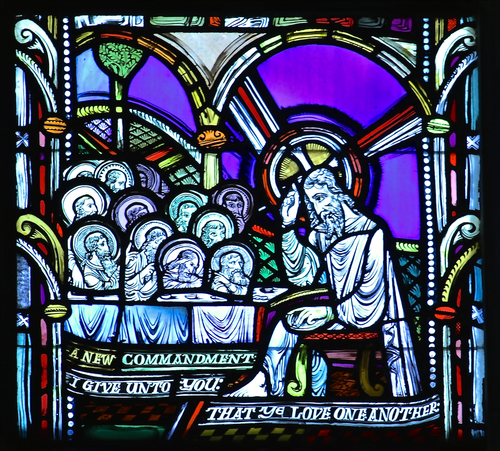
John 13:31-35 – Love One Another

Stained glass by Edgar Miller (1899-1993)

When he was gone, Jesus said, “Now the Son of Man is glorified, and God is glorified in him. If God is glorified in him, God will glorify the Son in himself, and will glorify him at once.

“My children, I will be with you only a little longer. You will look for me, and just as I told the Jews, so I tell you now: Where I am going, you cannot come.

“A new command I give you: Love one another. As I have loved you, so you must love one another. By this everyone will know that you are my disciples if you love one another.” (New International Version)

The Church was formed to represent Christ on earth. The Church is a new community of believers in Jesus, called and empowered by the Holy Spirit for mission.

Christianity was never intended to be just a personal faith; it was designed by God to be the community of the redeemed. Christian community is vital to every individual’s faith.

“No one can have God for his Father who does not have the Church for his Mother.”

John Calvin (1509-1564)

Loyalty and commitment to God translates to having a dedicated and devoted spirit to one another in the church. 

One of the last commands Jesus gave to his disciples before he went to the cross was to “love one another.” The Old Testament instructed the Israelites to love each other (Leviticus 19:18). Yet, Jesus gives new meaning to the command through four distinctions of loving one another.

A New Model of Love: Jesus

Our Lord’s life and teaching gave new meaning to the command to love each other. Notice what Jesus did in the Upper Room just before giving the command to love one another:

It was almost time for the Jewish Passover festival. Jesus knew that the time had come for him to leave this world and go back to the Father. Jesus had always loved the people in the world who were his. Now was the time he showed them his love the most.

Jesus and his followers were at the evening meal. The devil had already persuaded Judas Iscariot to hand Jesus over to his enemies. (Judas was the son of Simon.) The Father had given Jesus power over everything. Jesus knew this. He also knew that he had come from God. And he knew that he was going back to God. So while they were eating, Jesus stood up and took off his robe. He got a towel and wrapped it around his waist. Then he poured water into a bowl and began to wash the followers’ feet. He dried their feet with the towel that was wrapped around his waist. (John 13:1-5, ERV)

Jesus modeled a service-oriented love of compassionately meeting the need of another, regardless of who that person is. It is instructive to us that Jesus washed the feet of Judas Iscariot, along with all the other disciples. 

Christ died for us while we were still sinners. This demonstrates God’s love for us.

Romans 5:8, GW

We are to love everyone in the community of saints, and not just our friends or the ones we like. Loving one another also means we will be realistic in understanding that community is messy and downright hard work.  

A New Motive: Christ First Loved Me

Jesus has loved us with a love that took care of our brokenness once for all. Because of that love, we are now motivated to love each other. John would later say in his first epistle: 

God showed his love for us by sending his only Son into the world, so that we might have life through him. This is what love is: it is not that we have loved God, but that he loved us and sent his Son to be the means by which our sins are forgiven. Dear friends, if this is how God loved us, then we should love one another. (1 John 4:9-11, GNT)

Love is an attitude and a frame of mind. The motivation for the Christian is different than anyone else’s motive:  We are so thankful for Christ’s love to us, that we cannot help but extend that same love to one another in the church. 

This kind of love transcends human willpower. This is love as a grateful response for the grace shown us in Christ.

A New Motivator: The Holy Spirit

The Spirit energizes and enables us to love each other. Jesus also said in the Upper Room: 

If you love me, you will do as I command. Then I will ask the Father to send you the Holy Spirit who will help you and always be with you. (John 14:15-16, CEV)

There are times when we may lack the ability or spiritual energy needed for the work of loving each other. It is in those times that we need to check our spiritual electrical box to make sure we haven’t tripped a breaker by trying to live the Christian life on our own strength. 

We need the Spirit. The Spirit gives us the zeal we need to love one another. 

We typically don’t do anything in life unless we have the motivation for it. The Spirit is like the Christian’s personal trainer – encouraging, exhorting, getting in our face, comforting, and spurring us – toward the new way of love. 

A New Mission: World Evangelization

All people will know we are Christ’s disciples if we love one another. The way we treat each other in the church is foundational and fundamental to the mission of loving our neighbors who don’t know Jesus.

“Mission is putting love where love is not.”

St. John of the Cross (1542-1591)

When the church has a healthy and even supernatural dynamic of loving one another, they joyfully proclaim the good news to every person that Jesus is the answer to the terrible brokenness of this world.

Community is necessary to mission. Lesslie Newbigin (1909-1998) was a British missionary to India for forty years. After retiring and returning to Britain, he found his homeland was very different than when he left. He was astounded to find Britain had become very less Christian and was now predominantly un-Christian. It was clearly a post-Christian society. What to do about it? Here is Newbigin’s response:

“I have come to feel that the primary reality of which we have to take account in seeking for a Christian impact on public life is the Christian congregation.  How is it possible that the gospel should be credible, that people should come to believe that the power which has the last word in human affairs is represented by a man hanging on a cross? 

I am suggesting that the only answer, the only hermeneutic of the gospel [the only way society can discern who Jesus is] is a congregation of men and women who believe it and live by it. I am, of course, not denying the importance of the many activities by which we seek to challenge public life with the gospel – evangelistic campaigns, distribution of Bibles and Christian literature, conferences, and even books such as this one. But I am saying that these are all secondary, and that they have power to accomplish their purpose only as they are rooted in and lead back to a believing community.”

Conclusion

The implications of community for our faith are significant. If we keep other Christians at a distance and give them the stiff arm, we are really giving God the stiff arm. Jesus identifies so closely in love to his people, that to love them is to love him.

The late African-American preacher E.V. Hill told the following story about an experience with a white Christian leader in the 1950s:

“As a freshman at Prairie View College (part of the Texas A&M system) I was actively involved and was one of two students selected to go to our denomination’s annual meeting in Memphis. The trip through the South was by car—three whites and two blacks traveling together. I had no idea how we’d eat or how we’d sleep. So great was my anxiety and hatred over how the trip might turn out that I almost backed out entirely …. In all my experience I had never seen a white man stand up for a black man and never felt I would. 

But then Dr. Howard, the director of our trip and a white man spoke up. ‘We’ll be traveling together,’ he said. ‘If there isn’t a place where all of us can eat—none of us will eat. If there’s not a place all of us can sleep—none of us will sleep.’ That was all he said, but it was enough! For the first time in my life, I had met a white man who was Christian enough to take a stand with a Christian black man.” 

May the Spirit give us the courage together to love one another.

Gracious Lord, I pray for those who will believe in you through the good news of forgiveness in Christ. I pray that all of them may be one just as you are one. May they be brought to complete unity to let the world know that you sent the Son, Jesus, and have loved them even as you have loved us. Righteous God, may you help us make you known in the world so that the love you have for us may be in them through the cross of Christ. Amen.

Hebrews 9:1-12 – Remembering Christ Together

Photo by Krivec Ales on Pexels.com

Now the first covenant had regulations for worship and also an earthly sanctuary. A tabernacle was set up. In its first room were the lampstand and the table with its consecrated bread; this was called the Holy Place. Behind the second curtain was a room called the Most Holy Place, which had the golden altar of incense and the gold-covered ark of the covenant. This ark contained the gold jar of manna, Aaron’s staff that had budded, and the stone tablets of the covenant. Above the ark were the cherubim of the Glory, overshadowing the atonement cover. But we cannot discuss these things in detail now.

When everything had been arranged like this, the priests entered regularly into the outer room to carry on their ministry. But only the high priest entered the inner room, and that only once a year, and never without blood, which he offered for himself and for the sins the people had committed in ignorance. The Holy Spirit was showing by this that the way into the Most Holy Place had not yet been disclosed as long as the first tabernacle was still functioning. This is an illustration for the present time, indicating that the gifts and sacrifices being offered were not able to clear the conscience of the worshiper. They are only a matter of food and drink and various ceremonial washings—external regulations applying until the time of the new order.

But when Christ came as high priest of the good things that are now already here, he went through the greater and more perfect tabernacle that is not made with human hands, that is to say, is not a part of this creation. He did not enter by means of the blood of goats and calves; but he entered the Most Holy Place once for all by his own blood, thus obtaining eternal redemption. (New International Version)

A healthy approach to looking at the whole of the Bible is to see it as an unfolding drama of redemption in six acts: 

  1. Creation of the world.
  2. Fall of humanity.
  3. Israel and the law.
  4. The earthly ministry of Jesus.
  5. The Church. 
  6. Return of Christ.

We are presently in act five, the church age. The previous four acts were all important in leading up to this act, just as the scenes in a play all build upon one another.

So, then, Israel and the law had their place in this drama of redemption. But we are no longer in that act. This is one reason why we do not hold to all the ceremonial and sacrificial stipulations of the old covenant because it has been superseded by the new covenant.

The previous act of the law had its limitations. It was never designed to completely clear the conscience of the worshiper. Its purpose was to be a reminder of sins that points forward to a better time when the sin issue would be settled once and for all. That time has come. 

The person and work of Jesus has completely cleared the conscience of the worshiper because his sacrifice is the sacrifice to end all sacrifices. Christ’s finished work is both thoroughly pervasive and completely permanent.

Therefore, there is no longer any need to languish in guilt as though we were stuck in act three of God’s redemption drama. 

We do not need to be reminded of our sins anymore. Instead, we are to be reminded of Christ’s finished work on the cross, and that his blood has washed away our sins. We are to remember rightly and have Jesus before us continually. Our redemption is not temporal, but permanent. 

Taking some time each day to remind ourselves of this new reality and enjoy act five of the drama is both sage and necessary in order to live a successful Christian life. Here are some wonderful privileges to remember together of being united with Christ contained within the book of Hebrews:

  • Church connects to other like-minded people who help us live for God.

Encourage each other every day while you have the opportunity. If you do this, none of you will be deceived by sin and become stubborn. (Hebrews 3:13, GW)

  • Church creates a sacred space for us to relate to the divine.

So, whenever we are in need, we should come bravely before the throne of our merciful God. There we will be treated with undeserved kindness, and we will find help. (Hebrews 4:16, CEV)

  • Church enables us to reflect on gratitude.

Since we are receiving a kingdom that cannot be shaken, let us be thankful, and so worship God acceptably with reverence and awe. (Hebrews 12:28, NIV)

  • Church provides opportunities to serve and give to others.

Keep on loving one another as brothers and sisters. Do not forget to show hospitality to strangers, for by so doing some people have shown hospitality to angels without knowing it. Continue to remember those in prison as if you were together with them in prison, and those who are mistreated as if you yourselves were suffering. (Hebrews 13:1-3, NIV)

  • Church teaches us forgiveness.

“I will forgive their sins and will no longer remember their wrongs.” (Hebrews 8:12, GNT)

  • Church gives us purpose and meaning.

Because Jesus lives forever, his priesthood lasts forever. Therefore, he is able, once and forever, to savethose who come to God through him. He lives forever to intercede with God on their behalf. (Hebrews 7:24, NLT)

Saving God, you sent your Son, the Lord Jesus, to take care of the sin issue once for all through his blood. I give you unending thanks for your grace. May your Holy Spirit press this reality of forgiveness and clarity of conscience firmly into my mind and heart so that I will always live for you in all things. Amen.

Hebrews 3:7-19 – Encourage One Another Daily

So, as the Holy Spirit says:

“Today, if you hear his voice,
    do not harden your hearts
as you did in the rebellion,
    during the time of testing in the wilderness,
where your ancestors tested and tried me,
    though for forty years they saw what I did.
That is why I was angry with that generation;
    I said, ‘Their hearts are always going astray,
    and they have not known my ways.’
So I declared on oath in my anger,
    ‘They shall never enter my rest.’ ”

See to it, brothers and sisters, that none of you has a sinful, unbelieving heart that turns away from the living God. But encourage one another daily, as long as it is called “Today,” so that none of you may be hardened by sin’s deceitfulness. We have come to share in Christ, if indeed we hold our original conviction firmly to the very end. As has just been said:

“Today, if you hear his voice,
    do not harden your hearts
    as you did in the rebellion.”

Who were they who heard and rebelled? Were they not all those Moses led out of Egypt? And with whom was he angry for forty years? Was it not with those who sinned, whose bodies perished in the wilderness? And to whom did God swear that they would never enter his rest if not to those who disobeyed? So, we see that they were not able to enter, because of their unbelief. (New International Version)

Although many people do their outdoor grilling with propane and propane accessories, there are still some who go with the old charcoal grill. The key to a good hot grill is in the stacking of the briquettes into a neat pile before lighting them. If this is not done, it is likely the white hot fire will never get going. At the most, the briquettes will become warm but quickly grow cold and die.

The New Testament lesson for today operates with the same principle. We are not to stoke a fire of evil with an unfaithful heart. Instead, we are to gather together with our shared value of Jesus and warmly encourage each other every day so that we don’t become insensitive and cold to God.

Just as a pile of charcoal needs all the individual briquettes together to become hot, so every Christian needs other Christians to speak into their life every day. If this dynamic does not happen, the heart will grow cold and hard. Eventually, if left unchecked, the heart falls away from the faith.

There are some churches around the world which wisely take today’s teaching to heart. They have opportunities every day for believers to gather and encourage one another. Some even provide multiple chances to meet throughout a day.

Early in the morning they come together for prayer and encouragement before going off to their jobs and busy lives. At noon there are bible studies or prayer groups during lunch. And in the evening there is vespers, or some sort of Scripture reflection along with strengthening each other in faith.

There is a reason why many places on this earth have grown hot for God with Christians being added daily. It may be wise and necessary to re-think and re-do our spiritual practices to better accommodate and reflect an obedience to these very verses in the book of Hebrews. Consider just a few ways of potentially doing this:

  • Meet virtually for 10-15 minutes at the same time every morning. Take advantage of shared technology. Read a portion of Holy Scripture and offer a reflection or encouragement. Pray for one another. You might also sing or practice some silence together.
  • Meet physically for 10-15 minutes at either sunrise or sunset every dawn or dusk with some neighbors. Offer prayers of gratitude to God and spend some minutes in worship.
  • Create space in a church building through a church ministry – or in your home with a few friends or family – to read the Daily Lectionary Scriptures or some other plan.
  • Prayer walk through your community or neighborhood with one or two others at the same time every day for a set amount of time.
  • Establish a daily worship service in the church or other gathering place at the same time each day for 30 minutes. It can be as planned or unplanned, as liturgical or free as you like. I suggest a healthy combination of planning and improvising.
  • Get together with some other like-minded believers to brainstorm ideas of what might be helpful to daily encourage each other in the faith.

Whenever we are together as believers in Jesus, it gives us the opportunity to smile and give direct eye contact, listen to each other with focused attention, validate one another’s honest strivings toward the spiritual life, offer gratitude, and acknowledge each person’s gifts, strengths, and abilities.

May you engage in practices which soften and enlarge your heart for each other and for the world, so that a hard small heart might be far from you. Be a white hot believer who burns with grace, mercy, and love for God’s people and God’s world.

Blessed Father, Son, and Spirit – the Holy Trinity whom I serve, I have been made in your image – the image of the triune God. Help me to reflect that image every day by encouraging my fellow believers and allowing them to exhort me toward love and good deeds in the faith of Jesus Christ through the power of the Holy Spirit.  Amen.

Hebrews 1:1-4, 2:5-12 – World Communion Sunday

In the past God spoke to our ancestors through the prophets at many times and in various ways, but in these last days he has spoken to us by his Son, whom he appointed heir of all things, and through whom also he made the universe. The Son is the radiance of God’s glory and the exact representation of his being, sustaining all things by his powerful word. After he had provided purification for sins, he sat down at the right hand of the Majesty in heaven. So, he became as much superior to the angels as the name he has inherited is superior to theirs….

It is not to angels that he has subjected the world to come, about which we are speaking. But there is a place where someone has testified:

“What is mankind that you are mindful of them,
    a son of man that you care for him?
You made them a little lower than the angels;
    you crowned them with glory and honor
    and put everything under their feet.” [Psalm 8:4-6]

In putting everything under them, God left nothing that is not subject to them. Yet at present we do not see everything subject to them. But we do see Jesus, who was made lower than the angels for a little while, now crowned with glory and honor because he suffered death, so that by the grace of God he might taste death for everyone.

 In bringing many sons and daughters to glory, it was fitting that God, for whom and through whom everything exists, should make the pioneer of their salvation perfect through what he suffered. Both the one who makes people holy and those who are made holy are of the same family. So, Jesus is not ashamed to call them brothers and sisters.He says,

“I will declare your name to my brothers and sisters;
    in the assembly I will sing your praises.” [Psalm 22:22] (New International Version)

Today is World Communion Sunday. We come to the Lord’s Table with awareness of Christian sisters and brothers throughout the world, in all nations, and in all the various traditions of Christianity. We may not all agree about a lot of things in the church and the Christian life. Yet, every Christian tradition – past and present – has and does observe communion around the Lord’s Table. It is a practice which binds us and reminds us of our unity with another.

And that unity is focused and centered in Jesus Christ our Savior and Lord. Jesus is the person who holds us together. Jesus is the one in whom all the good promises of God are fulfilled. Today we remember Jesus, commune with Jesus, and express our hope in Jesus.

We remember that Jesus was made perfect through suffering – and that we, too, experience spiritual formation through suffering.

We commune with Jesus and one another because the cross of Christ achieved deliverance from spiritual estrangement and relational loneliness and gathered us into the one people of God.

We hope with confident expectation, as we celebrate Jesus at the Table along with all the saints everywhere, that Christ will return and take us to be with him forever in glory. There will be no more suffering, no more pain, no more poverty, no more oppression, no more injustice. There will be complete faith, realized hope, and absolute love for all time and forever. Amen!

Our past, present, and future all belong to Jesus. And we are not alone, for all Christians in everyplace from every race, ethnicity, class, and gender – whether they are Pentecostals in Puerto Rico, Anglicans in Africa, Catholics in Poland, Coptic Egyptians, or Orthodox Russians – the beautiful diversity of Christ’s Body comes together in harmonious unity at the Lord’s Table. It is this sacrament which raises our awareness of both solidarity with Christ and with all believers everywhere.

The purpose of the Lord’s Table is to participate in the blessings of Christ by visually re-creating the story of Jesus. There are three different terms for the Table in the New Testament, and each term is meant to convey a different aspect of the Table’s significance. 

The Lord’s Supper is a focus on remembrance, a memorial of Christ’s death that is deeply reflective and contemplative. 

What you must solemnly realize is that every time you eat this bread and every time you drink this cup, you reenact in your words and actions the death of the Master. You will be drawn back to this meal again and again until the Master returns. You must never let familiarity breed contempt.

Anyone who eats the bread or drinks the cup of the Master irreverently is like part of the crowd that jeered and spit on him at his death. Is that the kind of “remembrance” you want to be part of? Examine your motives, test your heart, come to this meal in holy awe. (1 Corinthians 11:26-28, MSG) 

The Eucharist literally means “thanksgiving.” The Lord’s Table as Eucharist means we celebrate Christ’s victory over sin, death, and hell on our behalf. 

While they were eating, Jesus took a piece of bread, gave a prayer of thanks (Eucharist), broke it, and gave it to his disciples. “Take it,” he said, “this is my body.” Then he took a cup, gave thanks to God (Eucharist), and handed it to them; and they all drank from it. (Mark 14:22-23, GNT) 

Communion means to participate in Christ and with other Christians. This emphasizes that when we partake of the Lord’s Table, we ought to do so with unity and fellowship. We are more than individual Christians. We share in the Lord together as the community of the redeemed.

When we drink from the cup that we ask God to bless, isn’t that sharing in the blood of Christ? When we eat the bread that we break, isn’t that sharing in the body of Christ? By sharing in the same loaf of bread, we become one body, even though there are many of us. (1 Corinthians 10:16-17, CEV) 

As we allow the Table to be a remembrance, celebration, and participation with each other, we engage in a ritual that helps us to know Christ better. And we are better able to realize God’s grace to us.

Participating and sharing in communion is important because we can easily be fragmented and not fellowship with one another in a local church, as well as the world-wide church. The cross of Jesus Christ has ended division. The cross has brought us peace and reconciliation between God and others. 

The suffering of Jesus on the cross has restored a broken relationship between us and God, and also between one another. Therefore, there is to be no more ignoring one another, or brothers and sisters elsewhere, because we are one unified people around the good news of Jesus – enjoying solidarity with each other in both our joys and our sufferings.

One awareness needed as we share in communion together is to be mindful of others. Not everyone is the same. We must avoid coming to the Table expecting people to be the way we want them to be. Instead, we are to come because we have staked our souls on the fact that Christ is the Way, the Truth, and the Life, and the Church is the best place to be while we all struggle to figure out what that means. We come because we’d be hard pressed to say which is the bigger of the two scandals of God: that he loves me—or that he loves everyone else. 

The Lord’s Table is the great leveler, where we all have equal footing and accept one another according to a common confession of Christ. Communion emphasizes participation in the body and blood of Christ, as well as participation with all Christians everywhere. 

Therefore, we are not alone. Communion means God is with us, and that Christ has so closely identified with us that he took our place on the cross. As a result, every believer in Jesus is linked to all the others so that, when one suffers or rejoices, all suffer or rejoice, whether it is a Pastor down the street rejoicing over a newly saved soul, or a suffering Syrian Christian trying to survive in a refugee camp.

Let us live up to what, and whom, we profess. Since we are God’s forgiven people, we are to work at living the Christian life together. This unity is symbolized by partaking together of the same loaf of bread and drinking from a common cup.

One Sunday, a group of missionaries and believers in Papua New Guinea were gathered to observe communion together.  After one young man sat down, one of the missionaries recognized that he seemed to be quite upset. Then, after a while, the young man seemed to be fine. 

The missionary leaned over and whispered to him, “What was it that troubled you?”  The young man replied, “The man who just came in happens to be the man who killed and ate the body of my father.  And now he has come in to observe communion with us. At first I didn’t think I could do that. But it is all right now.  He is washed in the same precious blood as I am.”  And so together they participated in Christian communion.

We have peace because of Jesus. Christ’s suffering and death has brought reconciliation not only between us and God, but between each other. As we approach the Lord’s Table, let us be aware not only of our personal relationship with God, but our relationships with one another in the local church, and our unity with the world-wide church. 

May our lives be shaped and formed around the cross of Jesus Christ, as we remember, celebrate, and participate together.

Almighty and everlasting God, may this time we partake of the body and blood of Jesus unite us in the community of saints who know your love and proclaim your Son with fervor and grace to a broken and hurting world. May your healing hands be the salve for ending hurt and violence in this world, even as we prepare for the next. In the holy Name of Jesus. Amen.