Confronting the Evil in Front of Us (Mark 6:14-29)

St. John the Baptist rebuking Herod, by Giovanni Fattori (1825-1908)

King Herod heard of it, for Jesus’s name had become known. Some were saying, “John the baptizer has been raised from the dead, and for this reason these powers are at work in him.” But others said, “It is Elijah.” And others said, “It is a prophet, like one of the prophets of old.” But when Herod heard of it, he said, “John, whom I beheaded, has been raised.”

For Herod himself had sent men who arrested John, bound him, and put him in prison on account of Herodias, his brother Philip’s wife, because Herod had married her. For John had been telling Herod, “It is not lawful for you to have your brother’s wife.” 

And Herodias had a grudge against him and wanted to kill him. But she could not, for Herod feared John, knowing that he was a righteous and holy man, and he protected him. When he heard him, he was greatly perplexed, and yet he liked to listen to him. 

But an opportunity came when Herod on his birthday gave a banquet for his courtiers and officers and for the leaders of Galilee. When his daughter Herodias came in and danced, she pleased Herod and his guests, and the king said to the girl, “Ask me for whatever you wish, and I will give it.” And he swore to her, “Whatever you ask me, I will give you, even half of my kingdom.” 

She went out and said to her mother, “What should I ask for?” She replied, “The head of John the baptizer.” Immediately she rushed back to the king and requested, “I want you to give me at once the head of John the Baptist on a platter.” The king was deeply grieved, yet out of regard for his oaths and for the guests, he did not want to refuse her. 

Immediately the king sent a soldier of the guard with orders to bring John’s head. He went and beheaded him in the prison, brought his head on a platter, and gave it to the girl. Then the girl gave it to her mother. When his disciples heard about it, they came and took his body and laid it in a tomb. (New Revised Standard Version)

Feast of Herod with the Beheading of St John the Baptist, in the Museo del Prado, Madrid, Spain

The earthly life and mission of Jesus was connected to the social and political affairs of Judea and the Roman Empire. In truth, Christ’s impact is never only ethereal; rather, it smacks against every system and organization in this world.

John the Baptist’s death was closely connected to Christ’s mission and ministry; and it was also a result of the social and political forces John was subjected to. This would explain why Herod thought of Jesus as a resurrected John, after killing him. Both the messages of John and Jesus were met with resistance by the powers that be.

Marriages in the ancient world, especially among governmental officials, were primarily political affairs, and not love arrangements. The more authority and power a person had, the greater the political implications and impact there was. And marriage was one way of consolidating more power.

Herod’s marriage to Herodias may have been politically expedient, but was ethically repugnant, and John let him know about it. Herod was both a Jew and a Roman official, with his actual allegiance being to himself.

Herodias considered John as politically repugnant and found it unethically expedient to silence him once and for all when she had the opportunity. John the Baptist discovered first-hand that hell hath no fury like a woman’s scorn. Herodias hated him and waited for an opportune time to be rid of him once and for all.

But not only did Herodias orchestrate John’s demise, she did it in a way that sought to humiliate him. To die in battle at the hand of an enemy soldier was an honorable death; but to be executed because of a woman’s handiwork was a mark of shame.

Anyone who lives for God and speaks truth to power will nearly always suffer deep consequences. Hence, this is why a great many prophets ended up dead, often by tortuous methods – including Jesus and nearly all his original disciples.

Unfortunately, there are individuals in this world who are incapable of doing good.

Whenever such persons talk a good line, or do a good deed, it’s always in the service of a larger evil agenda. They often end up in positions of authority, simply because they have no scruples and will lie to you with a straight face.

And they will do anything to not only hold on to their power, but to acquire more so that they can be in control of everything around them. Of course, the people around such a person are miserable. They typically feel powerless to change the situation.

So, if there’s going to be transformation, there will need to be a prophet – someone like John the Baptist – who has the courage to speak truth to power and remind the world that God is the sovereign of the universe.

The Gospel writer Mark presents Herodias as a person with influence and power who only cares about her own interests. She had no scruples in using her daughter for malevolent purposes.

Whereas the young daughter of the synagogue ruler Jairus was (earlier in Mark’s account) raised to life by Jesus, in today’s story the young daughter of Herodias became the vehicle of a grisly murder. And, of all things, it’s this girl who brought the severed head of John the Baptist on a platter to her mother.

We are meant to see the impact and consequence when those in power have self-centered objectives and dark hearts. This is in direct contrast to both Jesus Christ and John the Baptist, both of whom gave their lives for that which is right, just, and good.

God’s mercy and redemption will eventually overwhelm all of creation. The cross and resurrection of Christ have won the victory over evil. Yet, until Christ returns, the dark forces of this old world know their time is short; and they are doing everything they can to throw a monkey wrench into the benevolent machine of grace, before the demonic forces themselves are thrown into the pit forever.

Christian mission and ministry was never designed to be easy nor pain-free. But it is meant to bring hope, love, redemption, peace, and satisfaction to all who believe.

Christ has connected himself to us. Let’s keep that gracious connection going by doing what is right and living a good and just life, and confronting the evil in front of us – to the glory of God. Amen.

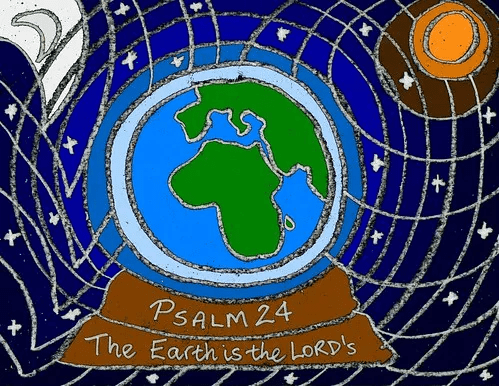
Everything Belongs to God (Psalm 24)

By Stushie Art

The earth is the Lord’s and all that is in it,
    the world, and those who live in it,
for he has founded it on the seas
    and established it on the rivers.

Who shall ascend the hill of the Lord?
    And who shall stand in his holy place?
Those who have clean hands and pure hearts,
    who do not lift up their souls to what is false
    and do not swear deceitfully.
They will receive blessing from the Lord
    and vindication from the God of their salvation.
Such is the company of those who seek him,
    who seek the face of the God of Jacob.

Lift up your heads, O gate
    and be lifted up, O ancient doors,
    that the King of glory may come in!
Who is the King of glory?
    The Lord, strong and mighty,
    the Lord, mighty in battle.
Lift up your heads, O gates!
    and be lifted up, O ancient doors,
    that the King of glory may come in!
Who is this King of glory?
    The Lord of hosts,
    he is the King of glory. (New Revised Standard Version)

The world belongs to God; and so do we. People have a simple, yet profound, task in this life: To confess the Lord’s great and sovereign ownership of everything, including themselves; and to therefore live a good and holy life because of that theological understanding.

“There is not a square inch in the whole domain of our human existence over which Christ, who is Sovereign over all, does not cry, Mine!”

Abraham Kuyper

Abraham Kuyper (1837-1920) was born in the Netherlands. He was a church minister, university professor, and politician – having established a Christian university, as well as served in the Dutch parliament and as Prime Minister of the Netherlands.

Kuyper labored throughout his life to flesh-out the theological implications of a sovereign God. He consistently insisted that all we do as humans is to be integrated and brought under the lordship of Jesus Christ.

He firmly believed that all things belong to God in Christ; thus, all the fragments of our lives are to be oriented and integrated around our Creator’s great claim upon us as creatures. Whether a pastor, teacher, or politician – every vocation, each activity, and all thoughts and intents rightly belong to God.

By Stushie Art

This means that religion and spirituality cannot be kept within superimposed limits. There is no separation of any one domain of human thought from the rest, no isolation of any one domain of human life from another or from Christ.

The spiritual life is not limited to merely the ethereal. It is both celestial and terrestrial – heavenly and earthly – concerned for the immaterial and the material. God cares about it all, because it all belongs to God.

God owns the world. So, the implications of this for us is huge. It means we don’t really own anything. We are simply stewarding all that God has given us – including our very lives.

The chaos of this world, from a biblical perspective, comes from creatures attempting to assert their own sovereignty and to control things. Since we were not created to be little gods roaming about doing our own thing, the inevitable result is a topsy-turvy messed-up world.

God’s divine claim and ownership of the world means that absolute authority does not rest with nations, states, or leaders. Everything we see, as well as what we don’t see, belongs to the Lord.

A significant task of believers is to confess and bear witness to God’s rightful and benevolent rule in this world. In fact, Christians everywhere pray toward this end every week:

“Your kingdom come, your will be done, on earth, as it is in heaven.” (Matthew 6:10)

The circle of life, within Holy Scripture, is the Creator God bestowing life and relationship to created humans, who then respond by practicing just and righteous living – thereby receiving renewal from the Lord and life anew. Theoretically, this movement can go unbroken. It can be a regular celebration in consistent rhythms of worship and adoration of God.

When we are able to get into the intended divine groove of faith, life, and worship, we will discover our meaning and purpose in the world.

By rightly ordering our lives, centering and grounding them in the gracious and loving relationship of Creator and creature, then we find true blessing – because it enjoys an intuited stamp of approval by the God who makes life possible.

In the Christian tradition, Jesus is the Victor, the King of Glory. All the promises and hopes of people are found and focused, in Christ. We enter through Jesus, the door of life, into deliverance from death and everything which separates us from God, others, and self.

Jesus comes to bring blessing, justice, righteousness, mercy, purity, and peace. For this is how the world was meant to operate from the beginning. We are to open the ancient door of faith, especially when the Lord comes knocking:

Listen! I am standing and knocking at your door. If you hear my voice and open the door, I will come in and we will eat together. Everyone who wins the victory will sit with me on my throne, just as I won the victory and sat with my Father on his throne. If you have ears, listen to what the Spirit says to the churches. (Revelation 3:20-22, CEV)

Old Abraham Kuyper is long dead, and yet he got it right, if we are able to hear him:

“Whatever people may do, to whatever they may apply their hands – in agriculture, in commerce, and in industry, or in mind, in the world of art, and science – they are, in whatsoever it may be, constantly standing before the face of God. They are employed in the service of God. They have strictly to obey God. And above all, they must aim at the glory of God.”

Blessed Lord, Creator of heaven and earth, though I am quite capable of fretting, complaining, and lamenting about how out of control things seem, the truth is that nothing is outside your grip. I may not always see your hand, discern your heart, or like your ways, but you are God and there is no other. 

So, continue to renew my thinking, gentle my heart, and deepen my worship. I humbly and gladly affirm that you are God, and I am not, through Jesus Christ, my Lord, who with you and the Holy Spirit reign sovereign as one God, now and forever. Amen.

The Grace of Redemption and Gratitude (Exodus 37:1-16)

Bezalel made the ark of acacia wood—two and a half cubits long, a cubit and a half wide, and a cubit and a half high. He overlaid it with pure gold, both inside and out, and made a gold molding around it. He cast four gold rings for it and fastened them to its four feet, with two rings on one side and two rings on the other. Then he made poles of acacia wood and overlaid them with gold. And he inserted the poles into the rings on the sides of the ark to carry it.

He made the atonement cover of pure gold—two and a half cubits long and a cubit and a half wide. Then he made two cherubim out of hammered gold at the ends of the cover. He made one cherub on one end and the second cherub on the other; at the two ends he made them of one piece with the cover. The cherubim had their wings spread upward, overshadowing the cover with them. The cherubim faced each other, looking toward the cover.

They made the table of acacia wood—two cubits long, a cubit wide and a cubit and a half high. Then they overlaid it with pure gold and made a gold molding around it. They also made around it a rim a handbreadth wide and put a gold molding on the rim. They cast four gold rings for the table and fastened them to the four corners, where the four legs were. The rings were put close to the rim to hold the poles used in carrying the table. The poles for carrying the table were made of acacia wood and were overlaid with gold. And they made from pure gold the articles for the table—its plates and dishes and bowls and its pitchers for the pouring out of drink offerings. (New International Version)

This section is, for the most part, a mirror image of Exodus 25:23-40 – which provides meticulous instructions from God on how to build the Ark of the Covenant and the Table that goes with it.

The purpose of this section in Holy Scripture is to give a detailed report that everything the Lord instructed Moses to do, was obediently done, down to every last detail.

This was of upmost importance to the biblical writer, because half-obedience is really not obedience, at all. And there needs to be obedience in order to realize blessing.

God had a purpose with ancient Israel to establish them as God’s people, with God dwelling amongst them. The way this would happen was by means of all the specific prescriptions for the Tabernacle with its worship implements.

Foremost amongst those worship implements was the Ark and the Table, simply because that was the place of meeting with God – and even more specifically – the place of redemption.

The Tabernacle was built, then erected and put into place, just as it was described by God to Moses. And that is the point. The Lord does not change. There was no Plan B or altering the agenda as things went along, because human sin and people’s foibles mucked up everything. No, that’s not how it went down.

Nothing detracts or sidelines God from accomplishing divine purposes – especially when it comes to redeeming people and coming alongside them.

Just because the Israelites disastrously made an idol in the form of a golden calf, and worshiped it as if it were God, did not mean God’s plan failed.

In fact, the Lord made the plan even better by showing exceeding grace in not wiping out the entire lot of them – but instead used the situation to demonstrate steadfast love and accomplish the divine purpose of redemption.

No matter how you slice or dice it, it always comes out as grace.

My hope is that you can see that through all of the details of worship implements and Tabernacle protocol, God bent over backwards to be with the people.

God is holy. God is absolute purity and light. That holiness and purity would incinerate us in a nanosecond if we didn’t have things in place to help us be with God. That was what the Ark and the Table helped to do for Israel.

There are times in Holy Scripture when things get repeated. Repetition, according to many scholars, communicates emphasis. The repeated details of the Ark and the Table, as well as all the other articles associated with worship, communicate the heart of God in wanting us to have access to the divine. In other words, its repeated because it’s important.

Access, redemption, worship, and mercy are all important for the believer. We learn from today’s seemingly mundane verses that:

  • Sin must be addressed in order to have access to God
  • A way has been made for us to be with God
  • We are enabled and empowered to approach God
  • We have received the mercy of redemption from God
  • We are to therefore give mercy to others through table fellowship and forgiveness
  • And we are to give thanks and have gratitude in our hearts to God

Listening to the instructions of God, obeying them, and enjoying them is at the heart of good religion. May it be so, to the glory of God.

Accept, O Lord, our thanks and praise for all that you have
done for us. We thank you for the splendor of the whole
creation, for the beauty of this world, for the wonder of life,
and for the mystery of love.

We thank you for the blessing of family and friends, and for
the loving care which surrounds us on every side.

We thank you for setting us at tasks which demand our best
efforts, and for leading us to accomplishments which satisfy
and delight us.

We thank you also for those disappointments and failures
that lead us to acknowledge our dependence on you alone.

Above all, we thank you for your Son Jesus Christ; for the
truth of his Word and the example of his life; for his steadfast
obedience, by which he overcame temptation; for his dying,
through which he overcame death; and for his rising to life
again, in which we are raised to the life of your kingdom.

Grant us the gift of your Spirit, that we may know him and
make him known; and through him, at all times and in all
places, may give thanks to you in all things. Amen.

Our Riches In Christ (Colossians 2:1-5)

I want you to know how hard I am contending for you and for those at Laodicea, and for all who have not met me personally. My goal is that they may be encouraged in heart and united in love, so that they may have the full riches of complete understanding, in order that they may know the mystery of God, namely, Christ, in whom are hidden all the treasures of wisdom and knowledge. 

I tell you this so that no one may deceive you by fine-sounding arguments. For though I am absent from you in body, I am present with you in spirit and delight to see how disciplined you are and how firm your faith in Christ is. (New International Version)

When you already have everything you need, it’s useless – and can even be damaging – to indulge in listening to fine sounding arguments about how you are missing out, lacking something, and/or falling short in some way.

For the Christian, the truth is: You now possess God’s treasure chest of wisdom and knowledge in Christ Jesus. So, why would you ever let someone deceive you through slick persuasion about having something superior to what you already have?

“Heresy” is really nothing more than making a bold claim to an alternative theological understanding than what you presently adhere to.

In some cases, an existing belief system is inferior and bogus. So, it’s a good thing when someone turns from bad religion in order to embrace a religion which is life-giving, helpful, and good.

Yet, if we already have a belief which is robustly full of righteousness and justice, and is good for the common life of everyone in the community, then it is dangerous to consider replacing it, or letting it fall into disuse.

The Apostle Paul’s consistent and overarching theme throughout his letter to the Colossian Christians is that Jesus Christ is sufficient, he is enough – more than enough – for our life and salvation.

That means the task of the Christian is to hold on to and cultivate what already has been taught to them according to apostolic tradition (that is, the Scriptures).

Another way of putting the matter: Learn to appreciate and enjoy what you already have, because it really is worth exploring, living into, and celebrating.

So, let’s put away any notions that standing firm in the faith involves defending your own personal brand of the Christian life (which is usually done obnoxiously) or for others to adhere to every jot and tittle of your own dogmatic theology.

To remain steadfast in the faith means primarily to nurture your faith – to actively pursue the spiritual life and concern oneself with the development of the soul. It is, more specifically, to keep on struggling to live into the words and ways of Jesus Christ; and to keep on learning and applying the apostolic teaching which has been passed down to us.

This is not too much to ask. It is reasonable (and biblical) to expect professing believers in Christ to put solid energy into encouraging one another in love and unity by means of sound Christian theology and doctrine.

Genuine and lasting unity depends upon both truth and love. Christians need to be of one mind and one heart, embracing the same values.

My dear wife and I recently celebrated 39 years of marriage together. Someone asked me today how we’ve made it all these years. I said that the main reason is that, although we are extreme opposites in nearly every way, we have both shared the same basic core values throughout our marriage. And that has gotten us through a lot of things.

Love for one another in the church will be maintained when we understand there is nothing being held back from us by God. The mystery of Christ has been revealed. There are no secrets. Solid and lasting relationships are built upon the foundation of truth. Nothing is held back.

We might as well lay bare everything, because it’s eventually going to happen one way or another.

Nothing in all creation is hidden from God’s sight. Everything is uncovered and laid bare before the eyes of him to whom we must give account.

Hebrews 4:13, NIV

If we begin to think the grass is greener on the other side of the fence, then we start listening to other people – perhaps even inviting other lovers into our lives. But the truth is: If I have some delicious fresh fried catfish on my plate, why in the world would I ever settle for a measly can of tuna?

The unity of the Colossian Church was at stake for the Apostle Paul. Just because someone is skilled in the art of persuasion, and can speak a good line, doesn’t necessarily mean that those words are good, right, or just.

There’s nothing wrong with persuasion. In fact, Paul himself was highly skilled in rhetoric and persuasion. At issue is losing sight of the message and focusing solely on the means of communicating the message.

Oftentimes a false teacher who peddles a different message other than apostolic teaching, has a highly believable way about them – which is why folks can be deceived. When one is being charmed, then critical analysis is rarely on their mind.

We can also be self-deceived, deluding ourselves, and talking ourselves into going down a bad path. It is most necessary to evaluate things according to the content rather than the attractiveness of the packaging.

Gifts of speaking and persuasion are good, so long as they are used for good, and controlled by sound thinking and directed by compassionate hearts.

There is no compelling witness for Christ if the church is fragmented and divided. But if we are convinced that our spiritual riches are found in Jesus Christ, then we shall find ways to remain connected and caring.

Therefore, let’s live as if we really believe this.

I always pray to the great and glorious Father, the God of our Lord Jesus Christ. I pray that he will give you the Spirit, who will let you know truths about God and help you understand them, so that you will know him better.

I pray that God will open your minds to see his truth. Then you will know the hope that he has chosen us to have. You will know that the blessings God has promised his holy people are rich and glorious. And you will know that God’s power is very great for us who believe. Amen. (Ephesians 1:17-19, ERV)