The Wealth and Wisdom of Solomon (2 Chronicles 9:29-31)

King Solomon, by British artist Simeon Solomon, c.1874

Everything else Solomon did while he was king is written in the records of Nathan the prophet, Ahijah the prophet from Shiloh, and Iddo the prophet who wrote about Jeroboam son of Nebat. After Solomon had ruled 40 years from Jerusalem, he died and was buried in the city of his father David. His son Rehoboam then became king. (Contemporary English Version)

The life of King Solomon can be found in the biblical books of 1 Kings (chapters 1-11) and 2 Chronicles (chapters 1-9). Solomon is also traditionally viewed as the author of three biblical books: Ecclesiastes, Proverbs, and Song of Songs.

Solomon was the son of Bathsheba and King David. He is most known for building the first Jerusalem Temple, as well as his immense wealth, wisdom, and numbers of wives.

Although his reign as king was marked by peace and prosperity, it fell apart after his death. Late in his life Solomon succumbed to worshiping many other gods, which the biblical editor connects with the split of the kingdom under his son Rehoboam.

King Solomon presides over the Old Testament as a sort of larger than life individual. He reigned over a united kingdom of Israel and Judah nearly a thousand years before Christ.

Coming to the throne after his father’s death, Solomon carried out a purge. He cunningly did away with his older brother Adonijah, and the commander of the army Joab. Both of them were characters only concerned with themselves and not the overall good of the kingdom. (1 Kings 2:13-46)

Once firmly ensconced in power, Solomon famously asked God for wisdom – after the Lord came to him in a dream and offered to grant the king any wish he wanted. In asking for wisdom instead of riches, glory, or long life, God was pleased to give him a great degree of discerning wisdom that no one before or since would ever have. (1 Kings 3:5-15)

The Judgment of King Solomon, by Frans Floris, c.1547

The proof of King Solomon’s wisdom came in many forms, including the rendering of justice. The biblical story is told of two women who came before the king, both claiming to be the mother of a baby. Solomon called for a sword and said the solution to the dilemma would be to cut the baby in two, and give each half to each woman.

One woman finds the solution agreeable, but the other woman protested, stating that she would give up the child rather than see the baby killed. King Solomon therefore concluded that this woman, not the other, was the child’s mother. (1 Kings 3:16-28)

King Solomon engaged in many building projects, but none more great than the Temple. To this day, Jerusalem continues as the center of Jewish prayer and worship. Indeed, Solomon’s impact is felt all these millennia later.

And then there were the wives. Lots of them. According to scripture, Solomon had 700 wives and 300 concubines (a concubine was a lesser wife who was not born of royalty or nobility). Many of his wives worshiped gods other than the Lord, which is why Solomon eventually allowed idols into the city.

A famous encounter with Solomon included the Queen of Sheba, which is a story told in both 1 Kings and 2 Chronicles. The country of Sheba, in the south of the Arabian peninsula, heard about Solomon’s renown. The queen decided to travel to Jerusalem with a large entourage in order to meet him for herself.

The Visit of the Queen of Sheba to King Solomon, by Edward Poynter, 1890

The queen was overwhelmed with what she saw and experienced; and was so impressed with Solomon’s wisdom and wealth that she gifted him with spices, precious gems, and gold from her own country. All sorts of various Jewish stories came out of this original biblical account.

The many wives of Solomon included women from the nations God commanded the Israelites not to marry, because they would lead their husbands astray to worship foreign gods. And that is exactly what happened, even to the wisest man in the world.

Because of this, we get some different takes on Solomon’s spiritual commitment in scripture and according to tradition. On the one hand, Solomon is presented as fully devoted to God, and careful to worship the Lord and communicate divine precepts. Yet, on the other hand, the Bible doesn’t hedge from stating that Solomon committed evil in God’s sight and was not loyal like his father David.

In truth, we are all a bit of a mix of sinner and saint, showing steadfast loyalty in many ways, along with a curious bent toward indulging our desires and letting them carry us to unfaithful places.

Yet, no one can doubt King Solomon’s influence and legacy on the religious world. His writings and collection of wise sayings, along with the colorful stories, are still read and retold by Jews and Christians to this day.

The biblical text tells us that after ruling for four decades, King Solomon was laid to rest in Jerusalem. He was the last ruler of a united Jewish kingdom. Because of this, and his legendary wisdom and wealth, Solomon’s reign is remembered by many as a golden era in history.

But whatever you think about the story of Solomon’s life, his legacy of proverbial sayings and experiential truth can continue to inform and teach us. Our lives will never come close to Solomon’s material riches, but perhaps we can gain something of the immaterial blessings through his wisdom.

Almighty God, I humbly ask that You grant me wisdom to make sound choices and decisions. Open my eyes to see Your truth clearly. Give me spiritual discernment to distinguish right from wrong. Help me not rely solely on my own limited understanding, but trust in Your wisdom to guide my steps. Grant me a heart eager to gain wisdom from Your Word and wise counselors. Let Your wisdom shape my thoughts, words, and actions each day. Amen.


Keep On Praying For What’s Important (Romans 15:22-33)

Together We Pray, by Jerome White

This is why I have often been hindered from coming to you.

But now that there is no more place for me to work in these regions, and since I have been longing for many years to visit you, I plan to do so when I go to Spain. I hope to see you while passing through and to have you assist me on my journey there, after I have enjoyed your company for a while. 

Now, however, I am on my way to Jerusalem in the service of the Lord’s people there. For Macedonia and Achaia were pleased to make a contribution for the poor among the Lord’s people in Jerusalem. They were pleased to do it, and indeed they owe it to them. For if the Gentiles have shared in the Jews’ spiritual blessings, they owe it to the Jews to share with them their material blessings. 

So after I have completed this task and have made sure that they have received this contribution, I will go to Spain and visit you on the way. I know that when I come to you, I will come in the full measure of the blessing of Christ.

I urge you, brothers and sisters, by our Lord Jesus Christ and by the love of the Spirit, to join me in my struggle by praying to God for me. Pray that I may be kept safe from the unbelievers in Judea and that the contribution I take to Jerusalem may be favorably received by the Lord’s people there, so that I may come to you with joy, by God’s will, and in your company be refreshed. The God of peace be with you all. Amen. (New International Version)

Paul’s Intentions

It always had been the Apostle Paul’s intention to preach Christ in places where the name of Jesus was not known. He wanted all people everywhere to hear the good news of grace, forgiveness, and new life in Jesus Christ as the fulfillment of all God’s good promises.

Paul wrote a rather complicated historical and theological letter to the Roman Church. He specifically addressed their situation of both Jew and Gentile Christians worshiping together in one church. They were often divided and critical of one another.

Throughout his letter, the Apostle provided a solid apologetic for staying together on clear biblical and theological grounds. Paul also wanted them to work side-by-side in practical matters of ministry, which would help them learn to appreciate each other.

So, Paul intended on visiting them – hopefully sooner than later – to encourage them in the faith, and as a stop on the way to Spain. He longed to get to the farthest geographic point of the continent and make Christ known.

To that end, Paul made a concluding personal statement and emotional appeal to the entire Roman Church – Jew and Gentile alike – for their abiding prayerful support of his ministry and intentions.

Paul’s Prayer

For Paul, and from a New Testament perspective, prayer is the most necessary activity a believer can do. Prayer connects the divine and the human in meaningful dialogue, as well as connecting people to each other in a common purpose of seeking the Lord and knowing Christ.

The Apostle practiced what he preached. Paul continually prayed for the Roman Church and wrestled in prayer for all the believers. (Romans 1:9-12)

He specifically asked the believers to pray that he be rescued from unbelievers; and that his ministry in Jerusalem might be good and acceptable to the believers in that place. Paul took great pains to gather a collection throughout many of the churches he established, so that he could bless the needy persons in Judea.

Paul’s Longing

The Apostle Paul constantly sought and worked toward solidarity between the Christian Jews and converted Christian Gentiles. They were ancient enemies, and at the time of Paul’s writing the Roman Empire and their occupation created even more animosity between the two groups of people.

Paul longed for the world to see an alternative to such enmity. The Church is to be the one place on earth where there are no walls, no separations, no divisions. The Body of Christ is to be a place of unity, mutual encouragement, and sincere love for one another, without prejudice or favoritism.

Unity and the ability to work together in a shared purpose of gospel proclamation was a high value to the Apostle Paul. That’s because it was important to Jesus.

Christ’s Prayer of Unity

Stained glass of Jesus praying

My hope is that Christians will never lose sight of their Lord’s high priestly prayer, as recorded by the Apostle John:

“Holy Father, protect them by the power of your name, the name you gave me, so that they may be one as we are one…My prayer is not for them alone. I pray also for those who will believe in me through their message, that all of them may be one, Father, just as you are in me and I am in you. May they also be in us so that the world may believe that you have sent me. I have given them the glory that you gave me, that they may be one as we are one—I in them and you in me—so that they may be brought to complete unity. Then the world will know that you sent me and have loved them even as you have loved me.” (John 17:11, 20-23, NIV)

If this is the heartbeat of Jesus, then I submit that Christians everywhere ought to also pray this prayer, and work toward that which is important to Christ himself.

I am also keeping in mind that there is nothing automatic about prayer. Paul did not get all of his prayers answered the way he wanted. In fact, so far, neither has Jesus. Two-thousand years later, we are living in a fragmented and polarized world more than ever, even in Christianity between all sorts of different Christian traditions.

On the one hand, we can and ought to bemoan the situation of disunity and even outright animosity between people who confess the name of Christ. This needs to impel us forward by embracing the values of both Jesus and Paul.

On the other hand, there is reason to hope, knowing that the good news can and is making a difference throughout the world. We can be encouraged to keep on praying and to continue persevering in prayer.

The Apostle Paul envisioned a new society in which old enemies would become friends and co-workers around building a community of persons who are redeemed by Jesus and seek to live into his words and ways.

May it be so, to the glory of God. Amen.

Be Careful about Your Decisions (2 Samuel 11:14-21)

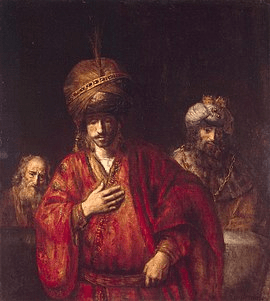
David and Uriah, by Rembrandt, c.1665

In the morning David wrote a letter to Joab and sent it with Uriah. In it he wrote, “Put Uriah out in front where the fighting is fiercest. Then withdraw from him so he will be struck down and die.”

So while Joab had the city under siege, he put Uriah at a place where he knew the strongest defenders were. When the men of the city came out and fought against Joab, some of the men in David’s army fell; moreover, Uriah the Hittite died.

Joab sent David a full account of the battle. He instructed the messenger: “When you have finished giving the king this account of the battle, the king’s anger may flare up, and he may ask you, ‘Why did you get so close to the city to fight? Didn’t you know they would shoot arrows from the wall? Who killed Abimelek son of Jerub-Besheth? Didn’t a woman drop an upper millstone on him from the wall, so that he died in Thebez? Why did you get so close to the wall?’ If he asks you this, then say to him, ‘Moreover, your servant Uriah the Hittite is dead.’” (New International Version)

Today we have a lesson in the middle of a story about King David’s greatest error in judgment and cover up of that decision. Indeed, bad decisions can often beget even more bad decisions.

It would be an understatement to say that David blew it. Our Old Testament books of 1 and 2 Samuel are arranged by the original editor in such a way that the chapter of 2 Samuel 11 is a hinge upon which the life of David moves.

All of the material before 2 Samuel 11 is generally positive, describing a man devoted to God in every way. But everything after this chapter is mostly tragic. The editor wanted readers and listeners to understand that God cares about morality and ethics by showing the consequences of both a life well-lived, as well as a life that is self-centered.

Before our verses for today, the story begins with David choosing adultery and taking another man’s wife. King David should have been doing the work of a king – protecting and serving Israel. But instead, he hung out in Jerusalem and avoided all the needed military stuff. (2 Samuel 11:1)

The editor wants us to see that King David was shirking his responsibility, which then brought a set up for moral failure. It appears David was resting on his laurels, content with his victories and successes. For the most part, at the time, the nation was happy and prosperous.

The king was walking around on the roof of his palace, instead of being in the trenches with his men, leading them in the defense of Israel.

Rather than giving proper orders as a king ought to do, David was sending people to do his personal bidding in satisfying his earthly wants. This is a significant reversal of what we see from earlier chapters in the story of David.

Up to this point we have observed David as a merciful king, seeking to use power for benevolent purposes in the common good of the nation. But in today’s chapter, David turns into the typical earthly king, ordering others around and using his authority to get what he wants.

The editor wants us to learn some lessons from David’s life. One of those lessons is that if the right and just King David can fall, then none of us are immune from falling into bad decisions which alter people’s lives forever.

The moment we think we are above falling, look out, because an arrogant nose dive into depravity is probably not far behind.

The stories of people who fall into immorality are mostly the same. Having some power or authority to wield, they use it to assert control over another person or group in order to get what they want – without being concerned for the needs and wants of others, and usually unconcerned for the negative consequences it brings upon other people.

It’s important that we call such behavior what it is: Evil. Awful. Selfish. Ungodly. A violation of ethics and morality. An offense against God.

David committed adultery, then lied, manipulated others, and covered up his actions. He murdered an innocent man, and was okay with an entire regiment of soldiers getting killed to ensure that an innocent man would be dead.

None of that icky nasty stuff was a mistake, or a lapse in judgment. It was pre-meditated sin.

And the way to deal with such sin is not to say something like “I did it, but it wasn’t really me; I’m not really like that!” Well, apparently, you are. Maybe David thought he was above it all, and believed it wasn’t really something he could ever do. But he did.

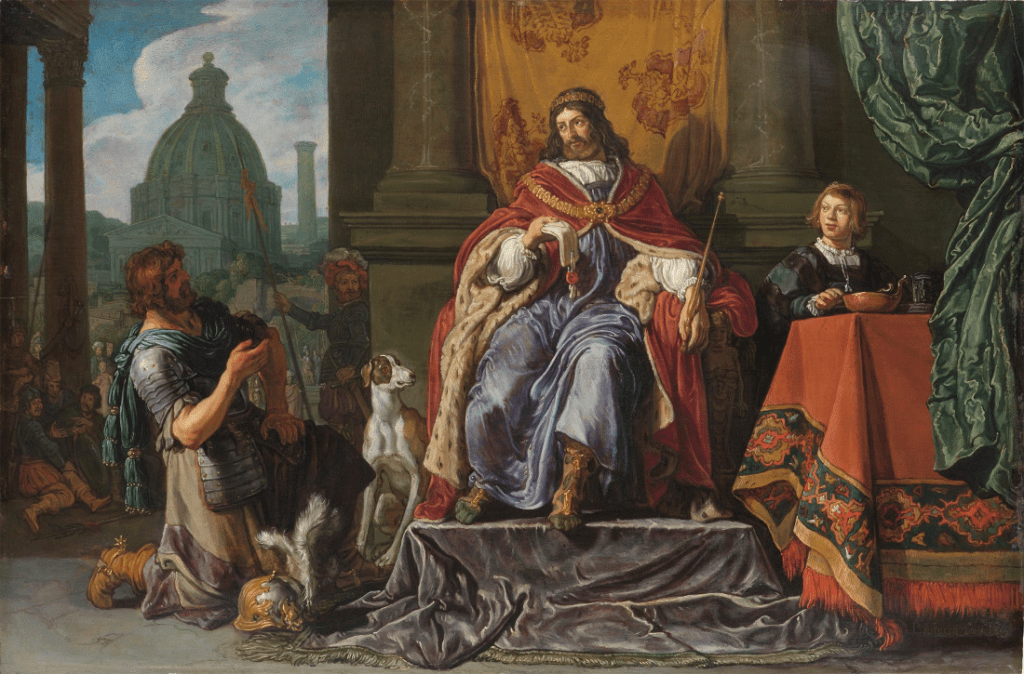
David gives Uriah a letter for Joab, by Pieter Lastman, 1619

Once we make an immoral and ungodly decision, it often causes us to start selling-out our principles and convictions. Sin only begets more sin, until we deal with it squarely.

Truth is a celebration of openness and honesty. Shame keeps to the shadows and prizes secrecy and remaining quiet. If one chooses not to go down the path of truth, then they will be continually encrusting their lives with lies so that no one ever knows.

In fact, much of religious legalism is nothing more than a person piling on the rules in order for others to not see the guilt and shame that hides deep within. Only through confession, repentance, and faith, will forgiveness, wholeness, and happiness ever occur.

Yet another lesson we can learn from this story of David is that the results which may satisfy our wants may not necessarily satisfy our needs, or God.

David accomplished what he wanted. He was successful in covering up his sin, and he got the woman he wanted. But God saw the whole thing, and was not okay with any of it. 

We must not assume that because we do something, and there was no immediate lightning strike, that it was okay. 

To only selfishly satisfy ourselves is to be a spiritual cannibal who eats other people alive.

So, how might we avoid falling into the same sorts of bad decisions which befell David?

  • Make prayers of confession a regular staple of your daily spiritual regimen. Had David engaged in prayer on the roof instead of being bored, we would likely have a very different story.
  • Maintain an active and engaged mind. An idle mind is the devil’s workshop. David was wandering around the palace instead of actively engaged in the government of his kingdom.
  • Keep the Sabbath. A day of rest helps the body to be in healthy rhythms of care, as well as enabling the spirit to connect meaningfully with God. Without adequate rest, we are like the little kid in a grocery store at 9pm throwing a fit and having a meltdown. David got out of a healthy rhythm as king, and it led to a fall.
  • Strengthen your family relationships. If you are married, live from the place of your marriage. Marriage is more than living with someone and having occasional fun; it is a one-flesh relationship that is meant to be a priority. Only from this relational place can a spouse effectively take on the world with all its needs and brokenness. 
  • Submit to accountable relationships. There are far too many lonely people with few friends in this world, even among people who are constantly around others. Everyone needs a small coterie of confidants with whom to share anything and everything with.  David’s close friends were all out with the army, and he was alone. Not a good thing.
  • Avoid stuffing all desire down as selfish and bad. Jettisoning desire only sets us up for a fall. But identifying godly desire enables us to make better decisions which engage the whole person.

Almighty God, you are the fountain of all wisdom and grace. You know our needs before we even ask, and our ignorance in not asking for the things we really need. Have compassion on our weakness, and mercifully give us those things that in our blindness we don’t know to ask for. 

Gracious Lord, we acknowledge and confess our sinful nature, prone to evil and slow to good.  You know our secret sins, and how often we have offended you and damaged others through wandering from your ways, wasting your gifts, and forgetting your love. Cleanse us from our hidden sins and forgive our faults for the sake of your Son, our Savior, Jesus Christ who loved us and gave himself for us. Amen.

For the Life of the World (John 6:1-21)

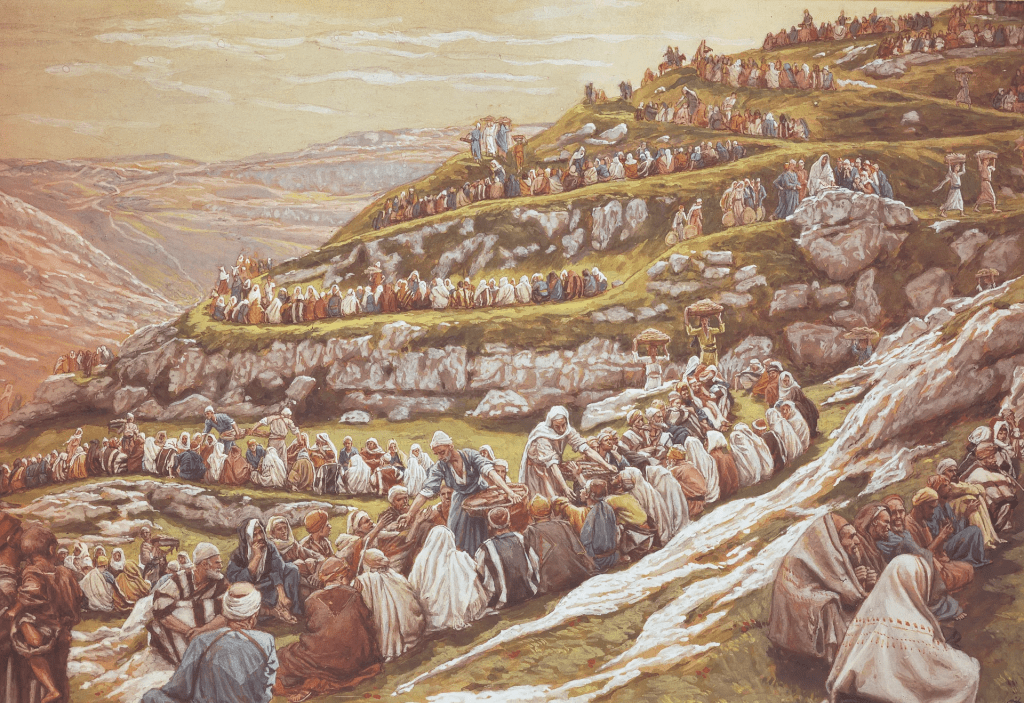
The Miracle of the Loaves and Fishes, by James Tissot, 1886

After this Jesus went to the other side of the Sea of Galilee, also called the Sea of Tiberias. A large crowd kept following him because they saw the signs that he was doing for the sick. Jesus went up the mountain and sat down there with his disciples. 

Now the Passover, the festival of the Jews, was near. When he looked up and saw a large crowd coming toward him, Jesus said to Philip, “Where are we to buy bread for these people to eat?” He said this to test him, for he himself knew what he was going to do. 

Philip answered him, “Two hundred denarii would not buy enough bread for each of them to get a little.” One of his disciples, Andrew, Simon Peter’s brother, said to him, “There is a boy here who has five barley loaves and two fish. But what are they among so many people?” 

Jesus said, “Make the people sit down.” Now there was a great deal of grass in the place, so they sat down, about five thousand in all. Then Jesus took the loaves, and when he had given thanks he distributed them to those who were seated; so also the fish, as much as they wanted. 

When they were satisfied, he told his disciples, “Gather up the fragments left over, so that nothing may be lost.” So they gathered them up, and from the fragments of the five barley loaves, left by those who had eaten, they filled twelve baskets. When the people saw the sign that he had done, they began to say, “This is indeed the prophet who is to come into the world.”

When Jesus realized that they were about to come and take him by force to make him king, he withdrew again to the mountain by himself.

When evening came, his disciples went down to the sea, got into a boat, and started across the sea to Capernaum. It was now dark, and Jesus had not yet come to them. The sea became rough because a strong wind was blowing. When they had rowed about three or four miles, they saw Jesus walking on the sea and coming near the boat, and they were terrified. But he said to them, “It is I; do not be afraid.” Then they wanted to take him into the boat, and immediately the boat reached the land toward which they were going. (New Revised Standard Version)

Christ Walking on the Waters, by Julius Sergius Von Klever, c.1880

The Deliverers Moses and Jesus

The Apostle John intended us to see the link between Moses and Jesus. God used Moses to bring deliverance of the people from slavery through a miracle at the Red Sea. The Lord also used him for a divine provision of manna in the wilderness.

And the Lord Jesus brought about a deliverance of the disciples from anxiety through a miracle on the Sea of Galilee. Christ also brought a divine provision of food in the middle of nowhere for thousands of people.

The miraculous displays by Jesus happened at the time of Passover, the very time that Jews celebrate the deliverance from Egypt. Just as divine power was exerted at the time of Moses in the original Passover, so also divine power likewise showed itself with Jesus in the supply of food and control of the sea.

What’s more, today Christians everywhere around the world remember God’s saving events with the elements of bread and cup, recalling divine deliverance and provision, and finding relief from their fears and anxieties.

A Miraculous Provision and Distribution of Food

It’s no coincidence that Jesus is pictured as sitting on a mountain – reminiscent of Moses on a mountain receiving the divine law and wisdom. The gathering of people around Christ was so great (thousands of them) and the need for food equally as great, that Jesus questioned his disciples concerning resources for such a large crowd.

Christ, of course, could have circumvented his disciples and simply provided the needed foodstuffs without them. Yet, he didn’t, on purpose. Always the rabbi and teacher, Jesus intended to give the disciples a lesson they wouldn’t forget.

After ascertaining that the only food available was a boy’s five barley loaves and two dried fish, Jesus knew that this was plenty, in order to feed up to 5,000 people. It was enough, because Jesus is enough. Only a small amount is needed to fill the bellies of thousands.

Sacramental Living, by Charissa Jaeger-Sanders

And, what is more, for those with the faith to see it, a little communion wafer and a small swallow from a cup is more than enough to satisfy and satiate the hungriest of faithful and penitent people.

Not only did the people eat as much as they needed and wanted, but there was also so much remaining food that the twelve disciples collected twelve baskets of bread. They could keep on ministering, providing, and distributing for people because little is much when God is in it. Long after Christ’s death and resurrection, his followers continued to give with the divine largess from Jesus.

Walking on Water

It had been a full day of teaching and miraculous ministry, in the full light for all to see. Christ’s power, however, is also operative at night. The darkness is not able to subdue continued miracles from Jesus.

For the Apostle John’s writings, darkness is almost always a theological statement, denoting that there are dark forces operative on this earth. And those powers definitely did not like Christ’s effective day of ministry.

The actual physical storm symbolized the chaotic and angry response of the sinister elements in the world. But despite the terrible conditions, Jesus calmly walked on the sea as the new Moses who takes charge of the water.

The disciples abject fear turned on a dime into exuberant joy, as they realized it was indeed Jesus who entered the boat. In addition, they experienced an immediate place of safe harbor.

Christ was standing in the divine tradition of bringing people from stormy circumstances and evil situations to the safe haven of God’s presence.

Jesus saves people from their fears and anxieties, their travails and ills, and their guilt and shame. Christ also provides everything we need, both material and immaterial. And he does it for the life of the world, for everyone who comes by faith.

Gracious Lord, you are the Sustainer of the hungry. Like a mother, you long to feed your children until each is satisfied. Turn our eyes to you alone, so that, aware of our own deepest longings, we will reach out with Christ to feed others with the miracle of your love. Amen.