Be Merciful to Me (Psalm 57)

“For thy mercy is great unto the heavens, and thy truth unto the clouds.” (Psalm 57:10, KJV) by Bible Art

Be merciful to me, O God; be merciful to me,
    for in you my soul takes refuge;
in the shadow of your wings I will take refuge,
    until the destroying storms pass by.
I cry to God Most High,
    to God who fulfills his purpose for me.
He will send from heaven and save me;
    he will put to shame those who trample on me.
God will send forth his steadfast love and his faithfulness.

I lie down among lions
    that greedily devour human prey;
their teeth are spears and arrows,
    their tongues sharp swords.

Be exalted, O God, above the heavens.
    Let your glory be over all the earth.

They set a net for my steps;
    my soul was bowed down.
They dug a pit in my path,
    but they have fallen into it themselves.
My heart is steadfast, O God;
    my heart is steadfast.
I will sing and make melody.
    Awake, my soul!
Awake, O harp and lyre!
    I will awake the dawn.
I will give thanks to you, O Lord, among the peoples;
    I will sing praises to you among the nations.
For your steadfast love is as high as the heavens;
    your faithfulness extends to the clouds.

Be exalted, O God, above the heavens.
    Let your glory be over all the earth. (New Revised Standard Version)

The Human Condition

Maybe it’s just me, yet it seems, over the past several years, that our world has become increasingly depressed, jaded, and unkind. Things like appreciation and encouragement of others are found less and less as time goes on. It’s as if we are all in some sort of collective funk, in which everyone has an underlying sullenness and frustration about them.

Humanity has suffered a great deal of change and loss, without a healthy means of grieving and lamenting for what has happened to them. In other words, we simply don’t know what to do with our hurt, so we end up projecting our hurt onto others. *Sigh*

There is something that we all share together about the human experience: Sooner or later, someone or a group of people will let us down. They will hurt us in some way. And that hurt will change us – either for good or for ill.

What’s worse, many have experienced, or will experience, some sort of abuse and victimization from another person or group – leaving them scarred by trauma. And, what’s more, there are those who have had their very lives at risk, because someone intentionally sought to kill them. 

King David’s Condition

That is the company David found himself in when King Saul, and the later when his son Absalom, sought to do away with his life.

To David’s credit, he never retaliated and did not try and turn the tables by putting a hit out on either Saul or Absalom. Instead, David cried out to God. And we get to listen in on the prayer. Today’s psalm is David’s prayerful reliance upon the God in whom he put all his trust and praise. 

The entire basis of prayer is to let God be God. So, how do we exactly do that?

Our Condition

Whenever the storms of life assail us, calloused persons trample on us with impunity, devious individuals set traps for us, and greedy organizations prey upon us, we must refuse to respond in kind.

Instead, let us deliberately praise the Lord, rely on divine protection, and pray to God, so that we might steadfastly hold on to our confidence. Because if God is for us, nothing nor no one, can be against us.

That advice may seem like a sort of pie-in-the-sky rot of ginning up positive thoughts when there is nothing positive to be seen in the experience. Yet, please keep in mind that we must never, and I repeat, never invalidate another’s experience, nor our own, when those experiences are hellish.

There is always hope. There are two unshakable truths which are constant, and are never diminished by any adverse circumstance:

  1. God is present with us
  2. God loves us

If we know nothing else, and everything seems to be descending into the abyss of tragedy, the twin towers of divine presence and divine mercy stand guard as the strongest sentinels over our dilapidated situation, and struggling faith.

Letting God be God means not to try and control things we have no control over. Rather, it means to affirm that the Lord is willing and capable of handling our worst stuff.

It could be that we are stuck in the belly of a whale because, without our knowing it, there are sharks surrounding us, who cannot get to us because of divine attention and protection.

Our perspective of life-circumstances is, at best, severely limited. It is much better to place faith in the God who sees it all, with an expansive eye which misses nothing.

One of the best things, to me, about the psalms is that they are a wonderful collection of prayers we can adopt for our own. Not only can we use them for ourselves, but we are also obliged to do so. 

If anyone has been in an adverse situation, so deep that it feels like having ambled into a pride of lions, it’s quite likely that the experience leaves one with no adequate words to say. There we are – paralyzed with fear, and unable to move. 

So, let the psalm say for you what you cannot even begin to utter yourself. The Word of God is not meant to sit on a coffee table,  or to rest on a shelf; it is meant to be opened and used for prayer. Allow it to do its intended purpose.

Who knows? Perhaps your faith in the mercy of God, and your praises lifted to God, will give rise to a newfound confidence and peace, so that you can rest secure, even when all around you is going to hell.

Be merciful to me, O God, for in you my soul takes refuge. Even though I feel the slash of people with tongues as swords, my heart is steadfast, and I will exalt your name above the heavens. Let your glory be over all the earth! Amen.

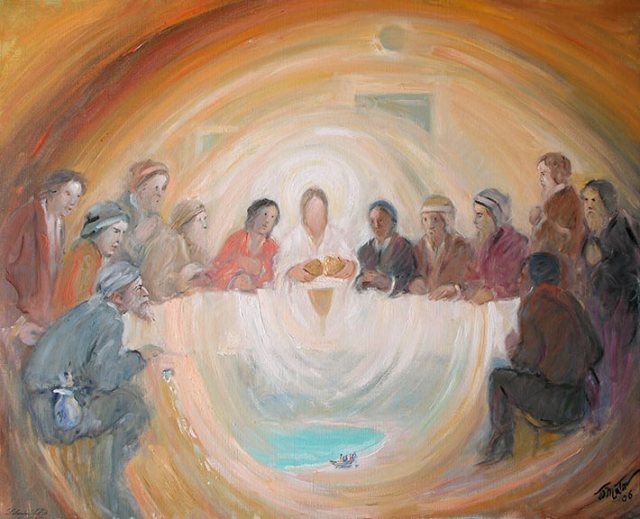
I Am the Bread of Life (John 6:35, 41-51)

Ethiopian Orthodox depiction of Jesus sharing with the disciples

Jesus said to them, “I am the bread of life. Whoever comes to me will never be hungry, and whoever believes in me will never be thirsty…

Then the Jews began to complain about him because he said, “I am the bread that came down from heaven.” They were saying, “Is not this Jesus, the son of Joseph, whose father and mother we know? How can he now say, ‘I have come down from heaven’?” 

Jesus answered them, “Do not complain among yourselves. No one can come to me unless drawn by the Father who sent me, and I will raise that person up on the last day. It is written in the prophets, ‘And they shall all be taught by God.’ Everyone who has heard and learned from the Father comes to me. Not that anyone has seen the Father except the one who is from God; he has seen the Father. Very truly, I tell you, whoever believes has eternal life. I am the bread of life. Your ancestors ate the manna in the wilderness, and they died. This is the bread that comes down from heaven, so that one may eat of it and not die. I am the living bread that came down from heaven. Whoever eats of this bread will live forever, and the bread that I will give for the life of the world is my flesh.” (New Revised Standard Version)

The lesson for today begins with the first of seven “I am” statements in John’s Gospel from Jesus:

  1. “I am the bread of life. Whoever comes to me will never be hungry, and whoever believes in me will never be thirsty.” (John 6:35)
  2. “I am the light of the world. Whoever follows me will never walk in darkness but will have the light of life.” (John 8:12)
  3. “I am the gate. Whoever enters by me will be saved and will come in and go out and find pasture.” (John 10:9)
  4.  “I am the good shepherd. The good shepherd lays down his life for the sheep.” (John 10:11)
  5. “I am the resurrection and the life. Those who believe in me, even though they die, will live,and everyone who lives and believes in me will never die.” (John 11:25-26)
  6. “I am the way and the truth and the life. No one comes to the Father except through me.” (John 14:6)
  7. “I am the true vine, and my Father is the vine-grower. He removes every branch in me that bears no fruit. Every branch that bears fruit he prunes to make it bear more fruit. I am the vine.” (John 15:1-2)

Also, for the first time in the Gospel of John, the Jews are named and identified as the ones who cause conflict for Jesus. John, of course, did not mean every single Jew; he was referring chiefly to the Jewish religious establishment, the leaders. And even then, he, of course, was not making reference to every single rabbi or person in the ruling council.

It’s important to say that, because Jews throughout the centuries have had far too much persecution from Christians who think all Jews have it in for Jesus. So, please, exercise some plain common sense and basic human kindness when it comes to reading the New Testament Gospels; they are most definitely not anti-Semitic.

The religious leaders were taking issue with the claims of Jesus, his “I am” statement. They argued that Jesus was a plain ordinary Jew from a typical Jewish family. There’s no need, the authorities contended, for Jesus to think of himself any other way than a common Jew.

Instead of entertaining the complaint against him, Jesus pointed to God the Father. God initiated the action by sending Jesus; and takes action by drawing people to Jesus. And Christ does his part by raising those people up at the last day; and teaching them about God’s actions of deliverance.

When it comes to the earthly ministry of Jesus, seeing is believing, and hearing is learning. Trust what you see with Jesus; and believe it. Have faith in what you hear from Jesus; and learn from it.

I Am the Bread of Life, by Joseph Matar

I like Jesus. I like metaphors. Jesus is a metaphor guy. I like that. Jesus said that he is the bread of life. Those who come to Jesus are satisfied. Those who eat him, live forever. This isn’t cannibalism, it’s a metaphor. The bread that Jesus gives for the life of the world is his flesh.

Metaphors help us relate to the concept, and grasp the message. If you’re hungry, just looking at a loaf of bread isn’t going to help you be satisfied. Obviously, you have to eat the bread and do more than see it, smell it, and touch it.

What’s more, people do more than eat once. We eat repeatedly, every day, at least a few times a day, in order to be healthy and alive.

Come and see Jesus. But do more than that. Ingest him. Take Jesus into your life. Let the bread of life come into you and thoroughly satisfy you. And do it every day. Do it several times a day. Make sure your soul is continually full of Jesus.

Then, you will have life to the full, an abundant life, filled with good things and right relationships.

Jesus is the bread of life. He is the great “I am.” And so much more.

Yet, perhaps at first glance, Jesus is just one person amongst a panoply of historical characters and religious figures. However, if we will but taste Jesus, we will come to see something very different about him. He’s more than a human being, more than a compelling teacher, and more than a miracle worker.

Jesus may appear, to many, as nothing more than a common person. But there’s really nothing ordinary about him, at all. Taking the time to have a good look at the Gospel of John, and watching Jesus move from village to village, and person to person will help us see a rather uncommon person who was no ordinary human being.

He moved to the beat of a different drum, and danced an alternative jig. And if we observe more closely, we can see the other two dance partners with him.

And with our two ears, when he says, “I am,” we can respond with an emphatic, “He is.”

Merciful Father, you heard the prayers of your people in the wilderness and fed them bread from heaven despite their sin. Graciously hear us today and feed us, too, with the Bread of Life from heaven, our Lord Jesus Christ, who lives and reigns with you and the Holy Spirit, one God, now and forever. Amen.

Absalom’s Conspiracy (2 Samuel 15:1-13)

Absalom propitiating friends, painted 1595, in the National Museum, Warsaw, Poland

In the course of time, Absalom provided himself with a chariot and horses and with fifty men to run ahead of him. He would get up early and stand by the side of the road leading to the city gate. Whenever anyone came with a complaint to be placed before the king for a decision, Absalom would call out to him, “What town are you from?” He would answer, “Your servant is from one of the tribes of Israel.” Then Absalom would say to him, “Look, your claims are valid and proper, but there is no representative of the king to hear you.” And Absalom would add, “If only I were appointed judge in the land! Then everyone who has a complaint or case could come to me and I would see that they receive justice.”

Also, whenever anyone approached him to bow down before him, Absalom would reach out his hand, take hold of him and kiss him. Absalom behaved in this way toward all the Israelites who came to the king asking for justice, and so he stole the hearts of the people of Israel.

At the end of four years, Absalom said to the king, “Let me go to Hebron and fulfill a vow I made to the Lord. While your servant was living at Geshur in Aram, I made this vow: ‘If the Lord takes me back to Jerusalem, I will worship the Lord in Hebron.’”

The king said to him, “Go in peace.” So he went to Hebron.

Then Absalom sent secret messengers throughout the tribes of Israel to say, “As soon as you hear the sound of the trumpets, then say, ‘Absalom is king in Hebron.’” Two hundred men from Jerusalem had accompanied Absalom. They had been invited as guests and went quite innocently, knowing nothing about the matter. While Absalom was offering sacrifices, he also sent for Ahithophel the Gilonite, David’s counselor, to come from Giloh, his hometown. And so the conspiracy gained strength, and Absalom’s following kept on increasing.

A messenger came and told David, “The hearts of the people of Israel are with Absalom.” (New International Version)

Although Absalom, a son of David, began to despise his father, he learned some things from him, namely, the ability to wait and plan. He spent two years preparing to kill his half-brother Amnon, and four years getting ready to kill his father and take his throne.

I’m sure Absalom did not feel like a murderer. He likely looked at the situations and felt justified in doing away with Amnon, then going after David. To be sure, Amnon had committed a heinous crime – one in which Tamar, Absalom’s sister, was left bereft, only to be cared for by her brother. Absalom seems to have believed he was merely dispensing justice, not murder.

David, typically astute and proactive, was anything but that when it came to his family; he did not initiate very much of anything. The king’s inaction was so profound that Absalom began plotting a takeover. As in the case of Amnon, it’s likely that Absalom saw forming a conspiracy as bringing some needed justice.

After all, it appears that King David had become lax in his royal responsibilities. Seemingly, David was no longer himself – deciding cases in favor of the weak, needy, and vulnerable. Absalom was more than happy to fill the void.

Absalom evidenced an oversized ego in believing that if he were the judge in the land, everything would be okay. Whenever a person who feels the smack of injustice begins interacting with others who have not been receiving justice, rarely does that person rely upon the Divine Judge for righteousness. Absalom took matters into his own hands.

Whenever we hear the cry “It’s not fair!” there is often, not far behind, an angry person seeking to become judge, jury, and executioner.

So, Absalom worked the crowd. He spent years refining his image, and presenting the sort of reputation he sought from the people. Absalom was handsome and charming. The country became putty in his hands.

What nobody knew was that Absalom had an axe to grind, that underneath the silver tongue and the careful marketing opportunities was a person who was downright hurt, and mad enough to destroy and kill.

Finally, he began implementing his plot for taking over the kingdom. And he would need all the appearances of royal approval from some people in high positions. A religious banquet with a few hundred people, including David’s trusted counselor, would do the trick. The plan was to gain enough endorsements to gain momentum for others to join the conspiracy.

And it worked. The hearts of the people were with Absalom. They loved the guy.

Yet, the thing about it is, it wasn’t so much that Absalom loved the people, near as much as he hated his father, King David.

For the truly right, just, and good people of the land, they could observe the distinction. They knew better. The good people of the kingdom could discern that Absalom may look good, but something didn’t smell right about him.

No matter how flawed David was, or how much he had slipped in his duties, he was still nevertheless the king, the anointed one whom God had chosen. And the wise people could keep their wits about them, and begin to see what was really going on.

Anyone who comes along and tells us that they can make everything better, and do it quickly, is probably a hack preacher who, like Absalom, has a grievance against someone.

We can do better than leaders like that. And we can do better than to incessantly criticize existing leadership – no matter where it’s found – until we have done our due diligence in spending years in prayer for our leaders, and done what we could do to help them be successful in their positions.

Nurturing bitterness and hate is a one way trip to the grave. The evidence is seen in the constant vitriol we hear on a daily basis. But cultivating wisdom and discernment, along with a healthy spiritual and religious life, brings sanity and compassion where it needs to be.

Which way do you want to go?

Blessed heavenly Father: Forgive me for the things in my life which continue to keep me from the path you have chosen for me. Remove the sins from my life that block me from becoming the person you want me to be. Fill my life with your Holy Spirit that I may be a light unto others, so that they may come to know you. Amen.

A Sad Family Situation (2 Samuel 14:25-33)

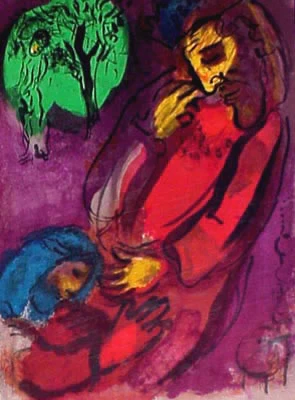
David and Absalom, by Marc Chagall, 1956

In all Israel there was not a man so highly praised for his handsome appearance as Absalom. From the top of his head to the sole of his foot there was no blemish in him. Whenever he cut the hair of his head—he used to cut his hair once a year because it became too heavy for him—he would weigh it, and its weight was two hundred shekels by the royal standard.

Three sons and a daughter were born to Absalom. His daughter’s name was Tamar, and she became a beautiful woman.

Absalom lived two years in Jerusalem without seeing the king’s face. Then Absalom sent for Joab in order to send him to the king, but Joab refused to come to him. So he sent a second time, but he refused to come. Then he said to his servants, “Look, Joab’s field is next to mine, and he has barley there. Go and set it on fire.” So Absalom’s servants set the field on fire.

Then Joab did go to Absalom’s house, and he said to him, “Why have your servants set my field on fire?”

Absalom said to Joab, “Look, I sent word to you and said, ‘Come here so I can send you to the king to ask, “Why have I come from Geshur? It would be better for me if I were still there!”’ Now then, I want to see the king’s face, and if I am guilty of anything, let him put me to death.”

So Joab went to the king and told him this. Then the king summoned Absalom, and he came in and bowed down with his face to the ground before the king. And the king kissed Absalom. (New International Version)

Parents are people, and so, they don’t always make sense. David was both a king and a parent. And those two roles often got mixed and complicated for him.

David’s son Abasalom had killed another son, Amnon, who had sexually assaulted a daughter, Tamar, Abasalom’s sister. Yes, it sounds a lot like a Bible soap opera.

Joab, David’s military general (and cousin) convinces the king to bring Absalom back to Jerusalem, having fled Jerusalem after killing Amnon. And David did so. Yet, he gave an order that Absalom was not to come into his presence, even though David longed for his son.

It was a case of the nonsensical – the parental approach of yearning for an adult child, while at the same time, shunning and shaming them. Indeed, these were incongruent actions on the part of David.

When Tamar was assaulted, David found out and was very angry; yet he neither dealt with Tamar by giving her support and compassion, nor dealt with Amnon in meting out justice.

As for Absalom, David’s feelings for him did not translate into action. It appears the story wants us to see the wide gap between King David’s emotions and actions.

Perhaps the emphasis on Absalom’s sheer beauty is designed to emphasize the incongruence of David – this handsome man is put at arm’s length by his father. Furthermore, this behavior would eventually put David’s royal position in jeopardy.

When guilt and shame are not confronted, it leads to a downward spiral into continued levels of degradation.

The assault of Tamar led to the murder of Amnon, which led to the inactions of David. Everyone ended up responding to someone else’s guilt by adding their own guilt to it. In this scenario, everyone loses something, and there is a lot of unnecessary grief.

Abasalom returned to his hometown of Jerusalem. But everything had changed. He was simply existing. Honestly, Absalom needed something, anything, instead of living day after day in a house without any love or acceptance. Absalom was in that awkward place of wanting either mercy or judgment, acceptance or punishment, because to live in limbo was shrinking him to nothing.

For those who know the story of David and Absalom, you understand where all of this family dysfunction is leading; and it will not end well.

It could be that Jesus had this story in the back of his head when he told the parable of the prodigal son (Luke 15). Perhaps Christ wanted us to see what could happen when a father chooses to respond with actions of grace, acceptance, and undeserved kindness. Even though the son had done something awful and was full of guilt, when he finally made his way home, the father ran to him, embraced him, and accepted him with a blowout party.

We can only wonder what would have happened had David stepped into the situations of his children’s lives when they were going awry. Methinks that had David done so, with his characteristic wisdom and mercy, there would have been a very different outcome in his family.

One way of viewing this story is that the incongruence of King David toward Absalom, with his combination of longing and rejection, was a stubborn passive-aggressive refusal to give his son the grace and love which God had given to him. In light of the story’s eventual end, this view makes a lot of sense.

Yet, this doesn’t have to be the same for you or me in our family relationships today. We can choose to love, instead of inflexibly holding on to a denial of love. One can do all the mental gymnastics of justifying that denial by believing you’re teaching the kid a lesson, or giving them what they deserve, but it’s really, at it’s core, choosing not to love with the love provided by God.

Réconciliation d’Absalom et de David, by Gabriel de Saint-Aubin, 1752

Absalom eventually entered David’s throne room and received a kiss. But it was simply too little, too late. And that’s why, at some point after this, Absalom decided to replace his emotionally and actively distant father as king.

If guilt, shame, evil, and sin go unchecked for too long, it makes for a terrible mess of people’s lives; and usually results in either verbal violence, physical violence, or both.

But it doesn’t have to be that way….

For being quick to see the sins of others, and slow to repent of our own, forgive us, Lord.

For clinging to remembered hurts, and brushing off gestures of kindness, forgive us, Lord.

For the divisions among us that damage our mission to the world, forgive us, Lord.

For the work we have not done because we refused to do it together, forgive us, Lord.

For these and all our sins, O God, we weep in sorrow and ask for your forgiveness, through Jesus Christ our Lord. Amen.