Proverbs 1:1-7 – Right, Just, and Fair

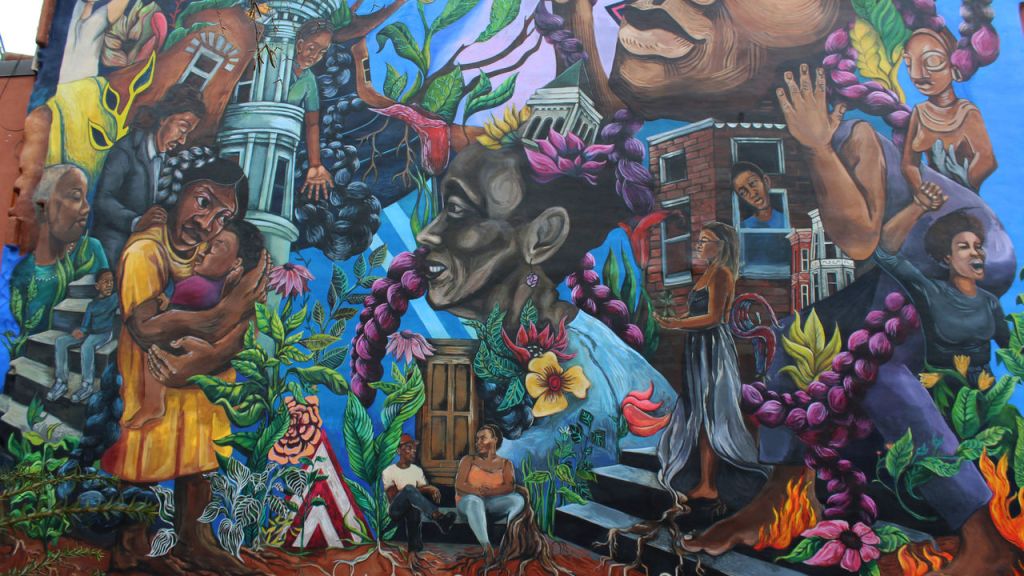
“Passing Wisdom, Planting Seeds,” building art in Brooklyn, New York City by artists Danielle McDonald and Jazmine Hayes

These are the proverbs of Solomon, David’s son, king of Israel.

Their purpose is to teach people wisdom and discipline,
    to help them understand the insights of the wise.
Their purpose is to teach people to live disciplined and successful lives,
    to help them do what is right, just, and fair.
These proverbs will give insight to the simple,
    knowledge and discernment to the young.

Let the wise listen to these proverbs and become even wiser.
    Let those with understanding receive guidance
by exploring the meaning in these proverbs and parables,
    the words of the wise and their riddles.

Fear of the Lord is the foundation of true knowledge,
    but fools despise wisdom and discipline. (NLT)

The pursuit of wisdom is a noble aspiration for the New Year. One of the best places to go in that pursuit is the biblical book of Proverbs because it is all about living wisely and not foolishly.

To acquire and live by wisdom means learning to become right, just, and fair in all our interactions and dealings with others.

“Right” for the ancient King Solomon is a relational term – to be righteous, to have right relationships with God and other people. Righteousness involves experiencing peaceful, harmonious, and fruitful relations. For the Christian, right living is to know the wonderful freedom and joy of an unhindered relationship through Jesus Christ in dependence upon the Holy Spirit. 

When it comes to fellow human relations, a person characterized by righteousness does not, for example, let the sun go down on their anger. It is to know personal peace as well as to be a peacemaker so that relationships do not remain strained but enjoy harmony.

“Just” is closely related to “right.” We might tend toward primarily understanding justice as a punitive act – and that is certainly a part of the term. God punishes the wicked (not us!) with appropriate timing and wisdom; and deals with those who withhold righteousness and love through their uncaring, inattentive, or evil acts. 

Solomon understood justice as mostly concerned with providing a person with the necessities of life. So, for example, if someone is hungry and needs food, or does not have clean water to drink, it is a “just” act for us to provide those critical needs. God is deeply concerned for justice and expects people to act in this same manner.

“Fair” is to be egalitarian. Fairness and equity binds righteousness and peace together by avoiding prejudice toward others and their needs. It means to not show favoritism because there is an unshakable belief in the equality of all people, no matter where they are from, what they do, or who they are.

Therefore, if we exercise righteousness and justice exclusively with individuals and groups we like, but ignore others in need, there is no fairness. To give our love and service to all persons without strings attached, or without being concerned to get paid back, is the practice of being fair in all our affairs.

To live in the way of being right, just, and fair in all things is to be wise. Conversely, the classic fool is one who judges others, creates discord, and ranks persons according to their own personal standard of who deserves help, and who does not. Trying to have a useful and gracious conversation with a fool is like trying to reason with a toddler – you will get nowhere. 

A good place to start in pursuing the wise and biblical virtues of righteousness, justice, and fairness is to ask God to open our eyes to those within our sphere of influence who need both physical and relational needs met. Then, follow through with loving those persons for whom God brings into our lives.

Almighty God, the essence and source of wisdom, you are always right, just, and fair in all things, I praise you for your infinite and abundant wisdom. Whereas you abound in wisdom, I am lacking. Please help me to grow in wisdom as I increase in my knowledge and respect of your divine presence. By means of your Spirit, please increase my depth of insight as I study your Holy Word. Hold me back from leaning on my own understanding and enable me to wholeheartedly embrace the wisdom from above. Righteous God help me to grow in wisdom continually and consistently. Teach me your ways. Since you are a just God who shows no favoritism, lead me into being like you in my dealings with others through the example of Jesus Christ, in the strength of the Holy Spirit. Amen.

Revelation 21:1-6 – Making All Things New

Make All Things New by James Janknegt, 2005

Then I saw a new heaven and a new earth; for the first heaven and the first earth had passed away, and the sea was no more. And I saw the holy city, the new Jerusalem, coming down out of heaven from God, prepared as a bride adorned for her husband. And I heard a loud voice from the throne saying,

“See, the home of God is among mortals.
He will dwell with them;
they will be his peoples,
and God himself will be with them;
he will wipe every tear from their eyes.
Death will be no more;
mourning and crying and pain will be no more,
for the first things have passed away.”

And the one who was seated on the throne said, “See, I am making all things new.” Also, he said, “Write this, for these words are trustworthy and true.” Then he said to me, “It is done! I am the Alpha and the Omega, the beginning, and the end. To the thirsty I will give water as a gift from the spring of the water of life. (NRSV)

The world as we now know it will someday disappear. We have a future hope – it will literally be heaven on earth. The entire planet will be a renewed and God will descend to dwell with us. The Lord will bring us to the original design of the garden with Adam and Eve – an unhindered relationship between divinity and humanity. We shall no longer be dogged by our personal shame, institutional and systemic evil, and the temptations and oppression of Satan. Tears, death, sorrow, and pain will be a thing of the past. Eventually, our struggle with the fallen nature of everything will be completely over.

The message from the Apostle John to the early church was extremely encouraging. The people had faced all kinds of trouble and persecution due to their Christian commitment. To know that suffering only lasts for the night, but joy comes in the morning because of Jesus, changes everything. To the ancient church, as well as us today, this is a comfort and help in our present adversities.

Yet, we are such an impatient people! We want good things to happen, and now! All God’s people throughout history have been looking ahead for the ultimate fulfillment of God’s promises. The Apostle John did not  give a brand-new revelation to the church but upheld and anticipated what had been known and true for centuries. God said to the prophet Isaiah:

“See, I will create
    new heavens and a new earth.
The former things will not be remembered,
    nor will they come to mind.
But be glad and rejoice forever
    in what I will create,
for I will create Jerusalem to be a delight
    and its people a joy.
I will rejoice over Jerusalem
    and take delight in my people;
the sound of weeping and of crying
    will be heard in it no more. (Isaiah 65:17-19, NIV)

Making All Things New by Beth Lighthouse, 2018

In the first Advent of Christ, many of God’s people thought for certain all these promises would finally be realized. Yet, like a young couple in their engagement period, the promises of God had been initiated and promised, but not yet realized or consummated. The Apostle Peter addressed a common question asked throughout the ages:

“What happened to the promise that Jesus is coming again? From before the times of our ancestors, everything has remained the same since the world was first created.” (2 Peter 3:4, NLT)

Peter responded, in part, by reminding Christians:

Do not let it escape your notice, dear friends, that with the Lord a single day is like a thousand years and a thousand years are like a single day. The Lord is not slow to keep his promise, as some think of slowness, but he is patient toward you, not wanting anyone to perish but all to change their hearts and lives. (2 Peter 3:8-9, CEB)

“I am making everything new,” said Jesus. And he wanted John to get that down in writing so not to forget. God is still in the process of moving history to its final stage. Will we be patient in letting God do this work until the final day comes, or will we be impatient? 

Although we are awaiting the end of all things, this is no time to be idly sitting by, twiddling our thumbs with nervous anxiety. Nor are we to go all apoplectic with furious activity creating prophecy charts, trying to figure out exactly the day and hour of Christ’s Second Advent. No, rather, we properly anticipate the Second Coming when we let God change our hearts and lives, our neighborhoods and workplaces, our families, and churches, to be just like Christ.

God is presently preparing for Christ’s return by doing away with the old order to make room for the new. The Apostle Paul put it this way to the Corinthian Church:

When anyone is in Christ, it is a whole new world. The old things are gone; suddenly, everything is new! (2 Corinthians 5:17, ERV)

With each transformed life, we are reminded God is not slow in keeping promises but is now vigorously active preparing for the last day.

The Revelation of John helps us to break our fixation with the past and the ways we have always done things.  God’s capacity and ability to renew is astounding. Even now, we can walk now in newness of life.

We were buried with him through baptism into death, that just as Christ was raised from the dead by the glory of the Father, even so we also should walk in newness of life. (Romans 6:4, NKJV)

To avoid impatience and to keep persevering, it is helpful to have a big picture view of what God has done, is doing, and will do.

In the Fall of 1991, a car driven by a drunk driver jumped its lane and smashed headfirst into a minivan driven by a man named Jerry Sittser. He and three of his children survived, but Jerry’s wife, four-year-old child, and mother died in the crash. In his book A Grace Revealed Sittser shares the following interaction with one of his surviving children, David, months after the accident:

“Do you think Mom sees us right now?” he suddenly asked.

I paused to ponder. “I don’t know, David. I think maybe she does see us. Why do you ask?”

“I don’t see how she could, Dad. I thought Heaven was full of happiness. How could she bear to see us so sad?”

Could Lynda, my wife, witness our pain in Heaven? How could that be possible? How could she bear it?

“I think she does see us,” I finally said. “But she sees the whole story, including how it all turns out, which is beautiful to her. It’s going to be a good story, David.”

God knows the whole story. When everything dies, all is stripped from our lives, and the world as we know it is done away with, what are we left with?  God and the renewal of all things. The troubles of this present evil age will be eradicated forever.

Whenever we seek to do away with the world’s grinding poverty and the starvation of children; whenever we work to end global sex-trafficking and domestic abuse; whenever we tackle epidemics, pandemics, and disease; whenever we help others face and cope with the evil of this world; whenever we come alongside others in their trouble; whenever we extend comfort to the grieving and grace to the wayward; whenever we choose mercy and kindness; then, God is using us to make everything new.

The end is coming. But it is not yet here. God is presently working to make everything new by bringing deliverance from sin, death, and hell to people throughout the world.

Almighty God, in the New Year, at this moment of transition, we understand this is the moment of your intervention. We offer to you, O Lord, everything that makes us sad and upset; everything that makes us desperate; all our unfulfilled plans, and all our unrealized dreams. They are yours. Take them and transform them into something beautiful, magnificent, and new. Let your Holy Spirit make us new creations in Jesus Christ our Lord.  Amen.

Ecclesiastes 3:1-13 – What Time Is It?

There is a right time for everything, and everything on earth will happen at the right time.

There is a time to be born
    and a time to die.
There is a time to plant
    and a time to pull up plants.
There is a time to kill
    and a time to heal.
There is a time to destroy
    and a time to build.
There is a time to cry
    and a time to laugh.
There is a time to be sad
    and a time to dance with joy.
There is a time to throw weapons down
    and a time to pick them up.
There is a time to hug someone
    and a time to stop holding so tightly.
There is a time to look for something
    and a time to consider it lost.
There is a time to keep things
    and a time to throw things away.
There is a time to tear cloth
    and a time to sew it.
There is a time to be silent
    and a time to speak.
There is a time to love
    and a time to hate.
There is a time for war
    and a time for peace.

Do people really gain anything from their hard work? I saw all the hard work God gave us to do. God gave us the ability to think about his world, but we can never completely understand everything he does. And yet, he does everything at just the right time.

I learned that the best thing for people to do is to be happy and enjoy themselves, as long as they live. God wants everyone to eat, drink, and enjoy their work. These are gifts from God. (ERV)

Time is finite. We cannot get it back once we lose it. So, it is important to use our time in ways that reflect our most cherished values and commitments. For that, we need wisdom to know what to do, what not to do, and when to do it.

We can often use our time in strange ways. For example, Rafael Antonio Lozano of Plano, Texas has been on a quest to visit every company-owned Starbucks on the planet. He began his mission in 1997, when there were 1,304 Starbucks stores worldwide. Currently, there are 31,256 stores. As of September 2019, Lozano reported having visited over 15,000 global locations. 

Despite his impressive pace, Lozano is realistic about the nature of his quest, saying, “As long as they keep building Starbucks, I’ll never be finished.” He is also realistic about the importance of his mission. “Every time I reach a Starbucks, I feel like I’ve accomplished something,” he said, “when actually I’ve accomplished nothing.”

The book of Ecclesiastes would say, “There is a time to drink coffee, and a time to stay home.” Certainly, Lozano’s personal mission is extreme. But before we get too hard on Rafael, do we have a personal mission?  Does it reflect the stewardship of time God has given us?  When we get to the end of our lives, will we feel like we have accomplished something only to discover that we have accomplished nothing?

Time is a gift from God, and a temporary commodity to be used for God before the end of time comes.

One of the realities of time is that our lives are full of seasonal rhythms and change over time. These are built into the life God has given us. The book of Ecclesiastes is one that, throughout its contents, explains that nothing we pursue has any permanence to it. We throw ourselves into some work or activity, but what does that activity really do for us in the end?

Time is our master, and we must respect it.

When I was twenty years old, I thought nothing of playing a round of golf in the morning and three sets of tennis in the afternoon, then staying up late at night with friends. If I did that same thing today, I would have a team of doctors attending me in the hospital. We all, at some point, try to defy time and act like we can do the things we once did in the past. Sometimes it takes a lot for us to accept our limitations, whether it is our play or our work. Ecclesiastes teaches us that forces from the outside seem to always dictate what we can do and not do.

Time can be a harsh taskmaster.

The clock relentlessly and inexorably moves forward with the cycles and rhythms of life offering only meaninglessness, as we discover we are prisoners of time. But for the believer, time can be redeemed with godly purpose and meaning, no matter what the season of life is. Because there is time, and all things will someday come to an end – all activity, or the lack of it, will be judged according to how we denied or accepted our limitations due to time. 

Ecclesiastes also offers to us what seems a subversive perspective that is counter-cultural to our society. Whereas many Americans believe that if we work hard and do the right thing we can shape our own lives and our own prosperity, the Teacher of Ecclesiastes insists on submitting and moving with the events, rhythms, and seasons of God.  

Apart from God, time is futile and meaningless. In our denial, it is no wonder so many persons are so unhappy with their lives.

In the seasons of life and experiences we have from birth to death, the conclusion of Ecclesiastes is that everything is out of our control. Too many of us try to exert control over events, people, and circumstances when, in truth, any control we have is an illusion. I call this the “c-clamp syndrome,” trying to clamp down on others to get them to submit to our agenda.

Instead, Holy Scripture directs us to practice self-control – to focus on myself and my own actions:

Moderation is better than muscle, self-control better than political power. (Proverbs 16:32, MSG)

Prepare your minds for action and exercise self-control. Put all your hope in the gracious salvation that will come to you when Jesus Christ is revealed to the world. (1 Peter 1:13, NLT)

The end of everything has come. Therefore, be self-controlled and clearheaded so you can pray. (1 Peter 4:7, CEB)

Do your best to improve your faith. You can do this by adding goodness, understanding, self-control, patience, devotion to God, concern for others, and love. If you keep growing in this way, it will show that what you know about our Lord Jesus Christ has made your lives useful and meaningful. (2 Peter 1:5-7, CEV)

We cannot make time stand still. So, we must focus on how we spend our time now. It is time for us to lay aside lesser pursuits and diligently pursue God. We each must give ourselves to the unforced rhythms of grace and let God redeem the time. What time is it?  It is time to live in harmony with God in all we say and do.

God of all time help us to know ourselves. Teach us to recognize our weaknesses and work to walk in holiness. Let us follow you in all things, submitting to the times you have for us. Thank you for your unending grace and mercy toward us when we need it most. Help us to trust you with our lives through Jesus Christ our Lord in the power of the Holy Spirit. Amen.

2 Peter 3:8-13 – It’s Time

But do not forget this one thing, dear friends: With the Lord a day is like a thousand years, and a thousand years are like a day. The Lord is not slow in keeping his promise, as some understand slowness. Instead he is patient with you, not wanting anyone to perish, but everyone to come to repentance.

But the day of the Lord will come like a thief. The heavens will disappear with a roar; the elements will be destroyed by fire, and the earth and everything done in it will be laid bare.

Since everything will be destroyed in this way, what kind of people ought you to be? You ought to live holy and godly lives as you look forward to the day of God and speed its coming. That day will bring about the destruction of the heavens by fire, and the elements will melt in the heat. But in keeping with his promise we are looking forward to a new heaven and a new earth, where righteousness dwells. NIV)

The Apostle Peter invites us to see the moving of history as God sees it. Peter addressed two questions and concerns the people had about the Lord’s coming: Will this coming be worth the wait? And what should I be doing in the meantime now while I wait?

The people in Peter’s time were impatient. They saw time from a mere human perspective and needed a bigger understanding of God’s purposes. The fact of the matter is that God’s timing is different than ours. There are two words for “time” in the New Testament: chronos and kairos. 

Chronos is where we get our English word “chronological.” This is time measured by the clock and is the way much of our lives are governed. The other term for time, kairos, is seasonal time. Kairos is not determined by the clock but is event oriented. 

God is not time-oriented in the sense that we are, that is, God is not ruled and controlled by the clock. God is event-oriented, which is why the Lord’s understanding of time is that a thousand years are like a day, and a day like a thousand years. In other words, God measures time differently than most Westerners do. When the Bible says Christ is coming soon, it means there are no events left in the course of history except the Day of the Lord, the return of Jesus, to judge the living and the dead.

I admit I am a clock-oriented guy. I also confess that my wife and girls are not. They are much more event oriented than me, so I suppose when it comes to time, they are the godly ones. After all, the seasons will continue to come and go but a clock will eventually die, that is, when its time is up.

I cannot begin to count how many hours of my life have been spent waiting on my wife and girls. I used to get frustrated and impatient because I thought they should be clock-oriented, like me. Yet, over the years, I have learned to accept this reality. Now I take the time of waiting and read. I have read a lot of books over the years through my waiting. I used to want to time travel because of wasted time, but that is all in the past now.

A clock-oriented guy like me needs to grasp that God has all the time in the world. God serves no clock. Clocks are merely playthings for the Lord. When God wants a hot time, he just puts a clock in the oven. I, however, tend to get antsy, impatient, and frustrated, believing that God must operate on my time schedule. However, what looks like divine tardiness to me is really something else.

God seems slow in keeping divine promises. But the truth is, the Lord takes all the time in the world because of divine mercy. While I am beating my chest trying to get everyone on my time deadlines, God beats up the clock, just to kill time.

In the face of so much that is not right with the world, we might wonder why God is not just stepping in and taking care of all the evil and unjust situations on this earth. What we view as a lack of mercy is, in fact, sheer grace on God’s part – patiently waiting for all kinds of people to confess their guilt and shame and come to Jesus. God is waiting for that lost soul to make their way to forgiveness. You cannot bear your secrets with a clock around because time will tell.

Whereas I tend to think I am waiting on God, God is waiting for me, too. What should I be doing in the meantime while I wait? We ought to be living holy and godly lives as we look forward to Christ’s coming and speed its coming. Yes, God is the One who is waiting on us. Do you know the time of the Second Coming? No, me neither; we have not met yet.

The holiness and peace of God’s people will influence the timing of the Christ’s return. When God upends our current situations, it is time to get a new set of circumstances. In other words, since God is an event-oriented God, the Lord has all the time in the world to wait on us to be the kind of people we need to be.

The fact that we are two-thousand years removed from the first Advent of Christ probably does not speak very well to the church in general. It will do no good to sit on our watches so that we can be on time. God is still waiting for a lot of folks to come to repentance, as well as the church to take up her mandate of making disciples.

God is gracious and does not bully us or strike us with lightning when we disobey. Rather, God is patient, wanting us to approach and receive mercy. The Lord is waiting for us to avail ourselves of divine help to live holy and godly lives. Holiness simply means to be separated from evil and attached to God. Godliness means to live a worshipful and spiritually disciplined life.  Our Lord’s patience means deliverance from all that disconnects us from Jesus so that we might rightly attach ourselves to Christ.

Robby Robins was an Air Force pilot during the first Iraq war. After his 300th mission, he was given permission to immediately pull his crew together and fly his plane home. They flew across the ocean to Massachusetts and then had a long drive to western Pennsylvania. They drove all night, and when his buddies dropped him off at his driveway just after sun-up, there was a big banner across the garage—”Welcome Home!”  How did his wife know? No one had called her, and the crew themselves had not expected to leave so quickly.

Robins relates, “When I walked into the house, my wife came running down the hall—she looked terrific—hair fixed, make-up on, and a crisp yellow dress. ‘How did you know?’ I asked.  ‘I didn’t,’ she answered through tears of joy. ‘Once I knew the war was over, I knew you’d be home one of these days. I knew you would try to surprise me, so I was ready every day.'”

In the history of redemption, the war has been won. There is only one event left on God’s calendar: The return of Jesus. When a clock stops ticking, it just hangs around. That is not what the Lord wants. Throwing the watch across the room will not make time fly; Jesus will come when he comes. Meanwhile, our focus is on living holy and godly lives as we wait….

Even so, come Lord Jesus.