1 Timothy 6:11-12 – How to Fight the Good Fight

But you, Timothy, are a man of God; so, run from all these evil things [the love of money]. Pursue righteousness and a godly life, along with faith, love, perseverance, and gentleness. Fight the good fight for the true faith. Hold tightly to the eternal life to which God has called you, which you have declared so well before many witnesses. (New Living Translation)

Today’s New Testament lesson is a pertinent message for contemporary Christians. These verses come as the conclusion to the Apostle Paul’s letter to a young pastor in Ephesus, Timothy. The epistle is filled with encouragements, exhortations, and warnings of how to go about conducting ministry. 

Paul left Timothy with some pointed instruction to pursue righteousness, godliness, faith, love, steadfastness, and gentleness. These are the qualities which ought to inform every practice in the church and the Christian life. 

The Apostle gave Timothy a sacred trust, to hold tightly and guard the message of faith in Christ given to him. This good news of forgiveness and grace leading to eternal life through Jesus must be continually upheld. Because there will always be other individuals and groups distorting and diluting this wondrous salvation.

Two Exhortations

These two exhortations – pursuit of a godly life and grabbing hold of Christian good news – needs to be always held together. To only pursue virtuous practices apart from grasping the message will cause slow erosion and compromise the faith entrusted to us. To only embrace the gospel without trying our best to live a virtuous life will lead to ornery and combative attitudes, as well as behavior which undermines the very gospel we seek to uphold.

So, then, competing in the arena of spiritual warfare is useless without knowing why we are in that arena to begin with. We are striving for the hearts, minds, and souls of people who need the life-giving message of God’s grace in Jesus Christ. We are to carefully apply the poultice of grace to the incredible need of the world’s people, using all the virtues of righteousness and godliness at our disposal. 

Badgering, bullying, and bludgeoning people with the truth are unbiblical because it ignores the virtuous practices integral to our faith. On the other hand, loving others without careful proclamation of the gospel misses a central thrust of Paul’s letter to Timothy.

Ensure you are putting your energy into the right things. Uphold the faith delivered to us through sacred Scripture. Use love and gentleness in everything said and done. Seek after righteousness and godliness. Clutch eternal life and hold it tightly. With both hands, uphold the sanctity of the Christian message through the sacredness of holy living. We are to pursue the following:

Righteousness and Godliness

Being right with God comes through the justifying work of Jesus. This right standing then is to work out itself in practical daily living. We are to strive toward having right relationships with others.

Once you’re convinced that Christ is right and righteous, you’ll recognize that all who practice righteousness are God’s true children. (1 John 2:29, MSG)

Desire first and foremost God’s kingdom and God’s righteousness. (Matthew 6:33, CEB)

Like righteousness, godliness is given to us so that we are viewed as godly. Yet, living a godly life is a skill which requires much training. Since God is One and Love, so we are to work at unity and loving others with the divine power given to us.

By his divine power, God has given us everything we need for living a godly life. We have received all of this by coming to know him, the one who called us to himself by means of his marvelous glory and excellence. (2 Peter 1:3, NLT)

Train yourself in godliness, for, while physical training is of some value, godliness is valuable in every way, holding promise for both the present life and the life to come. (1 Timothy 4:7-8, NRSV)

Faith and Love

Faith is also a gift of God. Once given, we are to hold onto it, lean into it, and rely on it throughout our lives. We pursue our faith through being above board on all things and listening to our inward conscience, even and especially when outward circumstances are troublesome.

Love is the actionable means of meeting another’s needs. Armed with a robust faith in God, we are to confidently love the world, knowing the Lord has our back.

Cling to your faith in Christ and keep your conscience clear. For some people have deliberately violated their consciences; as a result, their faith has been shipwrecked. (1 Timothy 1:19, NLT)

What you heard from me, keep as the pattern of sound teaching, with faith and love in Christ Jesus. Guard the good deposit that was entrusted to you—guard it with the help of the Holy Spirit who lives in us. (2 Timothy 1:13-14, NIV)

Perseverance and Gentleness

We contend for the faith delivered to us by having the long view of Christianity and the Christian life. A daily walk of faith is rarely glamourous. The growth of our spirits and the construction of our souls is tedious and patient work. It requires a great deal of endurance.

Do not throw away your confidence; it will be richly rewarded.

You need to persevere so that when you have done the will of God, you will receive what he has promised. For,

“In just a little while,
    he who is coming will come
    and will not delay.”

And “But my righteous one will live by faith. (Hebrews 10:35-38, NIV)

The practical working of perseverance in one’s life is marked by gentleness. When we take the long view, we can be gentle, not rushing or hurrying people to be godly beyond their own personal growth capacity.

Let your gentleness show in your treatment of all people. The Lord is near. (Philippians 4:5, CEB)

Holding tight to the gospel message is a very practical affair. It isn’t an abstract doctrinal or dogmatic defense but a righteous, godly, believing, loving, enduring, and gentle application of truth in daily life.

King Jesus, Lord of all, help me to keep your commandments in ways consistent with the gospel of grace so that your church is encouraged, and your world is blessed with both the message and the medium. Amen.

Mark 10:42-45 – True Leadership

Jesus called them together and said, “You know that those who are regarded as rulers of the Gentiles lord it over them, and their high officials exercise authority over them. Not so with you. Instead, whoever wants to become great among you must be your servant, and whoever wants to be first must be slave of all. For even the Son of Man did not come to be served, but to serve, and to give his life as a ransom for many.” (New International Version)

Leadership as Service

I remember a time when all politicians, government officials, and police were known as “public servants.” It was routinely assumed that such persons served the common good of all persons, regardless of who they are. I am also not delusional about the fact that, back in the day, just as today, there are those who served themselves first. However, at least, the ideal and vision of service was continually before the people.

Power is to be wielded for the benefit of the powerless. Authority is to be used to help those who cannot help themselves. Contemporary understandings of authority for many people today often do not have the common good as their guiding principles of leadership.

Misuse of Leadership

Rather, authority becomes the means of convincing others of the leader’s opinion or position. Power is used to influence, even arm-twist people toward the leader’s ideas. What’s more, those who enabled the leader to come to power expect that leader to use authority to benefit a particular agenda and only one slice of the human population. Lost is the vision of meeting needs for everyone, not just a certain constituency.

The ultimate use of power is to share it, even lay it down. Jesus did it in his incarnation, life, and death. He only took it up again after his mission was finished. We are to follow his cues on power and authority. We have opportunities galore to follow Christ in his leadership practice. For example, I once lived in a community with a large single parent family population. After talking with the elders of my church about this situation, they became excited about the prospects of reaching moms and children struggling to make it day to day.

The discussion did a hard turn of direction when I suggested we have some of those moms come in, sit around the table with us, and dictate what would constitute effective ministry which meets their needs. I was intentionally proposing that we, as church authority figures, share our power with the moms. The elders weren’t having it. One of them said outright, “Well, we can’t do that! We know better!” (than the moms do)

Whenever those in power and authority believe it is their mandate to make decisions without even having conversations with those whom those decisions effect, then they have become masters of small worlds, lords of folly, and ideational bullies. It is not the way of Jesus.

Appropriate Use of Leadership

Proper use of authority doesn’t mean we boss people around. It means we do what we need to do to help everyone in our scope of power. Taking charge must always begin with self. The self-control and self-discipline of the leader is the basis of leadership.

The heart of Christianity is loving service to one another as Christians, and humble service to a world which doesn’t believe, or act like us. Christian leaders are to focus on others’ well-being, success, and growth. They are to value character over career.

Christian disciples follow Jesus in the use of power and authority through:

  • Taking a humble posture of consulting and collaborating with others. And when decisions are made, they maintain relational connections.
  • Including others, and never vilifying or casting blame when stating a case for something.
  • Dealing with trouble and working to clear a toxic environment of noxious attitudes.
  • Directly confronting those they have an issue with, without creating destructive triangles to diffuse responsibility.
  • Encouraging a healthy dynamic of love and service which seeks listening before acting.

Leadership is more about being than about doing. Responsible use of authority comes from the person who understands themselves, is curious about others, and seeks to wisely apply Christ’s compassion to meet human need.

The Leadership of Jesus

Jesus healed people and delivered them from evil, sometimes at great risk to himself. He continually eschewed the perks of power to single-mindedly pursue the Father’s will. Even in his selection of disciples, Jesus purposely overlooked others to choose a rather motley band of men made up of uneducated country bumpkins, the poor, and the overzealous.

The Lord Jesus proclaimed a kingdom that belongs to children, using power to drive out demons and forgive sins. Christ delegated his authority to the disciples to do this same sort of work.

Jesus isn’t offering leadership theories; he is offering himself. Christ is our model of the appropriate use of power. Therefore, humbling ourselves must become our ambition! Our Lord, the ultimate authority above all authorities, humbled himself. Though being powerfully divine, he took the form of a servant, and became obedient to death, even the particularly shameful death on a cross—the ultimate humiliation. Yet God exalted Jesus Christ as Lord of the universe. (Phil 2:5-11)

Will you divest yourself of the pride in believing you know what is best for everyone around you? Will you cease speaking and start listening? Will you follow Jesus to the risky place of sharing power and authority with the powerless?

God, I am far too often influenced by what others think of me. I am always pretending to be either richer or smarter or nicer than I really am. Please prevent me from trying to attract attention. Don’t let me gloat over praise on one hand or be discouraged by criticism on the other. Nor let me waste time weaving imaginary situations in which the most heroic, charming, witty person present is myself. Show me how to be humble of heart, like you. Amen.

Acts 10:34-43 – Alive with a New Vision

Then Peter began to speak: “I now realize how true it is that God does not show favoritism but accepts from every nation the one who fears him and does what is right. You know the message God sent to the people of Israel, announcing the good news of peace through Jesus Christ, who is Lord of all. You know what has happened throughout the province of Judea, beginning in Galilee after the baptism that John preached—how God anointed Jesus of Nazareth with the Holy Spirit and power, and how he went around doing good and healing all who were under the power of the devil, because God was with him.

“We are witnesses of everything he did in the country of the Jews and in Jerusalem. They killed him by hanging him on a cross, but God raised him from the dead on the third day and caused him to be seen. He was not seen by all the people, but by witnesses whom God had already chosen—by us who ate and drank with him after he rose from the dead. He commanded us to preach to the people and to testify that he is the one whom God appointed as judge of the living and the dead. All the prophets testify about him that everyone who believes in him receives forgiveness of sins through his name.” (New International Version)

Peter’s Vision

The Apostle Peter, a Jew, was told by God to go to the house of Cornelius, a Gentile. God had given Peter a vision of unclean animals, saying, “Get up, Peter. Kill and eat.”  While Peter was wondering about how to make sense of this, men came to retrieve Peter and take him to the house of Cornelius the Centurion.

The death and resurrection of Christ is universal in its scope. It effects every person on planet earth. God shows no favoritism. The cross of Christ is for all kinds of people from every nation, race, and ethnic group. Peter invites us to have a perspective on the cross which delivers us from all wrongdoing and misguided living. The Apostle encourages us to interpret the resurrection of Jesus as a new lease on life to millions of people. Peter’s message is to view the life and death of Jesus and see it as our redemption.

My Vision

For the first seventeen years of my life, I grew up in a nice family, a nice church, and attending a nice school. I heard the facts of Jesus, and the story of Jesus. I heard and understood that Jesus lived on this earth; lived a holy life; was a loving and good teacher; that evil persons had him arrested, tortured, and killed on a cross; that after three days he rose from death; and, that he now lives with the Father in heaven. I simply took all these Christian facts for granted. And yet, I never looked at those facts from my own perspective.

I did not see that as a teenager I was metaphorically speeding down a gravel road about to hit a t-intersection and face spiritual death. I did not interpret those events of Jesus from the angle that it was all done for me.  After all, there are all kinds of needy and lost people in the world, and I was living in Christian America. It’s all good for me, right? 

But it wasn’t all good. My heart was dark and unable to see the good news that Jesus did it all for me. Then, not too unlike what God did for Peter in seeing the world a new way, I saw that Jesus died for me. It totally changed my life.

“For we know that since Christ was raised from the dead, he cannot die again; death no longer has mastery over him. The death he died, he died to sin once for all; but the life he lives, he lives to God. In the same way, count yourselves dead to sin but alive to God in Christ Jesus.”

Romans 6:9-11, NIV

Suddenly, I saw life around me as if it were a new world. I began seeing and experiencing God’s love. I started to see the beauty and grace of God everywhere. I began to experience peace. These are the very things the gospel does for us – changes us from the inside-out.

When Peter preached his message to the household of Cornelius, they both were changed. Peter gained a brand new perspective on Gentiles and on God’s grace. And Cornelius began to interpret Jesus in a way that brought hope and life. 

A Cosmic Vision

In forty years of proclaiming the message of God’s peace through Christ to others, I have seen that the gospel is for everyone – poor and rich, the paranoid schizophrenic and the well-adjusted, addicts and non-addicts, those without much education and the highly educated, mean people and nice people.

One of the interesting things about the book of Acts is that it ends quite abruptly. We have all these wonderful stories about the good news of Jesus changing people’s lives, and then, in the middle of one of those stories with the Apostle Paul, the book of Acts just ends with chapter 28. The wise way of interpreting the abrupt ending is to see that God is still writing a story. The Lord is still active in the world, helping people to see Jesus in new and life-giving ways.

Today the right and proper way to interpret the story of Christ is that he is alive!  Because he lives, we live, if we direct our faith squarely toward Jesus. There is forgiveness through the cross. Since Jesus is alive, we are alive. Alive to the grace of God that has taken care of the guilt and shame issue once for all through the cross. Alive to the possibilities of what God wants to do in and through us. Alive to the people around us who need Jesus. Alive to one another. Alive in Jesus. 

God Almighty, thank you that Easter is for all people, that your love and salvation are for all who confess with voices and heart that the tomb is empty because Jesus is risen so that we might know forgiveness, and be reborn through Christ, your Son, our Lord, who with you and the Holy Spirit reign as one God, now and forever. Amen.

Psalm 98 – Sing a New Song

Sing to the Lord a new song
    because he has done wonderful things!
His own strong hand and his own holy arm
    have won the victory!
The Lord has made his salvation widely known;
    he has revealed his righteousness
    in the eyes of all the nations.
God has remembered his loyal love
    and faithfulness to the house of Israel;
    every corner of the earth has seen our God’s salvation.

Shout triumphantly to the Lord, all the earth!
    Be happy!
    Rejoice out loud!
    Sing your praises!
Sing your praises to the Lord with the lyre—
    with the lyre and the sound of music.
With trumpets and a horn blast,
    shout triumphantly before the Lord, the king!
Let the sea and everything in it roar;
    the world and all its inhabitants too.
Let all the rivers clap their hands;
    let the mountains rejoice out loud altogether before the Lord
    because he is coming to establish justice on the earth!
He will establish justice in the world rightly;
    he will establish justice among all people fairly. (Common English Bible)

Please notice the point of today’s psalm: Sing to the Lord a new song. Yes, a “new” song. This means we have an obligation to bring fresh music to our worship of God. This is a summons to get an original voice. Rather than going down the same ruts in our speaking and living, we are to exercise some creativity.

It seems as if those who want to stick with the “tried and true hymns” of the church have forgotten those hymns are only a few hundred years old in a church which is two-thousand years old. Back in the nineteenth century, a bitter worship battle ensued between those who wanted to sing the new hymns and those who had been singing the psalter for the past few hundred years.

The reason we sing new songs is because God is continually performing wonderful deeds in every generation. God has not only worked in the past; the Lord is doing the miraculous in the present, as well. The psalmist is thinking in cosmic, not provincial, terms. Included in the praising of new songs are a variety of creatures, along with all of creation.

Rivers Will Clap and Mountains Shout by Itamar Raz

We sing because of what God has done in the past, is doing in the present, and will do for the future. Creative and fresh praise that remembers previous divine works, experiences the now of the Spirit, and anticipates the coming of the Lord is the sort of praise called for in the psalm.

Being attentive to God’s mighty deeds helps us breakout into new vistas of living. Considering God’s works through new songs can become so invigorating that everyone and everything on earth is encouraged to join into the imaginative expression of praise.

We are to praise the Lord in this present time because of what God has done in the past, with a continual eye to the future when Christ will come again. If we don’t make the effort to offer praise that is fresh, creative, and thoughtful for our present time, then we ought not be surprised when a watching world gives a shoulder-shrugging “meh” to our tepid singing. And if such vibrant praise seems foreign, then the time is past due for a renewed focus on the works of God because the Lord really has done miraculous things for us.

Let’s jump start your creativity a bit:

  • Do some prayer walking through your neighborhood. See the community through another’s eyes.
  • Write in a journal or collect photos of significant experiences. No one needs to read or see it unless you want them to. Although, it’s a good idea to share with others.
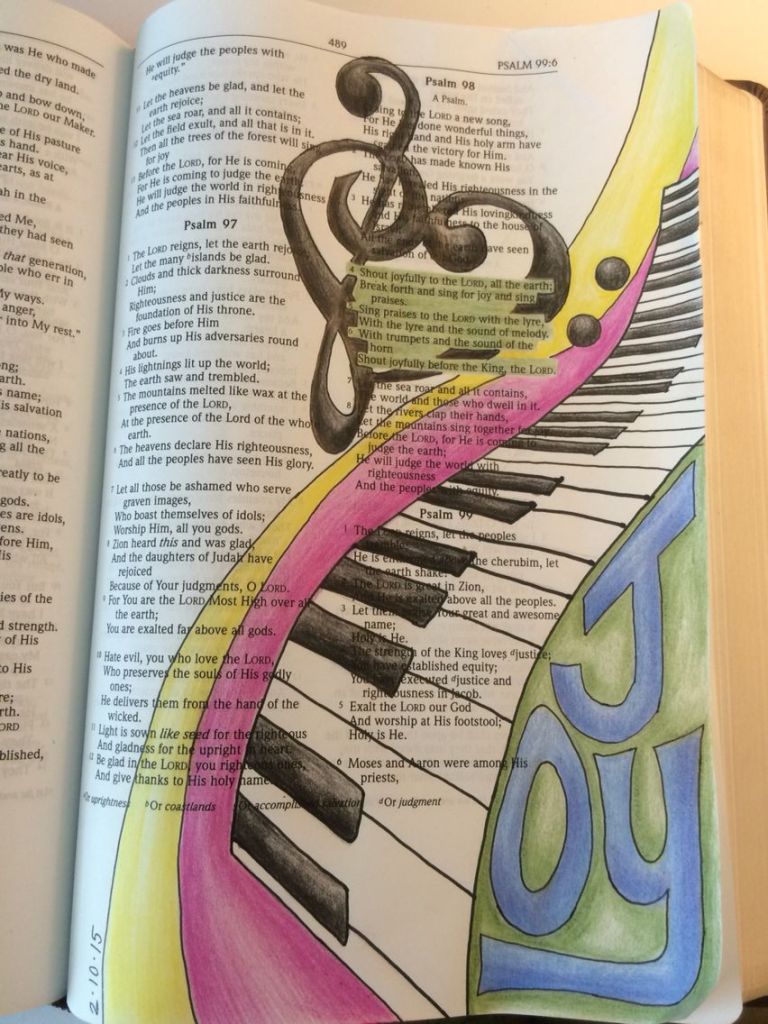
  • Sketch, paint, or sculpt. Make a visual depiction of your joy or experience. It doesn’t matter if it looks like a second grade art project. It’s the process of creating that matters.
  • Participate in a new activity, like taking an online class or developing a different routine.
  • Don’t just do what somebody else did. Reflect on what is important to you. Then, make something to remind you of its value.

You are already a creative artist. You just might not know it, yet. Since you carry within yourself the DNA of a creative God, the Lord’s image and likeness within wants a creative outlet. Open yourself to the possibility of smelling colors, talking to trees, and listening to what animals have to say to you. In doing so, you just might discover that the miraculous has been under your nose all along.

Mighty God, your holy arm of power has done incredible works in history. What’s more, you have done influential works in my life, especially through deliverance from evil and transformation of heart.  For this, and for all your miraculously good work, I praise the gracious and wonderful name of Jesus Christ, my Savior and Lord. Amen.