Hebrews 13:17-25 – Pray for Pastoral Leaders

Be responsive to your pastoral leaders. Listen to their counsel. They are alert to the condition of your lives and work under the strict supervision of God. Contribute to the joy of their leadership, not its drudgery. Why would you want to make things harder for them?

Pray for us. We have no doubts about what we’re doing or why, but it’s hard going, and we need your prayers. All we care about is living well before God. Pray that we may be together soon.

May God, who puts all things together,
    makes all things whole,
Who made a lasting mark through the sacrifice of Jesus,
    the sacrifice of blood that sealed the eternal covenant,
Who led Jesus, our Great Shepherd,
    up and alive from the dead,
Now put you together, provide you
    with everything you need to please him,
Make us into what gives him most pleasure,
    by means of the sacrifice of Jesus, the Messiah.
All glory to Jesus forever and always!
    Oh, yes, yes, yes.

Friends, please take what I’ve written most seriously. I’ve kept this as brief as possible; I haven’t piled on a lot of extras. You’ll be glad to know that Timothy has been let out of prison. If he leaves soon, I’ll come with him and get to see you myself.

Say hello to your pastoral leaders and all the congregations. Everyone here in Italy wants to be remembered to you.

Grace be with you, everyone. (The Message)

A survey on American clergy by the Schaeffer Institute found some of the following information:

  • 90% of pastors report working between 55-75 hours per week.
  • 70% of pastors constantly fight depression.
  • 50% of pastors feel so discouraged that they would leave the ministry if they had another job lined-up right away.
  • 80% of pastors believe church ministry has negatively affected their families.
  • 80% of pastoral spouses feel lonely and underappreciated by church members.
  • 40% of pastors report serious conflict with a parishioner at least once a month.
  • 50% of pastors starting out will not last five years.
  • Only 10% of pastors will actually retire as pastors.
  • Over 1,700 pastors leave the ministry every month in the United States; 1,300 of them are fired by their churches.
  • The number one reason pastors leave the ministry is that church people are not willing to go the same direction and support the goal of the pastor; pastors believe God wants them to go in one direction, but the people are not willing to follow.

As a church pastor myself, the one thing I want every single church member to know is: Your prayer support is the Pastor’s life support. 

Without regular, earnest, sustained, fervent, and constant prayers lifted upwards on behalf of pastoral leaders and their families, no matter how hard they labor or how much they work, the church ministry will go nowhere. 

Conversely, however, with habitual and spirited prayer, even the most anemic weaknesses of an individual pastor can be transcended, and the church can thrive and flourish with spiritual health and joy.

Lift prayers for your pastor today and every day, appealing to God concerning the following:

Protection from the enemy

Rest

Anointing of the Spirit

Yielded heart to God

Effectiveness in ministry

Righteous life of integrity

The spiritual and relational glue which binds believers together is prayer. Churches are bound to clergymen and clergywomen, not by a legal agreement, but by a bond formed and sustained by God. 

The heart of prayer is listening, and as we allow God to speak to us through Holy Scripture, in the events of the world and in the silence of our hearts, we are enabled to unite our prayer to the intercession of the Holy Spirit.

The renewal of the Church everywhere will not occur through the latest program or becoming expertly savvy webmasters. Instead, sustainable church ministry will come through a renewal of spirituality.

Ordinary Christian parishioners who are prepared to share their lives with God in focused, daily, intentional prayer will be the spiritual means of seeing God’s benevolent rule and ethical will done here on earth, as it is always done in heaven.

Loving God, thank you for being our shield and strength. You are a God of compassion and faithfulness. Please protect, nourish and sustain clergy, church councils, and faith community leaders everywhere through the work of your Holy Spirit. May they find rest and encouragement in your loving care.

Gracious God, without you we can do nothing. Clothe Christian leaders everywhere with your Holy Spirit so that with joy and reverence they may lead your people with integrity and effectiveness, worthily proclaiming your gospel of love.

Righteous God, you have shown us what is good. So, help ministers everywhere to do what you require: act justly; love mercy; and walk humbly with you.

Almighty God, through your Son, Jesus Christ, you gave the holy apostles many spiritual gifts and commanded them to feed your flock. Inspire all pastors to preach your Word diligently and your people to receive it willingly so that together we may receive the crown of eternal glory, through Christ, our Lord, who with you and the Holy Spirit reign as one God, now and forever. Amen.

Luke 18:35-43 – Lord, Have Mercy

Coptic Church icon of Christ healing the blind man

As Jesus was coming near Jericho, there was a blind man sitting by the road, begging. When he heard the crowd passing by, he asked, “What is this?”

“Jesus of Nazareth is passing by,” they told him.

He cried out, “Jesus! Son of David! Have mercy on me!”

The people in front scolded him and told him to be quiet. But he shouted even more loudly, “Son of David! Have mercy on me!”

So, Jesus stopped and ordered the blind man to be brought to him. When he came near, Jesus asked him, “What do you want me to do for you?”

“Sir,” he answered, “I want to see again.”

Jesus said to him, “Then see! Your faith has made you well.”

At once he was able to see, and he followed Jesus, giving thanks to God. When the crowd saw it, they all praised God. (Good News Translation)

This is one of my very favorite stories in the entirety of Holy Scripture. And I will tell you why….

Because Jesus listens with ears of mercy.

Jesus was headed to Jerusalem and had a lot on his mind and his heart. He knew what was coming, that his passion and death awaited him. No one would fault Jesus for not hearing a blind man shouting. But Jesus was listening so that he might hear someone just like the needy blind man. Rather than being distracted and lost in his head, Jesus was just the opposite – being attentive and aware of the humble folk right in front of him.

Because Jesus speaks with words of mercy.

Once Jesus listened, he responded by asking a question. I am impressed with Jesus throughout the Gospels. Christ gave people the gift of choice. He acknowledged people and respected them by not simply and indiscriminately healing, as if he were some fix-it guy. Jesus Christ bestowed on the lowliest of people the human dignity of choice by empowering them to answer a question.

Because Jesus pays attention with divine appointments of mercy.

Our Lord took the time to heal the blind man. Jesus could have simply healed him without even stopping his journey. He could have just waved his hand and the man would be healed. What’s more, Jesus could have even started a healing factory where everyone with a need got healed: bring ‘em in, move ‘em out, and keep the line moving. Jesus was doing more than giving sight; he was giving a man the blessing of time and personal attention. The Gospel is never impersonal, which is why we ought to resist being non-relational in ministry to others.  It isn’t simply about meeting a need but about blessing other people with the gift of relationship.

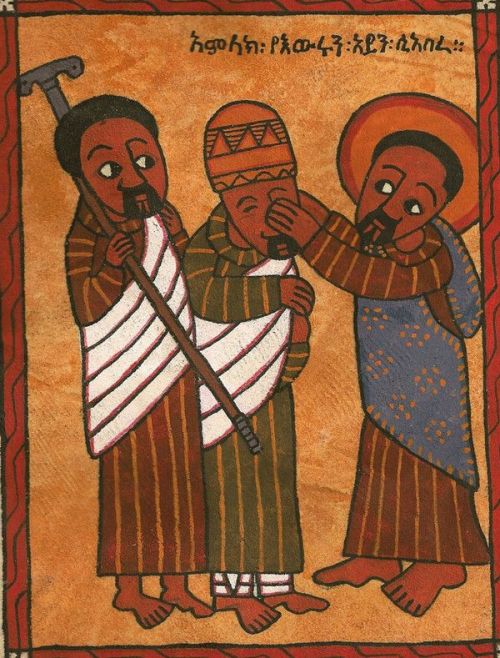
Ethiopian Orthodox Church depiction of Jesus healing the blind man

Because Jesus reaches out with the touch of mercy.

Jesus touched the man’s eyes (Matthew 20:29-34; Mark 10:46-54). He didn’t have to do that. The Lord of all most certainly could have healed without touching. In fact, it most likely may have been downright gross. A lot of people had eye diseases with runny pussy eyes in the ancient world.

Because the blind man didn’t listen to the crowd.

I really love that! Maybe it’s the rebel in me. I just believe it is such a beautiful thing whenever someone refuses to be shamed by another and embraces their need. That is exactly what the blind man did. He not only refused to give-in to peer pressure, but he also responded to them by shouting all the louder. May his tribe increase!

Because the blind man could actually see.

The man already had sight – not physical sight but spiritual eyes which could see better than anyone else in the crowd. One of the great ironies throughout the Gospels is that the sighted crowd seems to never see who Jesus really is, while blind folk see Christ clearly for who he is: the Son of David, the rightful king, the Savior of all. It matters not how much faith one possesses but in whom that faith is placed. A thimble-full of faith is enough to move mountains, while a water tower full of faith misplaced in someone else cannot even provide a single glass of refreshment.

Because the blind man followed Jesus.

Once healed by Jesus, there were plenty of persons who simply walked away and went about their lives. Yet, this man, who was given the gift of physical sight, started following Jesus and giving thanks to him. It feels a lot like my own testimony of experiencing the love of God in Christ and not ever wanting to leave it, so I’ve been following Jesus for over forty years, still having gratitude in my heart.

Because one lowly non-descript blind man made a difference.

I don’t think the man ever set out to change the world. Yet, he did. Here we are reading his testimony all these millennia later. At the time, please take note that one man becoming a disciple of Jesus and living a life of gratitude changed the entire crowd from being a group of shushing church ladies to a robust throng of worshipers. One individual makes a difference. Don’t let anyone tell you otherwise.

Lord Jesus Christ, Son of God, have mercy on me, a sinner.

Lord Jesus Christ, Son of David, heal me, a broken person.

Lord Jesus Christ, Son of Man, help me, a lost and lonely individual.

Lord have mercy, Christ have mercy, Lord have mercy on my love-starved soul. Amen.

Acts 17:16-31 – How to Effectively Communicate

While Paul was waiting for them in Athens, he was greatly distressed to see that the city was full of idols. So, he reasoned in the synagogue with both Jews and God-fearing Greeks, as well as in the marketplace day by day with those who happened to be there. A group of Epicurean and Stoic philosophers began to debate with him. Some of them asked, “What is this babbler trying to say?” Others remarked, “He seems to be advocating foreign gods.” They said this because Paul was preaching the good news about Jesus and the resurrection. Then they took him and brought him to a meeting of the Areopagus, where they said to him, “May we know what this new teaching is that you are presenting? You are bringing some strange ideas to our ears, and we would like to know what they mean.” (All the Athenians and the foreigners who lived there spent their time doing nothing but talking about and listening to the latest ideas.)

Paul then stood up in the meeting of the Areopagus and said: “People of Athens! I see that in every way you are deeply religious. For as I walked around and looked carefully at your objects of worship, I even found an altar with this inscription: to an unknown god. So, you are ignorant of the very thing you worship—and this is what I am going to proclaim to you.

“The God who made the world and everything in it is the Lord of heaven and earth and does not live in temples built by human hands. And he is not served by human hands, as if he needed anything. Rather, he himself gives everyone life and breath and everything else. From one man he made all the nations, that they should inhabit the whole earth; and he marked out their appointed times in history and the boundaries of their lands. God did this so that they would seek him and perhaps reach out for him and find him, though he is not far from any one of us. ‘For in him we live and move and have our being.’ As some of your own poets have said, ‘We are his offspring.’

“Therefore, since we are God’s offspring, we should not think that the divine being is like gold or silver or stone—an image made by human design and skill. In the past God overlooked such ignorance, but now he commands all people everywhere to repent. For he has set a day when he will judge the world with justice by the man he has appointed. He has given proof of this to everyone by raising him from the dead.” (New International Version)

“Focus on clarifying what is being observed, felt, and needed rather than on diagnosing and judging,”

Marshall Rosenberg

The city of Athens was a major intellectual center in the ancient world. Ideas, philosophy, reason, rhetoric, and debate were standard fare amongst the citizens. At the time of the Apostle Paul’s arrival in the city, Greece knew next to nothing about Christianity. Paul’s response to what he saw and felt, dictated what he did and said; it was both wise and deeply impactful to the people of Athens. It’s almost akin to a seminar in how to communicate with folks who believe and live very differently than ourselves.

Observation

Paul entered the city and made a simple observation: Athens is full of idols. Out of all the observations Paul could have made, this one would not likely be made by most people visiting the city. Athens was a glorious place with its unparalleled architecture. The Acropolis and the Agora were resplendent with the arts and democracy.

For all its physical beauty and brilliance, the one thing Paul homed-in on was the idols. This would have struck many folks as odd – something like focusing on the dog collar instead of the dog. Yet, Paul was using more than his physical eyes – his spiritual sight was making a big observation – that Athens was very much a religious place.

Feeling

The Apostle felt upset and distressed. Paul was disturbed down deep in his gut with the spiritual state of this renowned city-state. The sheer volume of idols and the practice of idolatry created an overwhelming sense of both pity and anger.

Paul handled his emotions well. By freely acknowledging them, he was then able to choose his response. Had he not done so, it is likely Paul might have just gone on some frustrating tirade, thereby never truly connecting relationally with the people. There’s nothing wrong with being irritated or exasperated; its what we do with those feelings which are important.

Need

It is our emotions, not our thoughts, which move us to act. Paul knew why he was feeling disturbed and decided not to stuff those feelings but step out and address the great need he was observing. He decided to meet the Athenians on their turf and on their level by reasoning with them every day in the great buildings and open spaces of the city.

While in Athens, it seems Paul understandably utilized the Socratic method of dialogue – involving questions and answers. Its impressive that throughout the Acts of the Apostles, Paul demonstrated a deft ability to communicate and connect with a broad range of people.

Appeal

Paul wasn’t interacting and dialoging just for the fun of it; he wanted to make an appeal, a request to seriously consider the Christian good news of Jesus Christ’s resurrection as a viable philosophy of life. He made his appeal with Jews, Greeks, and passers-by, as well as philosophers.

Since the massive intellect of Paul could handle any reasoned debate, he was invited to the Areopagus, which was the place where the best-of-the-best carried-on their discussions.

Paul’s address to them was incredibly cogent and well-reasoned – finding common ground from which to debate and maintaining outward grace amidst his inward disturbance.

Conclusion

The late British exegete, John R.W. Stott, reflected on today’s New Testament lesson and gave us words which are still relevant:

“Why is it that, in spite of the great needs and opportunities of our day, the church slumbers peacefully on, and that so many Christians are deaf to Christ’s commission, and dumb with tongues-tied in testimony? The major reason is this: We do not speak as Paul spoke because we do not feel as Paul felt. We have never had his indignation. Divine jealousy has not stirred within us. We constantly pray, ‘Hallowed be Thy Name,’ yet we do not seem to mean it… Paul saw people created in the image and likeness of God giving to idols the homage which was due to God alone… and he was deeply pained by it.”

John R.W. Stott

May the good news be so pressed into our minds, hearts, and guts that what comes out of us is deep compassion, wise dialogue, and effective ministry for the sake of our Lord. Amen.

*Above picture: ruins of the Greek Acropolis in Athens where the Apostle Paul addressed the Areopagus.

Colossians 1:15-23 – Worship That Is Fit for a King

The Son is the image of the invisible God, the firstborn over all creation. For in him all things were created: things in heaven and on earth, visible and invisible, whether thrones or powers or rulers or authorities; all things have been created through him and for him. He is before all things, and in him all things hold together. And he is the head of the body, the church; he is the beginning and the firstborn from among the dead, so that in everything he might have the supremacy. For God was pleased to have all his fullness dwell in him, and through him to reconcile to himself all things, whether things on earth or things in heaven, by making peace through his blood, shed on the cross.

Once you were alienated from God and were enemies in your minds because of your evil behavior. But now he has reconciled you by Christ’s physical body through death to present you holy in his sight, without blemish and free from accusation— if you continue in your faith, established and firm, and do not move from the hope held out in the gospel. This is the gospel that you heard and that has been proclaimed to every creature under heaven, and of which I, Paul, have become a servant. (New International Version)

Jesus is King. Neither you, nor I, are. 

A simple statement; yet, not easily engrafted into daily life. 

The original sin of Adam and Even was rebellion – to break the bonds of loving authority God provided for them. We (especially us Americans) have this nasty anti-authoritarian strain which runs rather deep in us. 

As a child, when my middle daughter was grappling with the implications of faith in Christ, she once blurted out an honest cry that we can likely resonate with: “I just don’t want another person in my life telling me what to do!” 

Indeed, Jesus is King; we are not.

The New Testament lesson for today is rich with the pre-eminence and lordship of Jesus Christ: 

  • All things were created through Jesus and for him. 
  • Everything in all creation is held together by Jesus. 
  • Christ is the head of the church. 
  • In Jesus Christ, complete divinity exists and reigns. 
  • Jesus made peace through the cross because he had the authority and the qualifications to do so. 
  • Broken relationships and proper lines of authority are now restored and redeemed in Christ.

We can also likely relate to, at times, indulging an illusion of being in control and independently dictating the course of our lives. Yet, mercifully, Jesus is the great Sovereign, and this is a good thing – because in Christ we find reconciliation and purity of life. 

“The supreme thing is worship. The attitude of worship is the attitude of a subject bent before the King… The fundamental thought is that of prostration, of bowing down.”

G. Campbell Morgan

Because Christ is King, we really ought to submit to him. In fact, we need to pay some attention to how our bodies are to submit to his lordship.

When the body moves to animating physical actions of submission, this helps the heart to follow. Whole person worship involves engaging the mind, spirit, emotions, and, yes, the body. To neglect the body in worship is to truncate the ability to connect with God in Christ.

A typical metaphor for the Church is the “Body of Christ.” We can live into that phrase through an embodied spirituality of submission. Our individual bodies are temples of the Holy Spirit, important for expressing worship. (1 Corinthians 3:16)

God created us with literal physical bodies. And Jesus has a literal physical body. Bodies are important for whole person worship. This means the physical postures we take in worshiping King Jesus are significant. We need to pay attention to them.  

A healthy practice for Christians is to kneel in the presence of the Lord. I realize some Christian traditions do it as a part of their worship, and some do not. Some like it, some don’t. Yet, bowing, even prostrating oneself (if you are physically able!) can be a powerful symbol of the heart’s desire and disposition to submit to the lordship and authority of Jesus Christ. 

Crawling out of bed in the morning onto one’s knees and beginning the day aiming to live into the will of God, and ending the day in the same manner, are a practical means of remembering who Jesus is and who we are.

I believe all believers need to feel free in adopting a physical posture of worship which helps them connect with God in Christ. For some, that will be sitting in a comfortable position in contemplation. Others will want to stand, raise their hands, even dance in praise.

It also behooves us to let our bodies respond to whatever is happening with us spiritually. Exuberant praise needs the expression of hand clapping and toe tapping. Confession of sin needs a bit of bowing, kneeling, even prostrating. For prayer, hands open and palms facing up to receive blessing from God is a good bodily position of worship.

You get the idea. Just remember we need to strive for congruence in our worship, that is, what is happening with our outward bodily movements needs to match what is occurring inward with our spirits. And when the two are in sync, meaningful worship can happen – worship of submission fit for a king.

Sovereign God, in your mercy you have sent your Son, the Lord Jesus, who has brought reconciliation to a once broken relationship.  I bow before you in obedience, submission, and worship.  Let me live a cross-shaped life through enjoying the peace you have given me in Christ in both body and soul. Amen.