Nonsensical Theology (Job 17:1-16)

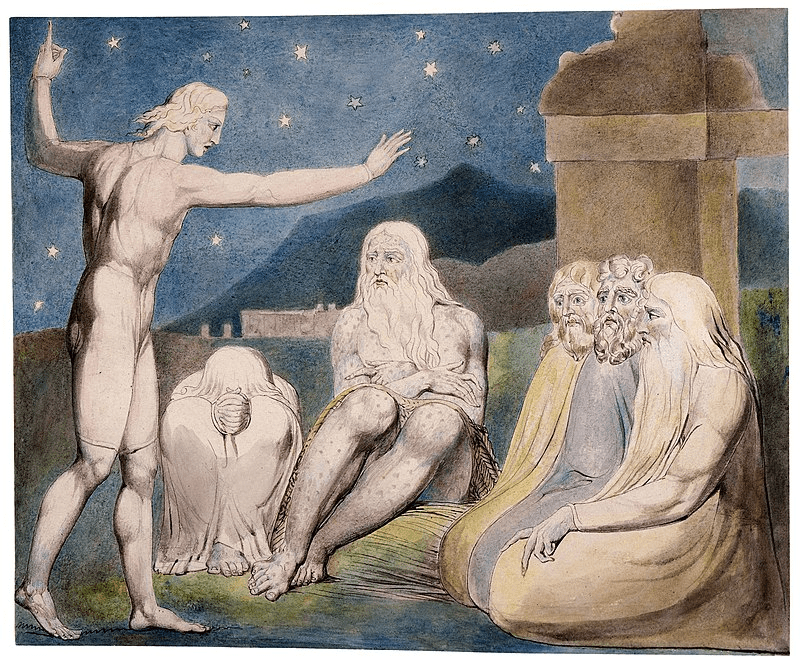
The Nonsense #1, by Jacqueline Withers

My spirit is broken,
    my days are cut short,
    the grave awaits me.
Surely mockers surround me;
    my eyes must dwell on their hostility.

“Give me, O God, the pledge you demand.
    Who else will put up security for me?
You have closed their minds to understanding;
    therefore you will not let them triumph.
If anyone denounces their friends for reward,
    the eyes of their children will fail.

“God has made me a byword to everyone,
    a man in whose face people spit.
My eyes have grown dim with grief;
    my whole frame is but a shadow.
The upright are appalled at this;
    the innocent are aroused against the ungodly.
Nevertheless, the righteous will hold to their ways,
    and those with clean hands will grow stronger.

“But come on, all of you, try again!
    I will not find a wise man among you.
My days have passed, my plans are shattered.
    Yet the desires of my heart
turn night into day;
    in the face of the darkness light is near.
If the only home I hope for is the grave,
    if I spread out my bed in the realm of darkness,
if I say to corruption, ‘You are my father,’
    and to the worm, ‘My mother’ or ‘My sister,’
where then is my hope—
    who can see any hope for me?
Will it go down to the gates of death?
    Will we descend together into the dust?” (New International Version)

The biblical Book of Job is a troublesome story in more than one way. It not only reveals the grinding trouble of Job in losing nearly everything and everyone he had, but the story also presents some theological trouble for us.

Just when we may believe we have some understanding about how God operates in the world, the life of Job throws a theological monkey wrench into the whole thing.

Job was a righteous person, who did good in the world. He was happy and wealthy. And most people would attribute his earthly success to his spiritual piety. Yet, Job’s awful loss and suffering seem anything but a good, just, and right response from God.

Although Satan was behind all of Job’s trouble, the story makes it plain that it was God who let it all happen.

However, the Book of Job is not much concerned about God’s justice; rather, it is a story about a change in worldview. Job went from health, wealth, and happiness to sickness, poverty, and grief. It all happened quickly, one tragic event after another.

The beginning premise of the story is to question whether a privileged person in prosperity is devoted to God simply because of material and familial blessing. How would such a person look, act, and think, after having it all taken from him? Would he continue to be pious and faithful toward God, or not?

Job and his friends had the same worldview, theology, and outlook on things. But after what Job went through, a clear division opened in which the friends never budged from their views.

Yet, Job had an awakening. He saw and felt anarchy in the world. He experienced the putrid spiritual and emotional abscess of unimagined circumstances so bad that it made him wish he were never born.

Through it all, Job never lost his attachment and faithfulness to God. But he did lose his old view of the world.

Job saw firsthand that tidy theological systems of thought and belief are only that. If those systems cannot withstand the smack of worldly horror, then one needs a different system (and not a different God).

In the teeth of such misfortune, one cannot explain things in a nice neat linear fashion. In other words, bad things that happen to us don’t necessarily require repentance, condemnation, or punishment. That’s what Job’s friends believed needed to happen. But Job knew better.

A truism in life is that it’s hard to appreciate something you’ve never experienced.

You may have thoughts, opinions, and beliefs about marriage and child-rearing as an unmarried person without kids. But your world turns upside-down when those relationships become your daily reality and life. Old views become antiquated in the face of these real flesh-and-blood people.

And it’s also difficult for the privileged, the prosperous, and the well-positioned to appreciate the life of the underprivileged, the poor, and those without any power and authority in this world.

They, of course, have plenty of beliefs and opinions about how things ought to be, and what the disadvantaged among us need to do. But one cannot put themselves in their shoes, simply because the poor don’t even have shoes that the wealthy could put on.

In today’s society, it can also be difficult for the reasonably happy and optimistic among us to imagine what life is like for those whose daily reality is debilitating depression and chronic anxiety. What would happen if everything that made optimistic persons happy were completely taken away from them?

Whatever would happen, such a person’s world would never be the same again. Something would change within them. Their thoughts would be altered. There would be no going back to the status quo of things before.

Could Job, in his health and wealth, have appreciated the anguish of victims from senseless calamity? Could he have ever considered God as an enemy against him?

Maybe if one of Job’s friends had experienced terrible suffering, he himself would have responded with the established tidy worldview of telling him he needed to repent of his sin. After all, they were his friends for a reason – sharing their creed and convictions on life.

But horrible suffering opened a chasm between Job and his friends. Only Job alone knew that his disaster was undeserved – that he had done nothing against God.

Sometimes, all you and I can do in the midst of senseless and seemingly needless suffering, is to, like Job:

  • affirm our innocence and our integrity, even though no one understands
  • reaffirm our faith and commitment to God, even though what we are going through is confusing and makes no sense
  • awaken to the plight of others who go through hard things and need a friend who will truly listen and have compassion on us

Keep watch, dear Lord, with those who work, or watch, or weep this night, and give your angels charge over those who sleep. Tend the sick, Lord Christ; give rest to the weary, bless the dying, soothe the suffering, pity the afflicted, shield the joyous; and all for your love’s sake. Amen.

Making Sense of Faith and Trouble? (Job 15:1-35)

Job with his friends, by Gerard Seghers (1591-1651)

Then Eliphaz the Temanite replied:

“Would a wise person answer with empty notions
    or fill their belly with the hot east wind?
Would they argue with useless words,
    with speeches that have no value?
But you even undermine piety
    and hinder devotion to God.
Your sin prompts your mouth;
    you adopt the tongue of the crafty.
Your own mouth condemns you, not mine;
    your own lips testify against you.

“Are you the first man ever born?
    Were you brought forth before the hills?
Do you listen in on God’s council?
    Do you have a monopoly on wisdom?
What do you know that we do not know?
    What insights do you have that we do not have?
The gray-haired and the aged are on our side,
    men even older than your father.
Are God’s consolations not enough for you,
    words spoken gently to you?
Why has your heart carried you away,
    and why do your eyes flash,
so that you vent your rage against God
    and pour out such words from your mouth?

“What are mortals, that they could be pure,
    or those born of woman, that they could be righteous?
If God places no trust in his holy ones,
    if even the heavens are not pure in his eyes,
how much less mortals, who are vile and corrupt,
    who drink up evil like water!

“Listen to me and I will explain to you;
    let me tell you what I have seen,
what the wise have declared,
    hiding nothing received from their ancestors
(to whom alone the land was given
    when no foreigners moved among them):
All his days the wicked man suffers torment,
    the ruthless man through all the years stored up for him.
Terrifying sounds fill his ears;
    when all seems well, marauders attack him.
He despairs of escaping the realm of darkness;
    he is marked for the sword.
He wanders about for food like a vulture;
    he knows the day of darkness is at hand.
Distress and anguish fill him with terror;
    troubles overwhelm him, like a king poised to attack,
because he shakes his fist at God
    and vaunts himself against the Almighty,
defiantly charging against him
    with a thick, strong shield.

“Though his face is covered with fat
    and his waist bulges with flesh,
he will inhabit ruined towns
    and houses where no one lives,
    houses crumbling to rubble.
He will no longer be rich and his wealth will not endure,
    nor will his possessions spread over the land.
He will not escape the darkness;
    a flame will wither his shoots,
    and the breath of God’s mouth will carry him away.
Let him not deceive himself by trusting what is worthless,
    for he will get nothing in return.
Before his time he will wither,
    and his branches will not flourish.
He will be like a vine stripped of its unripe grapes,
    like an olive tree shedding its blossoms.
For the company of the godless will be barren,
    and fire will consume the tents of those who love bribes.
They conceive trouble and give birth to evil;
    their womb fashions deceit.” (New International Version)

The biblical character of Job had asked the friends to hear him out on his case against God. But they did not stay quiet and listen. Instead, they got irritated with Job and accused him of sin.

One of the three friends, Eliphaz, went from exhortation to an outright rebuke of Job. He took him to task on what he was saying, and gave Job a hellfire sermon designed to get him right with God.

Eliphaz had a problem with Job’s approach to God. Yet, we as readers know that none of this suffering was Job’s fault. In reality, it was Eliphaz who had the problem: He was stuck in a particular way of thinking to the point of not being able to entertain another’s point of view.

Each of the three friends did not distinguish between their assumptions and the truth. They had such engrained habits of thinking and living, that their minds were not open to the experience of Job being anything but sinful.

The major presupposition that Eliphaz held is that anyone who experiences such extreme hardship and suffering as Job is being punished by God. And that was a false presupposition.

There is a tragic irony with the story of Job and his friends. Eliphaz assessed Job’s situation and words as wicked. What’s more, Eliphaz believed that Job added to that sin by contending with God and insisting on his own personal innocence.

Yet, what Eliphaz said about Job was actually true about himself. Eliphaz was the one speaking out of ignorance and pride, as if he knew how the universe really works. In truth, Eliphaz was talking about himself, without knowing it.

Eliphaz presupposed, assumed, and believed that wicked persons are the ones who experience a life of pain, terror, illness, and deprivation. Thus, Job is wicked. And therefore, believed Eliphaz, Job’s future destiny was in jeopardy.

Is crying out in pain and giving a vulnerable yell toward God sin? Is it a sign of wickedness? Will it lead one to hell?

In the view of Eliphaz, yes. Because to challenge God is to rebel against God. To experience extreme suffering is a sign of personal wickedness against God.

By taking a good hard look at the entirety of the Book of Job, I can say with confidence that Eliphaz was, at best, ignorant; and, at worst, hurtful. He had no idea how off target he really was. The sinner in the room was not Job; it was Eliphaz.

The friends had too simple and easy of a theology of suffering. They equated Job’s suffering with God’s punishment. Reading the story of Job, however, challenges that simplistic theology.

Job insisted that his supposed punishment was undeserved. And he was right. Terrible misfortune is not necessarily a result of personal sin or wickedness.

The piety of Job was strong enough to accept the misfortune that fell upon him, without rebelling against God (Job 1:10). Yet, Job’s faithfulness to God could not make sense between his agonizing suffering, the loss of property and family, and God’s silence and purpose in it all.

And maybe that is, in part, the point of the Book of Job – that there are people all over the world who undergo hard circumstances and grinding loss, without knowing why they are going through it.

Hopefully, this awakening to the suffering of others will kindle within us a more compassionate spirit and empathetic presence with those feeling the nonsensical situations of their lives.

Almighty God, I bring to you all those who suffer in body, mind, spirit or with grief. May your loving kindness and divine presence sustain them in the midst of their pain. May those who are stretched beyond their capacity to cope and remain hopeful gain a sense of coherence, comfort and strength in the Lord. Amen.

Directives For the Married and Divorced (1 Corinthians 7:10-16)

To the married I give this command—not I but the Lord—that the wife should not separate from her husband (but if she does separate, let her remain unmarried or else be reconciled to her husband) and that the husband should not divorce his wife.

To the rest I say—I and not the Lord—that if any brother has a wife who is an unbeliever and she consents to live with him, he should not divorce her. And if any woman has a husband who is an unbeliever and he consents to live with her, she should not divorce the husband. 

For the unbelieving husband is made holy through his wife, and the unbelieving wife is made holy through the brother. Otherwise, your children would be unclean, but as it is, they are holy. But if the unbelieving partner separates, let it be so; in such a case the brother or sister is not bound. It is to peace that God has called us. Wife, for all you know, you might save your husband. Husband, for all you know, you might save your wife. (New Revised Standard Version)

Having specifically addressed questions about sex; and having directly talked to the Christians in Corinth who were single; the Apostle Paul then turned to the married persons in the church. He gave directions about their concerns of divorce and how to handle a spouse who does not share the believing spouse’s Christian beliefs.

Divorce

Divorce is one of those things that no one plans on happening when they are married; and yet, it happens. The Apostle was realistic about the situation. He upheld the sanctity of marriage, while recognizing that the ideal of two people remaining together and blessing one another doesn’t always happen.

I find it interesting, as well as gracious and understanding, that Paul neither condemns nor denounces the divorced person. He assumes that both spouses have responsibility, and both can take initiative as partners in a marriage.

A Christian married to an unbelieving partner, according to Paul, ought to remain married. As long as the non-believing spouse is willing to remain in such a marriage, then it should continue.

The Apostle’s rationale is that peace, not divorce, needs to be the controlling characteristic of both the marriage and of the Christian life.

“Mixed” Marriage

Furthermore, Paul believed that Christians are not defiled by pagan spouses. This is important when it comes to the children of a Christian and non-Christian marriage. The relationship is sanctified by the presence of both the believing spouse and the Holy Spirit.

In addition, the Apostle saw that the Christian spouse is in a special position for God to work through them to the unbelieving spouse. On this point, Paul is sanguine and optimistic. Instead of worrying about impurity for the Christian, he foresaw an opportunity for purity in the non-Christian.

The Apostle Paul’s realism reminds us that if we are looking for ultimate satisfaction through marriage (or singleness and celibacy) it will never be found.

That’s because, as Christians, contentment and peace comes through giving our lives to serve the Lord Jesus in love. To love another, and offer the gift of self-sacrificial service to them, is the ultimate path to the way of Christ.

In losing our lives, we find them; in being last, we are promoted to first.

Marriage is beautiful. Divorce is ugly. Sometimes, despite a believer’s greatest efforts at being peaceful and loving, a divorce occurs. It takes two to have a marriage. There are times when the believing person must let their spouse go, that is, if that spouse wants to go.

Although divorce can be ugly and sad, full of broken dreams, and littered with missed expectations, it doesn’t need to stay that way. The divorced person, becoming single, now has the opportunity to bring something beautiful out of the brokenness.

Kintsugi

“Kintsugi” is a Japanese term for the art of repairing broken objects. The word literally means to “join with gold.” This art form uses a particular lacquer to reattach broken pieces. Then the newly attached joints are decorated with gold (or silver) powder.

The working idea behind the art of kintsugi is to embrace the flaws and the imperfections. By doing so, the artist can create a beautiful piece of art, stronger than the original.

Applying this to relationships, people no longer have to simply live with the shame of a broken marriage. We can assign value to people who are divorced, and stop trying to hide the relational damage. Through intentional efforts on healing, the scars left behind can truly become a source of beauty – instead of permanent ugliness.

Ikigai

Another Japanese concept which can be relevant for us is “ikigai.” It refers to having a reason for living, a sense of purpose and meaning to life. The idea behind ikigai is to help people find what is truly important to them, and then to live a life full of joy and purpose. Notice the concept is based on that which is internal – fulfillment, satisfaction, joy, and meaning – instead of external factors such as money, fame, power, or position.

Jesus joyfully lived his life on this earth to serve others. He came not to be served, but to serve, and to give his life as a ransom for many (Mark 10:45). If marriage was the ideal for everyone in this world, I’m quite sure Jesus would have modeled that for us by getting married. But he didn’t.

Neither marriage, nor singleness, is what really counts. Faith, expressing itself through love, is what actually counts. (Galatians 5:6)

And when Jesus was broken, the result became the salvation of the world. By his wounds, we are healed. (Isaiah 53:5)

All of this demonstrates for us where and what we are to assign meaning. And just because things don’t work out like we want, and leaves us in a state of brokenness, our lives can be transformed into a beauty beyond what we could have imagined.

This is the strength and ability of Christianity. Methinks we ought to let it have its way in our lives.

Almighty and everlasting God, the One who makes us whole in our brokenness, calls us to deeper faith, and delivers us from all things that hinder our devotion to you: Hear our prayer, Lord, and break open all we hold back from you, so that we may see a vision of your helping and healing presence in our lives and in our world, through Jesus Christ, in the power of the Holy Spirit. Amen.

Questions About Sex (1 Corinthians 7:1-9)

Now regarding the questions you asked in your letter. Yes, it is good to abstain from sexual relations. But because there is so much sexual immorality, each man should have his own wife, and each woman should have her own husband.

The husband should fulfill his wife’s sexual needs, and the wife should fulfill her husband’s needs. The wife gives authority over her body to her husband, and the husband gives authority over his body to his wife.

Do not deprive each other of sexual relations, unless you both agree to refrain from sexual intimacy for a limited time so you can give yourselves more completely to prayer. Afterward, you should come together again so that Satan won’t be able to tempt you because of your lack of self-control. I say this as a concession, not as a command. But I wish everyone were single, just as I am. Yet each person has a special gift from God, of one kind or another.

So I say to those who aren’t married and to widows—it’s better to stay unmarried, just as I am. But if they can’t control themselves, they should go ahead and marry. It’s better to marry than to burn with lust. (New Living Translation)

After getting into several issues of interpersonal relations within the church, the Apostle Paul turned his attention to matters the Corinthian congregation had questions about. Primary among them were issues of sex and marriage.

Within an ancient port city that was rife with all sorts of sexual practices and immorality, it was inevitable that the Corinthian Christians would wonder about the nature of sex and the marital relationship. Is it okay to have sex? Is sex good? What’s sex supposed to be like in marriage? How am I to treat my spouse when it comes to sex?

It seems every culture in every era has plenty of questions about sex and marriage.

The Apostle’s answer to the Corinthian believers is that sex is a good thing, that is, within a proper context. Sex is similar to fire. They’re both good, but they both have an incredible potential for destruction if there are not some solid boundaries and limits to them.

And that’s where marriage comes in and has a significant role for us as sexual beings. Marriage is also a good thing; it’s good to have a marital partner to share life with and to consummate a loving relationship with the intimacy of sex.

Our sexual drives are strong. After all, we were created with both the desire and the bodily equipment for sex. And marriage is a sacred institution which is strong enough to provide those boundaries and limits that we need to enjoy sex without harming others and ourselves.

In a world full of all manner of sexual deviancy and disorder that destroys many people, the marriage relationship is, ideally, a safe place for sexual expression and enjoyment.

For that good to happen, it is most necessary for the marriage bed to be a place of mutual love, of equal acceptance and sharing. Sex always turns bad when it is forced or coerced. It must be an agreed upon activity, or it moves into the place of covetousness, greed, and selfishness.

Again, ideally, marital relations are an opportunity for the marriage partners to think about and satisfy one another. In other words, the best sex happens when each partner considers what is best for the other.

The marriage bed is not the place to insist on your way. Rather, marriage, at its heart, is a deliberate and volitional decision to serve the other person – whether in bed, or out of bed.

It’s not uncommon for individuals who come to Christ out of a culture awash in unhealthy sexual practices to question if sex is good, or not; and whether one ought to abstain from sex, even if already married.

The Apostle Paul’s counsel is that abstinence from sex between two married partners is good – but only for an agreed upon period of time, and only for the purpose of prayer and fasting. In other words, if and when a couple agrees to forego sex for a time, spiritual practices must replace sexual practice. Without a clear plan, married couples can cause one another more harm than good.

Always know when to come back together again. That’s because our old adversary, Satan, is far too crafty in arranging temptations to derail us from the good gift of sex, and the good institution of marriage.

Paul made it clear that he was not pronouncing some ex cathedra instruction concerning abstinence for couples; he was only answering a question and providing some helpful counsel in order to maintain legitimate relations with each other. Nobody is under obligation to abstain, let alone be celibate.

However, the Apostle, an unmarried and celibate person himself, wanted to point out that there are advantages to the celibate life. I must say, I cannot disagree with Paul’s observation that life is whole lot simpler being single than married!

Yet, Paul also understood that the celibate single life is not for everyone. He gave the sage teaching that both marriage and celibacy are gifts from God. One is not necessarily better than the other.

Unmarried persons are not in a lesser class of people simply because they are single. And if they have the ability to manage their desires and emotions when it comes to sex and relationships, then Paul would say, more power to them. There is no need to be married, just to be married.

Conversely, however, there is certainly no need to be single and celibate, as if this were some superior spiritual situation. Believing that singleness is necessary for spiritual commitment, or mandating that an entire group of people must be single and celibate in order to serve Christ, is completely foreign to the Apostle Paul’s line of thinking.

Any single person who discovers they are swimming in sea of sexual desire ought to marry, rather than be frustrated and struggle with self-control. Imposing unnecessary suffering on oneself is not at all spiritual or preferable – it’s masochistic, and helps no one.

The reality of married and non-married relationships is that they both have their advantages and their disadvantages. Both marriage and singleness are good. Both sex and celibacy are gifts to receive with gladness and joy.

So, make sure to unpack your gift well.

Holy God, in the midst of our sexualized world of insanity and disordered loves, I ask for your mercy and grace to be pure and holy, just as You are holy. Enable us all to live into healthy forms of sexual relations, without succumbing to the sexual immorality all around us.

Almighty God, I thank you for the gift of sex and marriage, as well as the gift of singleness and celibacy. May Your healing love meet us in our sexual brokenness, and Your compassion overflow to the sexually oppressed.

Blessed God, I am grateful for Your blessing upon us, for never shaming nor humiliating us, but making us pure and holy in Jesus Christ our Lord, through the enablement of the Holy Spirit. Amen.