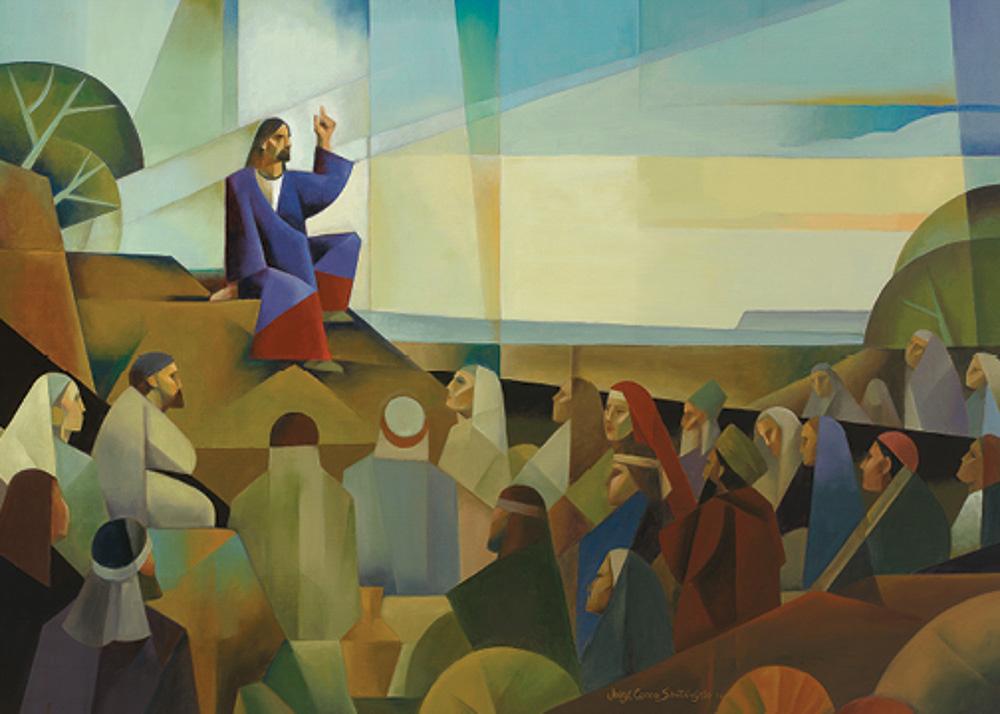
Galatians 3:23-29 – A Ministry of Equals

Until the time when we were mature enough to respond freely in faith to the living God, we were carefully surrounded and protected by the Mosaic law. The law was like those Greek tutors, with which you are familiar, who escort children to school and protect them from danger or distraction, making sure the children will really get to the place they set out for.

But now you have arrived at your destination: By faith in Christ, you are in direct relationship with God. Your baptism in Christ was not just washing you up for a fresh start. It also involved dressing you in an adult faith wardrobe—Christ’s life, the fulfillment of God’s original promise.

In Christ’s family there can be no division into Jew and non-Jew, slave and free, male and female. Among us you are all equal. That is, we are all in a common relationship with Jesus Christ. Also, since you are Christ’s family, then you are Abraham’s famous “descendant,” heirs according to the covenant promises. (The Message)

Ever since the fall of humanity, people have had the predilection to organize themselves in groups that keep them distinct from other groups. Whether it is high school peer groups or office politics; whether class warfare or church cliques; there has always existed a tendency to think better about the groups we identify with, and to look down and believe the worst about those we don’t understand or just don’t plain like.

Jesus is the person who changes it all. Faith in Christ Jesus is what makes each of us equal with each other, whether Jew or a Greek, in bondage or in freedom, a man or a woman. The cross of Christ not only brought deliverance from sin, death, and hell; the work of Jesus Christ ushered-in a new egalitarian society.

I’m not sure the English translations of the Apostle Paul’s phrasing to the Galatian Church can truly capture his emphatic pathos about this issue. For Paul, Christ’s cross has done so much more than bring personal salvation; it has completely eradicated prejudice, discrimination, and division. 

Therefore, the Church is to be the one place on earth where divisions no longer exist. It is to be a foretaste of heaven. The Church is to be a new society, a community of the redeemed, based in equity, diversity, and inclusion, from every people group, race, ethnicity, and gender. Together as one, just as God is One, the Church lives the kingdom values of Christ’s words and ways in a fragmented world.

Since the ground is level at the cross, we are to live into Christian unity with a humble attitude and loving actions. To do otherwise is to be immature. We (hopefully) expect kids to be kids and not be like adults. They need teaching, training, and tutoring to learn. When kids grow up and get into adulthood, we then expect them to be like an adult. If they continue in childish behavior, they are immature.

Many adult Christians are still stuck in spiritual childhood. The evidence of this is seen in trying to stratify church society into insiders and outsiders, those who have always been in the church and newcomers who haven’t, the committed servants and the lax pew sitters.

Rather than all of that dividing of people, energy is to be placed with living into the egalitarian society inaugurated by Jesus (and Paul). Not taking women’s leadership seriously, avoiding relationships with the poor, and being xenophobic all come from a place of immaturity. It is childish behavior. Jesus expects better.

Embracing an egalitarian society neither means we are all the same nor should act alike. The diverse backgrounds and experiences of people help make a rich mosaic of support for one another in the Body of Christ.

Being egalitarian means all people are created in the image and likeness of God – no exceptions. All persons, therefore, deserve morally equal treatment, respect, and justice. A just and good Christian ethic ensures all believers are handled with love, given sound instruction, and are free to explore their gifts and abilities within the church.

Church, at its heart, is a community of equals. Thus, the church, as an egalitarian community, must actively reject racism, sexism, and all forms of discrimination while purposefully seeking ways to create and maintain a unified community without divisions.

Jesus reached out to the misfits and marginalized in society who were suffering from political, cultural, gender, and religious oppression and discrimination. The community of persons Christ formed included people of all ages and backgrounds. Children were welcome. Women sat down with men to learn and became active participants alongside one another.

Christ’s conversation with the Samaritan woman at the well, the parable of the good Samaritan, and the healing of the daughter of the Canaanite woman, all illustrate that ministry is to reach beyond our own familiar group. In short, Jesus practiced a radical hospitality.

Christians would do well to emulate their Lord, as well as take their cues on ministry from Paul, who grounded both his theory and practice in a Trinitarian theology of equals.

Gracious God, you have abolished barriers through the redemption of Christ.  Prevent me from erecting walls that would divide and use me to be a bridge so that others may experience equality in Jesus.  Amen.

Matthew 18:6-9 – Say “No” to Temptation

“If you cause one of these little ones who trusts in me to fall into sin, it would be better for you to have a large millstone tied around your neck and be drowned in the depths of the sea.

What sorrow awaits the world because it tempts people to sin. Temptations are inevitable, but what sorrow awaits the person who does the tempting. So, if your hand or foot causes you to sin, cut it off and throw it away. It’s better to enter eternal life with only one hand or one foot than to be thrown into eternal fire with both of your hands and feet. And if your eye causes you to sin, gouge it out and throw it away. It’s better to enter eternal life with only one eye than to have two eyes and be thrown into the fire of hell.” (New Living Translation)

It’s probably a good idea not to get on the wrong side of Jesus.

Throughout the Gospels, Jesus utilized a variety of teaching methods to communicate his message. In today’s Gospel lesson, Christ used the language of hyperbole to arrest attention and get his point across.

A universal truism of this world is that sin exists. In Holy Scripture, sin is anything people do or say – or fail to do and say – which damages or destroys another’s or one self’s physical, mental, emotional, or spiritual wellbeing.

Greed, envy, gluttony, sloth, anger, lust, and pride abound no matter where one goes on this planet. Sin is downright awful. It causes people to stumble, and, when unchecked, leads to personal and corporate chaos, unrest, and destruction. 

Whenever sin is viewed merely as a character flaw, or simply part of the fabric of organizations and institutions, then hellfire is not far off. Hell exists because of sin. 

We get the flavor that Jesus took sin quite serious. Christ considers sin so terrible and heinous that he deliberately used the height of hyperbole to communicate that radical, drastic, and decisive action must unequivocally be taken to get rid of it. 

The Lord Jesus wanted there to be no mistake in his communication: Sin is not something to dabble in or take a shallow approach; rather, sin must be eradicated, at all costs. The language is severe: If your hand, foot, or eye causes you to sin, cut it off. It’s better to enter life crippled or blind rather than be thrown into a suffering hell.

Temptations will inevitably come. Yet, how we handle those temptations and what we do with them is of eternal significance. 

We must get to the root of the sin – which happens through succumbing to temptation – and re-arrange our lives, alter our schedules, and change our lives in a radical way to remove putting ourselves in a position to sin. 

Solid daily spiritual habits of Scripture reading and prayer; time for sleep and rest; attention to Sabbath; and a regular exercise regimen are all ways to help ensure that temptation will not win the day.

And God forbid that we cause another to sin because we are hangry, tired, and out of shape because we’ve neglected ourselves for far too long. Self-care isn’t a luxury; it’s a necessity. Other people get hurt when we hurt ourselves.

Your self-care is always a valid excuse to say “no.”

If we take the words of Jesus to heart, perhaps we will gain awareness of the ways we need to metaphorically cut off a hand or gouge out an eye. For many people, this means learning to say “no.”

There doesn’t always need to be an explanation for assertively and courteously saying the word “no.” If an explanation is warranted, it should be brief. The word “no” doesn’t mean we are selfish pricks trying to wriggle out of responsibility. “No” simply realizes we are finite creatures with limited time, energy, and resources. Unlike God, we cannot do it all.

Setting personal boundaries is both wise and necessary. Without them, we let others chain us in bondage to their agendas. A lack of personal boundaries also typically means that the boundary-less person continually violates others’ boundaries. Since there are no fences in their own lives, they feel they can hop anybody else’s fence in front of them.

Violating someone’s space through mental or emotional manipulation, spiritual abuse, or bodily harm is sin. Jesus wants radical action to deal with such offense of others.

For the Christian, priority must be given to saying “yes” to Jesus, which then allows a “no” to come when there are competing priorities. A person unclear on their values and priorities will chronically violate others. If you have a specific plan of doing the will of God before being confronted with another person’s request, you’re more likely to stick to your original plan.

Jesus continually said “yes” to the Father. This framed and formed his earthly life so that he crossed social boundaries to speak to a Samaritan woman, a tax collector, and a leper – while maintaining the respect of another’s personal boundary by asking if they want to be helped and healed.

Sin is horrible – which is why Jesus went to the ultimate length to deal with it. He sacrificed himself and suffered an ignominious death so that sin’s power would be crushed, so that you and I could say “no” to temptation.

Holy God, you sent your Son to this earth to deal decisively with the world’s sin.  I choose today to walk in the forgiveness you offer through Jesus, and to avail myself of the Spirit’s power to forsake temptation in all its forms.  Amen.

1 John 2:18-25 – Who Is the Antichrist?

Dear children, this is the last hour; and as you have heard that the antichrist is coming, even now many antichrists have come. This is how we know it is the last hour. They went out from us, but they did not really belong to us. For if they had belonged to us, they would have remained with us; but their going showed that none of them belonged to us.

But you have an anointing from the Holy One, and all of you know the truth. I do not write to you because you do not know the truth, but because you do know it and because no lie comes from the truth. Who is the liar? It is whoever denies that Jesus is the Christ. Such a person is the antichrist—denying the Father and the Son. No one who denies the Son has the Father; whoever acknowledges the Son has the Father also.

As for you, see that what you have heard from the beginning remains in you. If it does, you also will remain in the Son and in the Father. And this is what he promised us—eternal life. (New International Version)

Throughout Christian history there have been churches, ministers, and individuals who have advanced certain persons as being the “antichrist,” enemies of Christ and his followers.  

Attempting to identify a particular enemy comes from a theological disposition that believes an antichrist is the first link in a chain of end-times events. Typically, a ruthless or dictatorial ruler, like Mussolini, Hitler, or Stalin received the label of “antichrist.” 

For some Protestants, the papacy continually gets set apart as being the antichrist. Seems like, ever since the Reformation, the Pope has received the dubious title from anti-Catholics. Today, it is standard fare for some evangelical end-times watchers to bemoan the state of the world and lay the blame in a particular person who is outside their own little group. 

Yet, the term “antichrist” has not typically been used as a title for one enemy setting-off a bomb of world-ending trauma. The earliest church, following the teaching of the Apostle John, understood antichrist not as an individual, but as a class of people who deny Jesus is the Christ. 

Indeed, John plainly said the antichrist is anyone who forsakes the Father and the Son. What is so disturbing about John’s talk of antichrist is that these persons arise from within the church, not outside of it.   

It has become too vogue in some circles of Christian evangelicalism to identify and label enemies outside their small groups, leading to a xenophobic attitude of distrust and finger-pointing toward all kinds of people.  

The fingers, however, must first be directed within our own house. It behooves us all to take up the instruction of John to internalize and remember sound teaching. If what you heard from the beginning abides in you, then you too will abide in the Son and in the Father.   

We are to embrace basic core cardinal truth given us. Then we will not be deceived by some supposed enlightened teacher who detracts from Trinitarian theology.   

It is the last hour – but not because of some politician, tyrant, or even religious figure. It is the end-times because Jesus has accomplished redemption for us, and the only event left is the return of Christ to judge the living and the dead.   

Therefore, we must all live with the possibility and tension that it could be today. We are to be prepared. That preparation comes through proclaiming Jesus in all we say and do – not by obnoxiously foaming at the mouth, fearmongering, or pointing fingers at those we don’t like. Rather, we emulate our Lord in the way of loving God and neighbor. 

When a person or group gets labeled by us as “enemy” or “antichrist” then our hate for them seems divinely justified and sanctioned. God, however, is the judge; not us. We are to follow the ethical instruction of Jesus to love our enemies, not curse them through slapping a moniker of “monster,” “devil,” “animal,” or some other non-human label on them. 

Weaponizing words in a verbal war which supposedly defends Christianity only shifts the focus off Jesus and onto how horrible another is. One of the great problems of our world, including many corners of Christianity, is the assumption we already know what another believes. So, we fail to listen. We do not care as we ought because we’ve already formed our judgments. 

“The moment someone attaches you to a philosophy or a movement, then they assign all the baggage and all the rest of the philosophy that goes with it to you. And when you want to have a conversation, they will assert that they already know everything important there is to know about you because of that association. And that’s not the way to have a conversation.”

Neil deGrasse Tyson

Within Christianity, there is much more we have in common with one another across the various traditions than that which is different. Yes, spiritual charlatans exist. Let’s just make sure we have done our due diligence in listening to another and being curious before we form our opinions. 

Despite our differences, the exchange of ideas and debate among various Christian groups in the early centuries of the church helped to clarify and form orthodox Christology. While it may be difficult to avoid labeling individuals in an increasingly complex society, we must act in good faith. 

Mighty God, you sent the Son to this earth to fulfill all your good promises. Let me embrace Jesus so fully and completely that the truth of his reality comes pouring out of me in every area of my life.  In his name I pray. Amen. 

1 Peter 1:3-9 – Be Joyful in Suffering

Praise be to the God and Father of our Lord Jesus Christ! In his great mercy he has given us new birth into a living hope through the resurrection of Jesus Christ from the dead, and into an inheritance that can never perish, spoil or fade. This inheritance is kept in heaven for you, who through faith are shielded by God’s power until the coming of the salvation that is ready to be revealed in the last time. In all this you greatly rejoice, though now for a little while you may have had to suffer grief in all kinds of trials. These have come so that the proven genuineness of your faith—of greater worth than gold, which perishes even though refined by fire—may result in praise, glory and honor when Jesus Christ is revealed. Though you have not seen him, you love him; and even though you do not see him now, you believe in him and are filled with an inexpressible and glorious joy, for you are receiving the end result of your faith, the salvation of your souls. (New International Version)

One of my favorite stories is Victor Hugo’s Les Miserables. It’s a story of grace and new life. The main character is Jean Valjean, who spends nineteen years in jail for stealing a loaf of bread for his starving family.  The experience in prison caused him to become a bitter man. 

By the time he is released, Valjean is hard, angry, and cynical. Since ex-convicts were not treated well in nineteenth-century France, Jean Valjean had nowhere to go. In desperation, he seeks lodging one night at the home of a Catholic bishop, who treats him with genuine kindness, which Valjean sees only as an opportunity to exploit. 

In the middle of the night, Jean Valjean steals the bishop’s silver and leaves. The next day, however, he is caught by the police. When they bring Jean back to the bishop’s house for identification, the police are surprised when the bishop hands two silver candlesticks to Valjean, implying that he had given the stolen silver to him, saying, “You forgot these.” 

After dismissing the police, the bishop turns to Jean Valjean and says, “I have bought your soul for God.” In that moment, by the bishop’s act of mercy, Valjean’s bitterness is broken.

Jean Valjean’s forgiveness is the beginning of a new life. The bulk of Victor Hugo’s novel demonstrates the utter power of a redeemed life. Jean chooses the way of mercy, as the bishop had done. 

Valjean raises an orphan, spares the life of a parole officer who spent fifteen years hunting him, and saves his future son-in-law from death, even though it nearly cost him his own life. There are trials and temptations for Valjean all along the way. 

What keeps Jean Valjean pursuing his new life is mercy. Whereas before, he responded to mercy with a brooding melancholy and inner anger, now – after being shown grace – Valjean responds to each case of unjust suffering with both mercy and joy, deeply thankful for the chance to live a new life full of grace.

Suffering and joy. They, at first glance, may seem to be opposites. Christianity views suffering as an occasion for joy, and not just empty meaningless grief. 

“A gracious soul may look through the darkest cloud and see God smiling on him.”

Thomas Brooks (1608-1680)

Followers of Jesus imitate their Savior through walking in the way of suffering. These sufferings are trials to our faith and the means by which our faith is developed, used, and strengthened. Just as gold is refined by being put through fire, so our faith is refined and proven genuine through the purging fires of life’s trials and troubles. 

Walking in the way of the Lord Jesus, adversity is our Teacher, helping us to know Christ better and appreciate the great deliverance from sin, death, and hell we possess in Jesus.

Adversity has a positive effect of making faith genuine. Every generation of Christians must come to grips with faith. Belief is not only a matter of confession with the lips; faith is also proven primarily through suffering. So, we must walk-the-talk, as well as talk-the-walk. 

Faith is like a new car – it is meant to be occupied, used, and driven – and not to only sit in the garage and be admired. A car is meant to be on the road, and if it does not perform well, we say it’s a lemon and we get another car. 

Cars are the vehicles getting us from point A to point B. And, hopefully, we enjoy the ride without being frustrated and having road rage. It is unrealistic, as drivers, to believe we will never have to drive in adverse road conditions. We know it is silly to believe the weather must always conform to our driving habits. 

Good drivers are good drivers because they drive a lot and have driven in nearly every road condition there is.  Mature Christians are those followers of Jesus who live their faith each and every day and, since they allow their faith to take them places, have seen all kinds of adversity, trials, and suffering along the road of life.

They have learned through all their troubles and trials to enjoy what God is doing in their lives instead of being frustrated and have faith-fury. Such Christians have the confidence they are receiving the goal of their faith, the salvation of their souls. They understand their faith grows and develops as they face the challenges of life every day with a firm commitment to their Lord Jesus.

There are times we feel overwhelmed by our circumstances and wonder how to get through them. Yet, no matter what happens, we still love Jesus and believe him, even though we don’t see him. Like Jean Valjean, we keep living our lives with joy knowing that mercy shapes our lives with purpose and meaning.

Peter could praise God because his life was transformed by the grace and mercy of Jesus. Peter went from an impulsive and fearful fisherman who denied the Lord three times, to a confident and courageous witness of Christ because he was regenerated, restored, and renewed by grace. He joyfully endured suffering and opposition because his faith was precious to him. 

There can be a tendency for many Christians to show a flat and staid attitude through the trials of life – trying to keep a stiff upper lip and endure. However, taking the approach of “It is what it is” only works for so long. 

Eventually “My God, my God, why have you forsaken me!” is a more appropriate response to trouble. It is precisely during those times when human hope fades that we rejoice – even though the rejoicing is through tears – in the living hope kept for us.

This gracious inheritance of hope is imperishable, undefiled, and unfading. That means we can live through a difficult day or week or month or even, dear God, a year or longer with spiritual endurance. We can persevere through a worldwide trial of pandemic. We can do more than survive – we can thrive through having our faith muscle stretched and strengthened. We are not alone. We all suffer together.

Our shared value of the risen Christ is the fuel that keeps our car of faith running. It is what transcends the stoic attitude of unfeeling endurance to a joyful flourishing of faith. 

Eventually, suffering will have done its work and we will be with Christ forever. Until that day, let’s not hunker down and stay in the garage of life. Let us explore all that God has for us, embracing both the meaning and the mystery of faith. Since our salvation is assured, let us live with confidence and run the race marked out for us. 

Let us not be complacent or slow in doing the will of God, but work for God’s kingdom purposes on this earth, in this age, while it is still called Today. And let us allow the trials of this age to do their work in us, responding to them with joy knowing that our faith is being strengthened for the benefit of blessing the world. 

To God be the glory. Even in suffering.

Blessed Lord, you created us and lovingly care for us. We accept all our sufferings willingly, and as truly obedient children we resign ourselves to your holy will. Give us the strength to accept your loving visitation to us through adversity, and never let us grieve your heart by giving-in to impatience and discouragement. We offer you all our pains to be used for your honor and glory.

Brother Jesus, you loved us so much as to suffer and die for our deliverance from sin. Through the love we have for you, we willingly offer all that we have ever suffered in the past, am now suffering, and will suffer in the future. We are grateful that your love enables us to suffer with joy. Because you suffered, we have new life in the name of Jesus who taught us to pray. Amen.