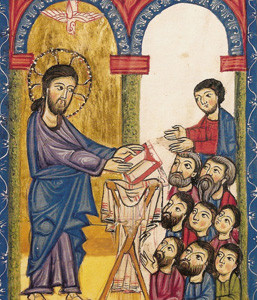
Jesus went back to Nazareth, where he had been brought up, and as usual he went to the meeting place on the Sabbath. When he stood up to read from the Scriptures, he was given the book of Isaiah the prophet. He opened it and read,
“The Lord’s Spirit has come to me, because he has chosen me to tell the good news to the poor. The Lord has sent me to announce freedom for prisoners, to give sight to the blind, to free everyone who suffers, and to say, ‘This is the year the Lord has chosen.’”
Jesus closed the book, then handed it back to the man in charge and sat down. Everyone in the meeting place looked straight at Jesus.
Then Jesus said to them, “What you have just heard me read has come true today.”
All the people started talking about Jesus and were amazed at the wonderful things he said. They kept on asking, “Isn’t he Joseph’s son?”
Jesus answered:
You will certainly want to tell me this saying, “Doctor, first make yourself well.” You will tell me to do the same things here in my own hometown that you heard I did in Capernaum. But you can be sure that no prophets are liked by the people of their own hometown.
Once during the time of Elijah there was no rain for three and a half years, and people everywhere were starving. There were many widows in Israel, but Elijah was sent only to a widow in the town of Zarephath near the city of Sidon. During the time of the prophet Elisha, many men in Israel had leprosy. But no one was healed, except Naaman who lived in Syria.
When the people in the meeting place heard Jesus say this, they became so angry that they got up and threw him out of town. They dragged him to the edge of the cliff on which the town was built, because they wanted to throw him down from there. But Jesus slipped through the crowd and got away. (Contemporary English Version)
Jesus was the hometown boy of Nazareth, the rising star who was putting the small village on the map. He walked into the synagogue on the Sabbath with the people all watching with pride, their chests puffed with delight over one of their own making it to the big time.
It just so happened that on that day the Old Testament reading was from the prophet Isaiah – a prophecy of grace and healing that fit the budding ministry of Jesus. Here was the hope of Israel. It was all bunnies and butterflies, until Jesus decided to say a few words to them all….
Jesus took the prophecy of Isaiah about proclaiming liberty to captives and the oppressed and then applied it, not to his fellow Jews who were present, but to, of all people, Gentiles!
Jesus just had to open his mouth and point out that in the days of Elijah, the prophet was sent to a Gentile woman. In addition, Jesus let everyone know the prophet Elisha cleansed a Gentile. The gathered synagogue worshipers understood exactly what Jesus was doing – claiming to be the ultimate prophet, sent for “those” people.
Are you ready to throw Jesus off a cliff?
It was too much for the people gathered for worship. All hell broke loose as the “worshipers” became so angry and insolent that they drove Jesus out of town and tried to kill him. Jesus had that kind of effect throughout his earthly ministry by saying and doing the unexpected.
The people of Nazareth seemed to have always interpreted the message of Isaiah and the prophets as being for themselves, not others. This is a probing story for today’s Christian Church. Whenever we lose sight of a biblical message and re-interpret it as being for only us, then we end up like the Nazarenes of old who did not recognize Jesus for who he really is and what he really came to do.
The burning question for individual Christians and all churches is this: Are you ready to throw Jesus off a cliff?
Take some time alone with God today and think about whether you have made Jesus into the image of what you want him to be, or whether you accept him as he is.
One clue to this is if you believe some person or people group should not have Jesus – he belongs to people like us. Perhaps today some soul-searching repentance is in order so that Christians will be true worshipers of Jesus, and not just a fan of him.
O God, you made us in your own image and redeemed us through Jesus your Son: Look with compassion on the whole human family; take away the arrogance and hatred which infect our hearts; break down the walls that separate us; unite us in bonds of love; and work through our struggle and confusion to accomplish your purposes on earth; that, in your good time, all nations and races may serve you in harmony around your heavenly throne; through Jesus Christ our Lord. Amen.
No widow may be put on the list of widows unless she is over sixty, has been faithful to her husband, and is well known for her good deeds, such as bringing up children, showing hospitality, washing the feet of the Lord’s people, helping those in trouble and devoting herself to all kinds of good deeds.
As for younger widows, do not put them on such a list. For when their sensual desires overcome their dedication to Christ, they want to marry. Thus, they bring judgment on themselves because they have broken their first pledge. Besides, they get into the habit of being idle and going about from house to house. And not only do they become idlers, but also busybodies who talk nonsense, saying things they ought not to. So, I counsel younger widows to marry, to have children, to manage their homes and to give the enemy no opportunity for slander. Some have in fact already turned away to follow Satan.
If any woman who is a believer has widows in her care, she should continue to help them and not let the church be burdened with them, so that the church can help those widows who are really in need. (New International Version)
The subject of widows is throughout all of Holy Scripture. Since well over half of all women in the ancient world above age 60 were widows, there were continual and ongoing needs to be addressed.
Women were mostly dependent upon men in the biblical world. So, whenever a husband died, this put the widow immediately at risk. The children and other extended family needed to step up and care for her. And, if this didn’t happen for whatever reasons, then the church would fill the void of caring for them.
Because of their vulnerable situation, God especially cares about widows. This is made evident by the many instructions and exhortations of the Lord to Israel:
The Lord your God is the God of all gods and Lord of all lords, the great, mighty, and awesome God who doesn’t play favorites and doesn’t take bribes. He enacts justice for orphans and widows, and he loves immigrants, giving them food and clothing. (Deuteronomy 10:17-18, CEB)
A father to the fatherless, a defender of widows, is God in his holy dwelling. God sets the lonely in families. (Psalm 68:5-6b, NIV)
Jesus maintained the stance of care and concern for widows in the Gospels:
Soon afterward, Jesus went to a city called Nain. His disciples and a large crowd went with him. As he came near the entrance to the city, he met a funeral procession. The dead man was a widow’s only child. A large crowd from the city was with her.
When the Lord saw her, he felt sorry for her. He said to her, “Don’t cry.”
He went up to the open coffin, took hold of it, and the men who were carrying it stopped. He said, “Young man, I’m telling you to come back to life!” The dead man sat up and began to talk, and Jesus gave him back to his mother. (Luke 7:11-15, GW)
So, it is no wonder that the Apostle Paul gave his young protégé Timothy some detailed instructions on how to handle ministry to widows in his church at Ephesus. The gist of that instruction is to encourage younger widows to remarry so that they would be properly cared for and enrolling older widows on a church list for support.
These widows within the church were expected to have a ministry of prayer and good works. This is truly wise counsel from Paul. Good relations and lifestyles require a healthy rhythm of giving and receiving. Widows are honored by having their needs met, as well as providing opportunities for them to give in ways they are able.
Religion that God accepts as pure and without fault is this: caring for orphans or widows who need help, and keeping yourself free from the world’s evil influence.
James 1:27, NCV
Whenever widows are only on the receiving end, they tend to become busybodies and gossips. And whenever they only give, then widows can be overlooked, and their daily needs neglected. All this is to say that there really needs to be thoughtful and intentional ministry to the widows among us.
Although in today’s modern society the status and station of many widows is different from the ancient world, there are still widows who need a life-giving ministry of both giving and receiving.
For this important dynamic to be successful, it’s necessary that adult children care for their elderly parents. I can testify firsthand as a hospital chaplain that there are many sons and daughters who fall woefully short of providing basic help to their aging mothers through a failure of consistent relational interactions, following through on needed paperwork, and answering calls in a timely manner.
Also, far too many aging widows are lonely with little to no resources and support in the form of both relationships and basic necessities. A truly Christian community is aware of the widows in their parish and seeks to honor them through establishing a ministry of giving and receiving.
Learn to do good. Seek justice. Help the oppressed. Defend the cause of orphans. Fight for the rights of widows.
Isaiah 1:17, NLT
Families and churches have a responsibility to the elderly in giving sufficient financial help, practical assistance with driving to appointments, and consistent companionship. They also have a responsibility to arrange opportunities for widows to give their time in prayer and helping out others through good works and good wisdom.
If we ourselves who are not widows have healthy rhythms of giving and receiving in our own lives, then we are in a position to help the elderly establish healthy rhythms, as well. Perhaps it is telling that any lack of attention to widows reflects our own personal neglect of spiritual and emotional health.
May God be in my head and in my understanding. May God be in my eyes and in my looking. May God be in my mouth and in my speaking. May God be in my heart and in my thinking. May God be at my end and at my departing. May God be with us, in all things and in every way. Amen.
Shout praises to the Lord! Everyone who serves him, come and praise his name.
Let the name of the Lord be praised now and forever. From dawn until sunset the name of the Lord deserves to be praised. The Lord is far above all of the nations; he is more glorious than the heavens.
No one can compare with the Lord our God. His throne is high above, and he looks down to see the heavens and the earth. God lifts the poor and needy from dust and ashes, and he lets them take part in ruling his people. When a wife has no children, he blesses her with some, and she is happy. Shout praises to the Lord! (Contemporary English Version)
When my firstborn daughter was an infant, I was a busy seminarian as well as working a job. I had very little discretionary time on my hands. Yet, I could stand over the crib of my beautiful little bundle of a girl for long stretches of time without ever thinking about all my responsibilities. Whenever she awoke I spoke to her in that kind of baby talk that only a doting father can do.
I imagine God looks at us in much the same way, as well as speaking and acting toward us in ways we can understand. Just as parents (hopefully) communicate on a level their kids can understand, so G-d condescends and stoops to our level in order to help us.
The Lord is seated on high, looking down on the heavens and the earth. G-d looks at us with lovingkindness and seeks our best interests. The Lord notices the poor and acts justly on their behalf. G-d observes the needy and lifts them from their want to a place where they can thrive. The divine condescension of God is a beautiful thing because without it we would be like a helpless baby.
G-d, while being unknowable and unreachable in so many ways, has nevertheless communicated with humanity in a way people can understand and to which they can respond. The Lord has accommodated, or made allowance for, our language and general level of understanding.
The Lord, sovereign and high above us all, has chosen to stoop and coo over us here on earth. G-d’s love affectionately delights in us. The psalmist’s portrayal of G-d is not of some aloof Being who is bothered with humanity’s pestering. Rather, G-d sees, notices, and cares. We don’t need to do some sort of spiritual back flips to gain G-d’s attention. We already have it.
This psalm of praise to G-d celebrates how the Sovereign of the universe notices and acts. We are meant to remember the great deeds of G-d – both those things done in history, and the things done for us, personally.
“Despite our earnest efforts, we couldn’t climb all the way up to God. So what did God do? In an amazing act of condescension, God climbed down to us and became one with us.”
Will Willimon
In Christianity, the concept of divine condescension and accommodation is given its supreme form in the person and work of Jesus Christ. By becoming human, Jesus accommodates himself to the human condition. Through his life, teaching, and ministry, Christ speaks as G-d, communicating sufficiently and effectively to humanity.
The redemptive events of Christ – his incarnation, holy life, death, resurrection, ascension, and glorification – are divine acts of grace, mercy, and love to all humanity. Praise and thanksgiving are the appropriate responses to such events done on our behalf.
This is one reason why the spiritual practice of journaling is such a good personal discipline because we then have a record of the ways in which G-d has acted on our behalf. When we look back and remember, we can praise the Lord all over again for lifting us from the ash heap. And this will fortify our spiritual mettle for the times when we need encouragement.
Keeping a gratitude journal and writing each day about at least one way the Lord has acted on your behalf, can bring encouragement, transformation, and joy to your life. I suggest you write for your own eyes only. This is between you and G-d. Therefore, you need not be concerned for correct spelling and grammar. It doesn’t even need to be legible, as long as you can read your own writing!
“Praise is the rehearsal of our eternal song. By grace we learn to sing, and in glory we continue to sing. What will some of you do when you get to heaven, if you go on grumbling all the way? Do not hope to get to heaven in that style. But now begin to bless the name of the Lord.”
Charles Spurgeon
What’s more, shouting our praises is not only appropriate but encouraged – even commanded. Shouting is both cathartic and fun. It builds emotional resilience and spiritual strength. Coupled with writing, shouting our praises has the effect of bringing spiritual growth and maturity to our lives.
We, of course, want to avoid shouting at others. Yet, we can take advantage of shouting while driving alone, out in the woods by ourselves, or even into a pillow. This isn’t weird. Shouting goes appropriately with praise and celebration.
In fact, it would be weird if there were no shouting. Try telling a sports fan watching their favorite team that they aren’t supposed to shout. Or just see what happens when a woman longing for children becomes pregnant for the first time.
Emotional expressions are expected whenever G-d shows up and accomplishes great deeds for us. To not do so is a sign of having spiders in your heart and garlic in your soul. It’s not right.
What are you thankful for today? Is there something in this day for which to praise the Lord, whether big or small? Will you give yourself permission to shout?
Accept, O Lord, our thanks and praise for all you have done for us. We thank you for the splendor of the whole creation, the beauty of this world, the wonder of life, and the mystery of love. We thank you for the blessing of family and friends, and the loving care which surrounds us on every side. We thank you for setting us at tasks which demand our best efforts and leading us to accomplishments which satisfy and delight us. We thank you also for those disappointments and failures that lead us to acknowledge our dependence on your mercy and grace.
Above all, we thank you for your Son, our Lord, Jesus Christ, the truth of his Word, the example of his life; his steadfast obedience, by which he overcame temptation; his dying, through which he overcame death; and his rising to life again, in which we are raised to new life. Grant us the gift of your Spirit so that we may know Christ and make him known; and through him, at all times and in all places, we may give thanks to you in and for all things. Amen.
For Christ did not enter a sanctuary made with human hands that was only a copy of the true one; he entered heaven itself, now to appear for us in God’s presence. Nor did he enter heaven to offer himself again and again, the way the high priest enters the Most Holy Place every year with blood that is not his own. Otherwise Christ would have had to suffer many times since the creation of the world. But he has appeared once for all at the culmination of the ages to do away with sin by the sacrifice of himself. Just as people are destined to die once, and after that to face judgment, so Christ was sacrificed once to take away the sins of many; and he will appear a second time, not to bear sin, but to bring salvation to those who are waiting for him. (New International Version)
Jesus is the central figure of the Bible. I could preach on the finished work of Christ every Sunday and never exhaust the immensely rich implications of his death for us.
Maybe today’s verses seem like a re-hashing of things we already know. Yet, it is important to keep plumbing the depths of Christ’s once for all sacrifice because it is through continually examining Jesus that we will experientially know our forgiveness is real. Having this reality sink deep into our souls enables us to extend forgiveness to others.
The original recipients of Hebrews were experiencing spiritual fatigue due to their difficult circumstances. The believers were so tired from swimming upstream that they considered quitting and giving up on Christianity (or at least the Church).
The author of Hebrews truly believed that the way to combat this tiredness was through a robust understanding of Christ. So, he sought to demonstrate that Jesus is superior to the old sacrificial system and has even superseded it.
There are three main distinctions between the old sacrificial system and the new way of Christ. They are meant to encourage us so that we will know our forgiveness is real. This awareness will help us persevere and live for Jesus in all we say and do, until he returns.
First Distinction: Reality versus a Simulated Copy
The Old Testament sacrificial system, and its worship rituals in dealing with the sin issue, were only a copy and a shadow of the real sacrifice, which is Christ. The Temple sacrifices, in other words, were merely a facsimile of the real thing.
When my girls were small, they always enjoyed going to our local large grocery store. At that store they had a row of mechanical horses that only cost a penny to ride for one minute. Riding the horses was always the highlight of shopping for them. Their Aunt once came for a visit and brought a coffee can full of pennies and took them to the grocery store just to ride the horses for an afternoon.
All three of my girls are now grown adult women. They do not ride mechanical horses anymore. They now ride real live horses. My daughters, as excited as they were to ride mechanical horses as small girls, now have no desire to do so because those horses were only a simulation of the real thing.
As Christians, since Christ has come as the true and real sacrifice for sin, we are no longer to be content with simulations and copies of the real deal. And we are to know the difference between them. Our forgiveness is neither a simulation nor a copy because Christ is the real thing.
As my girls were growing up, my wife and I had a certain process we went through with them when they did something wrong toward one another. We would talk about the offense, and then they would need to say the words, “I am sorry.”
However, the matter was never over until they hugged each other and told each other they loved the other. If they could do that, it was the real deal. You see, they could mouth the words to get us off their backs, but to hug and express love was the reality.
“To be a Christian means to forgive the inexcusable because God has forgiven the inexcusable in you.”
C.S. Lewis
Jesus did not just mouth words of forgiveness to us. He secured it through his death on a cross. It is not a cheap imitation kind of forgiveness. It is real. Christ died a violent death. The emphasis in Scripture on blood and sacrifice can be upsetting for many people.
Yet, we need to understand that the brokenness of this world is so bad that it requires drastic action. Christ’s death reflects the horrible sin of humanity. Since Jesus has secured forgiveness for us at such a steep price, we are to receive it with great humility and joy that God loves us that much.
Second Distinction: Once versus Endless Repetition
Jesus Christ came to deal with the sin issue once for all through his blood. He came to do away with sin, not just veneer over it. The old sacrificial system was like whitewashing a barn – it took care of the issue for a while, but it would need to be done over and over again.
We are familiar with temporary arrangements. For example, annual fees need to be paid and renewal stickers have to be put on a car’s license plate every year. Christ’s atonement, however, is no temporary arrangement. The forgiveness Jesus offers is permanent.
There is no need to keep offering sacrifices over and over because Christ is the sacrifice to end all sacrifices. The forgiveness we possess is not like paying an annual fee and getting a forgiveness sticker for the year. In Jesus Christ, we are forgiven! And this forgiveness was purchased with Christ’s own blood.
Author Henri Nouwen once told a story of a family he knew in Paraguay. The father, a doctor, spoke out against the military regime there and its human rights abuses. Local police took their revenge on him by arresting his teenage son and torturing him to death. Enraged townsfolk wanted to turn the boy’s funeral into a huge protest march, but the doctor chose another means of protest.
At the funeral, the father displayed his son’s body as he had found it in the jail—naked, scarred from electric shocks and cigarette burns, and beatings. All the villagers filed past the corpse, which lay not in a coffin but on the blood-soaked mattress from the prison. It was the strongest protest imaginable, for it put injustice on grotesque display.
“Forgiveness means that I continually am willing to forgive the other person for not being God.”
Henri Nouwen
The cross that held Christ’s naked and marred body exposed the violence and injustice of this world. The cross revealed what kind of world we have and what kind of God we have: a world of gross unfairness, and a God of sacrificial love. Because Jesus was willing to do this on our behalf, we have forgiveness once and for all through his blood.
This world needs forgiveness – not a cheap sentimental forgiving but a real forgiveness that lasts forever.
Third Distinction: Salvation versus Judgment
A lot of religious energy can be spent trying to figure out how to make ourselves acceptable to God. Part of the good news is that, in Christ, we do not need to fear the future. We have been made right with God through the death of Jesus. Through Christ’s sacrifice the doors to heaven and earth get flung wide open. The way has been secured, the trail has been blazed, and the road has been made smooth to come to God.
Jesus, unlike any Levitical priest, has entered God’s presence, providing access to the living God. Christ did not need to offer sacrifice for his own sins but offered himself solely on our behalf. Jesus did more than offer the sacrifice; he himself became the sacrifice. It was a sacrifice to bring deliverance to humanity, not judgment.
Either to justify or to judge is God’s business, not ours. Our concern is to believe in the once for all sacrifice of Jesus that brings a permanent forgiveness; and, to share that life-giving message with others so that they, too, can experience deliverance from sin, death, and hell.
We can have such a hard time forgiving others because we struggle with experiencing our own forgiveness. The path to extending grace to others is in deepening our knowledge, understanding, and awareness of God’s grace in Christ.
Conclusion
The author of Hebrews meant for the Christian life to be an exciting and abundant adventure following Jesus, the pioneer of our salvation. And yet, many Christians do not know anything about this kind of life. They only see the Christian life as a duty and a chore, a kind of cross to bear.
It is important we recognize it is our Lord and Savior, Jesus Christ, the object of our faith, who has delivered us so that we can live a new life of freedom enjoying our forgiveness and inviting others on the journey.
There was once an immigrant that booked passage on a ship with just enough money to buy a ticket, a block of cheese and some crackers for a long voyage. The first few days at sea the crackers and cheese tasted good, but eventually they became stale.
As he watched the porters carry large steaks, lobsters, chicken, beautiful salads and many other delicious foods to the other guests, he became so hungry that he finally stopped one of the porters. “I’II do anything to get one of those steaks,” he said. “I’II wash dishes, clean rooms, even mop the deck.” The porter replied, “You bought a ticket, didn’t you? The meals come with the ticket.”
Too many people today are cheese and cracker Christians—missing out on all of God’s steak dinners. All the resources of God are available to us, yet far too many of us live in self-imposed spiritual poverty.
For he has rescued us from the dominion of darkness and brought us into the kingdom of the Son he loves, in whom we have redemption, the forgiveness of sins.(Colossians 1:13-14, NIV)
Jesus did not die on the cross and rise from the dead so that we could live ho-hum Christian lives. He has granted us forgiveness so that we will eagerly enjoy the Word of God; enjoy laboring together in the Gospel; and look forward to how the Spirit will transform lives through Christ’s forgiveness.
Real forgiveness opens our minds, hearts, and our energies to live for Jesus, the pioneer of our salvation.