Accept One Another (Romans 15:7-13)

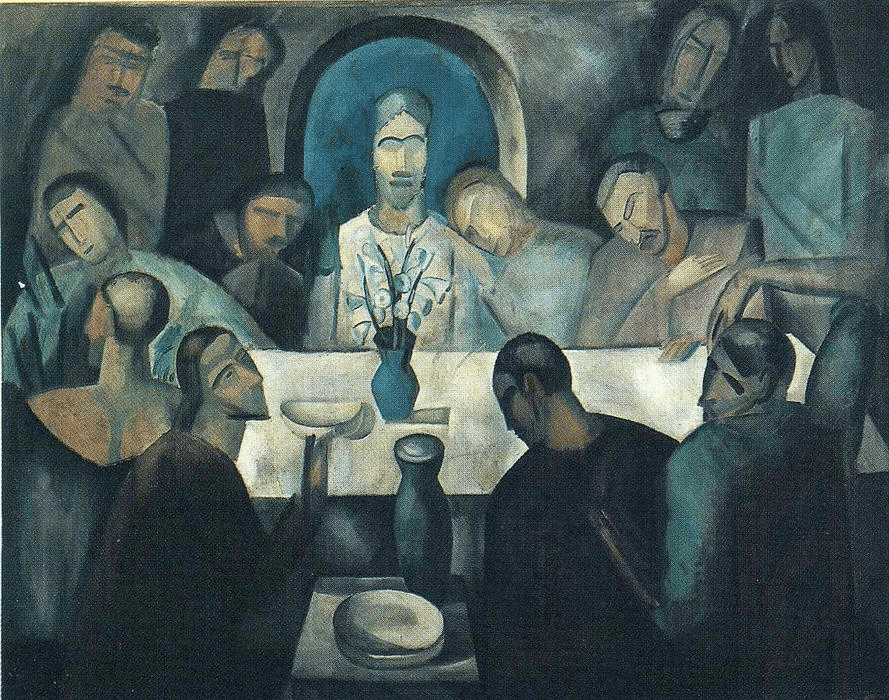
Christian Unity, by Gisele Bauche

Accept one another, then, just as Christ accepted you, in order to bring praise to God. For I tell you that Christ has become a servant of the Jews on behalf of God’s truth, so that the promises made to the patriarchs might be confirmed and, moreover, that the Gentiles might glorify God for his mercy. As it is written:

“Therefore I will praise you among the Gentiles;
    I will sing the praises of your name.”

Again, it says,

“Rejoice, you Gentiles, with his people.”

And again,

“Praise the Lord, all you Gentiles;
    let all the peoples extol him.”

And again, Isaiah says,

“The Root of Jesse will spring up,
    one who will arise to rule over the nations;
    in him the Gentiles will hope.”

May the God of hope fill you with all joy and peace as you trust in him, so that you may overflow with hope by the power of the Holy Spirit. (New International Version)

Anyone who desires to follow the pattern of Christ, actively seeks and promotes the acceptance of one another.

Jesus is the Christian’s model: Christ did not seek to be served, but to serve, and give himself for the benefit of others. The ministry of Christ was meant for the whole world, and not just for some persons. Christ’s mission and ministry included non-Jews, and not only his own Jewish people.

The person and work of Jesus Christ confirmed the promises made to the original Jewish patriarchs of Abraham, Isaac, and Jacob. Jesus did nothing brand new; he was simply upholding and actively seeking to accept Gentiles and bring them to God. This has always been true of God’s plan and purpose – which is why the Apostle Paul cited four different Old Testament passages.

All four references are to the Gentiles, to non-Jewish persons. And this is why Paul himself had a ministry to Gentiles. The biblical verses mentioned by the Apostle include Gentiles who offer praise to God; Gentiles engrafted alongside Jews as God’s people; and Gentiles who put their hope in the root of Jesse, the Messiah.

The good news of Jesus Christ is an inclusive – not exclusive – message. Thus, Christian ministry is designed to include others, to bring them into the fold of those who are redeemed by God.

Christian community is made up of all kinds of people from every race and ethnicity – without exception, and without favoritism.

The Apostle Paul made it clear to the Roman Church of both Jew and Gentile that his bedrock Christian ethic was one of inclusion and care for others. He supported his ethical understanding from Holy Scripture.

Paul was concerned that the Church include all sorts of Christ followers who may have some differing understandings and practices in living out their own Christian faith.

The Body of Christ is designed and meant to be big enough, strong enough, and resilient enough to handle all sorts of people who together want to follow Christ and serve others, like Jesus did.

The Apostle’s prayer is one of hope, having everyone in the church be accepting of one another. Paul wanted all Christians to work and worship together as the one people of God who live according to the pattern of Christ.

The Christian model of living is based not upon dietary laws or special days; it instead has it’s foundation in the example of Christ’s earthly ministry. All Christians are to:

  • glorify God together for the divine mercy shown to them
  • rejoice together as a unified voice expressing faith, hope, and love
  • share together in the hope that God’s promises are and will be fulfilled completely in Christ

God fills us with joy and peace, and causes us to overflow with hope by the power of the Holy Spirit – made possible because of the person and work of Jesus Christ.

Since God grants faith to whomever God wants to grant faith; and since the Holy Spirit fills whomever the Spirit wants to fill, we are, therefore, to accept those whom God has already accepted – without exception, and without prejudice.

For the Apostle Paul, the church’s identity was at stake. Paul was concerned for two questions:

  1. Will the church be, at its core, a community of redeemed persons by the grace of God who center all their lives around the person and work of Jesus?
  2. Or will the church be a community of opinionated individuals and groups all jockeying for position to have their way on how they believe things should go?

You can tell what a person’s identity is by their “identity markers.”

For the Jewish Christians, Sabbath-keeping, circumcision, food laws, and holding to certain days on the calendar marked their identity as God’s people. Those issues were so important that if you took them away, there would be an identity crisis; the people felt totally lost without their traditions.

For Gentile Christians, their identity was built around being more free-thinking. So, if you take away their freedom and ability to choose, the Gentiles will go nuts and have an identity meltdown. 

Paul’s answer was for both Jew and Gentile to accept one another and build their unity around Jesus, period. They needed to be sensitive to each other and focus on their shared identity of Jesus as the center of the Christian life.

It is very difficult to have hope, peace, and spiritual power, whenever there is disunity. The lack of acceptance is typically like a cancer which invades the Body and destroys it, unless there is a spiritual intervention.

Acceptance of others is more than a nice idea; and it doesn’t mean that we overlook differences of convictions or dogma. It just means that we choose to focus on what is most important. And for the Apostle Paul, that meant having a unity around the pattern of Christ.

Loving Lord, you came not to be served but to serve. Empower us to bless one another and our neighbors, so that your spirit of generosity, compassion, and selfless action transform us and the people in our midst. We pray together, as the one people of God, that you will guide us in your way; through Jesus Christ our Savior, in the strength of the Holy Spirit. Amen.

Don’t Assume (Job 32:1-22)

The Wrath of Elihu, by William Blake, 1805

Finally, these three men stopped arguing with Job, because he refused to admit he was guilty.

Elihu from Buz was there, and he had become upset with Job for blaming God instead of himself. He was also angry with Job’s three friends for not being able to prove that Job was wrong. Elihu was younger than these three, and he let them speak first. But he became irritated when they could not answer Job, and he said to them:

I am much younger than you,
so I have shown respect
    by keeping silent.
I once believed age
    was the source of wisdom;
now I truly realize
    wisdom comes from God.
Age is no guarantee of wisdom
    and understanding.
That’s why I ask you
    to listen to me.

I eagerly listened
    to each of your arguments,
but not one of you proved
    Job to be wrong.
You shouldn’t say,
“We know what’s right!
    Let God punish him.”
Job hasn’t spoken against me,
and so I won’t answer him
    with your arguments.

All of you are shocked;
    you don’t know what to say.
But am I to remain silent,
just because you
    have stopped speaking?
No! I will give my opinion,
because I have so much to say,
    that I can’t keep quiet.
I am like a swollen wineskin,
and I will burst
    if I don’t speak.
I don’t know how to be unfair
    or to flatter anyone—
if I did, my Creator
    would quickly destroy me! (Contemporary English Version)

Job and his three friends had talked themselves out. There were plenty of words and frustration, with nothing left but an impasse. We anticipate hearing from God….

But there is yet another who was present with Job and his companions. Elihu was a young man in tow with the older three friends. He respectfully held back and observed all the proceedings between the four men. As he watched, the angrier he became, to the point of feeling the need to speak up and offer his own voice concerning Job’s terrible suffering and trouble.

Elihu was angry because he believed Job was setting up himself as more righteous than God. And he was also perturbed with the three friends. He viewed them as bungling their argument against Job, offering no convincing answers.

Within the scope of what Elihu and the friends were talking about, the arguments were indeed found lacking. No one had the necessary wisdom to handle Job’s case.

But therein lies the problem. The assumptions are presuppositions which underlie all the arguments and speeches were off. The friends simply assumed Job was sinful, because they presupposed that anyone undergoing such terrible suffering is being punished by God.

Therefore, all of the bluster was doomed to go nowhere. Underneath all of the exhausting chaos was a cosmic drama which none of the human actors were privy to. In other words, nobody knew what they were talking about.

God only seems to be silent and absent from the perspective of us humans. We are an impatient people. Much like Elihu, we sit on our hands and bite our lips, waiting to get out what we want to say.

I wonder how much of Elihu’s listening wasn’t actually listening, but was thinking about what he was going to say when he got his chance. Job’s friends were ineffective in proving Job wrong and guilty before God, according to Elihu.

But if any of us begin our thinking and our speaking with assumptions and presuppositions which are off base, then it’s likely that nearly all of our thoughts and words will be unhelpful and even hurtful.

Too many people have a compulsion to speak and get their own opinions out. Few persons, however, have the same sort of compulsion to truly observe, listen, and learn. So, what we typically get are Elihu-like belching of speech – which may make the person speaking feel better, yet leaves everyone else groaning for them to keep their mouth shut.

An unteachable spirit which values one’s own thoughts and opinions over others is the mark of a fool, and not a sage. There ought never to be more wind coming from someone’s mouth than from the weather.

Unfortunately, many people claim to know and understand more than they actually do. And just because someone occupies a high position does not necessarily mean they know what they’re talking about.

In our anger and perturbed states of mind, we vent and talk too much, as if we have the corner on truth. Yet, how much of our talking is really worth others listening to us?

Instead of assuming we already know what is happening with another, there are questions we can ask ourselves, which may help guide us to speak more truthfully with helpful, not hurtful, words.

The following few questions can help orient us with compassion toward what another is saying:

  • What is the main point being made?
  • What might be going through their mind when they say that?
  • What need do they have that they are trying to satisfy?
  • What is the motivation of the person speaking?

Just as important is our own self-awareness. These questions can help us monitor ourselves as we listen and respond to others:

  • How am I feeling right now in this moment?
  • What do I need right now?
  • Why does that particular statement or opinion irritate me so much?
  • How am I presenting myself right now – my affect, posture, and eye contact?

We can also ask questions of God during a conversation:

  • Will you please help me to understand the person and what is being said?
  • How does this square with my understanding of you and your Word?
  • Which values – that are important to You – apply to this discussion?
  • What do you want me to say and do?

You will say the wrong thing
    if you talk too much—
so be sensible and watch
    what you say. (Proverbs 10:19, CEV)

The Book of Job would likely look a lot different if Job’s friends had taken such a wise saying to heart.

The following is a prayer from St. Francis of Assisi:

Lord, make us instruments of your peace.
Where there is hatred, let us sow love;
where there is injury, pardon;
where there is discord, union;
where there is doubt, faith;
where there is despair, hope;
where there is darkness, light;
where there is sadness, joy.
Grant that we may not so much seek to be consoled as to console;
to be understood as to understand;
to be loved as to love.
For it is in giving that we receive;
it is in pardoning that we are pardoned;
and it is in dying that we are born to eternal life. Amen.

Mercy and Judgment (Revelation 8:1-5)

Seven angels with seven trumpets, and the angel with a censer, from the Bamberg Apocalypse, c.1020 C.E.

Then, when the Lamb opened the seventh seal, there was silence in heaven for about half an hour.

Then I saw the seven angels who stand before God, and seven trumpets were given to them. Another angel came and stood at the altar, and he held a gold bowl for burning incense. He was given a large amount of incense, in order to offer it on behalf of the prayers of all the saints on the gold altar in front of the throne. 

The smoke of the incense offered for the prayers of the saints rose up before God from the angel’s hand. Then the angel took the incense container and filled it with fire from the altar. He threw it down to the earth, and there were thunder, voices, lightning, and an earthquake. (Common English Bible)

When I was kid, growing up on a Midwest American farm, I remember times when severe weather was coming. I knew it was going to be bad whenever everything became still and there was complete silence: No wind, no birds singing, no insects chirping, nothing moving whatsoever. It was the eerie silence which precedes something big coming.

That is the way it will be in heaven when the seventh seal is opened. The silence is so quiet that you know a lot of noise and movement are about to happen. It’s not serene silence; it’s scary silent.

With the opening of the seventh seal, a climactic moment is reached. The silence is not only an anticipation of the coming drama, but is also a sign of reverence and awe.

The seventh seal initiates a series of woes: The seven trumpets. But before the trumpets begin, an angel appears. Standing before a heavenly altar, the angel mixes incense along with prayers from the people, then offers them on the altar.

These prayers of the people are for justice, and a longing for the kingdom to come, and God’s will to be done, on earth, as it is always done in heaven.

The imagery relates to us that God hears the prayers, and will act, according to the divine character and will.

The angel takes fire from the altar and hurls it down to earth, causing thunder and lightning, and an earthquake. In other words, the prayers are being answered; they are having an effect. Judgment on the earth begins with the blowing of the seven trumpets.

As we may expect, the incredible silence gives way to an equally incredible noise of weather and the earth moving. And the angel, serving as a quiet and contemplative high priest, now moves to becoming a judge upon the earth.

It turns out that mercy and judgment are not two contrasting concepts and actions; they are two sides of the very same coin. The altar of mercy becomes the source of judgment.

Whenever there is an injustice, we want (and expect) to have that act acknowledged and taken care of by a proper authority. To have a judge simply say that he/she is merciful and will acquit the guilty, does not work in every situation. Mercy only exists because of the presence of guilt and judgment.

God takes care of sin because God loves. An unloving deity would be unconcerned, random, and capricious in handling injustice. But not the God of the Bible. God shows mercy to the righteous, and will judge the wicked.

God’s mercy extends to the point of acquitting the guilty, if God so desires to do so. And everyone needs mercy, because we all have committed injustices in our lives.

Yet, by means of humble contrition and faith, we can mercifully discover gracious amnesty. This is why Jesus came, to take care of the sin issue once for all through the Cross.

We have been made holy by God’s will through the offering of Jesus Christ’s body once for all. (Hebrews 10:10, CEB)

In the time of the Apostle John’s vision, which is the Book of Revelation, Christians were facing persecution and martyrdom. The prayers of the suffering believers rose to heaven:

They cried out with a loud voice, “Holy and true Master, how long will you wait before you pass judgment? How long before you require justice for our blood, which was shed by those who live on earth?” (Revelation 6:10, CEB)

God’s response to the prayers of the saints is to send judgmental fire against the earth by the hand of the angel. In John’s apocalyptic vision, not only are the believers in Christ facing trials and tribulations for their faith, but the unbelieving persecutors who victimize the saints will be punished, as well.

If the persecutors use fiery elements against the believers, God can (and will) turn that fire back on the them. This is similar to the Book of Exodus, in which the plagues that struck and judged the Egyptians were, at the same time, a means of protecting and preserving the Israelites.

The Book of Revelation included in the Christian canon of scripture, not for the purpose of predicting the time or the season in which Jesus Christ will come back to judge the living and the dead. Rather, John’s Apocalypse is meant to encourage the followers of Christ that their suffering will not last forever; and neither will the arrogance of the wicked.

We don’t know when all of this end-of-the-age stuff is going to shake out. Which is why it is so important we learn to persevere through suffering. Because we might have to wait awhile.

Prayer for us then becomes not simply something we do if we have a bit of discretionary time; it becomes vital for us. We discern that we must speak with God. We are compelled to offer our prayers. We feel the great need to cry out and petition God for justice and righteousness.

It seems, if I don’t pray, I won’t make it. Therefore, I must pray. I will pray with all of my heart and soul, till I cannot pray anymore. And then I will pray some more, because I need God.

There is nothing easy about moving through suffering. It’s hard to persevere. It hurts to be the brunt of another’s violent tongue and/or hand. Yet, we do not experience this alone. The divine presence is with us. And that makes all the difference.

Oh God:
Give me strength to live another day;
Let me not turn coward before its difficulties, or fail in its duties;
Let me not lose faith in other people;
Keep me sweet and sound of heart, in spite of ingratitude, treachery, or meanness;
Preserve me from minding little stings, or giving them;
Help me to keep my heart clean, and to live so honestly and fearlessly that no outward failure can dishearten me, or take away the joy of conscious integrity;
Open wide the eyes of my soul that I may see good in all things;
Grant me this day some new vision of your truth;
Inspire me with the spirit of joy and gladness and make me the cup of strength to suffering souls; in the name of the strong Deliverer, our only Lord and Savior, Jesus Christ. Amen.

Hold Onto Faith (Job 26:1-14)

Job, by Gonzalo Carrasco (1860-1936)

Then Job replied:

“How you have helped the powerless!
    How you have saved the arm that is feeble!
What advice you have offered to one without wisdom!
    And what great insight you have displayed!
Who has helped you utter these words?
    And whose spirit spoke from your mouth?

“The dead are in deep anguish,
    those beneath the waters and all that live in them.
The realm of the dead is naked before God;
    Destruction lies uncovered.
He spreads out the northern skies over empty space;
    he suspends the earth over nothing.
He wraps up the waters in his clouds,
    yet the clouds do not burst under their weight.
He covers the face of the full moon,
    spreading his clouds over it.
He marks out the horizon on the face of the waters
    for a boundary between light and darkness.
The pillars of the heavens quake,
    aghast at his rebuke.
By his power he churned up the sea;
    by his wisdom he cut Rahab to pieces.
By his breath the skies became fair;
    his hand pierced the gliding serpent.
And these are but the outer fringe of his works;
    how faint the whisper we hear of him!
    Who then can understand the thunder of his power?” (New International Version)

Sarcasm is a form of criticism. Criticism is a form of anger. Job was angry at his “friends.” Namely, because they had proved themselves to be not very good companions.

Job needed comfort and consolation, not hellfire sermons about his being sinful. Because, in fact, he had not sinned. His intense pain and suffering were not a punishment from God, as the prologue to the story of Job makes clear. (Job 1:1-22)

But neither Job nor his friends knew what was going on behind the scenes in the cosmic court of heaven.

Job only knew he was getting a lot of undeserved tragedy. And Job’s friends only knew that he was suffering terribly.

Job didn’t know how to interpret his situation. Job’s friends misinterpreted his situation as condemnation from the Lord.

Thus, Job became exasperated and angry. Job’s friends became the ignoramuses of ancient history.

Job was certainly no ignoramus. He knew what it meant to be right with God – which was why he was so doggone confused and confounded as to why he felt abandoned by God. Job knew his suffering wasn’t a result of unfaithfulness.

The biblical character Job came face to face with the reality that good people suffer, too.

The friends of Job kept reiterating how unworthy and sinful people are; and that Job must be especially sinful to be experiencing such trouble. And, of course, Job found this line of reasoning asinine.

The majesty of God, as Job understood it, is much greater and higher than his supposed friends could ever imagine. The dead know this better than anyone. Job himself was nearly dead, and so, he seems to see some things more clearly from his perspective of abject suffering.

Job’s observations of creation are profound reflections of God’s greatness and sovereignty in the world. His faith rested firmly with God alone, as Creator and Sustainer of the universe. So, he looked beyond the water and the clouds to heaven above.

Even in the realms we humans cannot see, God has authority and power over angelic beings. We cannot fathom the breadth and depth and extent of God’s reach and knowledge of all things. Indeed, humanity only observes a mere fraction of God’s rule and reign. And we barely know anything in comparison to God’s wisdom and knowledge.

In other words, our incredible God is so mighty and wondrous that it is incomprehensible to us.

Oh, the depth of the riches of the wisdom and knowledge of God!
    How unsearchable his judgments,
    and his paths beyond tracing out! (Romans 11:33, NIV)

God is big, to the point that only the fringes of God’s robe can fit inside the temple:

I saw the Lord, high and exalted, seated on a throne; and the train of his robe filled the temple. (Isaiah 6:1, NIV)

Although Job was flummoxed as to why God was silent and allowed suffering to happen, Job nevertheless had a majestic view of God which remained intact.

And, what’s more, Job seems to have gained an even more expansive view of God through his awful experience of suffering in both body and soul. In other words, Job got to know God better, and not for worse, because of his terrible situation.

Satan certainly meant to upend Job and cause him to renounce his faith; but God meant it all, ironically, for good.

Even though Job’s words about God appear similar to the words of his friends, they come from a very different place.

It’s one thing to talk of God’s majesty, sovereignty, and power when everything is going okay for you in your life. But it is an altogether different thing whenever your life has unraveled and distress is what you eat for breakfast.

To affirm God’s inherent power and goodness, smack in the middle of grinding hardship and ill health – and truly mean it – is the genuine article of faith.

Authentic faith is resilient and gains strength when tested and tried. Bogus faith crumbles like burnt toast when it is put through the fire.

True faith is always connected to hope and love. False faith evaporates and becomes nihilistic and hateful in the face of hellish circumstances.

Real faith perseveres through suffering, knowing that God is good, no matter what. Skin deep faith is herky-jerky, vacillating between confidence and doubt.

The only way for faith to be shown as real or fake is in the crucible of suffering. How we handle the adverse situations of life demonstrates where our faith is truly placed.

Satan’s statement to God was that Job’s faith would be shown to be a mere façade because God had blessed him with health, wealth, and family.

Satan was wrong. God was right. However, we may wonder about what Job thought of all this, once the suffering subsided.

I don’t know about Job. I can only speak for myself. I won’t list the long litany of trials and tribulations I have personally encountered in my life, and those I am facing presently. Yet, I will say that each of my experiences have taught me something important about God; and those hard experiences have changed and strengthened my faith in ways I could not have imagined.

Although I would never want to go through all of the past adversity again, I would not change a thing in my life. Because each of my experiences were formative in making me the person I am today – full of robust faith in God and confident in the Lord, no matter the circumstances.

Strengthen us, O Lord, by your grace, so that through your mighty power we may overcome all spiritual enemies, and with pure hearts serve you; through Jesus Christ our Lord, who lives and reigns with you and the Holy Spirit, one God, for ever and ever. Amen.