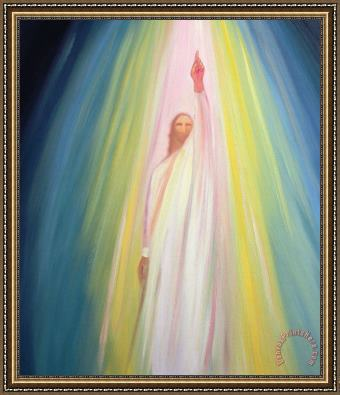
The Real Thing (Hebrews 9:24-28)

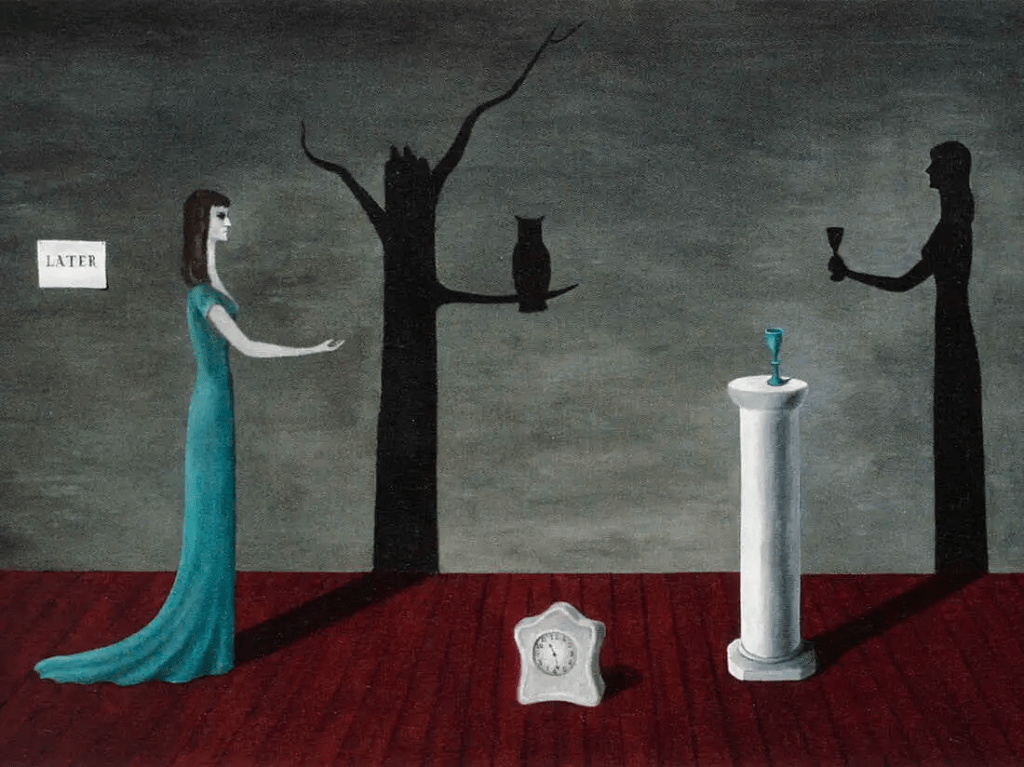
Strange Shadows (Shadows and Substance), by Gertrude Abercrombie, 1950

For Christ did not enter a sanctuary made by human hands, a mere copy of the true one, but he entered into heaven itself, now to appear in the presence of God on our behalf. 

Nor was it to offer himself again and again, as the high priest enters the holy place year after year with blood that is not his own, for then he would have had to suffer again and again since the foundation of the world.

But as it is, he has appeared once for all at the end of the ages to remove sin by the sacrifice of himself. And just as it is appointed for mortals to die once and after that the judgment, so Christ, having been offered once to bear the sins of many, will appear a second time, not to deal with sin but to save those who are eagerly waiting for him. (New Revised Standard Version)

I admit that the Book of Hebrews in the New Testament is one of my favorite books of the Bible. I also recognize that Hebrews is one of the most difficult books to deal with. And specifically, chapter 9 can be quite mind-boggling.

The author of Hebrews, whoever he was actually was, did the intellectually and theologically staggering job of establishing continuity between the two testaments of the Bible.

He compared and contrasted the old (or first) covenant with the new (or second) covenant, examining the Levitical priesthood and its sacrificial system, with Christ as the high priest whose singular sacrifice ended all sacrifices.

The old sacrificial system began on Mount Sinai. Moses sprinkled the sacrificial blood of bulls and goats on both the people and the tabernacle. He was consecrating them, and the sacrificial implements, so that everyone could participate in the worship of Yahweh.

In the new covenantal system, blood is also used to purify. Yet, the heavenly tabernacle could not be cleansed with the blood of animals. It required a better and superior sacrifice. (Hebrews 9:23)

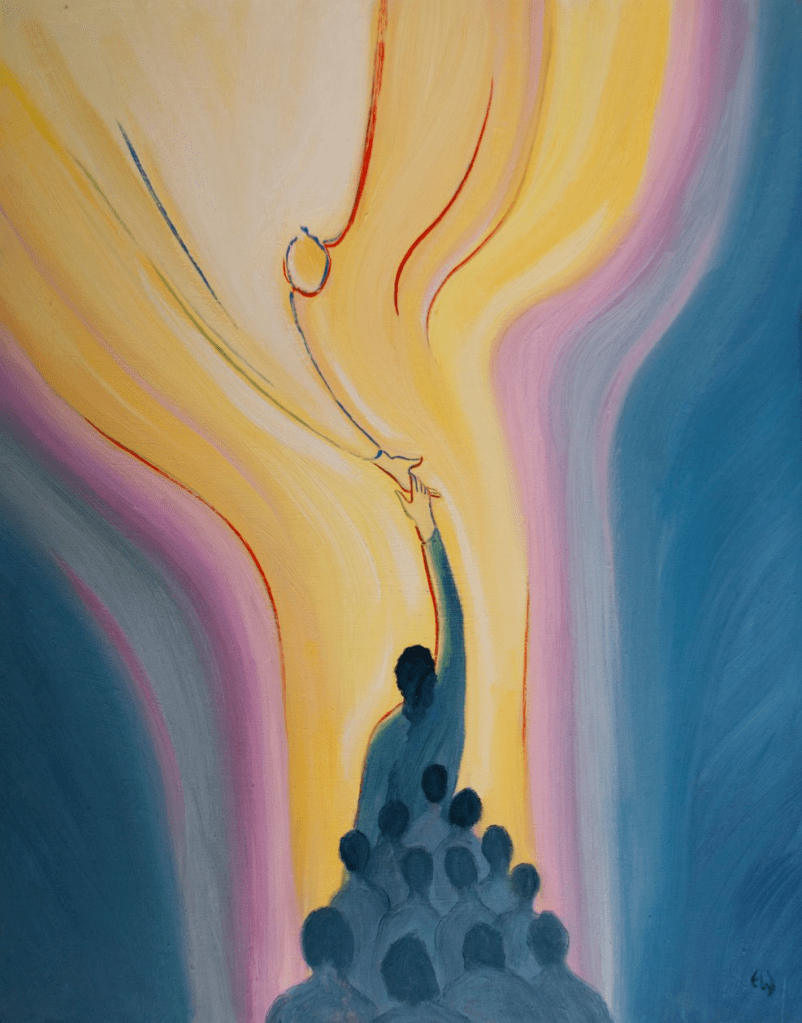
The Sacrifice of Christ, by Elizabeth Wang, 2002

That sacrifice is Jesus. He was both the high priest officiating the ritual, and the actual sacrificial offering. It is the life of Jesus, given in self-sacrificial death, which enables worshipers to come to God without any obstruction whatsoever.

Jesus does not have to keep offering himself. It was a one and done affair. One sacrifice on behalf of everyone. Once for all.

This is, of course, a distinctively Christian view and approach to the problem of guilt, shame, disobedience, and death. It has been a very compelling view for millions of people over the past two millennia.

In whatever way one seeks to understand and make sense of the author’s line of reasoning concerning a Christian approach to sacrifice and dealing with sin, what is apparent to me is that the author talked of a reality that we do not presently see.

The author of Hebrews was lifting up something important that he wanted us to notice. He was pointing out the reality of spiritual forces that have the power to both destroy and give life.

The earthly objects that we can see, touch, feel, hear, and smell are mere representations or shadows of heavenly things.

Many people, if not most people, today would say that invisible things such as our ideas and philosophies of religion are mere mental ways of understanding the objective reality in front of us that we can use our five senses to detect.

But the author of Hebrews insists – and I believe rightly so – that it’s the other way around. Everything we are presently experiencing with our objective senses is a projection of the ultimate invisible reality.

In other words, this entire world will pass away, because it is but a shadow in the history of eternity. The invisible God is the real deal. The heavenly sanctuary is reality. Love is the permanent operating system of eternity, and not your 401(k) or the next political election.

Jesus the Christ has offered himself once for all time, and for all sins. And he did it because the triune God – Father, Son, and Spirit – is a community of unitive love. That is, God is Love. So therefore, God can only do that which is love.

The end of time is not yet here. This present world with all of its inconsistent ways of doing both good and bad is still with us. But Jesus will come again.

The sin issue has been dealt with, once and for all. Christ did that. Jesus will return in order to bring salvation to those who are waiting for him.

If we must wait, let us do it patiently, with all of the faith and endurance it requires. Yet, this is not a passive waiting. We are to be busy proclaiming the good news of God’s invisible realm with both words and sacraments – with the signs and shadows and representations we have that point to the reality of God.

Everything visible and tangible on this earth is mirroring a greater, better, and superior reality which we cannot see with our eyes or touch with our hands.

Christianity is unabashed that all things point to Christ, who is the first and the last, the alpha and omega, the be all and end all of everything.

Come, Lord Jesus, Son of God, Son of Humanity. We long for you to return in glory and set us and this entire sinful world aright with your divine justice.

Be our guest, Lord Jesus, our Savior and Friend. We receive in faith your salvation. We trust that both the physical food and spiritual food you give will sustain us for our work and worship in this world.

May it be so, to the glory of God, and through the enablement of the Holy Spirit. You are one God – Father, Son, and Spirit – in one holy community of Love, now and forevermore. Amen.

Lessons From a Genealogy (Ruth 4:18-22)

Now these are the descendants of Perez: Perez became the father of Hezron, Hezron of Ram, Ram of Amminadab, Amminadab of Nahshon, Nahshon of Salmon, Salmon of Boaz, Boaz of Obed, Obed of Jesse, and Jesse of David. (New Revised Standard Version)

No, I didn’t make a mistake about what the verses are for today from the Revised Common Lectionary. Yes, the Old Testament lesson is a brief genealogy. And yes, there is something to learn from this.

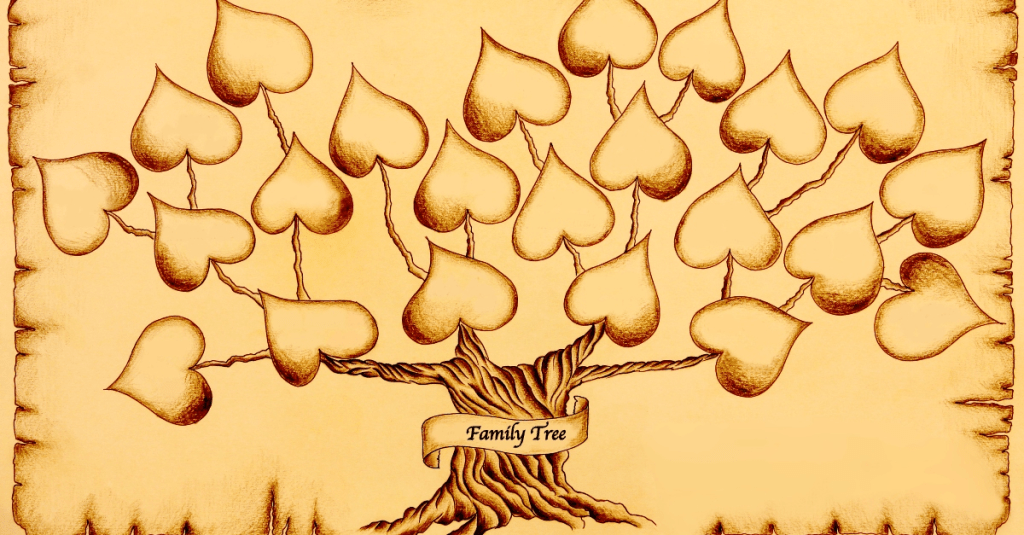
The Bible contains a lot of genealogies. Although they may be boring, with names we have difficulty pronouncing, every genealogy serves the same purpose that it does for your own family history.

Genealogies remind us of our connection with past generations. And this interconnectedness has influenced us in profound ways. You and I are the result of what history has produced. We are who we are, to a significant degree, because of the people who came before us.

By listing someone’s descendants in writing, it indicates an ongoing developing story which has happened, and continues to develop up to the present time, and even into the future.

One aspect about biblical genealogies that must be noted: Ancient compilers of genealogical lists did not often include every single person in the genealogy. They typically listed the more significant persons, and left out persons who barely dented history.

That’s because the biblical writer’s purpose in giving a genealogy was not necessarily to be exact and precise about each individual past actor. Rather, the writer usually has a moral and/or theological reason for providing the list.

For the writer of the Book of Ruth, the reason for this genealogy was to establish the bloodline and pedigree of King David. Perez was a son of the patriarch Judah (and Tamar). Boaz was a descendant of Judah. Boaz married Ruth, and they had a son, Obed, who was the grandfather of David.

I hope that you see the grace in every biblical genealogy. Including in our genealogy for today, we have two women, Tamar and Ruth. Both of them were unlikely candidates for producing a king. And even more unlikely to be included in greatest Christian genealogy of them all, the lineage of Jesus (Matthew 1:1-17)

The Gospel writer Matthew included in his genealogical list a note about Boaz. He was the son of Rahab. Yes, the same Rahab who was the prostitute in Jericho, and became a faithful woman included in God’s covenant community. (Matthew 1:5-6)

Ruth was a “heathen” woman from Moab, a nation which historically was hostile to Judah. Yet, through her own pious actions, Ruth became a worthy member of Judah, and listed as a great mother of the Jewish people.

The brief genealogy we have here is a part of an historical continuity in God’s covenant community. From Abraham to Judah to David to Jesus, and to the Christian Church, this both literal and spiritual heritage is brought about through a daughter-in-law of Naomi the Jew, Ruth.

None of us are truly alone. We are all connected as people. And Christians are spiritually linked to the covenant as God’s people, by faith.

Just as Abraham “believed God, and it was reckoned to him as righteousness,” so, you see, those who believe are the descendants of Abraham. And the scripture, foreseeing that God would reckon as righteous the gentiles by faith, declared the gospel beforehand to Abraham, saying, “All the gentiles shall be blessed in you.” For this reason, those who believe are blessed with Abraham who believed. (Galatians 3:6-9, NRSV)

This connection to the past, prevents us from having an over-individualistic faith in God and relationship to the Lord. We belong to the historical and worldwide communion of saints. We, both personally and communally, belong to God.

For the writer of the Book of Ruth, history is important. Genealogy is significant. God’s covenant matters. The Church’s life is bound up in the person of Christ, in King Jesus, Son of David, Son of Boaz and Ruth, Son of Abraham.

Not only do we belong to God, but we also belong to one another. We belong to ordinary people who showed extraordinary faith.

And it is through ordinary people that God works out divine purposes on this earth for the common good of all people.

We have many grandparents in the faith. We are linked to them by faith. There is a mystical spiritual connection that we enjoy with them. And that connection is shared with others of the faith, as well.

For by the grace given to me I say to everyone among you not to think of yourself more highly than you ought to think but to think with sober judgment, each according to the measure of faith that God has assigned. For as in one body we have many members and not all the members have the same function, so we, who are many, are one body in Christ, and individually we are members one of another. (Romans 12:3-5, NRSV)

Blessed Christ, you do not call us servants, but friends—companions on this mission to see love, peace, and hope made known. You do not leave us to fend for ourselves, but invite us into community with you and others. Draw us closer to you and one another, and help us to become companions and confidants in our collective journey of faith and perseverance. Amen.

Visible Signs of Invisible Realities (Hebrews 9:15-24)

For this reason Christ is the mediator of a new covenant, that those who are called may receive the promised eternal inheritance—now that he has died as a ransom to set them free from the sins committed under the first covenant.

In the case of a will, it is necessary to prove the death of the one who made it, because a will is in force only when somebody has died; it never takes effect while the one who made it is living. This is why even the first covenant was not put into effect without blood. When Moses had proclaimed every command of the law to all the people, he took the blood of calves, together with water, scarlet wool and branches of hyssop, and sprinkled the scroll and all the people. He said, “This is the blood of the covenant, which God has commanded you to keep.” In the same way, he sprinkled with the blood both the tabernacle and everything used in its ceremonies. In fact, the law requires that nearly everything be cleansed with blood, and without the shedding of blood there is no forgiveness.

It was necessary, then, for the copies of the heavenly things to be purified with these sacrifices, but the heavenly things themselves with better sacrifices than these. For Christ did not enter a sanctuary made with human hands that was only a copy of the true one; he entered heaven itself, now to appear for us in God’s presence. (Hebrews 9:15-24)

The Hebrew Christians were tired. They had faced adverse circumstances, unjust imprisonments, persecution, prejudice, confiscation of their property, and public ridicule.

Most of all, they encountered rejection from their Jewish families of origin. There was precious little support for them, outside of their group.

The suffering went on long enough that the Christians began to experience a weakening of faith. In their distress, they started considering whether to return to Judaism, and renege on their commitment to Christ.

The author of Hebrews saw the struggle and spoke up, encouraging and exhorting the believers to keep going, to exercise faith and perseverance in the face of their ongoing troubles.

The author’s overall message to the discouraged believers was that Jesus Christ is superior over everything and everyone. Christ is better than the angels, Moses, and Aaron. Jesus is the ultimate high priest who offered himself as a sacrifice, once for all.

By means of the cross, Jesus became the mediator of a new and better covenant. There is, therefore, no more need of another high priest. Christ now occupies that office permanently.

Jesus Christ Points us to God, by Elizabeth Wang

Christ’s death was efficacious for all. The sacrificial system with all of the officiating Levitical priests was the old order of things, meant to point us to Christ.

Offering sacrifices day after day, and engaging in prescribed liturgical rituals in order to access God, are no longer necessary. Perpetual anxiety exists wherever people keep wondering if they have done enough to satisfy their guilt and/or responsibility.

The answer of Christianity is yes, the work is finished; Jesus completed it, once and for all.

There is no longer anything that can distress us. Sin, death, and hell have been conquered through the death of Christ. His singular sacrifice has achieved victory over the sinful powers, and reconciliation and peace with God.

Blessed is the one
    whose sin the Lord does not count against them
    and in whose spirit is no deceit. (Psalm 32:2, NIV)

The covenant code’s sacrificial system was never designed to be a permanent way of doing things. All of the implements used in that system were symbols pointing to the real deal. They were a temporary means of leading people to Christ, who is the once for all sacrifice to end all sacrifices, the one who truly takes away our guilt and shame forever.

The picture is of Christ, as our high priest, who sprinkled us with his own blood and made us clean – not only today or for some temporary period of time – but for all time. We are not only made clean; we are made clean forever by the blood of Christ.

Cleanse me with hyssop, and I will be clean;
    wash me, and I will be whiter than snow. (Psalm 51:7, NIV)

The historical person of Jesus – his life, ministry, crucifixion, death, resurrection, ascension and glorification – was a visible image showing us the great importance of invisible realities.

The Ark of the Covenant was a visible sign of God’s invisible presence, and the need for a restoration of the divine/human connection.

The temple, the worship implements, and the whole sacrificial system was a visible sign of God’s invisible holiness, and the need for purity of heart amongst the people.

Jesus was a real person with a real body and real human needs, a visible reality which showed us the invisible God, and what God truly deems as right and good.

It is Jesus Christ, the Son of God and Son of Humanity, in whom we have redemption the forgiveness of sins. He is the image of the invisible God. (Colossians 1:14-15)

Christ is our Mediator, bridging the gap between heaven and earth.

Christ is our Savior, delivering us from our guilt and shame, our worry and anxiety, and our old enemy, death itself.

Christ is our Advocate, stepping in and acting on our behalf, and sending the Holy Spirit to be his continuing presence on this earth.

Christ is our champion, the pioneer of our salvation, securing redemption for us through his singular death.

Christ is our Intercessor, who even now lives to intercede for us, as we strive and struggle to live in humility, justice, and righteousness, as peacemakers in this world.

What this all means, from the vantage of Christianity, is that we need Jesus.

Without Christ, there is no hope. With Christ, all things are possible.

Jesus is the answer to every question, because Jesus is the center of all things. He is the fertile soil from which all of life sprouts; the first-fruit which provides life; and the continuing sustenance which saves us from a disconnected, fragmented, discouraging existence.

Along with the ancient Hebrew Christians, let us be encouraged with Christ, who is truly our everything.

Accept, O Lord, our thanks and praise for all that you have done for us. We thank you for the disappointments and failures that lead us to acknowledge our dependence on you alone.

Above all, we thank you for your Son Jesus Christ; for the truth of his Word, and the example of his life; for his steadfast obedience, by which he overcame temptation; for his dying, through which he overcame death; and for his rising to life again, in which we are raised to the life of your kingdom.

Grant us the gift of your Spirit; that we may know you and make you known; and through your Spirit, at all times and in all places, may give thanks to you in all things. Amen.

Work and Family (Psalm 127)

The Carpenter’s Son, Holy Cross Chapel, Houston, Texas

Unless the Lord builds the house,
    those who build it labor in vain.
Unless the Lord guards the city,
    the guard keeps watch in vain.
It is in vain that you rise up early
    and go late to rest,
eating the bread of anxious toil,
    for he gives sleep to his beloved.

Sons are indeed a heritage from the Lord,
    the fruit of the womb a reward.
Like arrows in the hand of a warrior
    are the sons of one’s youth.
Happy is the man who has
    his quiver full of them.
He shall not be put to shame
    when he speaks with his enemies in the gate. (New Revised Standard Version)

God is the Creator. We humans are creatures, created in the image and likeness of God. Therefore, we are inextricably tied to God, and quite dependent upon the Lord.

For the activities of our daily human life, we need God. When it comes to establishing a home, protecting our community, daily work, and raising children, we very much need God’s help to do all of this in a way that is successful and good.

Unless God is with us, in the center of all that we do, then our work in building a good life shall be in vain. How we go about living our lives with work and family, and who we look to as role models, makes a significant difference in the quality and effectiveness of our labor and relationships.

When my wife was growing up, her family had a prominent portrait of John Wayne in the living room above the television. That picture spoke volumes about the family ethos. They had horses and loved to ride and enjoy the outdoors. Hard work was a daily reality of life, as well as a rugged individualism that often suppressed all else in order to engage in work. 

Doing your best, striving for excellence, and learning responsibility are good things that mature people do every day. Yet, there is a fine line between hard work that provides and enriches, and lonely work that is frenetic and fueled by anxiety about the future.

The motives behind why we burn the candle at both ends are just as important to the Lord as the work itself. The psalm for today is a wake-up call for us to consider the frenetic pace of work and family life.

If we independently believe that our life is in our own hands, and we work with a worry that animates our every task, then we have lost touch with the understanding that it is God who ultimately provides us with every good thing in life. 

However, if we begin to relax and let go of our stubborn independent streak, then we work hard with the strength God gives. We let the Lord watch over us.

Trusting God in our work is connected to children being a heritage from the Lord. In the ancient world, children worked alongside their parents. Fathers and mothers did not go it alone – work was a family affair, as well as a community endeavor. 

Whenever we slip into a groove of worshiping individualism, rather than simply taking personal responsibility, then we must come back to the inter-dependence we were designed for as created human beings. 

The ethos the psalmist espoused is trust in God, reliance on others, and working together for the common good of all. 

Here are a few ways of working together and not carrying the load of work on our own:

Ask for what you want and need to accomplish the task. Whenever we don’t ask, we inevitably go the route of hustling for help through manipulation, guilt, and shaming others.

If someone says, “no,” simply ask another person or persons. Asking once just won’t do. And neither is commanding others to get things done. We have the ability to ask calmly, confidently, and compassionately. Accept the “no” which you might get, without retreating back to manipulation. This is especially needful when it comes to asking family members.

Ask God to help you in your work. Each day as I enter the hospital for which I am a Chaplain, I say a prayer, “God almighty, blessed Father, Son, and Spirit, please go before me, with me, and after me to each patient, their family members, and every team member I encounter today, with the love and compassion of Jesus Christ.”

Delegate, if possible. This is not the same thing as barking orders. Delegating is a realization that we are finite creatures with limitations of time, energy, and resources. It’s okay to share the load with others. In fact, most people are more than willing to help, if we but ask. It enables them to feel needed and important.

Be vulnerable and gracious. We all mess up our work, at times. And it’s important to own mistakes without heaping unnecessary criticism on ourselves, or others. Offering an apology, recognizing that you’ve bit off more than you can chew, and admitting your lack of energy are healthy, not sinful. Also, whenever others fall short of their responsibilities, it’s our job to handle it with grace – seeking to understand and help, rather than criticize and judge.

Working together, consulting, collaborating, and engaging in fellowship enable us to speak with those who may oppose, misunderstand, or misinterpret us. It’s also a more joyful way to live.

Sovereign God, you created all things and in you everything holds together. Preserve me with your mighty power that I may not fall into disconnection with you and others, nor be overcome by anxiety. In all I do direct me to the fulfilling of your purpose, through Jesus Christ my Lord. Amen.