If You Ask a Question, Be Ready for the Answer (Mark 12:18-27)

The Pharisees and Sadducees Come to Tempt Jesus, by James Tissot (1836-1902)

Some Sadducees, who say there is no resurrection, came to him and asked him a question, saying, “Teacher, Moses wrote for us that if a man’s brother dies, leaving a wife but no child, the man shall marry the widow and raise up children for his brother. There were seven brothers; the first married and, when he died, left no children,and the second married the widow and died, leaving no children, and the third likewise; none of the seven left children. Last of all the woman herself died. In the resurrection, when they rise, whose wife will she be? For all seven had married her.”

Jesus said to them, “Is not this the reason you are wrong, that you know neither the scriptures nor the power of God? For when people rise from the dead, they neither marry nor are given in marriage but are like angels in heaven. And as for the dead being raised, have you not read in the book of Moses, in the story about the bush, how God said to him, ‘I am the God of Abraham, the God of Isaac, and the God of Jacob’? He is God not of the dead but of the living; you are quite wrong.” (New Revised Standard Version)

Two-thousand years ago, in the first century C.E. (Common Era) the Jewish Sadducees learned the hard way that trying to discredit Jesus in public with silly questions is a bad idea.

Somehow, probably in a back room and perhaps drinking too much wine, they came up with a story designed to show, once and for all, that Jesus was nothing but a hayseed yokel from the bumpkin village of Nazareth who believes in a crazy notion like resurrection.

The Sadducees wanted a very public and definitive display that Jesus was a backward hick, not worth the time of day. So, they concocted a bizarre hypothetical story meant to discredit the supernatural. 

The Sadducees went to the Old Testament, and pointed out in the law that if a man dies without having children, the brother must marry the widow, thus keeping the legacy and land of the dead man in his family. By conjecturing that if this were to happen seven times over, they posed a hypothetical question: Whose wife would she be among all the brothers at this supposed resurrection?

As they were snickering to themselves believing that they had demonstrated the absurdity of resurrection, Jesus turned the tables on the Sadducees. Here are some observational lessons from this Gospel reading for today:

  1. Think again before you try and trip-up Jesus with philosophically ethereal questions.
  2. Consider that you will receive a rebuke from Jesus for being ignorant, mistaken, and wrong, if you try to posture yourself and control how a conversation with him ought to go.
  3. Be aware that Abraham, Isaac, Jacob, and Jesus are all alive. The Sadducees, however, no longer exist.
  4. Realize that Jesus will take the time and attention to listen and give feedback – maybe the kind you weren’t looking for.
  5. Understand that many things we get hung up on, Jesus doesn’t – and what Jesus sticks on, we may act like Teflon and let it slide.

And the lessons could keep coming, because there is always something to learn and discover when being with Jesus.

To deny resurrection is to deny Jesus. Christ died. He’s now alive. Hence, there is a resurrection. More than that, because Christ lives, others live. This is the Christian’s hope. 

I fully understand plenty of people don’t believe in resurrection. That’s their prerogative. I will simply point such a person no further than their own mind and heart. “Search your feelings,” as the Jedi would say, “What do they tell you?” The evidence you need, you already have.

And this was the penultimate lesson of Jesus to the inquisitive Sadducees. They already had the answer to their question for Jesus. It was right under their noses the entire time – right their in the law that they valued so highly. They just plain didn’t see it.

You already have everything you need for life and godliness in this present evil age. There’s no need to play philosophical games with Jesus.

One of the great sages of the last century, Dorothy from The Wizard of Oz, wisely said:

“If I ever go looking for my heart’s desire again, I won’t look any further than my own backyard. Because if it isn’t there, I never really lost it to begin with.”

Resurrection has always been there because God has always been around – even when we don’t see, perceive, or acknowledge the divine. Just because one may not believe in life arising from death, doesn’t mean it isn’t there or doesn’t exist.

It probably would not be a good idea to procrastinate the inevitable end-of-life scenario that awaits us all. Anytime is the right time to do a bit of personal funeral planning. Yet, if we mire it all with the esoteric hypothetical questions about what would happen in the most far-fetched of scenarios, methinks God is big enough and smart enough to see through our puny charade.

Better to ponder what is truly within your own soul, and how Jesus might already be present within and around all things, without us even knowing it. 

A good place to start in peering within is to give a straightforward honest reading of the New Testament Gospels and discover what resonates deeply with you about the person and work of Jesus.

Feel free to question Jesus about anything you want; just brace yourself for what kind of answer you might receive.

Keep Your Spiritual Confidence (Psalm 135)

Praise the Lord!
    Praise the name of the Lord;
    give praise, O servants of the Lord,
you who stand in the house of the Lord,
    in the courts of the house of our God.
Praise the Lord, for the Lord is good;
    sing to his name, for he is gracious.
For the Lord has chosen Jacob for himself,
    Israel as his own possession.

For I know that the Lord is great;
    our Lord is above all gods.
Whatever the Lord pleases he does,
    in heaven and on earth,
    in the seas and all deeps.
He it is who makes the clouds rise at the end of the earth;
    he makes lightnings for the rain
    and brings out the wind from his storehouses.

He it was who struck down the firstborn of Egypt,
    both humans and animals;
he sent signs and wonders
    into your midst, O Egypt,
    against Pharaoh and all his servants.
He struck down many nations
    and killed mighty kings—
Sihon, king of the Amorites,
    and Og, king of Bashan,
    and all the kingdoms of Canaan—
and gave their land as a heritage,
    a heritage to his people Israel.

Your name, O Lord, endures forever,
    your renown, O Lord, throughout all ages.
For the Lord will vindicate his people
    and have compassion on his servants.

The idols of the nations are silver and gold,
    the work of human hands.
They have mouths, but they do not speak;
    they have eyes, but they do not see;
they have ears, but they do not hear,
    a nose, but there is no breath in their mouths.
Those who make them
    and all who trust them
    shall become like them.

O house of Israel, bless the Lord!
    O house of Aaron, bless the Lord!
O house of Levi, bless the Lord!
    You who fear the Lord, bless the Lord!
Blessed be the Lord from Zion,
    he who resides in Jerusalem.
Praise the Lord! (New Revised Standard Version)

Idolatry in the Bible is greatly discouraged. To trust in or worship an idol is a big deal in Holy Scripture, precisely because it is totally worthless. Trusting an idol to do anything for you would be like talking to a bowling ball and asking it to balance your checkbook. In other words, there is no chance whatsoever of a bowling ball or an idol helping you in your life with anything at all.

An idol has zero power or authority to accomplish what you need. Idols are impotent and helpless and can do nothing. Anybody who focuses on something that has no agency to act in the world will soon lose their own personal agency to act in the world. One who practices idolatry will become just like their idol: worthless.

So, if idolatry is so irrelevant, then why do many people put their trust in “gods” other than God? Because so many of us have a form of spiritual attention deficit disorder in which we become attracted to all the shiny deities in front of us. It is no coincidence that idols are consistently lacquered over with gold or silver in order to display an extravagant wealth, communicate prestige, and attract new worshipers.

Slick idol marketing presents that worthless thing as valuable, as something you cannot live without. This ability to seduce others into placing trust and value into the irrelevant object is largely why much of the Old Testament condemns idolatry and encourages destruction of idols.

But this is how you must deal with them; break down their altars, smash their pillars, hew down their sacred poles, and burn their idols with fire… The images of their gods you shall burn with fire. Do not covet the silver or gold that is on them and take it for yourself, because you could be ensnared by it; for it is abhorrent to the Lord your God. (Deuteronomy 7:5, 25, NRSV)

Idolatry drains the energy we could be using for worship and life toward the One true God. The idols are an affront to a committed life of faith relational connections. They are a distraction, siphoning away resources that are better used elsewhere. Perhaps most of all, idolatry skews our worldview; the idolator ceases using common sense, and begins moving toward useless endeavors that do not enrich the entire community.

Instead, we can praise the Lord, because God is good and has our best interests at mind. Not only that, but God also has the ability to follow through with divine promises made. A bowling ball can’t do that! (it can’t even make it so you can throw a perfect 300 bowling game).

God is gracious, and holds us close. We belong to God. Remember all the ways the Lord has delivered people in the past, and let that memory give you confidence moving forward.

One of the best ways to know if the worship of God is intact, is by noticing if worshipers act in generous, gracious ways to uphold the unity and peace of the faith community.

But if a community is characterized by division and special interest groups, and by distortions of faith that only champion their particular brand of belief, then you are likely looking at idolatry. If you observe this, get out fast, while you can.

Whenever people are able to bless one another and bless the world, they themselves have received blessing from God. But if they continually curse each other and bemoan the world, then its time to leave. This earthly life is too short for messing around with a bunch of useless idolatry that gets us nowhere.

Maintaining faith in God – and not in something or someone else – will enable us to deal with our doubts and see the power of the Lord all around us.

O God, come to my assistance; O Lord, make haste to help me. Glory to the Father, and to the Son, and to the Holy Spirit—as it was in the beginning, is now, and will be forever. Amen. Alleluia.

There Is No Other God (Daniel 3:1-30)

Shadrach, Meshach, and Abednego are thrown into a fiery furnace, by Chris Torre

King Nebuchadnezzar made a gold statue. It was ninety feet high and nine feet wide. He set it up in the Dura Valley in the province of Babylon. King Nebuchadnezzar then ordered the chief administrators, ministers, governors, counselors, treasurers, judges, magistrates, and all the provincial officials to assemble and come for the dedication of the statue that he had set up.

So the chief administrators, ministers, governors, counselors, treasurers, judges, magistrates, and all the provincial officials assembled for the dedication of the statue that King Nebuchadnezzar had set up. They stood in front of the statue the king had set up.

The herald proclaimed loudly: “Peoples, nations, and languages! This is what you must do: When you hear the sound of the horn, pipe, zither, lyre, harp, flute, and every kind of instrument, you must bow down and worship the gold statue that King Nebuchadnezzar has set up. Anyone who will not bow down and worship will be immediately thrown into a furnace of flaming fire.”

So because of this order as soon as they heard the sound of the horn, pipe, zither, lyre, harp, flute, and every kind of instrument, all the peoples, nations, and languages bowed down and worshipped the gold statue that King Nebuchadnezzar had set up.

At that moment some Chaldeans came forward, seizing a chance to attack the Jews. They said to King Nebuchadnezzar:

“Long live the king! Your Majesty, you gave a command that everyone who hears the sound of the horn, pipe, zither, lyre, harp, flute, and every kind of instrument should bow down and worship the gold statue. Anyone who wouldn’t bow and worship would be thrown into a furnace of flaming fire. Now there are some Jews, ones you appointed to administer the province of Babylon—specifically, Shadrach, Meshach, and Abednego—who have ignored your command. They don’t serve your gods, and they don’t worship the gold statue you’ve set up.”

In a violent rage Nebuchadnezzar ordered them to bring Shadrach, Meshach, and Abednego. They were brought before the king.

Nebuchadnezzar said to them: “Shadrach, Meshach, and Abednego: Is it true that you don’t serve my gods or worship the gold statue I’ve set up? If you are now ready to do so, bow down and worship the gold statue I’ve made when you hear the sound of horn, pipe, zither, lyre, harp, flute, and every kind of instrument. But if you won’t worship it, you will be thrown straight into the furnace of flaming fire. Then what god will rescue you from my power?”

Shadrach, Meshach, and Abednego answered King Nebuchadnezzar: “We don’t need to answer your question. If our God—the one we serve—is able to rescue us from the furnace of flaming fire and from your power, Your Majesty, then let him rescue us. But if he doesn’t, know this for certain, Your Majesty: we will never serve your gods or worship the gold statue you’ve set up.”

Nebuchadnezzar was filled with rage, and his face twisted beyond recognition because of Shadrach, Meshach, and Abednego. In response he commanded that the furnace be heated to seven times its normal heat. He told some of the strongest men in his army to bind Shadrach, Meshach, and Abednego and throw them into the furnace of flaming fire. 

So Shadrach, Meshach, and Abednego were bound, still dressed in all their clothes, and thrown into the furnace of flaming fire. (Now the king’s command had been rash, and the furnace was heated to such an extreme that the fire’s flame killed the very men who carried Shadrach, Meshach, and Abednego to it.) So these three men, Shadrach, Meshach, and Abednego, fell, bound, into the furnace of flaming fire.

Then King Nebuchadnezzar jumped up in shock and said to his associates, “Didn’t we throw three men, bound, into the fire?”

They answered the king, “Certainly, Your Majesty.”

He replied, “Look! I see four men, unbound, walking around inside the fire, and they aren’t hurt! And the fourth one looks like one of the gods.” Nebuchadnezzar went near the opening of the furnace of flaming fire and said, “Shadrach, Meshach, and Abednego, servants of the Most High God, come out! Come here!”

Then Shadrach, Meshach, and Abednego came out of the fire. The chief administrators, ministers, governors, and the king’s associates crowded around to look at them. The fire hadn’t done anything to them: their hair wasn’t singed; their garments looked the same as before; they didn’t even smell like fire!

Nebuchadnezzar declared: “May the God of Shadrach, Meshach, and Abednego be praised! He sent his messenger to rescue his servants who trusted him. They ignored the king’s order, sacrificing their bodies, because they wouldn’t serve or worship any god but their God. I now issue a decree to every people, nation, and language: whoever speaks disrespectfully about Shadrach, Meshach, and Abednego’s God will be torn limb from limb and their house made a trash heap, because there is no other god who can rescue like this.”

Then the king made Shadrach, Meshach, and Abednego prosperous in the province of Babylon. (Common English Bible)

Daniel’s three companions in the fiery furnace, by Adrianoupolitis Konstantinos, 1725

At the core of today’s story, and of the entire book of Daniel, is the assertion and demonstration that there is no other God but Yahweh.

King Nebuchadnezzar believed that he himself was big stuff. It turns out, not so much. Even the great king ended up confessing that there is no other god who is able to deliver like the God of Shadrach, Meshach, and Abednego. When the mighty king looked into the fire, all of his pomp and control and wrath and power proved to be nothing before the One God of all.

The earthly king threw all of his weight into showing how powerful and great he could be; and all of that unleashing of kingly destructive force did absolutely nothing to even singe the hair of the three worshipers of God.

Nebuchadnezzar did a lot of talking, a lot of posturing, and showed a lot of anger. Conversely, God said nothing, and was supremely successful over him. Turns out that Nebuchadnezzar was only a little yippee puppy barking in front of the large Mastiff dog who could squish him with but a movement of his paw if he wanted.

The experience of King Nebuchadnezzar is a telling lesson on all earthly rulers who presume to be supreme and all-powerful in their position.

And even in the great king’s confession of God’s true might and power, it’s almost tongue-in-cheek, as if Nebuchadnezzar himself is delusional enough to think that he’s the one who is setting up God as God. For those who are familiar with the prophecy of Daniel, they know what’s coming up in Nebuchadnezzar’s future that will purge him of that idea once and for all.

In truth, whatever strength Nebuchadnezzar had, it was God-given. In reality, you and I are recipients of God’s grace and strength; not a one of us conjured up our own success.

Things like a pompous attitude, a spirit of self-centeredness, and a position of hubris are totally out of sync with the values of God’s rule and reign on this earth. We fret and strut upon the stage of this planet in vain; the Lord is really the One who holds it all. Carrying the world on our shoulders is to be way out of touch with our job description as humans. Such a thing will only make us look as foolish as old King Nebuchadnezzar.

In between a rock and a hard place, within the throes of trouble, there is no step by step formula in dealing with it. Even in searching for clear instructions betrays that we desire to have situations within our own control. Shadrach, Meshach, and Abednego did not presume upon God, but fully trusted God and knew that they had no control over the circumstance other than choosing their own attitude in it.

All of the officials had gathered before Nebuchadnezzar’s statue; but by the end of the story they stood as witnesses to the work of the true God. Their worship of the statue had gained them nothing; they ended up under a new threat from Nebuchadnezzar. The king commended Shadrach, Meshach, and Abednego’s defiance of his decree, but followed it with a new decree commanding the worship of their God.

King Nebuchadnezzar commanded others, but he himself did not worship. His death-threat is hardly a fitting way to bring people to worship the true God. That sort of behavior ought to highly instruct us in this American  election year cycle.

The oppressor does not have the last word. God creates a future beyond oppressive human systems.

Sovereign Lord, I pray that You will right all wrongs taking place in our world; and vindicate those being treated unjustly. Keep us from taking matters into our own hands, for vengeance is Yours, not mine. In Your grace and mercy, give justice and peace to all who have been cruelly and unfairly treated by their fellow humanity. May injustice and carelessness end, and may all people be drawn into Your saving arms of grace. Amen.

Jesus Shows Up (John 20:19-31)

The Doubt of St. Thomas, by He Qi

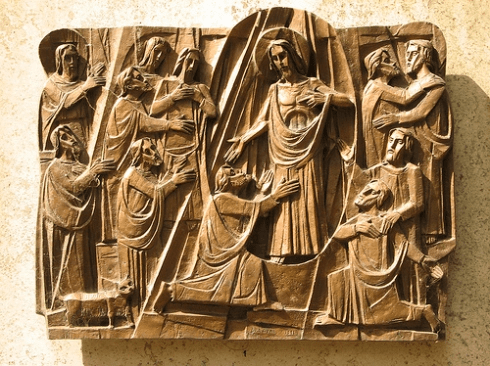
It was still the first day of the week. That evening, while the disciples were behind closed doors because they were afraid of the Jewish authorities, Jesus came and stood among them. He said, “Peace be with you.”After he said this, he showed them his hands and his side. When the disciples saw the Lord, they were filled with joy.Jesus said to them again, “Peace be with you. As the Father sent me, so I am sending you.”Then he breathed on them and said, “Receive the Holy Spirit.If you forgive anyone’s sins, they are forgiven; if you don’t forgive them, they aren’t forgiven.”

Thomas, the one called Didymus, one of the Twelve, wasn’t with the disciples when Jesus came.The other disciples told him, “We’ve seen the Lord!”

But he replied, “Unless I see the nail marks in his hands, put my finger in the wounds left by the nails, and put my hand into his side, I won’t believe.”

After eight days his disciples were again in a house and Thomas was with them. Even though the doors were locked, Jesus entered and stood among them. He said, “Peace be with you.” Then he said to Thomas, “Put your finger here. Look at my hands. Put your hand into my side. No more disbelief. Believe!”

Thomas responded to Jesus, “My Lord and my God!”

Jesus replied, “Do you believe because you see me? Happy are those who don’t see and yet believe.”

Then Jesus did many other miraculous signs in his disciples’ presence, signs that aren’t recorded in this scroll. But these things are written so that you will believe that Jesus is the Christ, God’s Son, and that believing, you will have life in his name. (Common English Bible)

Mosaic of Doubting Thomas, Cathedral of Monreale, Italy

When Jesus shows up, there is peace. Wherever Jesus goes, the Spirit of God is there. When Jesus appears, people believe.

The Meeting

After the crucifixion of Christ, the disciples were huddled together, mostly in fear of being found out and put out by the religious authorities. Out of nowhere, Jesus showed up, smack in the middle of the anxious group of men.

Christ in the center makes all the difference. From this central place, Jesus bestowed to the disciples his peace. The very first word the risen Christ spoke to his disciples was neither a command to stop being afraid, nor a rebuke for sitting around and doing nothing, or disappointment because they all ran away in the final hour of need at the crucifixion.  

Instead, the first word of Christ was a gift of peace. The presence and peace of Christ melted the disciples’ fear. Christ-centered peace is graciously given; and so, it only makes sense to gratefully receive it.

The Reality

Jesus showed up, then showed off his hands and his side. He was not fabricated out of the disciples’ imagination; he was not some ghostly apparition. Rather, Christ was standing in the middle of them, very real, very physical, and very alive.

Christ gave his disciples real truth: actual wounded hands and side, on a real body. Christ is risen and alive – not just spiritually, but physically. Since the resurrection of Jesus really happened, then nothing else matters; our joy is complete. We have what we need.

The Mission

As Jesus was sent by the Father, so Jesus sent his disciples; and he is still sending us, his disciples, out into the world. Just as Jesus came not to condemn the world but to save it, so we go out with words of grace and peace. The church exists for the life of the world – to bless it with the presence and peace of Christ.

“Whoever believes in me does not believe in me only, but in the one who sent me. The one who looks at me is seeing the one who sent me. I have come into the world as a light, so that no one who believes in me should stay in darkness.” (John 12:44-46, NIV)

Our spiritual DNA makes us little Christ’s walking around, doing the will of God, for the benefit of a world in darkness. We bear the name of Christ: Christians, proclaiming a message of life, delighting in God and creation; and not destroying the earth and its inhabitants.

The Gift

We are not alone. The Holy Spirit has been graciously given to us by Jesus. Although our mission is a big one, our resource for accomplishing it is even bigger. Jesus gives the Spirit in the same way he gives himself – as a sheer gift with no strings attached. Just as God breathed life into the very first people on earth, so Jesus breathes on the disciples and gives them new life and a new heart.

I will give you a new heart and put a new spirit in you; I will remove from you your heart of stone and give you a heart of flesh. And I will put my Spirit in you and move you to follow my decrees and be careful to keep my laws… and you will be my people, and I will be your God. (Ezekiel 36:26-28, NIV)

The Privilege

Christ has redeemed us, forgave us of our guilt and shame. Now, we pass on the forgiveness to others. The special mission of the Church is giving Jesus to others with grace and peace, so that they may believe he is truly the risen Lord; and so, receive Jesus, the Spirit, forgiveness, and purpose in life, with Christ at the center of all things.

For the one whom God has sent speaks the words of God, for God gives the Spirit without limit. The Father loves the Son and has placed everything in his hands. Whoever believes in the Son has eternal life, but whoever rejects the Son will not see life, for God’s wrath remains on them.” (John 3:34-36, NIV)

The Appearance

When Jesus appears, its good if we also show up to see him. It seems Thomas was late for church and missed the beginning of the service. He wasn’t with the other gathered disciples. Nobody knows where he was or what he was doing. But the important thing is that he did eventually show up, because showing up is the beginning of a changed life.

The Witness

After Jesus showed up, the disciples bore witness to what they saw and heard to Thomas. Yet Thomas, bless his doubting heart, wasn’t having it. He’s a realist. He wants proof, some actual physical evidence. Thomas was clearly a tactile learner because he needs some touch to believe any of this crazy talk of his disciple brothers.

The Risen Lord appears to St. Thomas and the apostles, Catacombs of St. Callixtus, Rome, Italy

Sometimes Thomas gets a bad rap, but he is really our Everyman. Doubt and skepticism are an important part of a full-orbed and honest faith. Jesus gave Thomas some space, time, and respect to begin wrapping his head and heart around this new reality of resurrection. I wonder if we all can do the same with others.

The Middle

A second time, Jesus showed up in the middle of the disciples. The Word became flesh and dwelt among us – and didn’t become a ghost and hang out in secret places. Once again, peace is given by Jesus to his followers. Both appearances happen on a Sunday (which is why Christians worship on Sunday); and both meetings are literally Christ-centered (which every Christian meeting is supposed to be). Every Sunday; and Christ in the middle. Keep those two together forever, and you cannot go wrong.

The Invitation

There’s no beating around the bush with Jesus. He immediately engaged Thomas and invited him to touch the wounds on his very real body. Christ knew Thomas’ hangup, and went right to it. Thomas wanted evidence; Jesus offered it. If we get anything out of this encounter, it’s that the risen Christ honors honest doubt.

The evidence is here. Now believe it, and stop disbelieving. We have documentary evidence of the Old and New Testaments; the Church’s witness in Creeds, Confessions, and contemporary narratives of changed lives; and the internal testimony of the Holy Spirit. Therefore, look into them carefully and draw a sound conclusion.

The Confession

“My Lord and my God!” That’s the confession and the conclusion Thomas drew from the evidence – not only that Jesus is real, alive, existed, a good teacher; or other people’s Lord and God – but that he is my Lord and my God.

Jesus cared enough for Thomas to specifically meet him personally at his point of need. The grace of God keeps coming and never runs out. Jesus is filled up to the full in both grace and truth.

The Believer

Thomas had the physical evidence. But it doesn’t take that to truly believe. God blesses those who’ve never seen nor touched, but still believe. Jesus was thinking of you and me, and not only the people in front of him at the time. The Lord Jesus blesses us with the gift of peace, grace, and faith.

Though you have not seen him, you love him; and even though you do not see him now, you believe in him and are filled with an inexpressible and glorious joy, for you are receiving the end result of your faith, the salvation of your souls. (1 Peter 1:8-9, NIV)

The Conclusion

All this is for our benefit, so that we, too, may believe that Jesus is the Christ, the Son of the living God. Since Jesus is alive, he continues to bless us with his presence, power, and peace. Jesus is with us:

  • through the Word of God, giving us his peace, showing up and meeting needs people.
  • at the Table in the sacrament of communion, bringing grace and forgiveness
  • in the person of the Holy Spirit, enabling and energizing us for mission and ministry to the world

It’s a life worth living, a Christ-centered life, full of God’s blessing. Amen.